-
Title
-
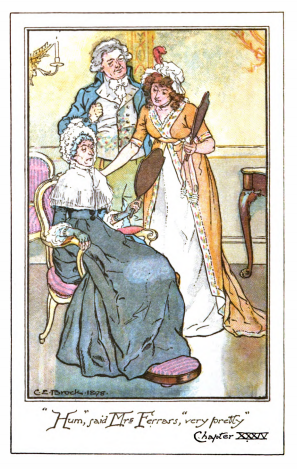
“Hum,” said Mrs. Ferrars, “very pretty”
-
Description
-
Here we see Mrs. Ferrars sitting in a parlor with her daughter, Fanny, standing next to her, and John Dashwood, her son-in-law. This scene occurs while Fanny and John Dashwood host a dinner party in London, inviting Elinor, Marianne, Mrs. Jennings, Colonel Brandon, Lucy and Anne Steele. The quote that is the title of the image is when Fanny introduced Elinor and Marianne to her mother, who was very dismissive of them. Fanny and Mrs. Ferrars hold fire screens in their hands fire screens painted by Elinor and given to her half-brother and his wife. Fire screens were used to block a woman’s face from the heat of the fire. The fashion of the time was for women to have pale skin, and the fire screen would keep a woman’s face from flushing from the heat. Colonel Brandon was admiring the screens, and Fanny informed her mother that they were done by Elinor. Mrs. Ferrars’ response was “Hum, very pretty” without really looking at them. Fanny blushed thinking her mother’s response was quite rude, praised their beauty, but not wanting to praise Elinor too highly, compared them with the paintings of Miss Morton, a rich woman whom Edward Ferrars was supposed to marry. This scene appears in chapter 34 as indicated underneath the image. The characters are shown in the traditional regency style, as Elinor and Lucy wear the regency style dress with an empire waist. Their hair is worn tied up, as was tradition for women after their “coming out” before the queen, signaling her entrance into society. They wear bonnets to protect their faces from the sun. Going for walks was a popular pastime among young upper-class women at this time, and bonnets were worn to protect the face from getting tanned, because having light skin was more fashionable. They also carry muffs used to warm the hands. The regency period dated to the early nineteenth century (1811-1820) when George, Prince of Wales, later George IV (r. 1820-1830), reigned as regent for his mentally ill father, King George III (r. 1760-1820). The regency period is associated with the rise of neoclassicism in art and fashion.
-
Image Creator
-
Charles Edmund Brock (engraver);Henry Matthew Brock (engraver)
-
Charles Edmund Brock (engraver)
-
Henry Matthew Brock (engraver)
-
Identifier
-
mta:25690
-
Source Name
-
Sense and Sensibility
-
Image
-
mta_25690_OBJ.png

 mta_25690_OBJ.png