-
Title
-
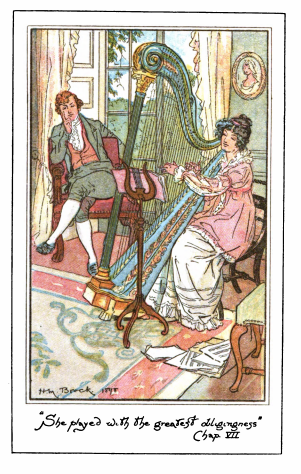
“She played with the greatest obligingness.”
-
Description
-
Here we see Mary Crawford playing her harp at the parsonage near Mansfield Park. Miss Crawford arrived at the parsonage near Mansfield after her sister and her husband, Dr. And Mrs. Grant, moved in. Miss Crawford and her brother, Henry Crawford, quickly became close friends with the Sir Thomas’ children, Thomas, Edmund, Maria, and Julia, and their cousin, Fanny. Miss Crawford had her harp brought from her home in Northamptonshire. Playing music was seen as a noble pastime for upper class women in this era, and women were expected to be skilled in some form of artistic endeavor, typically either music or drawing. In this image, Miss Crawford sits playing her harp with her music in a folder on a stand in front of her. Edmund sits next to Miss Crawford playing the harp, listening intently. Edmund fell in love with Miss Crawford and intended to marry her. This scene occurs in chapter 7 as noted underneath the title of this image. The characters are shown in the traditional regency style. Mary Crawford wears the regency style dress with an empire waist. Her hair is worn tied up, as was tradition for women after their “coming out” before the queen, signaling her entrance into society. Edmund wears a waistcoat and tailcoat, and knickers that stop at the knee. The regency period dated to the early nineteenth century (1811-1820) when George, Prince of Wales, later George IV (r. 1820-1830), reigned as regent for his mentally ill father, King George III (r. 1760-1820). The regency period is associated with the rise of neoclassicism in art and fashion.
-
Image Creator
-
Charles Edmund Brock (engraver);Henry Matthew Brock (engraver)
-
Charles Edmund Brock (engraver)
-
Henry Matthew Brock (engraver)
-
Identifier
-
mta:25696
-
Source Name
-
Mansfield Park
-
Image
-
mta_25696_OBJ.png

 mta_25696_OBJ.png