-
Title
-
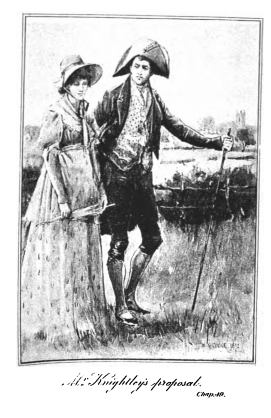
Mr. Knightley’s proposal
-
Description
-
Here we see Emma and Mr. Knightley walking through the estate outside Hartfield, the Woodhouse estate. She went out alone after the sun came out following a storm. She had been feeling down because Harriet loved Mr. Knightley and she thought he loved her back. Mr. Knightley went to visit his brother and sister-in-law in Brunswick Square in London. Upon hearing of Mr. Frank Churchill's engagement to Miss Jane Fairfax, he returned to Highbury. Mr. Knightley, like many people in town, believed that that Mr. Frank Churchill would propose to Emma, before it became known that he and Miss Fairfax were secretly engaged. Mr. Knightley then returned and declared his love for Emma. When Harriet declared her love for Mr. Knightley, Emma realized that she was in love with him. She was surprised by his proposal and gladly accepted. The only problem was Mr. Woodhouse, who wanted Emma to remain a spinster. Mr. Knightley proposed that he move to Hartfield from his home, Downwell Abbey, living there with Emma and Mr. Woodhouse until his eventual death. In this image, we see Emma and Mr. Knightley walking through the estate, with the house in the background. This scene occurs in chapter 49 as noted underneath the title of this image. The characters are shown in the traditional regency style, with Mr. Knightley wearing waistcoat, tailcoat, and knickers that stopped at the knee. Emma wears the regency style dress with an empire waist. Her hair is worn tied up, as was tradition for women after their “coming out” before the queen, signaling her entrance into society. She wears a bonnet to protect her from the sun while out on a walk. She also carries a parasol, an umbrella used to provide shade from the sun. The regency period dated to the early nineteenth century (1811-1820) when George, Prince of Wales, later George IV (r. 1820-1830), reigned as regent for his mentally ill father, King George III (r. 1760-1820). The Prince of Wales was a fan of Austen’s work, and she dedicates the novel to him. The regency period is associated with the rise of neoclassicism in art and fashion. The same image appears as an insert between pages 192 and 193 for the Dent 1893, 1894, 1895, 1896, and 1897 editions of Emma.
-
Image Creator
-
William Cubit Cooke (engraver)
-
Identifier
-
mta:25546
-
Source Name
-
Emma
-
Image
-
mta_25546_OBJ.png

 mta_25546_OBJ.png