-
Title
-
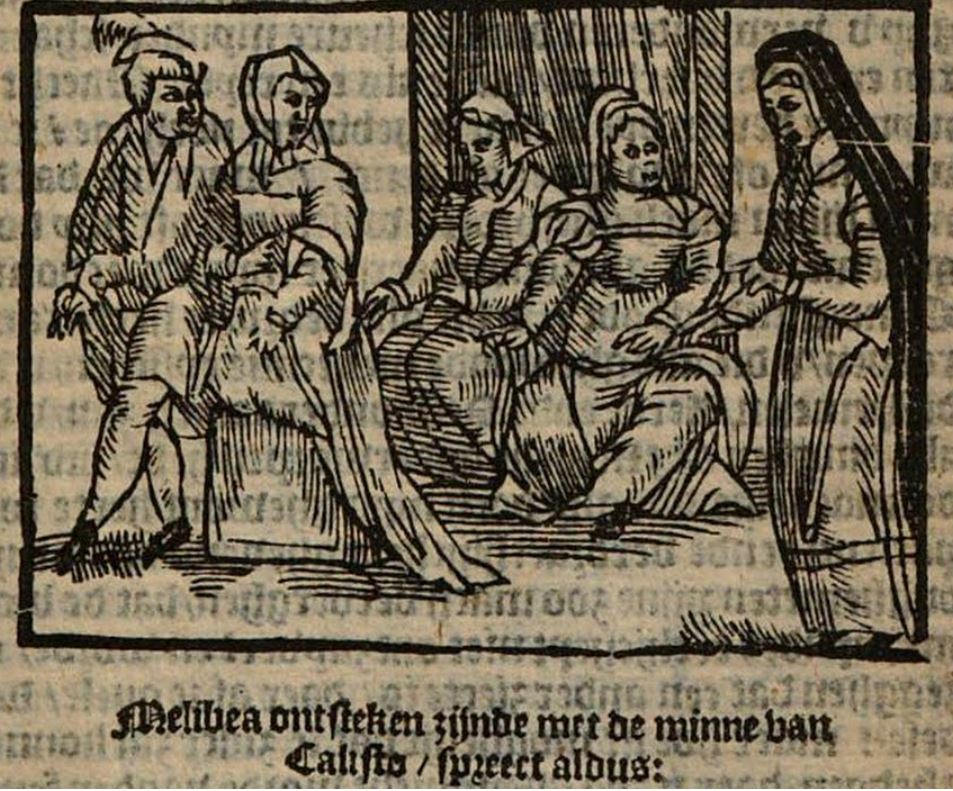
[Act X] Melibea ontsteken zijnde met de minne van Calisto / spreect aldus
-
Description
-
When Celestina arrives at Melibea’s house with Lucrecia, Melibea explains the pain in her heart and asks Celestina to tell her its cause. Celestina responds that the cause is love, and that she will only be cured if she confesses her passion for Calisto. In denial, Melibea angrily rejects this suggestion, but Celestina eventually persuades her to confess her love. Celestina proposes that the two lovers meet in Melibea’s garden that night at midnight, and Melibea agrees. To the left of the illustration, we see Alisa arriving with her sister’s page/servant. She is shown in a robe and a veil, while he is wearing a hat. The two central figures represent Melibea and Lucrecia, both of whom are wearing robes and veils. The right central figure is wearing a robe that appears a bit more decorative, and she is depicted with an expression of anger, both of which hint at the likelihood that it is meant to represent Melibea. The rightmost figure is Celestina, who is shown wearing a robe and a veil.The entire image is identical to the one found on page 130 of the text, and nearly identical to the one found on page 64. The composition is also entirely distinct from any of the illustrations found in the 1580 Antwerp edition.
-
Image Creator
-
Anonymous (Engraver);Heyndric Heyndricz (Printer)
-
Anonymous (Engraver)
-
Heyndric Heyndricz (Printer)
-
Identifier
-
mta:18256
-
Source Name
-
Celestina, Een Tragicomedie van Calisto ende Melibea, inde welcke staen veel profijtelijcke sententien oft spreecwoorden, ende veel nootzakelijcke waerschouwinghen, byzonder voor Jonghe-ghezellen, betoonende het groot bedroch vande Pluym-strijckers, van de ontrouwe Dienaers, ende voor al van de Koppelerssen en̄ lichte Vrouwē.
-
Image
-
mta_18256_OBJ.jpg
-
Subject
-
Spanish romances
-
Celestina (Fictitious character)
-
Melibea (Fictitious character)
-
Lucrecia (Fictitious character)
-
Alisa (Fictitious character)
-
Servants
-
Love
-
Passions
-
Manipulative behavior
-
Robes
-
Veils
-
Hats
-
Denial (Psychology)
-
Anger

 mta_18256_OBJ.jpg