-
Title
-
Von Minerva die auch Pallas
-
Description
-
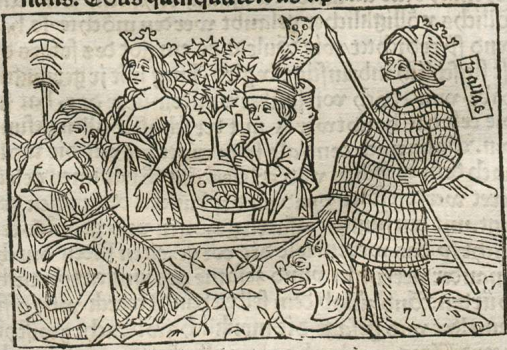
This engraving illustrates Minerva, also known as Pallas, standing on the right side of the engraving suited in armor, holding a lance in her left hand and a shield (with a depiction of Medusa on the front) in her right. We know this is Minerva as the name Pallas is engraved directly beside her. This engraving represents the importance of Minerva and what she brought to the world. Boccaccio explains that Minerva had discovered wool work and weaving. There is a woman in the left corner of the engraving shearing a sheep to signify this discovery. The woman standing behind her has fabric in her hand to signify the art of weaving that Minerva had given to the world. The man in the centre of the engraving is depicted with a millstone in his hand, pressing down into a bucket of olives. Boccaccio explains that Minerva had taught the world of men to do this so that they can extract and use oil from the olives. An olive tree stands in the background to further the significance. There is an owl resting on a tree stump next to Minerva, which Boccaccio explains, represents her wisdom.
-
Image Creator
-
Anonymous (Engraver)
-
Identifier
-
mta:17121
-
Source Name
-
Hyenach volget der kurcz syn von ettlichen frauen von denen johannes boccacius in latein beschriben hat und doctor heinricus stainhöwel geteütschet [Following the short stories of several women of which Giovanni Boccaccio wrote in Latin, and doctor Heinrich Steinhöwel translated]
-
Image
-
mta_17121_OBJ.png
-
Subject
-
Minerva
-
Pallas
-
Weaving
-
Wisdom
-
Roman Mythology
-
Important Women
-
Famous Women
 mta_17121_OBJ.png