-
Title
-
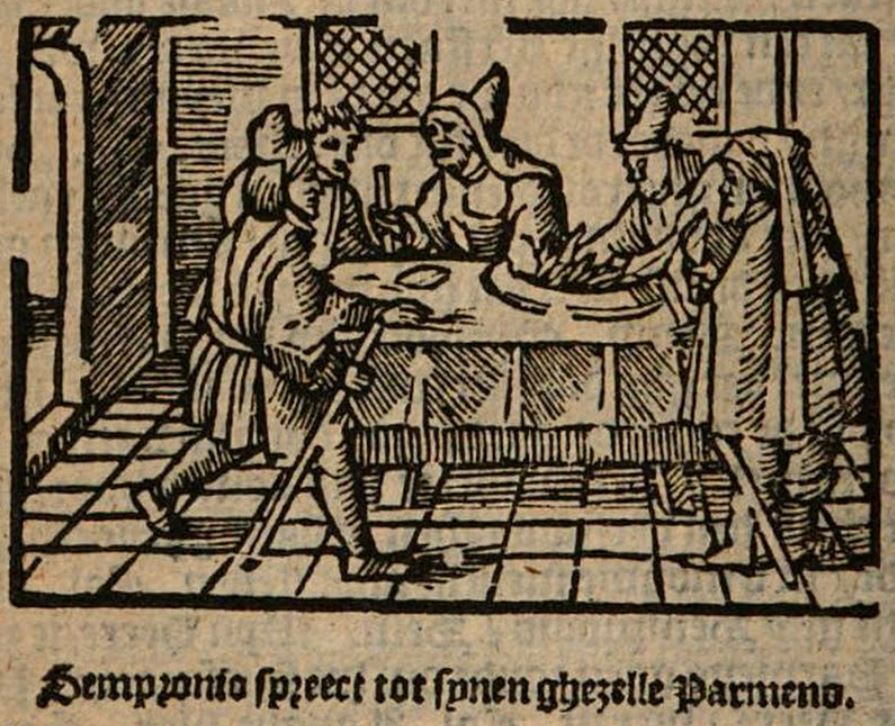
[Act IX] Sempronio spreect tot synen ghezelle Pármeno.
-
Description
-
When evening arrives, Celestina, Elicia, and Areusa wait for Pármeno and Sempronio to join them. Along their journey to Celestina’s house they discuss Celestina’s self-serving and deceitful ways. When they arrive, Elicia and Areusa are frustrated by their lateness. To make matters worse, Sempronio praises Melibea’s beauty and virtue, causing his lover Elicia to become jealous and infuriated. Celestina talks her down from her rage, and the four lovers share a meal while Celestina drinks her wine. Lucrecia knocks at the door and tells Celestina that Melibea wants her girdle returned. More importantly, she tells Celestina that Melibea is afflicted by an illness of the heart and has requested her presence. Thus, Lucrecia and Celestina depart for Melibea’s house.The central figure in this illustration, which is likely meant to represent Celestina, is shown wearing a veil (and likely a robe, although the table conceals this). The two figures seated on either side of her are likely meant to represent Elicia and Areusa, whereas the two figures in the foreground are likely meant to be Pármeno and Sempronio. The lack of distinct facial features makes it extremely difficult to determine who is who.The composition of this illustration is entirely distinct from any of the illustrations found in the 1580 Antwerp edition. Additionally, its production is even less careful than the other illustrations in this edition (proportions are off, facial features are indistinct, etc.). This may imply that it was an afterthought or a last-minute addition, but it may also imply that a separate artist, less experienced with engraving, was responsible for rendering this illustration.
-
Image Creator
-
Anonymous (Engraver)
-
Heyndric Heyndricz (Printer)
-
Identifier
-
mta:18254
-
Source Name
-
Celestina, Een Tragicomedie van Calisto ende Melibea, inde welcke staen veel profijtelijcke sententien oft spreecwoorden, ende veel nootzakelijcke waerschouwinghen, byzonder voor Jonghe-ghezellen, betoonende het groot bedroch vande Pluym-strijckers, van de ontrouwe Dienaers, ende voor al van de Koppelerssen en̄ lichte Vrouwē.
-
Image
-
mta_18254_OBJ.jpg

 mta_18254_OBJ.jpg