-
Title
-
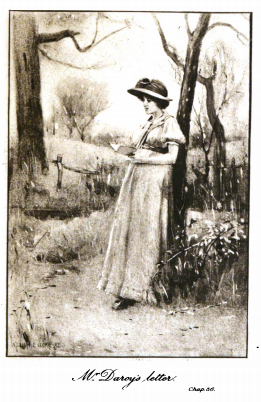
Mr. Darcy’s letter
-
Description
-
Here we see Elizabeth Bennet leaning against a tree, reading a letter from Mr. Darcy. In this letter, Mr. Darcy outlines the reality of the character and his relationship with Mr. Wickham. Mr. Wickham was a militia officer stationed in the town near Longbourn. He was very charismatic and Elizabeth’s sister, Lydia, ran away with him and got married, much to the distress of the rest of the Bennet family. Mr. Darcy disapproved of Mr. Wickham, as Wickham was Mr. Darcy's father’s godson, and Wickham tried to marry Darcy’s sister, Georgiana, in order to obtain her wealth. Wickham also inherited some money from Mr. Darcy’s father with the intention that he join the clergy, but he did not follow through with his clerical studies. In this letter he also explained why he split up Jane and Mr. Bingham, because he did not realize their mutual love. Darcy explained to Elizabeth that he thought Jane unworthy of Bingley and persuaded him to leave Netherfield. In his letter, he apologized for this misjudgment. The letter was intended to address Elizabeth’s accusations regarding his pride, and Elizabeth’s prejudices against him. The letter marks a shift in Mr. Darcy’s character and the beginning of the real love between Elizabeth and Darcy. This scene occurs in chapter 35 and is noted underneath the title of this image. The characters are shown in the traditional regency style, with Elizabeth wearing the regency style dress with an empire waist. Her hair is worn tied up, as was tradition for women after their coming out before the queen, signaling her entrance into society. She wears a bonnet to protect her face from the sun, common in regency style. These bonnets were a popular fashion because during this period one of the favourite pastimes of young women was going for walks, referenced frequently in Austen’s novels. The regency period dated to the early nineteenth century (1811-1820) when George, Prince of Wales, later George IV (r. 1820-1830), reigned as regent for his mentally ill father, King George III (r. 1760-1820). The regency period is associated with the rise of neoclassicism in art and fashion. The same image appears as an insert between pages 12 and 13 for the Dent 1893, 1894, 1895, 1896, and 1897 editions of Pride and Prejudice.
-
Image Creator
-
William Cubit Cooke (engraver)
-
Identifier
-
mta:25566
-
Source Name
-
Pride and Prejudice
-
Image
-
mta_25566_OBJ.png

 mta_25566_OBJ.png