-
Title
-
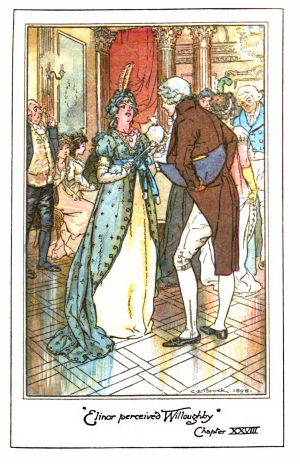
Elinor perceived Willoughby
-
Description
-
Here we see Willoughby speaking with Miss Grey at a party. Elinor is visible sitting on the left of the image looking at Willoughby. Marianne sits next to Elinor, not yet noticing Willoughby, and Sir John stands next to them. Marianne wrote to Willoughby after arriving in London, hoping to see him but he ignored her letters. At a party Elinor noticed Willoughby speaking with a woman. He came over to the sisters and spoke to Elinor briefly, ignoring Marianne. Outraged, Marianne asked Willoughby if he had received her letters, to which he said he had, and then hurried away. Marianne was heartbroken and the sisters left the party early and Marianne spent the rest of her time in London miserable. It was later revealed that the woman Willoughby was speaking to at the party, shown in this image, was Miss Grey, a wealthy heiress. Willoughby was not rich and liked to live beyond his means, and hence wanted to marry rich to support his lifestyle. Miss Grey did not approve of Marianne’s letters, and dictated Willoughby’s letter to Marianne in which he said he never loved her. This scene appears in chapter 28 as indicated underneath the image. The characters are shown in the traditional regency style. Miss Grey wears the regency style dress with an empire waist. Because it was an evening party, she wears short sleeves and gloves that come above her elbows. She holds a fan in her hand. A fan in this era was often used to signal to communicate with others at the party. Using the fan, a woman could signal if she was married, single, or engaged, that she was being watched by a chaperone, that she loved another man, among other things. Her hair is worn tied up, as was tradition for women after their “coming out” before the queen, signaling her entrance into society. Willoughby wears a waistcoat, tailcoat and knickers that stopped at the knee, and holds a bicorn hat under his arm. The regency period dated to the early nineteenth century (1811-1820) when George, Prince of Wales, later George IV (r. 1820-1830), reigned as regent for his mentally ill father, King George III (r. 1760-1820). The regency period is associated with the rise of neoclassicism in art and fashion.
-
Image Creator
-
Charles Edmund Brock (engraver)
-
Henry Matthew Brock (engraver)
-
Identifier
-
mta:25689
-
Source Name
-
Sense and Sensibility
-
Image
-
mta_25689_OBJ.png

 mta_25689_OBJ.png