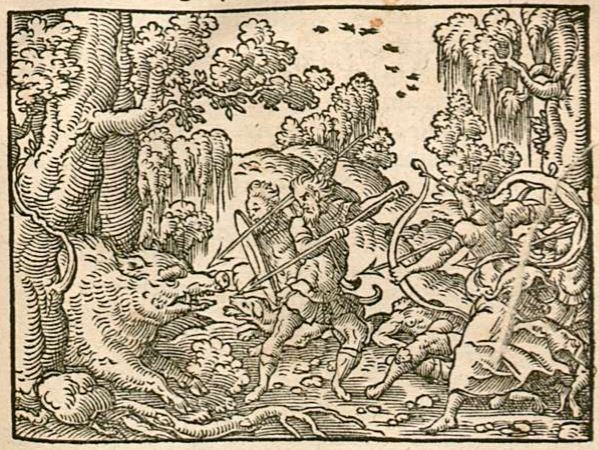
The goddess Diana had become enraged that the citizens of Sicily had given sacrificial offerings to Minerva, Bacchus, and Ceres without including her. To exact revenge on the citizens, Diana sends a massive boar to terrorize the city. King Cocalus of Sicily sought the help of heroes Meleager, Theseus, Jason of the Argonauts, and Atlanta, a famous huntress. Atlanta is depicted in the engraving with her bow drawn pointing at the boar, with two other men beside her, one of them most likely being Meleager. Atlanta ends up shooting the boar in the ear, and Meleager finishes it off.
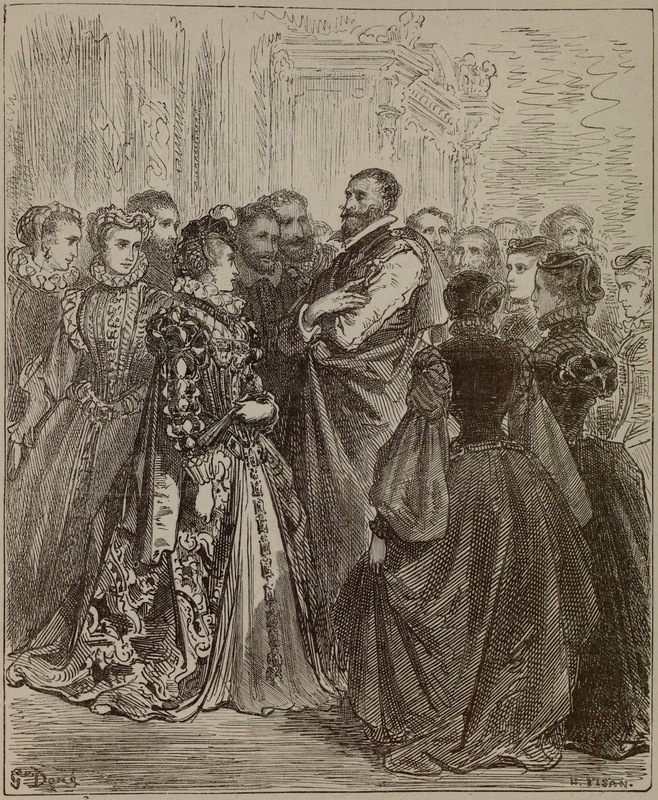
At the soirée, Don Quixote dances with Don Antonio Moreno’s wife and some of her friends. Signed by G. Doré (illustrator) and H.-J. Pisan (engraver). Part 2, ch. 62.
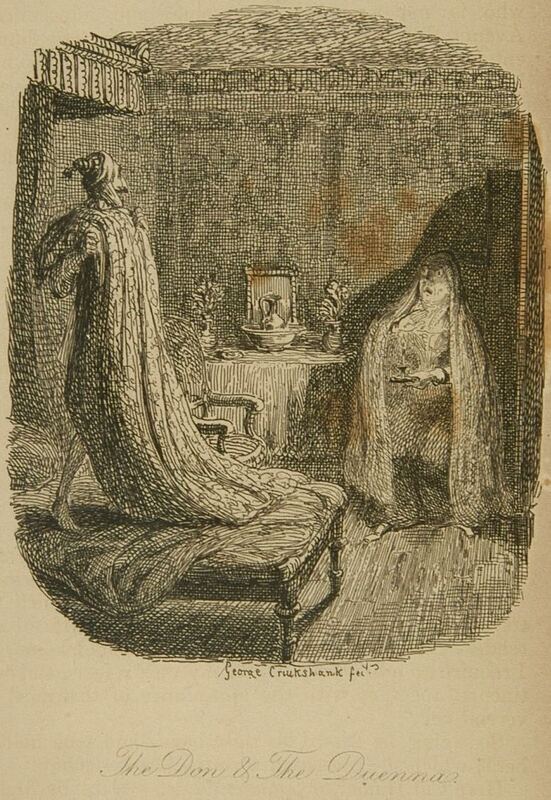
Doña Rodríguez, wearing a pair of spectacles and holding a candle, visits Don Quixote in his room at night. She discovers him standing on his bed, wrapped in his blanket, his face bandaged and marked by the cat’s claws. They scare each other, each believing that the other is a ghost. Signed by G. Cruikshank (illustrator and engraver). Part 2, ch. 48.
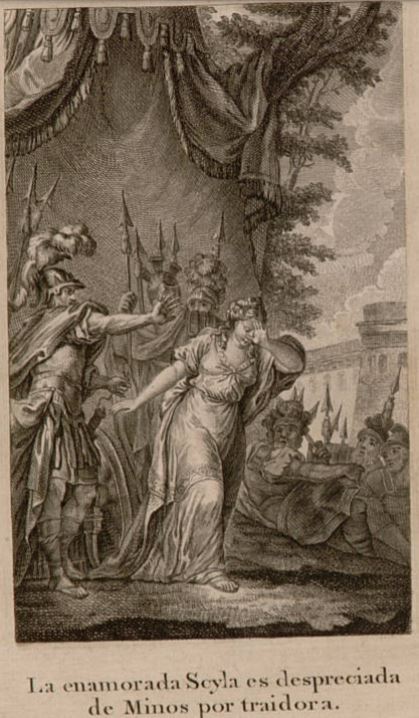
This engraving depicts Scylla, the daughter of King Nisus of Megara, betraying her father by helping King Minos of Crete. While King Minos had been attacking the city of Megara, Scylla had fallen in love with him while watching the battles from afar. She decided her love for King Minos was worth betraying her father and her city, so she cut off a piece of her father’s magical purple hair which kept him safe from harm and handed it over to King Minos. Although King Minos was the enemy of Megara, he found Scylla’s actions deplorable. This image depicts King Minos putting his hand in Scylla’s face as he wants nothing to do with her. Scylla is turning away from Minos and covering her face in shame. Many of Minos’ soldiers are depicted watching the event unfold.
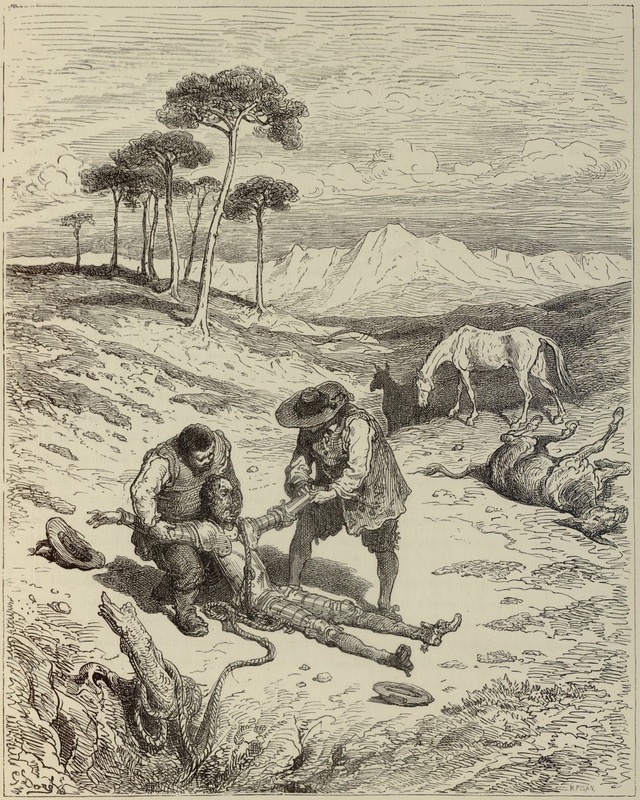
Sancho Panza and the bacherlor’s cousin pull Don Quixote out of Montesinos’ cave. His eyes are closed as if he is sleeping. Signed by G. Doré (illustrator) and H.-J. Pisan (engraver). Part 2, ch. 22.
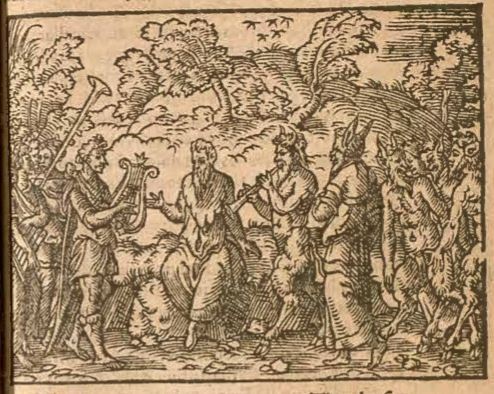
This engraving depicts a music competition between the gods Pan and Apollo. The judge of the competition is the god of Mount Tmolus, who is illustrated sitting down in the centre of the engraving with his legs crossed and arms pointed outwards. Pan is depicted as a satyr on the right side of the engraving playing his pipe. The left side of the engraving depicts the god Apollo with his lyre resting in his left hand while his right hand strums. The god of Mount Tmolus is depicted looking at Apollo, as he ends up choosing Apollo as the winner of the competition. King Midas of Phrygia is depicted standing next to Pan with the long ears of a donkey. Apollo had transformed his ears after Midas disagreed with Tmolus’ judging.
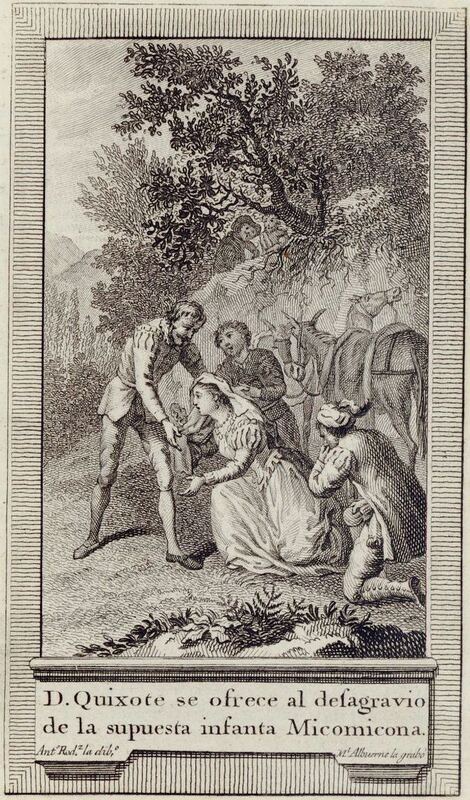
In Sierra Morena, princess Mimicona (Dorotea) kneels before Don Quixote and begs for his help while Sancho Panza explains who she is. The barber is disguised as Dorotea’s page with a fake beard (an oxtail). In the background, the priest and Cardenio watch the scene, hidden behind some shrubs. Signed by A. Rodríguez (illustrator) and M. Albuerne (engraver). Part 1, ch. 29.
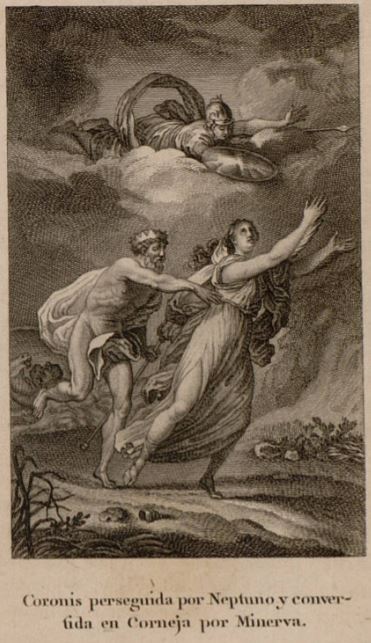
This image depicts the sea-God Neptune chasing a woman named Coronis. When walking along the sea shore, Neptune saw Coronis and became infatuated with her. He came from the water and began to chase her. The feeling was unrequited on Coronis’ part, and she cried out for help. The virgin goddess Minerva was sympathetic to the virgin woman Coronis and helped her plea. She helped her by transforming her into a crow so that she could fly away from Neptune. Minerva, depicted with her helmet, shield, and spear, is illustrated floating above Coronis in a bed of clouds as she reaches down to help her. Similarly, Coronis’ arms are reaching up towards Minerva.
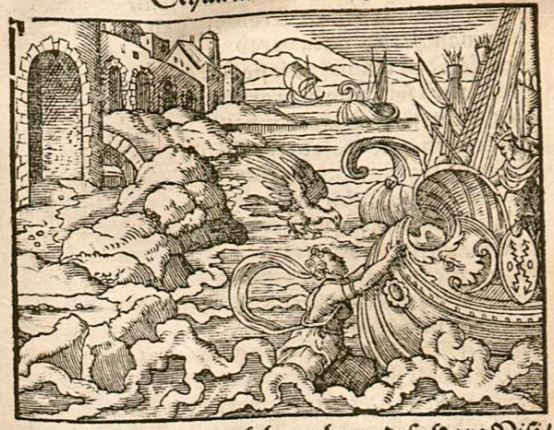
Scylla betrayed her own city in order to help King Minos defeat her father, King Nisus. Scylla betrayed her father because she had an intense unrequited love for King Minos. After betraying her city, King Minos was disgusted by Scylla’s actions by betraying her own father and wanted nothing to do with her. When Minos began sailing away from Megara, Scylla swam after him and clung to his ship. King Minos is illustrated on the right side of the engraving with a crown on his head. The eagle that is depicted flying towards Scylla is her father, King Nisus, who had been transformed into a sea eagle. Her father began to attack her before Scylla herself transformed into a rock dove.
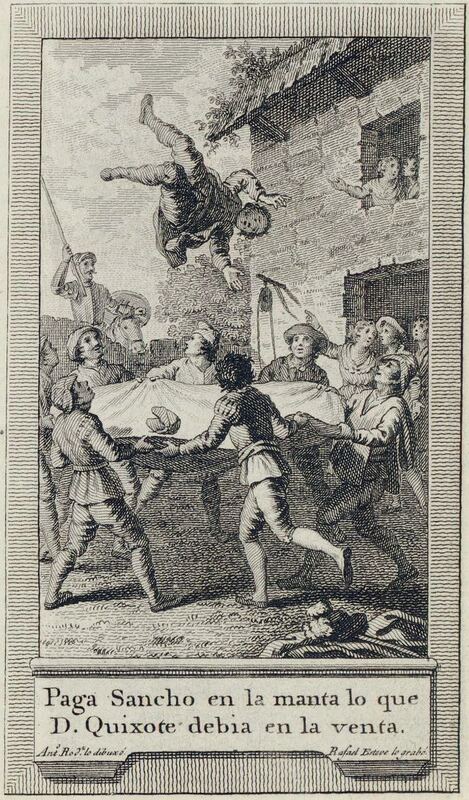
When Sancho Panza refuses to pay the innkeeper, guests at the inn toss him in a blanket in the courtyard and make merry with him. Among the guests are four wool carders from Segovia, three needlemakers from El Potro in Córdoba, and two residents of La Feria in Sevilla. In the background, Don Quixote looks on from behind the inn wall, while Maritornes watches from a window. Signed by A. Rodríguez (illustrator) and R. Vilella (engraver). Part 1, ch. 17.
Having fooled Quixote into thinking this country girl is Dulcinea Del Toboso who has been cursed by an enchanter, he lets go of her donkey. No sooner had the donkey moved ten steps than it began to kick and wince until it bumped the imaginary Dulcinea fell to the ground. Seeing her fall, Sancho stares at the donkey and makes himself as wide as possible to try and catch the rampant donkey. Quixote (behind Sancho) clad in armor, raises his arms in surprise upon seeing his lady the (imaginary) Dulcinea Del Toboso.
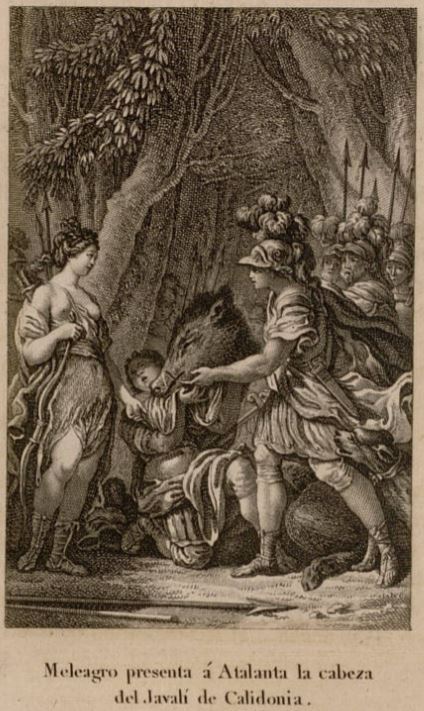
Meleager is depicted on the right side of the image holding the severed head of the boar he had just slain. The boar was sent by the goddess Diana to terrorize the city of Sicily as revenge for not being honoured in sacrifice by the citizens. Meleager is a local hero who was tasked, along with other heroes, to slay the boar. Atlanta, a famous huntress was also one of the people tasked with killing the boar, and although she did not kill it, she did hit its ear with an arrow. For her efforts, Meleager decides to share the honour and credit with Atlanta by giving her the severed head of the boar. Atalanta is depicted on the left side of the image looking at Meleager as he presents her the head.
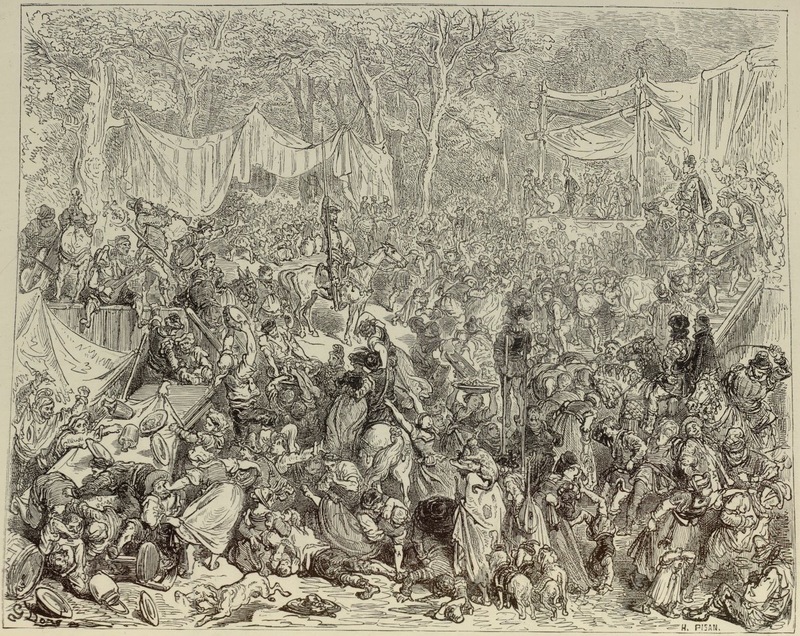
Don Quixote and Sancho Panza arrive at Camacho’s wedding. They appear at the centre of the composition, surrounded by cooks, musicians, dancers, children, and beggars. In Cervantes’ text, he describes an entire steer on a roasting spit, cauldrons large enough to hold the contents of entire slaughterhouses, dozens of wineskins, mounds of snowy white loaves of bread; in short, provisions so abundant they could feed an army. Signed by G. Doré (illustrator) and H.-J. Pisan (engraver). Part 2, ch. 20.
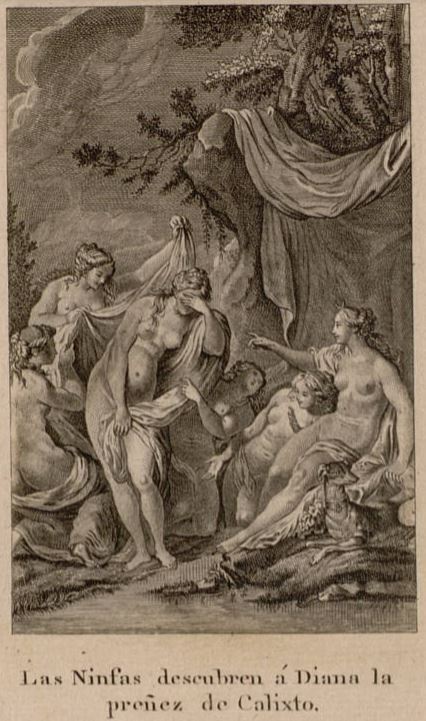
This image shows the nymph Callisto standing with her chest and stomach exposed to show that she is pregnant. Callisto had been raped by Jupiter who disguised himself as the goddess Diana and became pregnant as a result. There are two nymphs pulling Callisto’s clothes away from her to expose the stomach. The goddess Diana is sitting on the right side of the image and is illustrated pointing at Callisto as she hides her face in shame. Because Diana is a goddess of virginity, she shames Callisto for no longer being a virgin and casts her away.
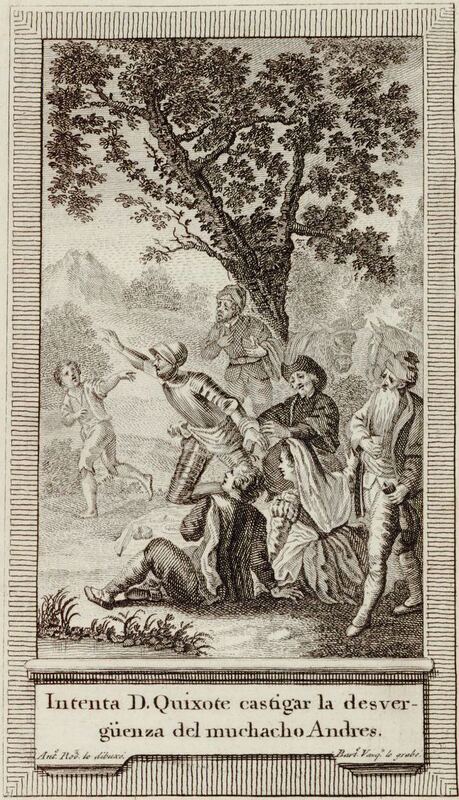
Andrés encounters the party having lunch near the road. After Don Quixote introduces him and recounts his story, Andrés reveals that after the errant knight had left, Juan Haldudo had continued to whip him. He blames Don Quixote for the extra lashes he received and curses him, running away before Don Quixote can punish him. Signed by A. Rodríguez (illustrator) and B. Vázquez (engraver). Part 1, ch. 31.
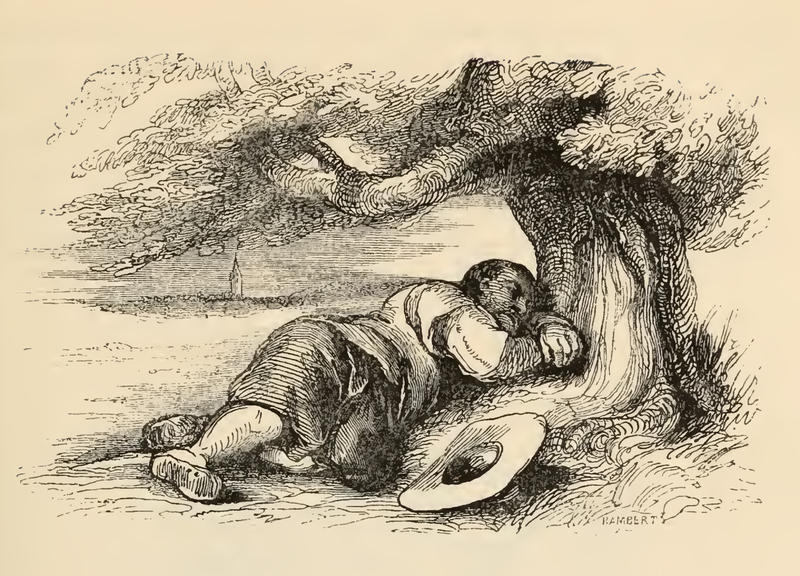
Sancho Panza sets himself at ease beneath a tree and lies down on his belly to pass the time so that Don Quixote might think he had spent a long time looking for Dulcinea Del Toboso. By his side he rests his hat, and in the background a spire from the city of Toboso can be seen.
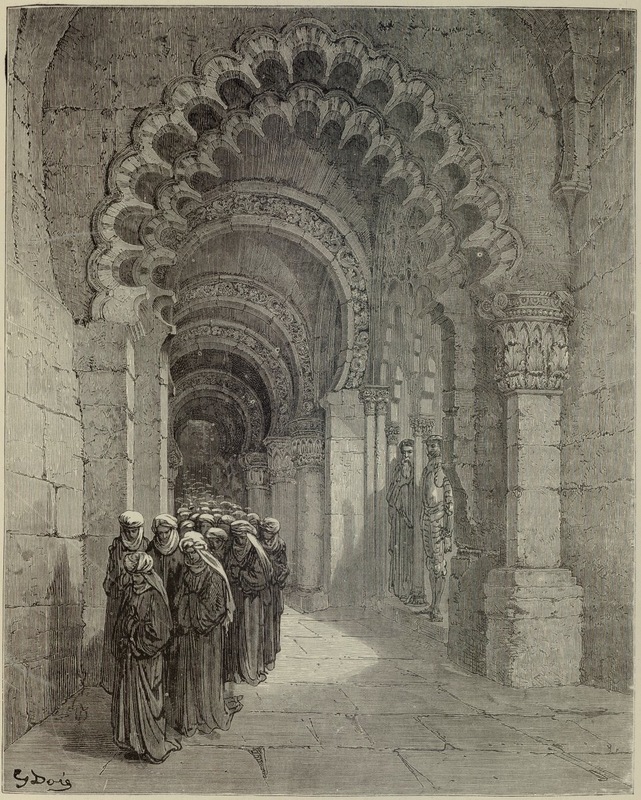
The illustration depicts one of Don Quixote’s visions in Montesinos’ cave: a procession composed of two lines of maidens, dressed in mourning and wearing white turbans, accompanies the matron Belerma, dressed in black and wearing a lengthy white train. She carries Durandarte’s heart, wrapped in cloth. Signed by G. Doré (illustrator) and H.-J. Pisan (engraver). Part 2, ch. 23.
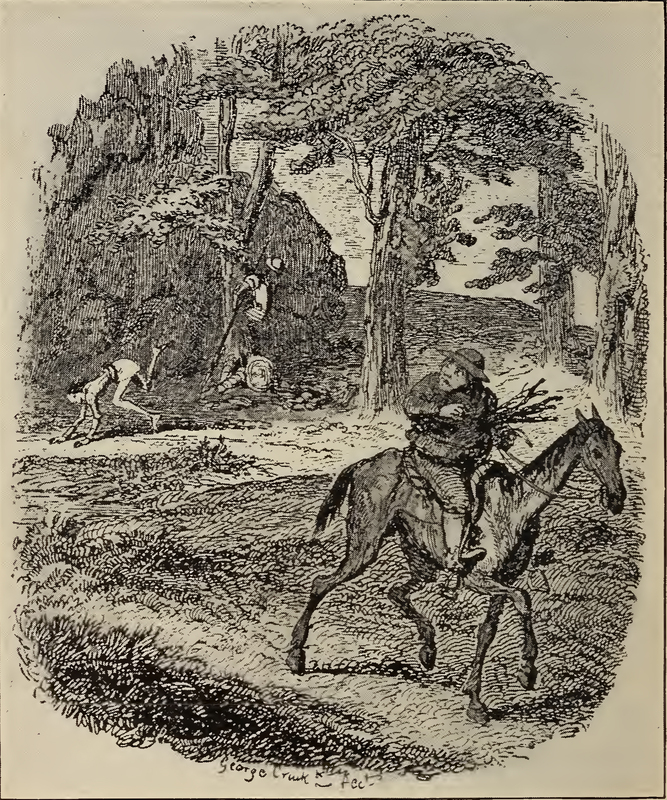
Don Quixote decides to undertake penance in the wilderness of the Sierra Morena to obtain honor for himself. Quixote tells Sancho Panza that he is worried about his princess Dulcinea, and writes a letter which Sancho Panza must deliver to her. Panza agrees, but asks why Quixote will not join him. Quixote explains that he must be left alone in the mountain while he thinks of his princess Dulcinea so that he may go mad like other fictional knight-errants such as Amadis of Gaul. Sancho Panza hesitantly agrees, and leaves Don Quixote to his penance on the back of Rocinante, which Quixote has allowed Panza to ride. As Sancho Panza leaves, Don Quixote strips his clothes and performs a hand-stand to demonstrate his madness and the torture which he is going inflicting on himself in thinking of Dulcinea.
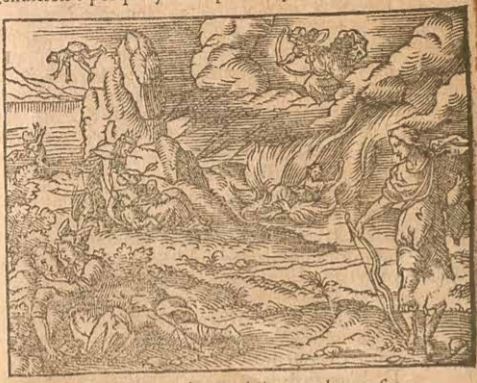
This engraving illustrates the story of Daedalion and his daughter Chione. Daedalion, the son of Lucifer, had a daughter whose beauty captivated thousands of suitors, including the gods Mercury and Apollo. The two gods had their way with Chione and both gods impregnated her. The bottom left corner of the engraving illustrates the god Mercury forcing himself upon Chione as she sleeps. After having two children born of Apollo and Mercury, Chione begins exclaiming that she is more beautiful than the goddess Diana. Diana is angered by these claims and punishes Chione. She shoots Chione through her tongue, which ends up killing her. This is illustrated in the engraving with Chione laying down as the arrow sticks out of her face with her father holding her up. Daedalion is depicted with a crown on his head. Diana is illustrated in the foreground of the engraving with the bow in her hand, as well as in the background of the engraving floating on a cloud. Daedalion was so upset by his daughter’s death that he plunged himself off Mount Parnassus. Before he hit the ground, Apollo transformed him into a hawk out of pity. Daedalion is illustrated in the top left corner of the engraving plummeting off the mountain with Apollo standing at the bottom.
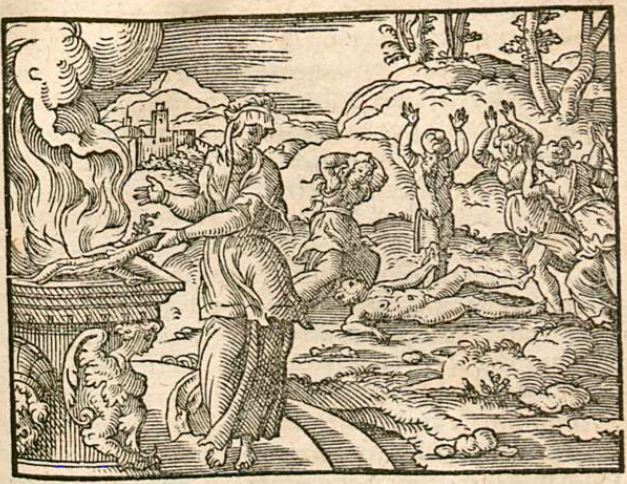
After hearing the news that her son killed her two brothers, Althaea puts aside her maternal instincts and decides to avenge her brothers. When her son Meleager was born, the Fates put a branch into a fire and told her that his life span would be as long as the branch. Althaea took the branch out of the fire and hid it away in order to save her child. When she finds out that Meleager killed her two brothers, she takes the branch out of hiding and, without looking, throws it into a fire, as depicted in the engraving. The burned-out branch ends up killing Meleager, and his sisters mourn over him which is depicted in the background of the illustration.
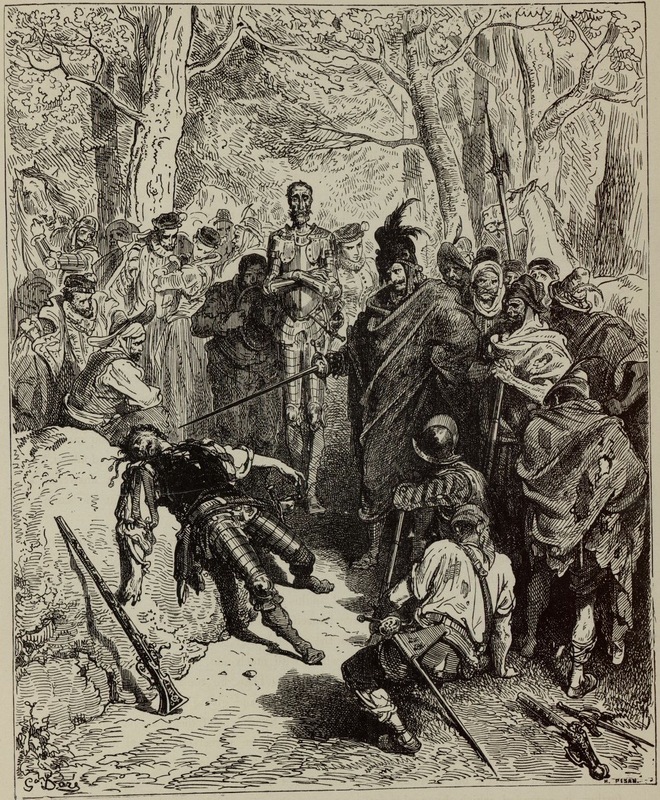
Roque Guinart overhears one of his bandits saying that their captain is more a friar than a bandit. Roque, drawing his sword, splits his head almost in two. He tells the other bandits that this is how he punishes insolent men who talk too much. Don Quixote and Sancho Panza look on. Signed by G. Doré (illustrator) and H.-J. Pisan (engraver). Part 2, ch. 60.
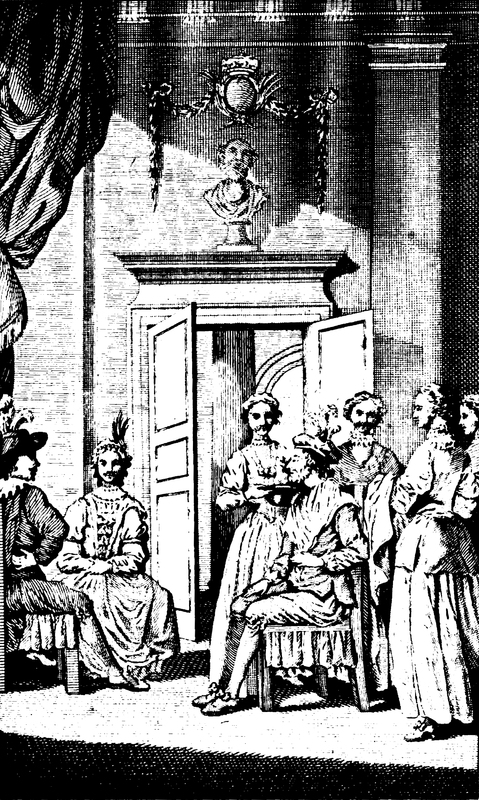
Having outwitted the doctor, Don Quixote calmed down being in the presence of the Duke (pictured to the left) and the Duchess (pictured sitting next to the door). As they talked, four damsels entered the room (pictured behind Quixote), one of them with a silver basin , another with a silver Aask, a third with a couple of fine clean towels upon her arm; and the fourth, a ball of Neapolitan soap. She who carried the basin then approached Don Quixote and placed it directly under his chin. Thinking that it was the custom of the country to wash beards instead of hands, he stretched out his chin. The damsel who had the soap then lathered his beard. Quixote shut his eyelids tightly to keep the suds from stinging his eyes. Inscribed beneath the image it says "the merry damsels lather well the knight; then leave him soaking in a woeful plight; and while the tingling soap his vision hides; the Duke and the Duchess almost split their sides".
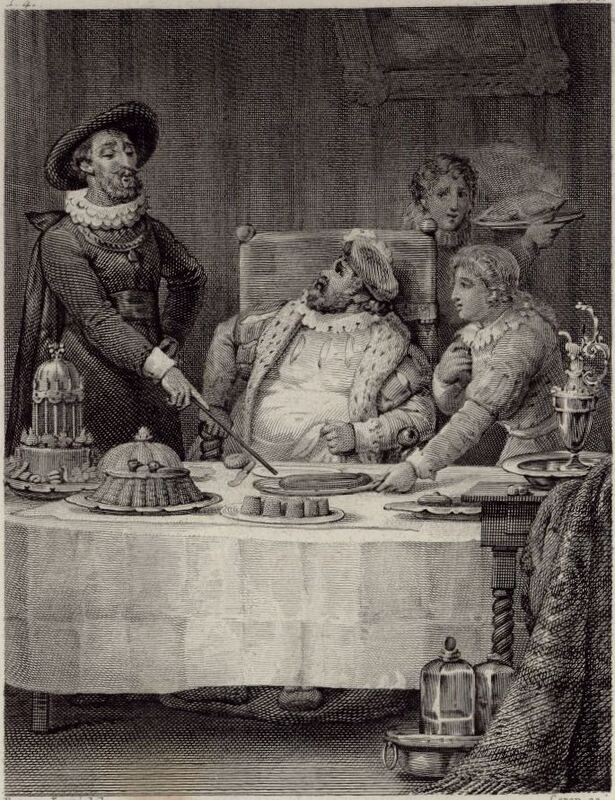
Sancho Panza is taken from the courtroom to a sumptuous palace, where, in a large hall, a royal table is set. Plates of food are placed before Sancho, but at the request of the physician Pedro Recio (left, holding a rod), they are taken away. Signed by E. Lami (illustrator) and J. Caron (engraver). Part 2, ch. 47.
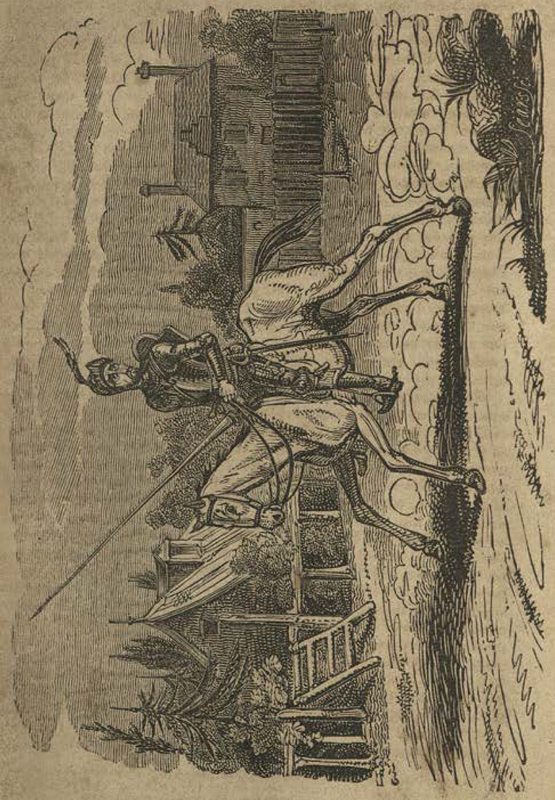
Having seen himself knighted, Don Quixote clad in armor gallops away from the inn atop Rocinante (his horse). As he rides towards his village in search of squire, he hears a noise from the nearby bushes and turns his head. In the background on the left stands the inn, and in the background on the left stands a simple stable.
Sancho Panza (left) blocks some country girl's from their path and lays hold of one of them by the halter of their donkey, falling to his knees and introducing himself and his master to the the country girl at the front of the procession. Seeing Sancho act thusly, Don Quixote (right) clad in armor, drops his lance and sword to the ground and places himself on his knees to pray. The two girls in the background speak amongst themselves about the two strange men. The girl in the front who Sancho has called Dulcinea pulls back her hand angrily to whip the two men.

![[The Country Girl who Don Quixote Imagines to be Enchanted Dulcinea Del Toboso Falls from her Donkey]](https://collections.cemvc.ca/files/large/bb35323a769f50ec2519918f5af07daa7eb02ea6.jpg)
![[Sancho Panza Grabs the Halter of a Country Girl's Donkey Trying to Convince Don Quixote that she is Dulcinea Del Toboso]](https://collections.cemvc.ca/files/large/5807ff26048ca089fcf28b4ac1f727f276d9e34d.jpg)