Sempronio and Pármeno are meant to be at Celestina’s house for lunch (to the right they are seen socializing with their lovers). However, Elicia and Areúsa become frustrated because they do not arrive on time. When they eventually arrive, the five sit down at the table and have a good meal. During the meal Elicia gets jealous and angry with Sempronio for his praise of Melibea. After she calms down, Celestina encourages the couples to embrace. We also see Lucrecia arriving at Celestina’s house with a message from Melibea (to the left of the image). Lucrecia begs Celestina to visit Melibea, and tells her that Melibea is afflicted with an illness of the heart. As a result, they depart for Melibea’s house.
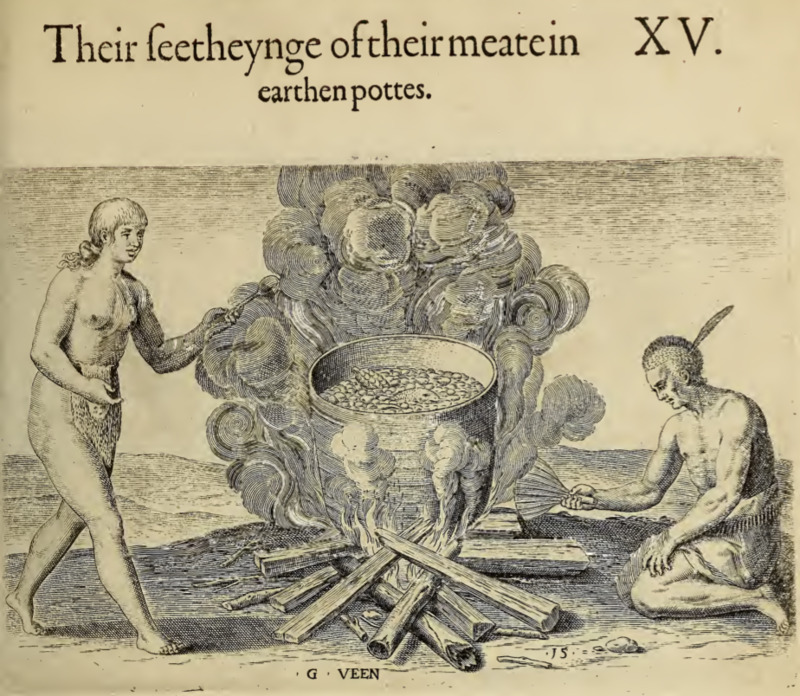
An Indigenous man and woman cook food in a large earthen pot over a fire. The woman holds a ladle, and the man kneels on the ground and fans the flames under the pot. Inside the pot a fish is identifiable, amongst other foods. Both individuals wear a fringed garment tied around their waist, and the man has a single feather in his hair.
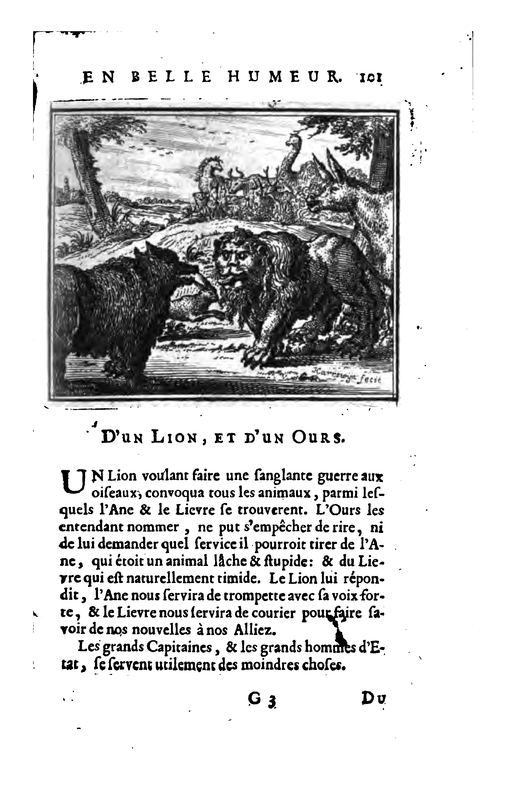
The lion decided all the animals must to go to war with the birds. The image depicts the gathering of all the animals shown in the background. When the bear laughed at the donkey and hare upon seeing them gathered and could not see what use they could be in the war. The lion gives the donkey the job of being a trumpet and the hare the job of being a courier. The foreground shows the bear facing the lion, donkey and hare.
This engraving depicts Lavinia, wife of Aeneas and queen of Laurentum, hiding in the forest with her baby in fear of her step-son, Ascanius. Lavinia had given birth to a son who she named Silvius. Boccaccio explains that after Aeneas died, Lavinia fled to the forest as she was afraid that her step-son would kill her. Lavinia was wrong, and Ascanius voluntarily gave the kingdom of Laurentum back to her and helped raise Silvius. Lavinia’s name is engraved at the top of the illustration, and Silvius’ name is engraved below his body at the bottom of the engraving. Ascanius is pictured on the right-hand side of the engraving with his hand touching a young Silvius’ face with brotherly affection.
Amelia Sedley kneels by her father’s bedside, holding his hand as they pray together as he dies. Two other men, possibly the doctor and the butler, also stand in the room, but a few steps back from the bed.
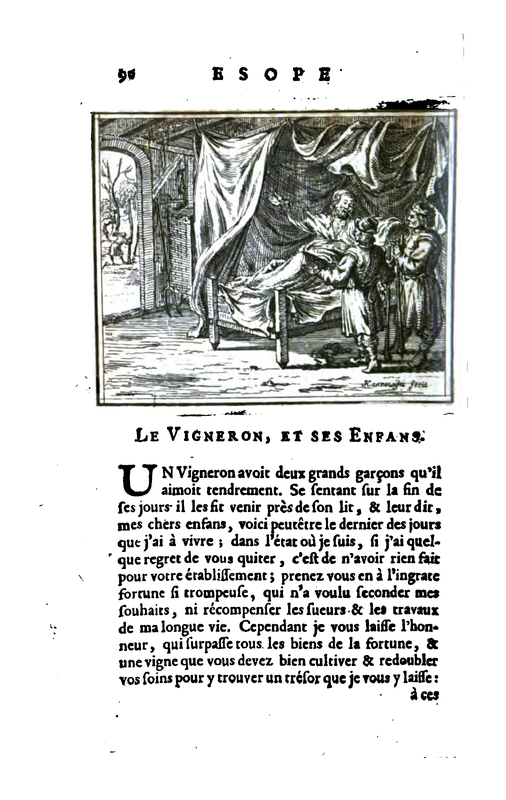
A winegrower had two big boys that he loved dearly. Feeling that he was at the end of his days, he brought them to his bed, and said to them, my dear children, this is perhaps the last of the days I have to live; in the state I am in, if I have any regret in leaving you, it is that I have done nothing for your recovery; take it from the ungrateful fortune, so deceitful, which did not want to support my wishes, nor to recompense the sweat and work of my long life. However, I leave you honor, which surpasses all the goods of fortune, and a vineyard that you must cultivate well and redouble your care to find a treasure that I leave you there: at these last words death takes him from this world.
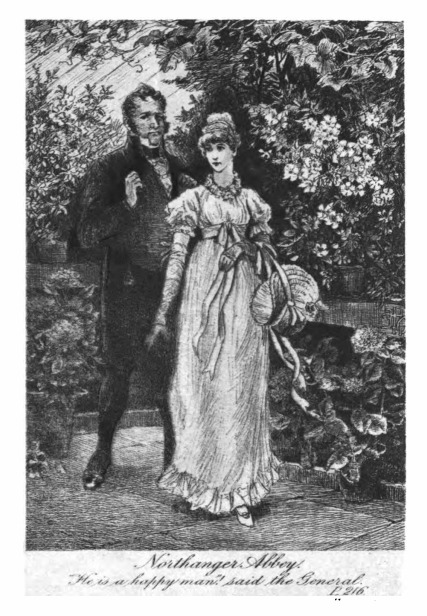
Here we see Catherine Morland and General Tilney walking through the gardens at Northanger Abbey. Catherine was invited to Northanger Abbey by Eleanor Tilney and her brother, Henry Tilney, after becoming close friends in Bath. This scene occurs shortly after Catherine's arrival, when General Tilney took Catherine on a tour of the property. This scene occurs in chapter 22 on page 216 as noted underneath the title of this image. The characters are shown in the traditional regency style, with General Tilney wearing waistcoat and tailcoat. Catherine wears the regency style dress with an empire waist. Her hair is worn tied up, as was tradition for women after their “coming out” before the queen, signaling her entrance into society. The regency period dated to the early nineteenth century (1811-1820) when George, Prince of Wales, later George IV (r. 1820-1830), reigned as regent for his mentally ill father, King George III (r. 1760-1820). The regency period is associated with the rise of neoclassicism in art and fashion. The same image appears as the frontispiece for the Dent 1893, 1894, 1895, 1896, and 1897 editions of Northanger Abbey.
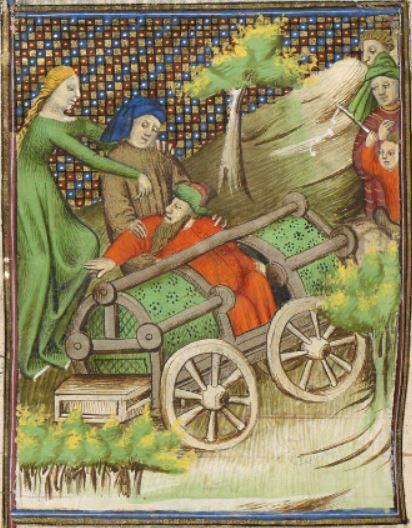
This illumination depicts a vestal virgin named Claudia. She is depicted grabbing onto a man wearing a brown shirt and a blue head wrap while hitting him. Her father was a noble man who, under the order of the senate, rode through a populous area of Rome on a chariot for a triumph procession. A man had run up to Claudia’s father in a rage and was about to attack him, but not before Claudia put herself in front of the man to protect her father. The man in the blue head wrap is illustrated grabbing on to Claudia’s father and attempting to drag him out of the chariot while Claudia attacks the plebeian. Boccaccio explains Claudia is praiseworthy due to her devotion to her father and for her actions of risking her life for him.
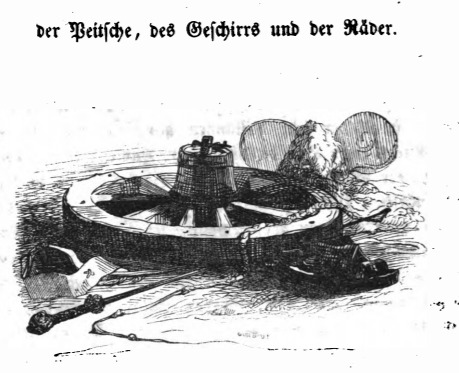
Here we see a pile with whips for horses, harnesses, and wheels for carriages. The Houyhnhnms asks about the horses in Europe and how they live. Gulliver explains that humans or yahoos govern the country and care for the horses or Houyhnhnms, and how humans use their horses, including the uses of whips and harnesses in controlling horses, and wheels on carriages. The same image appears in the 1843 Krabbe edition.
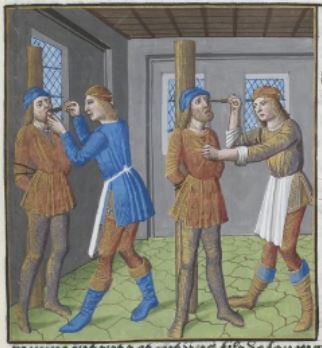
This image appears at the beginning of the chapter that treats Irene, the Eastern Roman Empress and mother of Constantine VI. Empress Irene was the regent to Constantine when her husband Leo had died. Constantine grew up and asserted that the throne was his and his alone. Irene attempted to get the throne back from her son and had him imprisoned. When he was freed, he sent her into a luxurious exile. When he exiled his mother, he went to war with the Bulgarians as they were trying to replace him as emperor with a man named Nicephorus. To exact his revenge on this Nicephorus, he had the tongues of Nicephorus’s brothers torn out and eyes gouged. This image depicts two men, one getting his tongue cut out and the other getting his eyes gouged with a knife.
The knights of Castile stand weeping around King Sancho’s body. Rodrigo is likely the one kneeling in the middle with his hands clasped. The man standing with his sword over is head is Diego Ordoñez, vowing to issue a challenge to the Zamorans to settle the score. The castle of Zamora can be seen in the background.
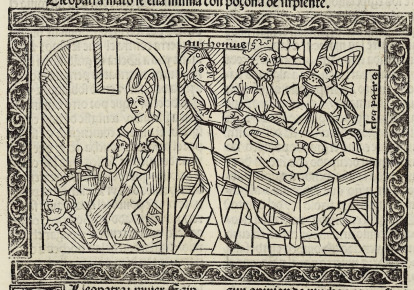
This engraving depicts two separate scenes. The right side of the engraving depicts queen Cleopatra of Egypt sitting at a dinner table, with her husband Antony beside her. Cleopatra had very expensive tastes and demanded a feast which would cost an outrageous amount of money. When Antony did not provide the entire feast Cleopatra demanded, she took out one of her pearl earrings and dissolved it in her drink and drank it to get the luxuriousness she desired. Cleopatra is depicted drinking the pearl in this image. The names Cleopatra and Antony (written as “Antonius”) are engraved beside their heads. There is a third figure in this scene, which is a man named Lucius Plautus who was called to be a judge of the feast. The left side of the engraving depicts the suicide of Antony. After realizing the forces of Octavian were on their way to destroy them, Antony plunged his sword into his chest, as depicted in the engraving. Cleopatra is depicted kneeling over his body before she kills herself as well.
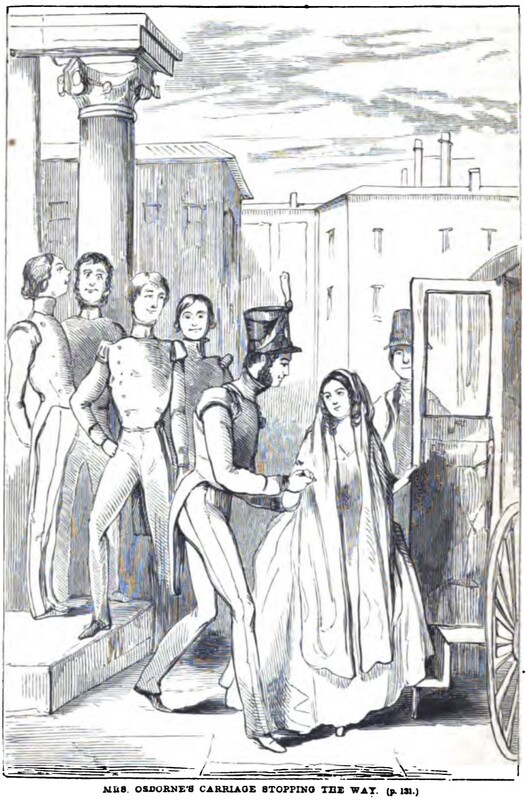
William Dobbin hands Amelia Osborne into her carriage as she leaves the ball. Behind the carriage door, the footman can be seen, and to the left of Dobbin, on the stair four young men are talking and smiling. In the background are three tall buildings, two with smokestacks. Below the illustration is printed its title and location in the story, “MRS. OSBORNE’S CARRIAGE STOPPING THE WAY. (p. 131.)”.
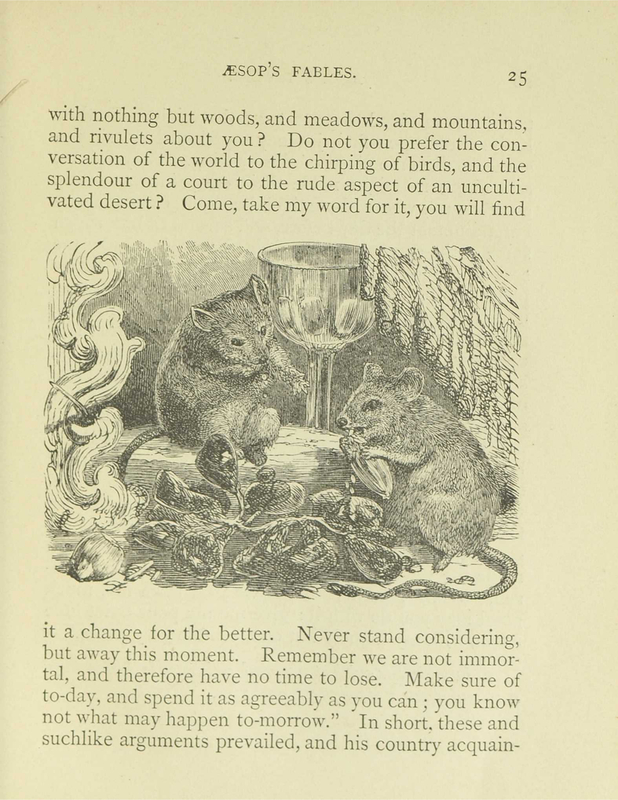
An honest, plain, sensible country Mouse is said to have entertained at his hole one day a fine mouse of the town. Having formerly been playfellows together, they were old acquaintance, which served as an apology for the visit. However, as master of the house, he thought himself obliged to do the honours of it in all respects, and to make as great a stranger of his guest as he possibly could.
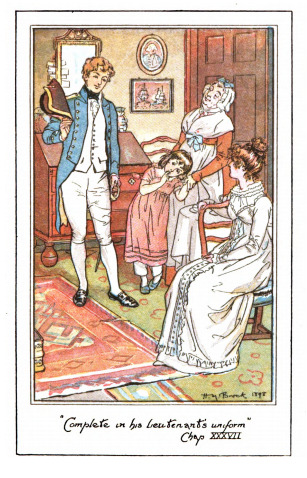
Here we see William standing in his lieutenant's uniform, as Fanny, her mother, and youngest sister, Betsey, admire him. William was given a promotion to Lieutenant at the recommendation of Mr. Crawford to his uncle, Admiral Crawford. William was given some time off, and Fanny and William traveled down to Portsmouth, their hometown, before he boarded his ship. William had to leave just three days after their arrival in Portsmouth, but Fanny stayed there for three months. In this scene, William shows off his new Lieutenant’s uniform to his sisters and his mother. This scene occurs in chapter 37 as noted underneath the title of this image. The characters are shown in the traditional regency style. Fanny, Mrs. Price, and Betsey wear the regency style dress with an empire waist. Fanny's hair is worn tied up. Mrs. Price has her hair tied up underneath a mop cap, a soft cloth cap used to protect her hair. She also wears an apron and a kerchief or “tucker”, a lightweight cloth worn around the neck and shoulders and tucked into a woman’s corset or apron. Betsey’s hair is cut short and is worn down. William wears the naval Lieutenant’s uniform. This uniform was a blue coat, the traditional colour worn by the navy, with white breeches and waistcoat. He has only one epaulette on the right shoulder, signaling that he had less than three years' experience. In his hand he holds his bicorn hat. He was only permitted to wear his uniform when on duty, and though when first given leave, he wanted to take it to Mansfield to show it to Fanny there, he was not allowed. This scene therefore takes place right before he boarded his ship. The regency period dated to the early nineteenth century (1811-1820) when George, Prince of Wales, later George IV (r. 1820-1830), reigned as regent for his mentally ill father, King George III (r. 1760-1820). The regency period is associated with the rise of neoclassicism in art and fashion.
Two women are killing a rooster. The woman on the left has her back to the viewer and is holding the rooster, upside down, in her right hand. She wears a cap and a long dress with a shirt and rope belt on top. The woman on the right is facing the left, but looking down at the rooster she is also holding in her left hand. In her right hand is a knife that she is holding out close to the rooster. She is wearing the same clothing. Under the handing rooster is a small step stool. In the left of the image is a pail with a mop in it leaning against a tree. Behind the tree and the women is a fence that is at elbow height. Behind the fence is a house on the right and many trees. There is also a tree right behind the woman on the right.
A woman in a long gown with wild loose hair flies through the sky, looking back with a fearful expression. She is holding out in front of her two swords or long daggers. Behind her, the sky is dark and filled with clouds, and at the bottom right of the image is the letter W from “We”, with bright rays coming out from it as if it were the sun.
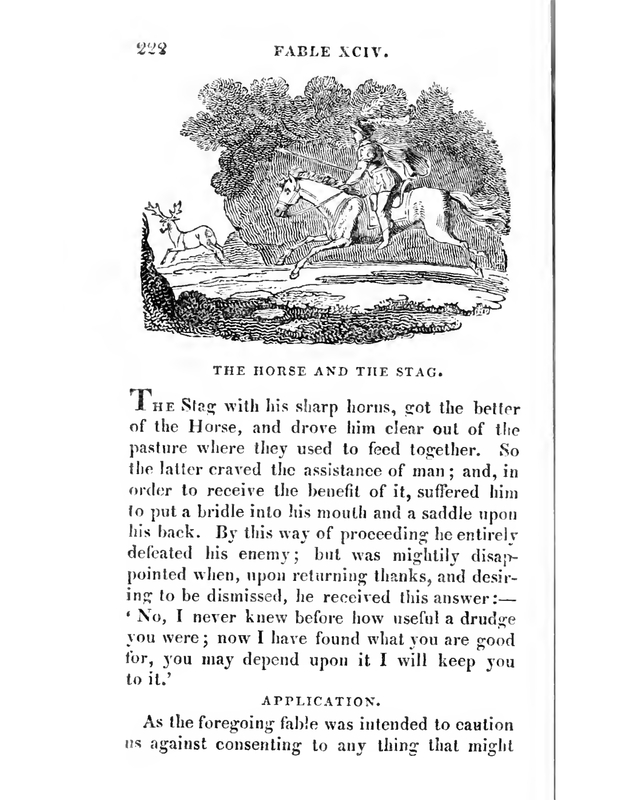
On the right side of the image there is a man riding a horse. They are facing towards a stag that is depicted on the left side of the image. Surrounding the man, horse, and stag are various bushes, trees, plants, and rocks.
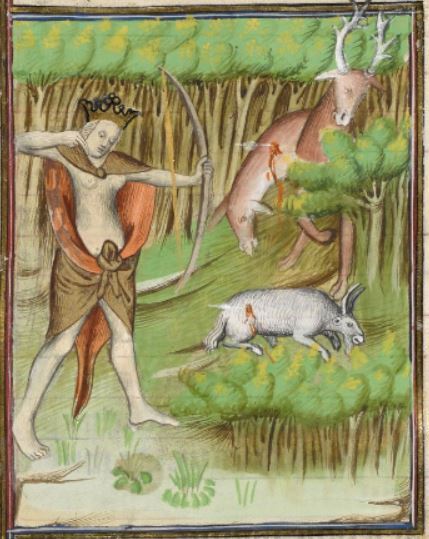
This illumination depicts Camilla, the daughter of King Metabus, hunting animals in the forest in order to make clothing out of their fur and skin. Camilla had been raised in the forest by her father after he was exiled from their kingdom. She set aside common womanly duties and devoted herself to hunting and preserving her chastity. She is illustrated wearing a cloak made from animal fur, as well as a crown to symbolize her royal status. Due to her strength and fearlessness, the Volscian people eventually summoned her back in order to be queen.
A boy with short curls and a girl with long ringlets and oversized ribbons walk towards each other, both smiling and on tiptoes. Between and above them is a large letter T, from “The”.
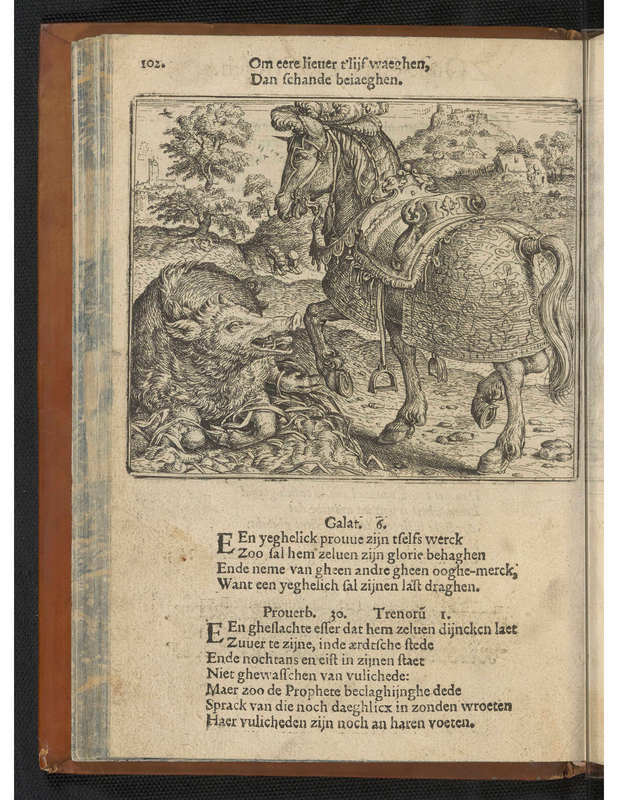
The boar and the war horse'; a boar lying in hay at left; a war horse standing at right; Dutch letterpress on verso; illustration to Eduwaert de Dene's edition of Aesop's Fables, "De Warachtighe Fabulen der Dieren"
Martha Crawley sits in a chair at Matilda Crawley’s bedside, holding a cup and saucer and scowling. Miss Crawley, who is ill, can be faintly seen inside the canopy of her bed.

![[Act IX - Lucrecia Visits Celestina]](https://collections.cemvc.ca/files/large/6b8d7433952c9bd549fa178a0dfb868f273bf58f.jpg)
![[Vanity Fair Vol. I Chapter II Inhabited Initial]](https://collections.cemvc.ca/files/large/f256f164cffcde4852dce9b30b48c43c56303f26.jpg)

![[The Death of Mr. Sedley]](https://collections.cemvc.ca/files/large/d906c4922d4d53a38b84700cdbf93ca5ae309752.jpg)
![[“Dead the King Don Sancho lieth”]](https://collections.cemvc.ca/files/large/63af95e2292adb5f0503c3825a5a79e7c19483d8.jpg)


![[Vanity Fair Volume I. Chapter XXXII Inhabited Initial, W]](https://collections.cemvc.ca/files/large/1405c4c0e4bcfb9aa1ff7142013b3e1ec626a228.jpg)
![[Vanity Fair Chapter XXXIV Inhabited Initial]](https://collections.cemvc.ca/files/large/844db6fc7ef5a240b23ad16835e3d654cc77aa13.jpg)
![[Martha Crawley at Matilda Crawley’s Bedside]](https://collections.cemvc.ca/files/large/f53934b233ca286b393131a5eb659a271d3049b9.jpg)