A group of Tupinambá women dance in a circle around a European man, who wears a feathered headdress and ratels around his calves. Two of the dancing women have infants strapped to their backs. The village, labelled ‘Uwattibi’, is comprised of five long structures arranged in a pentagram and surrounded by a fence.
Rawdon Crawley, smoking a cigar, leans over the billiards table as he lines his cue up with a ball. On the other side of the table is a man holding his cue vertically and looking nervous. In the background to the right are two other men, one standing and wearing a suit, and the other seated on the edge of a table while smoking.
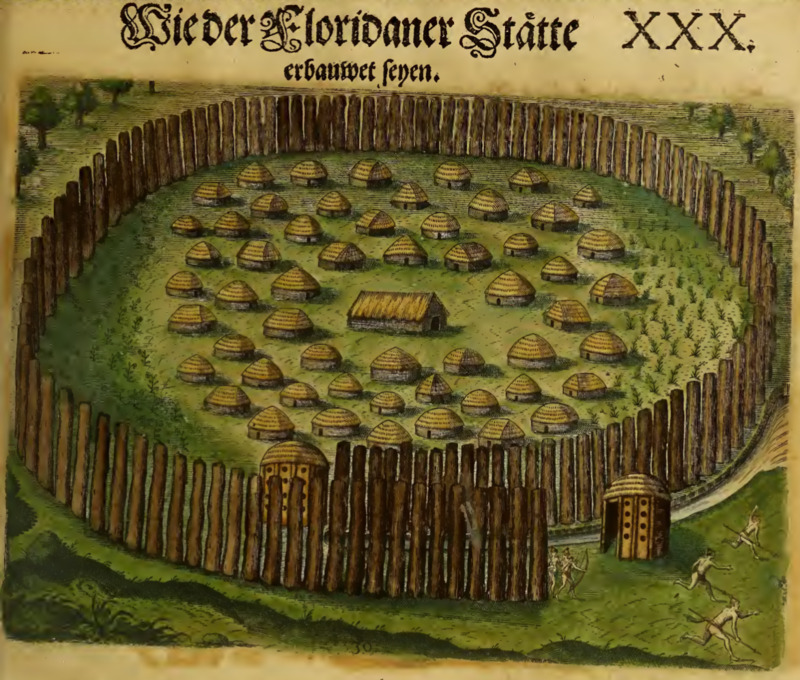
An Indigenous town is shown. The town is surrounded by large logs stuck into the ground, forming a large fence with one entrance. At both the exterior and interior of the gap there is a tall hut. Inside the fence, many round structures sit in a cluster. At the center of the cluster is a larger rectangular building. This illustration is identical to the one found on page 101 of Frankfurt 1591, but colored.
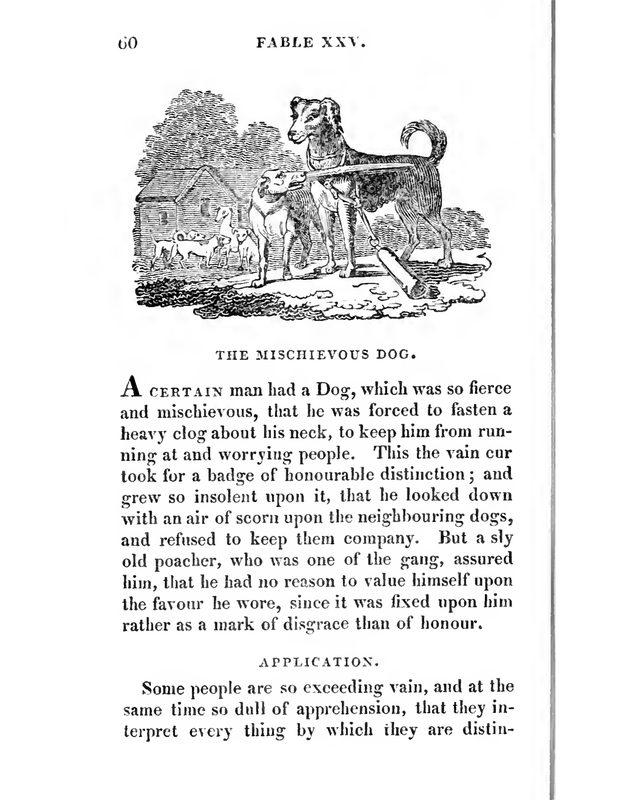
Two dogs stand in the foreground. The larger dog has a rope with a wooden clog and bar around its neck, and the smaller dog stands to the side of the larger dog, growling. In the background there is a house with four other dogs in front of it.
A group of Indigenous men, women, and children gather around two large pots, one sitting on the ground and one resting on a fire. The group cooks and eats meat and fish. Two individuals and a child sit in a large hammock while the rest sit and stand on the ground around the pots. One structure is visible in the background. This illustration is a simplified and mirrored version of the one found on page 57 of Paris, 1557.
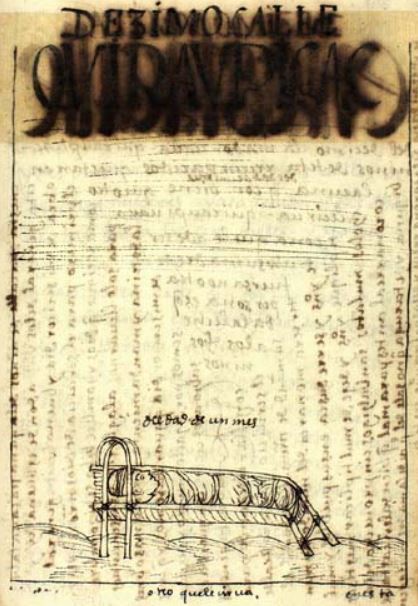
The author explains that there were ten paths for men to follow in the Inca Empire based on age division. This tenth path is called quiraupicac [cradle baby]. The group refers to babies from the age of one month old who must be cared for by their mother. The author also explains that this group is the last group division of Inca men. The image depicts a baby laying in a wicker cradle. The caption reads “de edad de un mes otro que le cirua” which translates to “one month old, others serve him.”
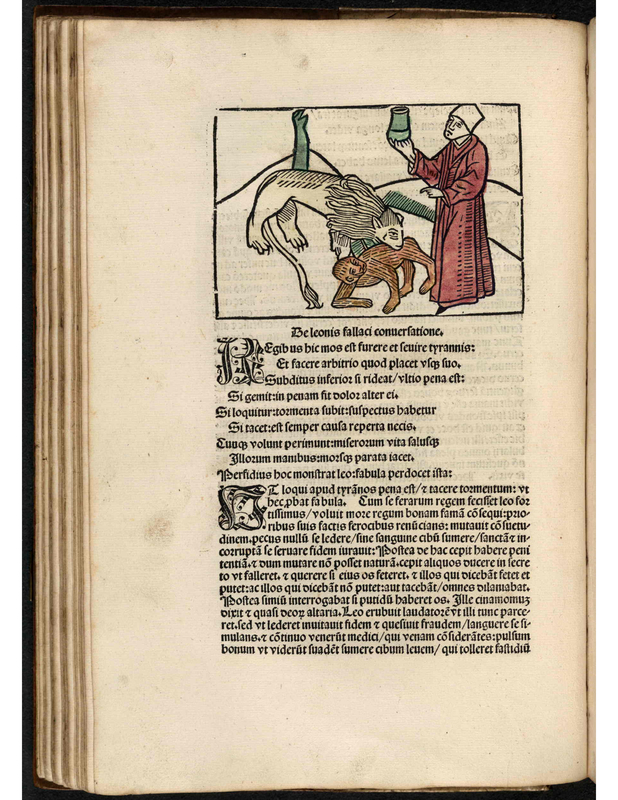
In front of a man who is holding a pot, a lion is attacking a monkey, biting it on the back. The man does not seem to be focusing on the lion and the monkey, but rather focusing on the pot that he holds above his head. The is a single, dying tree in the distance.
Tupinambá women prepare an alcoholic beverage using manioc (cassava) roots. On the left they chew the roots and spit them into a large pot. They then boil the chewed roots in a large pot over the fire, then strain the liquid into pots to cool (right). Behing the women, men drink from bowls and one plays a small wind instrument. More men dance in the background, holding round objects with half-moon symbols on them, perhaps ratels or religious items. Most of the men wear feathered headdresses and adornments around their waists, and some also wear feathered capes and necklaces.
An armored horse is on its hind legs with its head turned behind him. A man in armor is bent forward on the left side, possibly close to falling off the horse. He holds a stick in his left hand while holding onto the horse’s neck with his right hand. A wasp is on the horse’s behind, possibly having stung it.
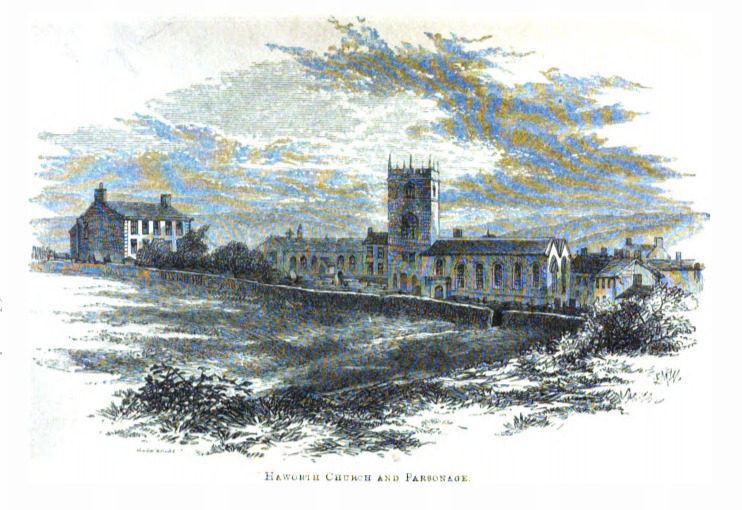
Here we see the Haworth Church and Parsonage in North England. The viewer stands on a hill, looking down into the town where we see the large Gothic church and the parsonage, where the clergy would live, is seen on the hill, slightly above the church. The image is shown looking down towards the town, as both Wuthering Heights and Thrushcross Grange are large estates outside the town.
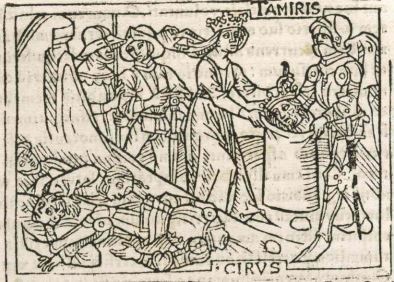
This engraving depicts Thamyris, queen of Scythia, placing the decapitated head of king Cyrus into a bag. Thamyris’ name is engraved above her head, and Cyrus’ name is engraved beside his body at the bottom of the image. Boccaccio explains that Cyrus had invaded Scythia looking for glory, and when he had killed Thamyris’ son, she exacted her revenge by killing his entire army. When Thamyris found Cyrus’ dead body, she took his head. There are other dead bodies among Cyrus which are his men. There are Thamyris’ soldiers surrounding her, and one who is helping her put the head of Cyrus into the bag.
Two Tupinambá men are shown from the front. Both men are adorned with face stones on their cheeks and chins and tattoos or paint in dots all over their bodies. The man on the left wears a large necklace and carries a club decorated with feathers on one end. The man on the right wears a large feathered headdress and feather adornment around his waist and carries a bow and several arrows.
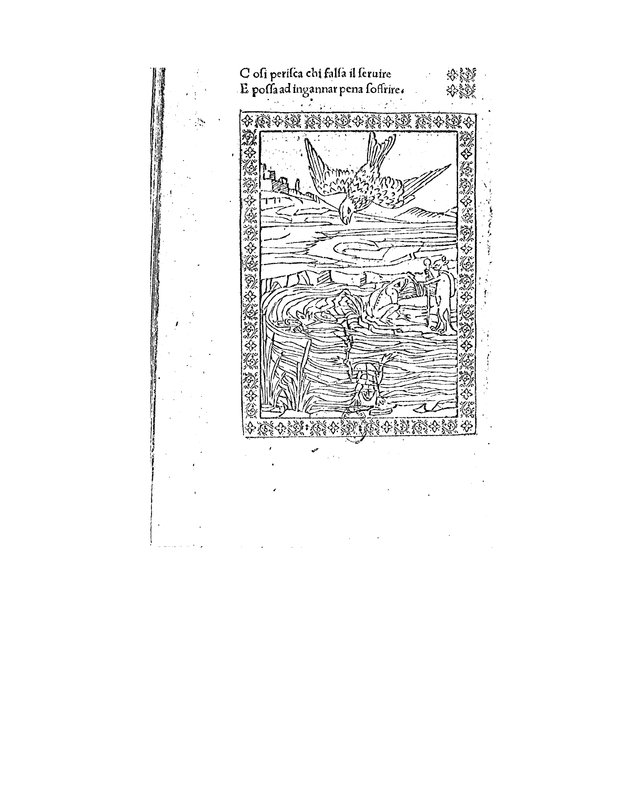
On the right side of the image we see a frog talking to a mouse that seems to be exploring on the shore of the pond. On the left we see the frog and mouse tied together, the frog is swimming downwards while the mouse struggles to stay afloat. At the top of teh image we see a bird that has presumably spotted the situation and is diving to grab both of them.
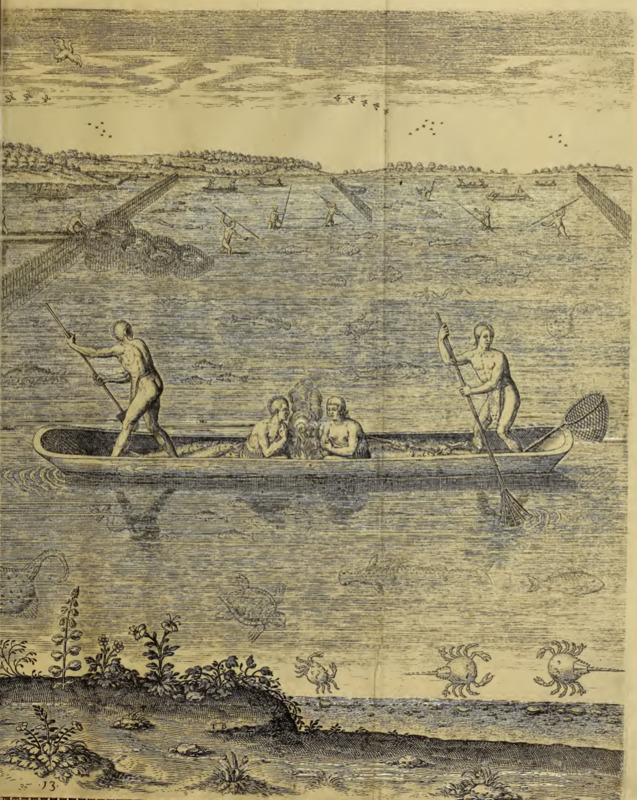
Four Indigenous people are shown in a canoe on the river. The person in the right end of the canoe fishes with a net on the end of a long stick, while the person in the left of the canoe appears to paddle. There are two individuals in the middle of the canoe sitting on either side of a fire. In the background several other Indigenous people fish in the shallows of the river on foot and in canoes using spears.
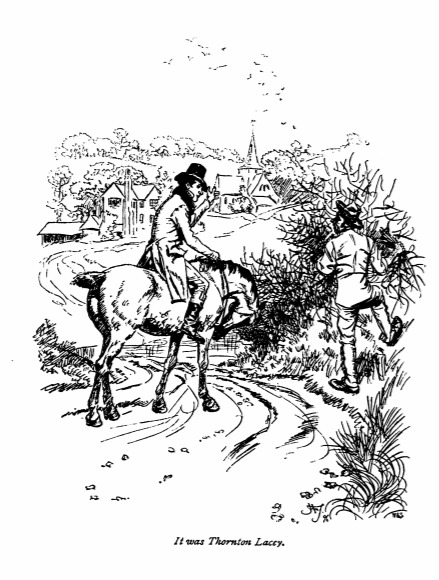
Here we see Mr. Crawford riding into the town of Thornton Lacey. He happened upon the town while out for a ride one day, and is seen in this image on horseback, asking someone where he was. Edmund had an estate in Thornton Lacey where he would move once he got married and began his work with the clergy. Mr. Crawford asked Edmund if he could rent his estate, wanting to move closer to Mansfield in his attempt to get Fanny to fall in love with him, but Edmund refused. This scene occurs in chapter 25. The characters are shown in the traditional regency style. Mr. Crawford wears a waistcoat and tailcoat, and breeches that stop at the knee and a top hat. The regency period dated to the early nineteenth century (1811-1820) when George, Prince of Wales, later George IV (r. 1820-1830), reigned as regent for his mentally ill father, King George III (r. 1760-1820). The regency period is associated with the rise of neoclassicism in art and fashion.
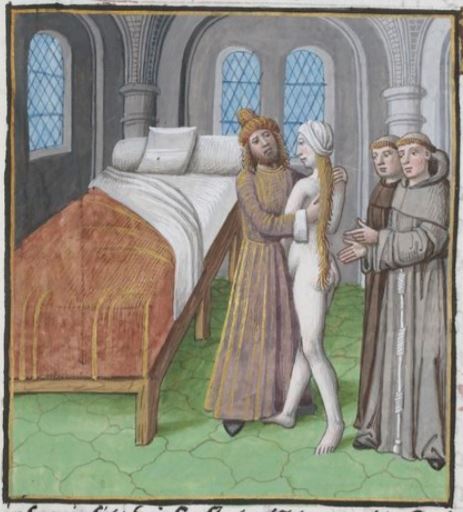
Paulina, a chaste and devout Roman woman is renowned for her naivety by being tricked into losing her virtue. Paulina worshipped the Egyptian god Anubis, and frequently went to the temple of Isis to pray to him. A man named Mundus had fallen in love with Paulina, despite her already being married. He bribed the priests of the temple to convince Paulina to stay overnight so that she can have an encounter with the god Anubis. Being the devout woman that she was, she accepted. Paulina is illustrated standing naked in the temple of Isis with her long orange hair covering her back. She is being embraced by Mundus, who had disguised himself as the god Anubis. He came to Paulina as she slept and told her that he was the god that she worshipped. He convinced her to sleep with him so that she can bear a child conceived by a god. Blinded by her naivety, Paulina had intercourse with the disguised Mundus. There are priests on the right side of the illustration who appear to be urging Paulina to embrace Mundus. Paulina found out about the deception after she had conceived a child. Emperor Tiberius exiled Mundus and punished the priests with torture for their crime against Paulina.
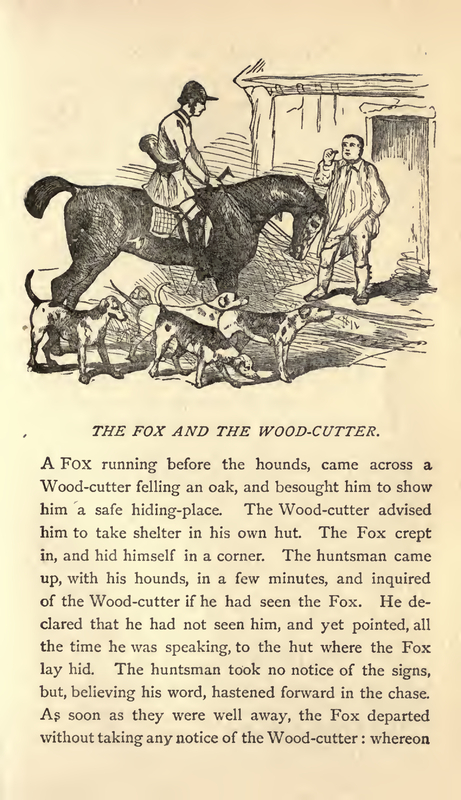
There are two men in front of a hut. One man is on a horse on the left side of the image, and the other man, who is closet to the hut is standing on the right side. Five hounds are standing on the right side of the horse. Both men are facing each other and seem to be talking. The man closest to the hut is pointing over his shoulder back at the hut with his right thumb.



![[Inside a village, Tupinambá women dance around a European man]](https://collections.cemvc.ca/files/large/c5fb65a188113531017d5e46705c6b73c57e0b21.jpg)
![[Rawdon at the Billiards Table]](https://collections.cemvc.ca/files/large/1161660ab624576be217857965bf7e0f2822413b.jpg)
![[Indigenous Brazilians cook and eat a meal]](https://collections.cemvc.ca/files/large/769a704428490ef4f0337a5001d11d840173a7b9.jpg)
![[The Tupinambá prepare a traditional beverage for a celebration]](https://collections.cemvc.ca/files/large/6d2d01c96480fa036cc63ecfb237cc0ea4129c8b.jpg)
![[The Stung Horse and the Falling Soldier]](https://collections.cemvc.ca/files/large/0d9386381c5e203d49094d35fe1cf3d39b8e4436.jpg)
![[Two Tupinambá men]](https://collections.cemvc.ca/files/large/a921740e38cd778f97eefce0090cf655e9fe87d6.jpg)