A vulture-like bird bound to a branch either feeds or feeds on a brood of young birds while another smaller bird watches and chirps at the large bird. Branches overlap and extend in the background towards the top, bending around the birds.
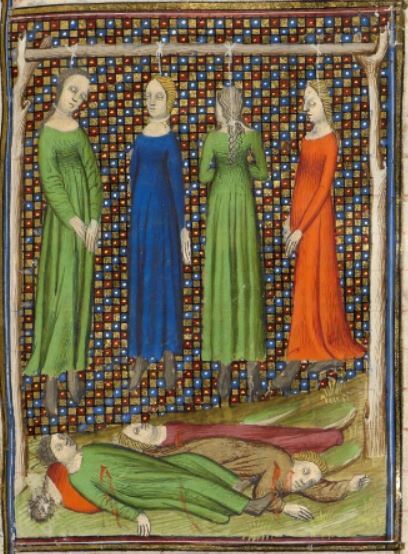
This illumination depicts the wives of the Cimbrians (a northern tribe) killing their children and hanging themselves. After their husbands were defeated in war against the Romans, the wives pleaded to their enemies for mercy and to let them become vestal virgins. When the Romans denied their request, they decided to kill their own children and hang themselves to save their virtue and to not die at the hands of their enemies. The women in the image are depicted with the nooses around their necks and hanging from trees, and their children are depicted dead on the ground.
Here we see a depiction of the war between Lilliput and Blefuscu. In the foreground we see two Blefuscan ships, with the men jumping ship out of fear of Gulliver. These ships are fairly small, as they only have one sail, compared to the multiple sails on the Lilliputian ships shown in other images. Gulliver, who’s head and shoulders are above the water are visible in the background. Gulliver’s participation was what won the war for the Lilliputians. The same image appears in the 1843 Krabbe edition.
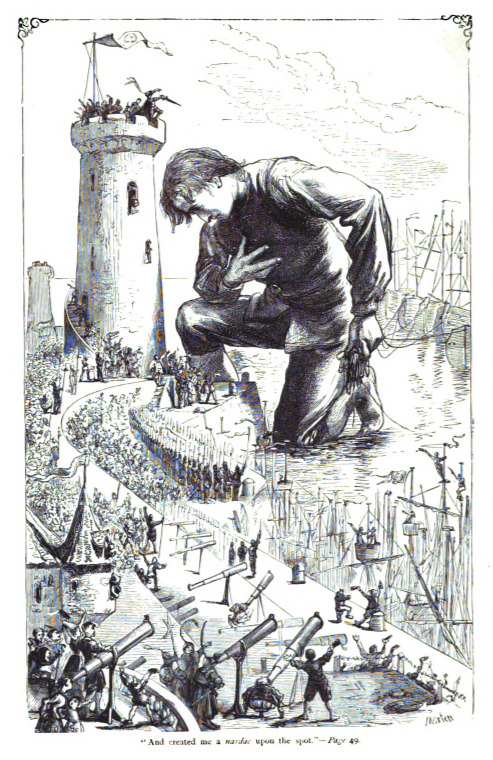
Here Gulliver was given the honour of ‘nardac’ for his work in the war between Lilliput and Blefuscu. Gulliver kneels before the Emperor of Lilliput, who stands on top of the lighthouse, holding a sword. Gulliver is still in the water, and a crowd gathered to see the spectacle. The honour of nardac is the highest honour for Lilliputians.
An ornately decorated title page. Two figures playing musical instruments appear atop the pedestals on either side of the illustration. The male figure on the left is playing the panpipes (or syrinx), and his horns and goat’s legs indicate that this is possibly a representation of the Greek deity Pan. The figure on the right is female and also has the legs of a goat, but it is difficult to ascertain her identity from this illustration alone. Above these pedestals, we see two helmets and two shields, the latter of which bear the coats of arms of Lang (to whom the edition is dedicated) and Wirsung. In the centre of the image, we see the title of the work. It appears to be either framed by an opening, or placed upon an altar of some sort.
This image is illustrated in a chapter that discusses the Christian priests in the colonial government in Peru. The image depicts a Jesuit priest, a hermit and a friar. The Jesuit is depicted in the centre of the image holding a rosary in his left hand while holding up his right hand. The friar is standing behind the Jesuit and looking down at the skull that the hermit is holding. The hermit is holding a skull as it is a symbol of mortality and wisdom. The Jesuit priest is depicted speaking with an indigenous man who is holding out a dead bird as his alms. The author praises the Jesuits, hermits and friars for keeping true to their religious duties and being charitable and respectful towards the indigenous peoples of Peru. The caption at the bottom of the image reads, “ci fuera estos santos padres dotrinando y diera limosna y no rrecibiera ni tomara plata ni fuera cudicioso de hacienda fuera otra orden de san francisco amara la pobresa santo de ellos grandes letrados” [If it were these holy priests endowing and giving alms and did not receive or take money or be judicious of the treasury, it was another order of Saint Francis, he would love the poor, saint of them, great lawyer].
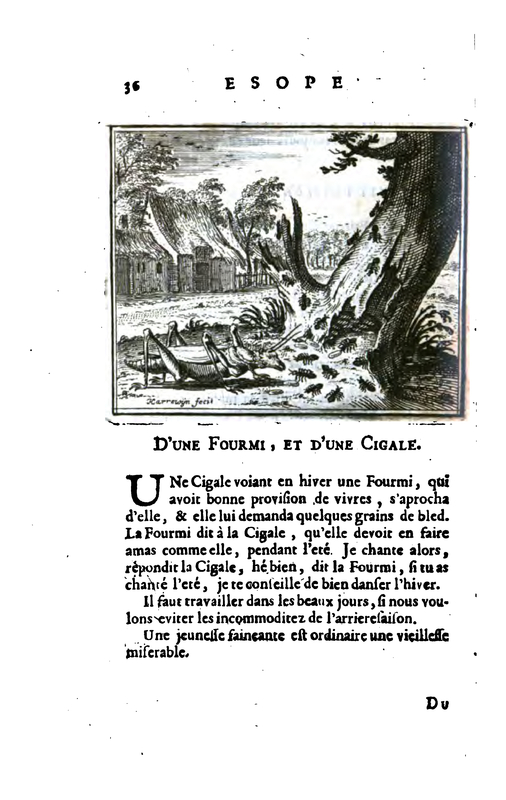
A cicada and an ant face and look at each other near the base of a tree. Many ants are crawling nearby on the grass and the tree. A building with a fence and trees are in the background. The illustration has the signature of Harrewijn in the center on the bottom.
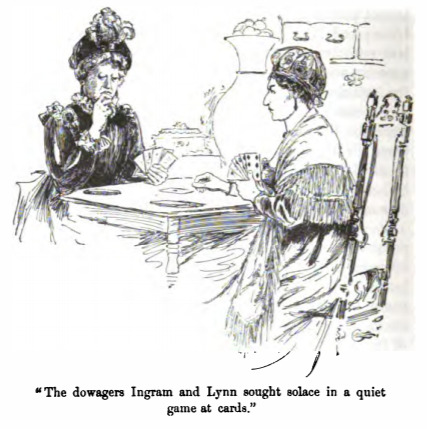
Here we see the dowagers who visited Mr. Rochester at Thornfield. While the younger members of the party went out shooting, the elderly ladies chose to stay indoors and play cards.
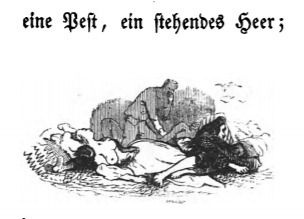
This image is showing bodies of those who have died of the plague. The plague was the code for the army. This image comes in a description of a conspiracy found by a professor from the Grand Academy on Balnibarbi. This idea is representing code word for terms in the conspiracy that Swift is satirizing. The professor advises that those named in the conspiracy papers be closely monitored at all times, naming specifically while they were using the bathroom, as this is when men were most thoughtful. This conspiracy is thought to be an allusion to the trial of Francis Atterbury, the bishop of Rochester for allegedly plotting with the Jacobites. Atterbury was charged with treason in 1722 and was exiled to France. The same image appears in the 1839 Krabbe edition.
In the foreground and to the left, we see a female figure knocking on the door to a house. Her long veil and slightly more aged appearance indicate that this is meant to represent Celestina. In her left hand she is holding either a lantern or a bag. In the foreground and to the right, we see a male figure (Calisto?) walking toward the house with a horse. A female figure (Melibea?) watches from a window in the top left corner, and two other figures (perhaps Melibea’s parents Alisa and Pleberio) watch from a balcony.The entire image is identical to the one found on the title page.
Four Indigenous women crouch around large pots on the ground. They chew roots (manioc/cassava) and then spit them into the vats, after which the concoction is boiled and strained. A woman holding a small child stands nearby watching. A man holding a bow and arrow also peers over the shoulders of the women. In the background two people tend to a large pot set over a fire, while another individual passes by carrying a large basket on their back. Several structures are also visible on the left and right. This illustration is a simplified and mirrored version of the one found on page 46 verso of Paris, 1557.
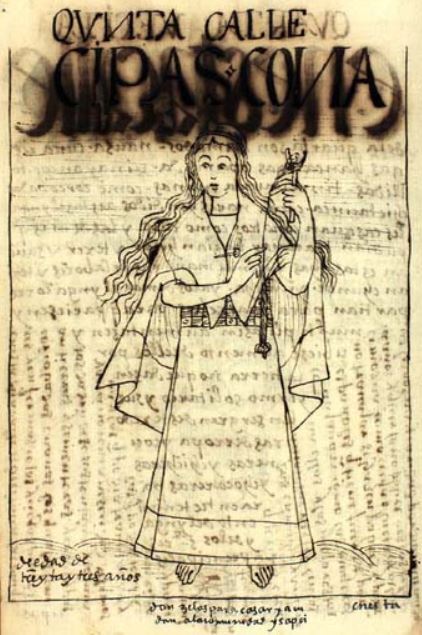
The author explains that there were ten paths for women to follow in the Inca Empire based on age division. This group was called sipsacona [pretty young women]. These women were thirty-three years old and were deemed to be at a marriageable age. The author explains that no man could marry these women without their personal consent. A young woman with long hair is depicted standing in the centre of the image as she spins yarn. The caption on the image reads “de edad de treynta y tres años, donzelas para casar y acudan a la comunidad y sapci,” which translates to “thirty-three years old, maidens of marriageable age and aid the community and sapsi.”
Here we see two horses grazing in a field in the summer. The Houyhnhnms asks about the horses in Europe and how they live. Gulliver explains that the horses in Europe are grazed in fields in the summer and live in stables in the winter. Gulliver explains that humans or yahoos govern the country and care for the horses or Houyhnhnms. The same image appears in the 1843 Krabbe edition.
This image depicts a bishop sitting in a chair in the centre of the page. He is dressed in ecclesiastic adornments and holding a long staff. The bishop is identified as Don Sebastian de Mendoza in the image’s title, but the author is referring to Fernando Gonzalez de Mendoza. He is illustrated pointing towards a priest who is kneeling before him. There is another priest standing behind the bishop looking into a book and holding his head up with his right hand. According to the author, this bishop was known to be a good, charitable man. The location of the image, “cuzco” [Cusco] is identified at the bottom of the page.
A group of Tupinambá people in five canoes approach a large European ship near the coast. In the canoe closest to the ship, Tupinambá men communicate with the European sailors. There is also a European man standing in the middle of that canoe. The two men in the canoe on the right have been fishing, there is a pile of fish in the bottom of the canoe and one of the men holds a fish towards the ship. An Indigenous village can be seen near the shore behind the ship, and three men with bows and arrows walk along the shore.
A small figure in a Roman helmet and uniform holds onto a pole twice as tall as he is. The pole is tipped with a spear point and a trailing banner is tied to it with a tasseled rope. The banner itself is decorated with symbols similar to the letters A and C overlapping, while the tails curls to form the letter E from “Enemies”.
This illustration depicts Sappho, the poetess, sitting down while playing the lyre. Her face shows a joyless expression as she plays her mournful songs. The man sitting in front of Sappho is the man she fell in love with whom rejected her interest in him, which resulted in the melancholic poetry and verses she wrote.
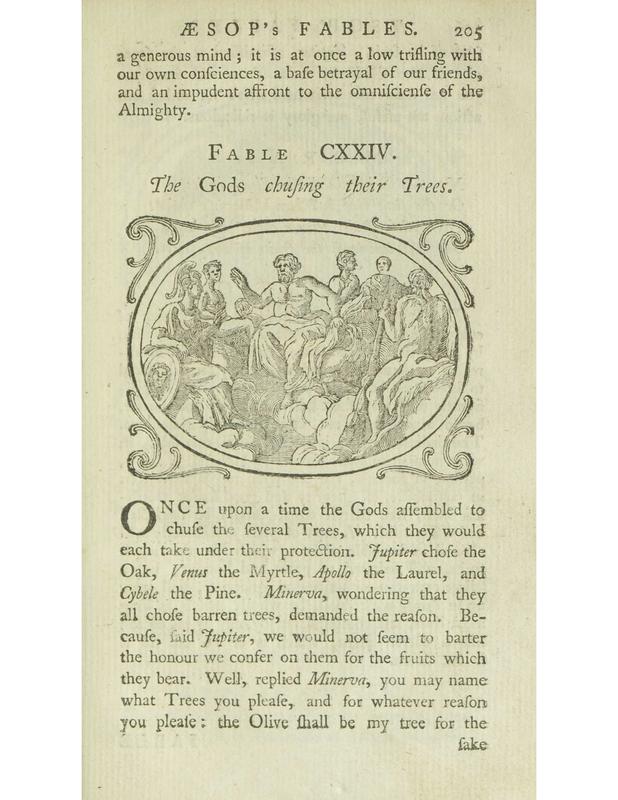
The Roman god Jupiter (Zeus) sits on a cloud in the middle of the illustration. Surrounding him are other gods. On his left is Minerva (Athena) wearing a helmet, and resting her arm on her shield and Cybele in the background. Behind Jupiter is Venus (Aphrodite) and Apollo and one unknown character holding a club, most likely being Hercules.

![[Gulliver aiding in the war against the Blefuscu]](https://collections.cemvc.ca/files/large/de39fe376078ca1f14d64719876d08cd14c415d3.jpg)

![[Title Page]](https://collections.cemvc.ca/files/large/096e730057cd0ea97b85fc855cf43ff625e76b20.jpg)

![La S[an]ta Bvena Obra i Limosna que an de Hazer a los Santicimos Padres de San Francisco y Hirmitano, de le Conpania de Jesus, Beatas, Biejos, Enfermos, Tollidos, Mancos, Ciegos, Cojos, Hombres Como Mogeres, an de Hazer Limosna los Yndios Cin Plata en Este Rreyno](https://collections.cemvc.ca/files/large/9f85727ff26a4936d321bc54c3c5bcc16307b1bc.jpg)
![[Act I – As Celestina Knocks on a Door, a Horseman Approaches and Three Figures Observe (Repeated)]](https://collections.cemvc.ca/files/large/3c0c529905e0fed67b657452e4255d0d81f7e2e2.jpg)

![[Indigenous Brazilians prepare an alcoholic beverage]](https://collections.cemvc.ca/files/large/23b49a4e1b46d61311b8894b4dbba2d29e94f865.jpg)
![[two horses grazing]](https://collections.cemvc.ca/files/large/926960f4c567cb4da73168c1df19a26e6fa07fc3.jpg)

![Sv S[enori]a Don Sebastian de Mendoza Obispo de la Gran Ciudad y Cauesa del Cuzco, Muy Cristiano, Justiciero, Amigo de Faboreser a los Pobres Yndios y Principales Deste Rreyno](https://collections.cemvc.ca/files/large/2bf2a0a1101281288afba6ea4e6f1b84e36b1cca.jpg)

![[Tupinambá people in canoes approach a large European ship]](https://collections.cemvc.ca/files/large/cac02163ef8e002a5266a65aae37f076eee5b514.jpg)
![[Vanity Fair Chapter XXXVII Inhabited Initial]](https://collections.cemvc.ca/files/large/903bf48d18a76b6d7401d0833670dad2c85673be.jpg)
![[Vanity Fair Volume I. Chapter XXII Inhabited Initial, E]](https://collections.cemvc.ca/files/large/d320857ab2a46578563bb5a1ebcbeddec6c2b16b.jpg)
![[Sappho Playing Mournful Songs with her Lyre]](https://collections.cemvc.ca/files/large/0431a82715254629b80f1afa397bac89b95c4a80.jpg)