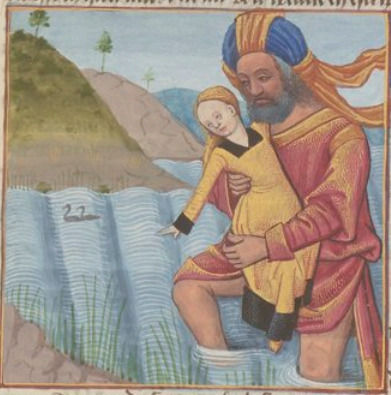
This illumination depicts a man named Metabus, king of the Volscians, carrying his child Camilla safely across a river. Metabus had been banished from his land due to a rebellion, and he brought his only child with him to keep her safe. When the Amasenus River had flooded, Boccaccio explains that Metabus tied Camilla to a lance and launched her across the river to get her across safely. This image, however, depicts Metabus carrying her across.
A horse, lion, canine, and bull all seem to rally in alliance against serpentine and eagle-like winged creatures. The horse kicks stones towards the creatures while the other watch intently.
In this image we see three Lilliputian warships preparing for battle with Blefuscu. The warship closest to the viewer is just leaving the dock, and there are two men, one on either side, releasing the ropes holding the ship in the dock as it leaves. This ship also has the letter L on its sail. This is because it represents Lilliput – also the first word of the chapter. Two flags fly from the highest mast. Two other warships are visible in the background. The same image appears in the 1843 Krabbe edition.
Here we see Lilliputians next to large shoes. This image appears at the beginning of Chapter Four, in which Gulliver visits the city of Mildendo. The Lilliputians were warned of Gulliver’s arrival in the city and told to go inside to stay out of Gulliver’s way. One of the Lilliputians holds a banner, representing this warning. On the banner we see the letter T, as the first word of the chapter is the.
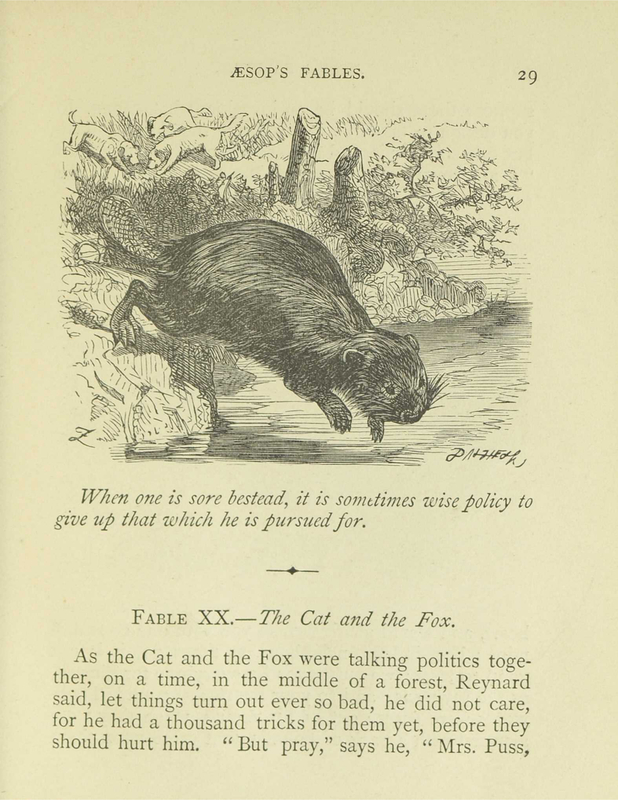
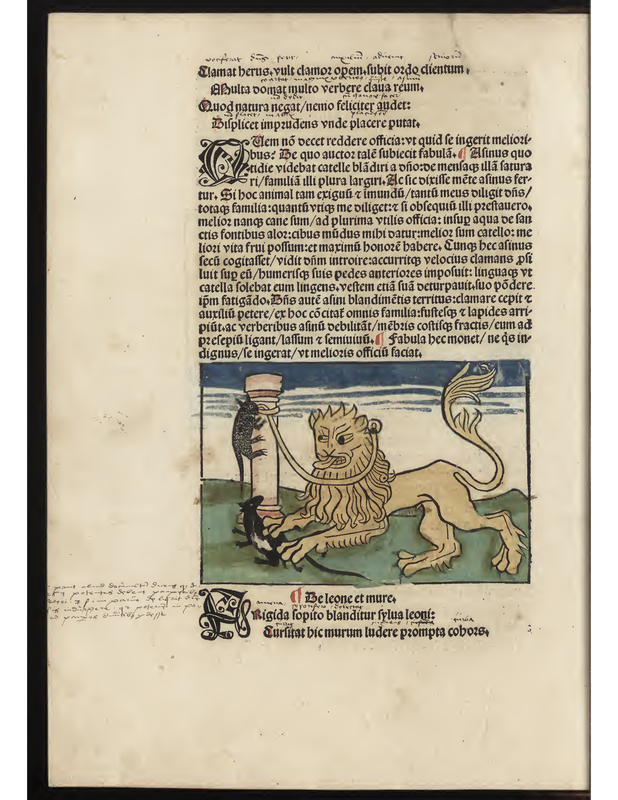
It is said that a Beaver (a creature which lives chiefly in the water) has a certain part about him which is good in physic, and that upon this account he is often hunted down and killed.
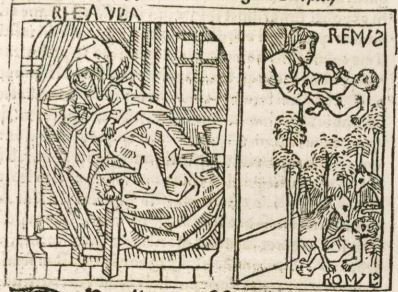
The vestal virgin Rhea Ilia is depicted on the left-hand side of the engraving, lying in a bed and looking distraught. We know that this is Rhea as her name is engraved above her head. She has a saddened expression on her face as she had just given birth to twin boys named Remus and Romulus who were forced to be exposed. Boccaccio explains that as a vestal virgin, she was forbidden from becoming pregnant. Her son’s Remus and Romulus are depicted on the right-hand side of the engraving being exposed through the window. Remus's name is engraved at the top right-hand corner and Romulus’ name is at the bottom right-hand corner. There are wolves surrounding Romulus as the mother wolf ends up raising the boys as her own. Rhea is buried alive for her punishment.
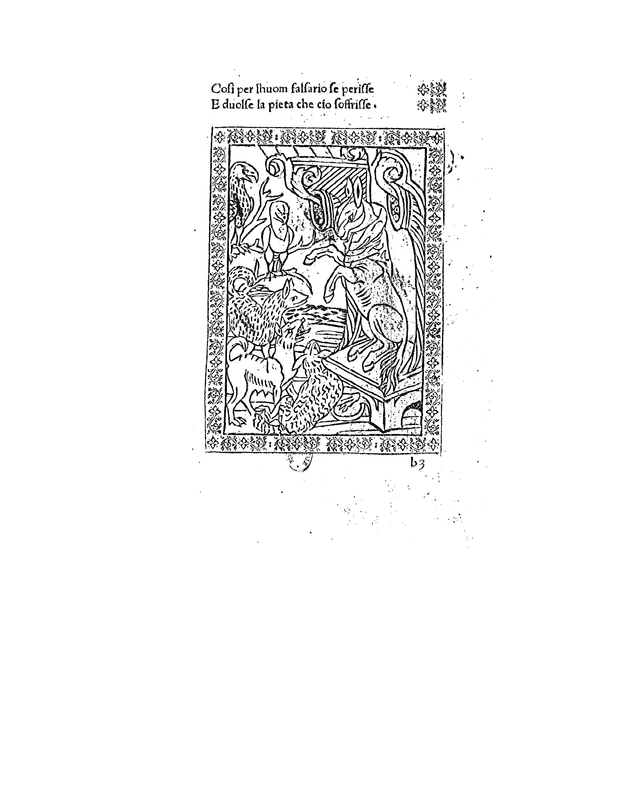
On the right side of the image there is a donkey elevated on a chair dressed in humans clothing who seems to be decieving the other animals. Surrounding the donkey are other animals on the ground including what seems to be a lamb, dog, and fox as well as two birds on the tree above. All the animals seem to be paying close attention to the doneky perhaps fooled into thinking he has authority.
In this image Lady Catherine de Bourgh’s lady maid, Dawson, rides in a barouche box into London. Lady Catherine implored Elizabeth to stay a month longer at Rosings because she was lonely after Mr. Darcy and Colonel Fitzwilliam departed. Elizabeth tried to refuse, saying she was needed in town the following week, but Lady Catherine said she could go in her party later in the month. Lady Catherine’s argument was that her maid had no objection to riding in the barouche box with the driver so there would be room in the carriage for Elizabeth. This scene occurs in chapter 37. The characters are shown in the traditional regency style. Dawson wears the regency style with a dress with an empire waist and an overcoat. She wears a bonnet and carries a purse. The driver wears a tricorn hat and a double-breasted jacket and holds a whip. The regency period dated to the early nineteenth century (1811-1820) when George, Prince of Wales, later George IV (r. 1820-1830), reigned as regent for his mentally ill father, King George III (r. 1760-1820). The regency period is associated with the rise of neoclassicism in art and fashion.
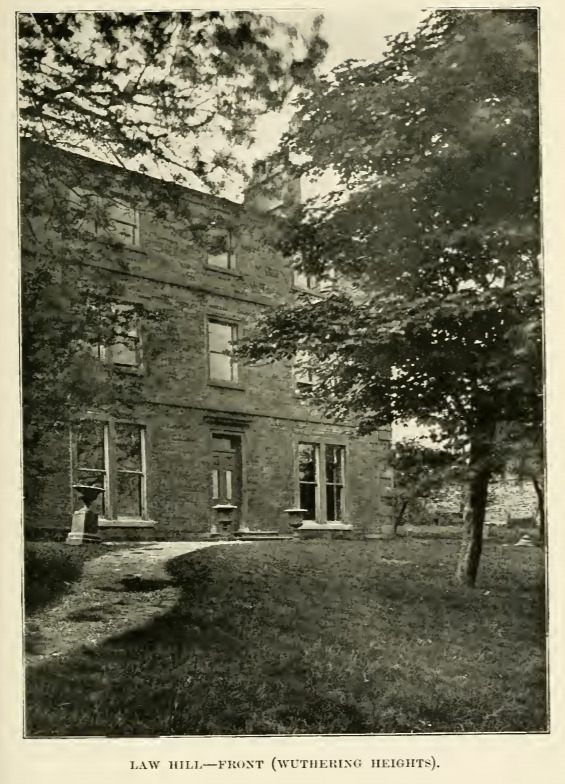
Here we see an image of Law Hill, a house near Halifax, England, on which Emily Bronte based the estate of Wuthering Heights. This image shows the front of the house and the path leading up to the entrance. This is the first in a series of photographs of the house, with others of the back and the outbuilding. The image is a reproduction of a photograph using a technique called photogravure, where photographs are taken on plates which could then be etched on to create a plate for use in a printing press.
Two groups of Indigenous people engage in battle from canoes. Both groups are armed largely with bows and arrows and fire at each other, and members of both groups wear feathered headdresses and adornments around their waists. There are also a few individuals blowing into an object, perhaps a wind instrument or blow gun. Two European men stand in the prow of the canoe farthest from the viewer on the right, aiming long guns at the opposing group. There are several men in the water between the two groups of canoes.
In this image we see Gulliver in his house in Lilliput. One of his pages in Lilliput is in his left pocket, into which Gulliver reaches. The other is sitting on Gulliver’s right knee writing on a tablet with a stylus, recording details about Gulliver’s life and where he comes from. Gulliver’s hat and sword are on Gulliver’s right, and behind Gulliver on his left is a book, his telescope and a small box. The same image appears in the 1839 Krabbe edition.
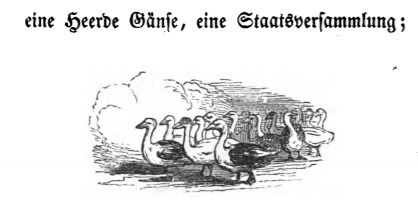
This image is of a herd of geese representing a senate. This image comes in a description of a conspiracy found by a professor from the Grand Academy on Balnibarbi. This idea is representing code word for terms in the conspiracy that Swift is satirizing. The professor advises that those named in the conspiracy plan be closely monitored at all times, naming specifically while they were using the bathroom, as this is when men were most thoughtful. This conspiracy is thought to be an allusion to the trial of Francis Atterbury, the bishop of Rochester for allegedly plotting with the Jacobites. Atterbury was charged with treason in 1722 and was exiled to France. The same image appears in the 1839 Krabbe edition.
Rebecca Sharp is pictured kneeling on a checkered floor at the base of a statue, crying with her face in her hands. The image is framed in an ornate letter E from Every, from behind which a devil leers.
Here we see Gulliver sitting on a rock with a Houyhnhnm who sits on his haunches. In the background we see the Houyhnhnm’s house. The Houyhnhnm teaches Gulliver their language, which Gulliver learns and is able to converse with the Houyhnhnms. The same image appears in the 1843 Krabbe edition.
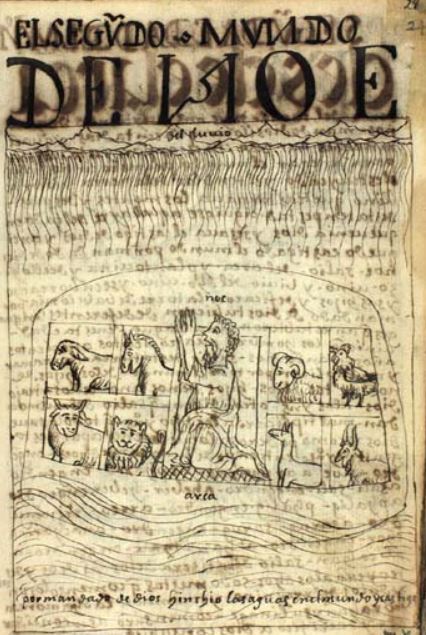
Felipe Guaman Poma de Ayala has depicted a biblical story from the Book of Genesis in this illustration. This image depicts Noah and the Flood, with Noah illustrated in the centre of the image kneeling as he looks up and prays to God. Surrounding Noah are all the animals that he was instructed to bring on the Arc with him to avoid the flood. The name Noé is written above Noah’s head to identify him. The word arca is written just below the arc. There is a caption at the bottom of the image that reads, Por mandado de Dios hinchió las aguas en el mundo y castigó which translates to By God's command he swelled the waters in the world and punished.
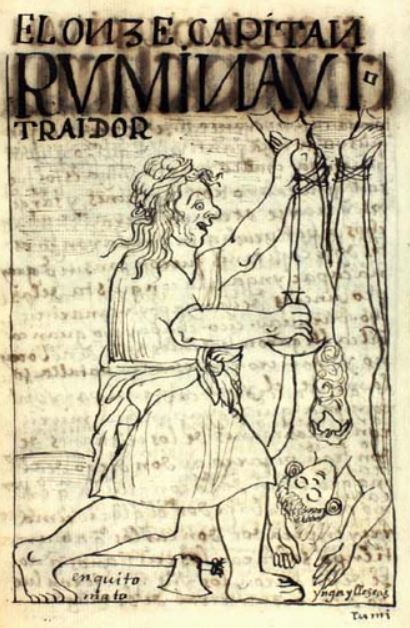
This illustration depicts the eleventh captain, Ruminaui. These captains were a level of Inca authority who helped lead the conquest of the Andes. The author describes him as a traitor due to his murdering of Prince Yllescas Inca, the son of Inca Emperor Huayna Capac. This image depicts his gruesome murder of the prince as he cuts open the prince’s abdomen while he is hung from his ankles. The words en quito mato ynga yllescas are written at the bottom of the image which translates to In Quito he killed Inca Yllescas.

![[three Lilliputian warships preparing for battle with Blefuscu]](https://collections.cemvc.ca/files/large/449e9721bd056cf33283b5cfff0c84593122e90d.jpg)
![[Lilliputians with large shoes]](https://collections.cemvc.ca/files/large/b0d4ca936ba3263d982f6b4a6842ad9f7f935d51.jpg)



![[Two Brazilian Indigenous groups engage in a naval battle]](https://collections.cemvc.ca/files/large/7883ee556b1de205bbffa7e9b288e19fabe458b8.jpg)
![[Gulliver and two of his attendants]](https://collections.cemvc.ca/files/large/3c3ed7bcb6a8d192f79115b81cc95c84a15b705b.jpg)

![[Vanity Fair Volume I. Chapter XV Historiated Initial]](https://collections.cemvc.ca/files/large/f78921d64bb5fab3e9bd6c6cab20f1ebf971d641.jpg)
![[Gulliver sits with a Houyhnhnm learning their language]](https://collections.cemvc.ca/files/large/b2e033bb594674f3c36e9c9a210edcc1ddce65c9.jpg)