A group of Indigenous Tupinambá people is shown on an island. They have captured a European man, who lays on his back on the ground with his hands clasped in front of him, as if pleading with his captors. An Indigenous man stands over him and gestures broadly, while a group of Indigenous people standing behind the captive appear to talk amongst themselves. A few of the Indigenous people carry bows. Several canoes are anchored along the shore of the island, and more members of the Indigenous group appear to be arriving to the island in the distance.
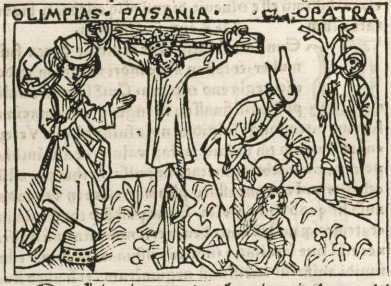
This engraving depicts Olympias of Macedon on the left-hand side of the engraving approaching a man hanging on a cross. We know that this figure is Olympias as her name is engraved above her head. The man being crucified is Pausanias, a man who helped Olympias with the murder of King Philip of Macedon (husband to Olympias). Boccaccio explains that Olympias placed the golden crown that Pausanias is wearing on his head to honour him and reward him for the assassination. Along with getting her husband murdered, she also had her husband’s new wife and child murdered out of anger. Cleopatra, King Philips other wife, is pictured on the right side of the engraving hanging by her neck on a tree. Her name is engraved above her head. Cleopatra’s child is depicted sitting on the ground as one of Olympias’ servants is bashing her head with a rock.
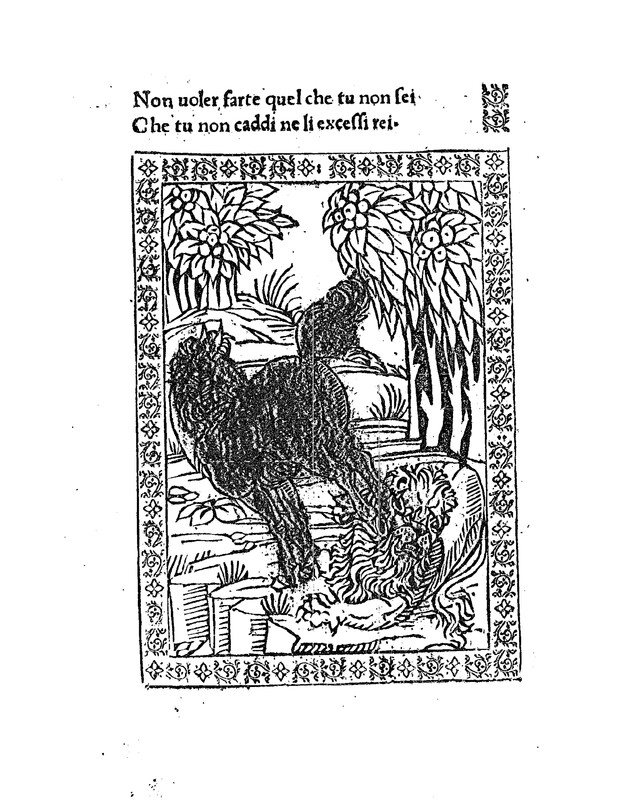
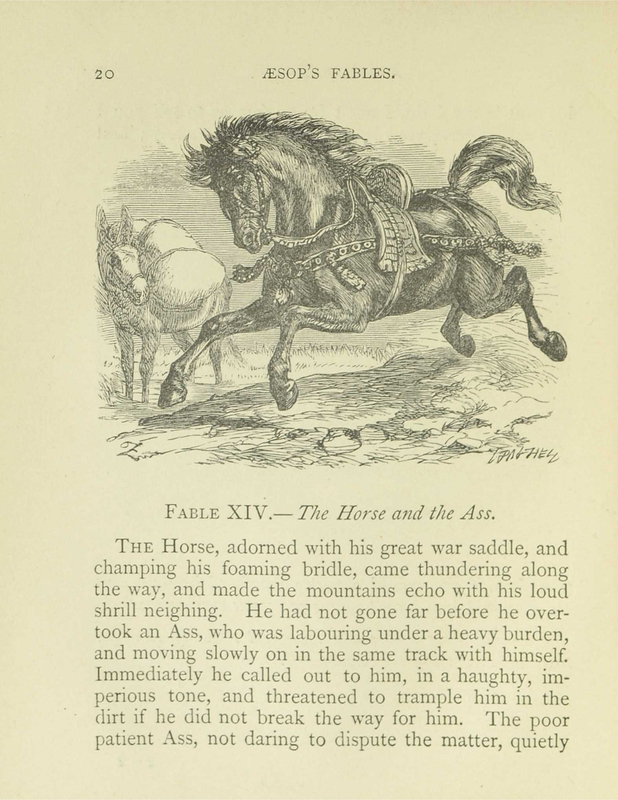
In foreground is an army horse with all its armor on the right side. To the left is a donkey, or a smaller horse, that is slightly bent forward. The smaller horse seems intimidated by the army horse. In the background, a small donkey and a small horse face each other. The horse, which is on the right, seems to be walking towards the donkey. The donkey, that is on the left, seems to be walking backwards, away from the horse.
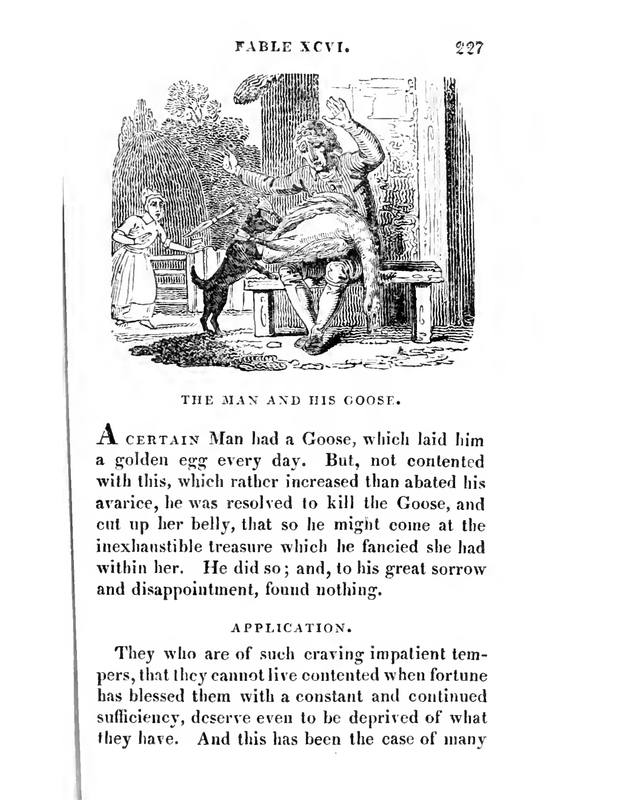
This image depicts a man sitting in front of a building on a bench. There is a goose sitting in the man’s lap, and a dog jumping up, with its front paws on the bench. On the left side of the image there is a woman facing towards the man, goose, and dog. Behind the women, there is a fence as well as various trees.
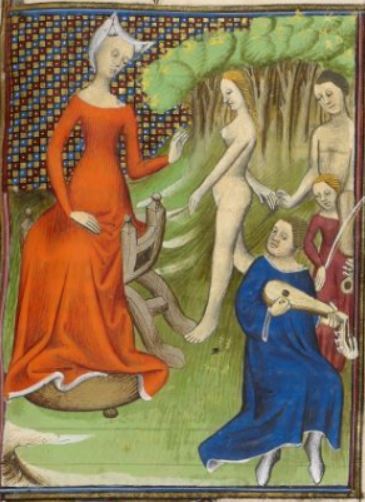
This illumination depicts the famous and wealthy prostitute Flora standing on the left side of the image. She is depicted looking to the right of the image where there are people engaging in sexual relations with one another, which symbolizes her life as a prostitute. There are also two figures playing musical instruments. Boccaccio explains that Flora used her wealth to have annual games held in her honour. He also explains that the Roman senate did not want a prostitute being honoured, so they fabricated a story which describes Flora being married to the wind, Zephyrus, who made her a goddess of flowers and trees.
Here we see Gulliver showing Captain John Biddel who rescued Gulliver and brought him aboard his English Merchant Ship one of the cows he brought from Blefuscu. Captain Biddel allowed Gulliver to board his ship and return to England. As thanks Gulliver offers one of the miniature cows to Biddel. In the image we see the two men in a room on the ship with a table separating the two. Gulliver holds the cow in his hands while Biddel looks in astonishment at it. Biddel is on the right and is wearing a wig as was the fashion of the eighteenth century. The same image appears in the 1843 Krabbe edition.
The horse, adorned with his great war saddle, and champing his foaming bridle, came thundering along the way and made the mountains echo with his loud shrill neighing. He had not gone far before he overtook an Ass, who was labouring under a heavy burden, and moving slowly on in the same track with himself.
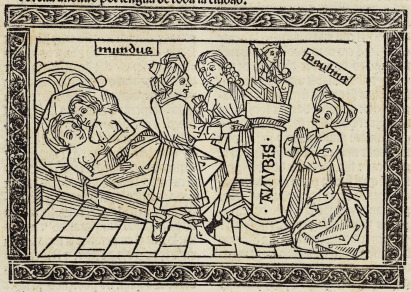
The Roman woman Paulina is depicted on the right side of the engraving as she kneels in prayer. She is looking up at the statue of the Egyptian god Anubis. Paulina’s name is engraved above her head at the top of the image to identify her. The statue of Anubis is sitting on a tall platform, with the name Anubis engraved on the platform. Paulina was an incredibly devout and chaste woman and was completely faithful to her husband. A man named Mundus had fallen in love with Paulina due to her overwhelming beauty, and when she continuously rejected his advances, he devised a plan to have her as his own. Mundus is depicted in the centre of the engraving handing a bag of money to a priest. Mundus bribed the priest of the temple to invite Paulina to sleep at the temple to have an encounter with the god Anubis in her sleep. Paulina stayed at the temple, expecting to have an experience with Anubis, however, Mundus came to Paulina in her sleep and pretended to be the god and convinced her to have intercourse with him. This is depicted on the left side of the engraving. Paulina and Mundus (disguised as Anubis) are illustrated in bed together after having intercourse. Paulina is famous for having been tricked into losing her virtue and chastity. Mundus ended up being exiled, and the priest was tortured for his involvement in the deception.
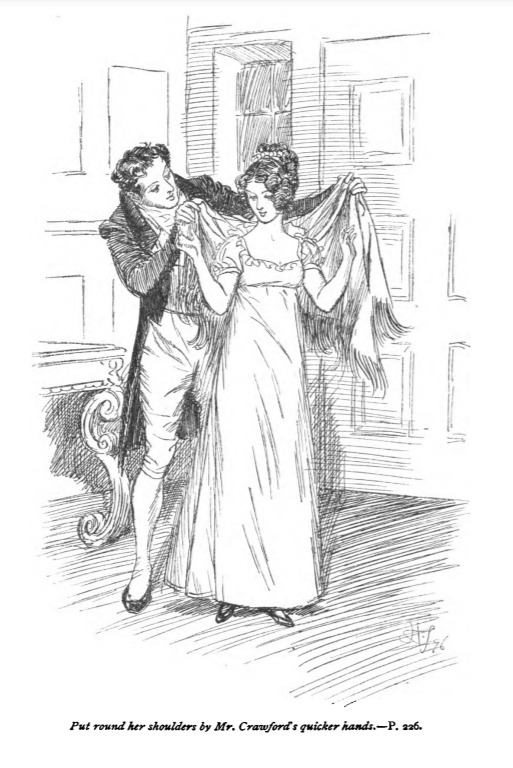
Here we see Mr. Crawford putting Fanny's shawl over her shoulders. Fanny, Edmund, Sir Thomas, and Lady Bertram went to visit Dr. And Mrs. Grant, for dinner while Mr. And Miss Crawford were staying with them. By this time, Mr. Crawford had decided he wanted to make Fanny fall in love with him. While they were leaving, Edmund retrieved Fanny’s shawl from the servant, but Mr. Crawford quickly took it from him to wrap around Fanny in an attempt to woo her. This scene occurs in chapter 25 on page 226. The characters are shown in the traditional regency style. Fanny wears the regency style dress with an empire waist. Her dress has short sleeves as was the style for women’s evening wear. Her hair is worn tied up, as was tradition for women after their coming out before the queen, signaling her entrance into society. Mr. Crawford wears a waistcoat and tailcoat, and breeches that stop at the knee. The regency period dated to the early nineteenth century (1811-1820) when George, Prince of Wales, later George IV (r. 1820-1830), reigned as regent for his mentally ill father, King George III (r. 1760-1820). The regency period is associated with the rise of neoclassicism in art and fashion.
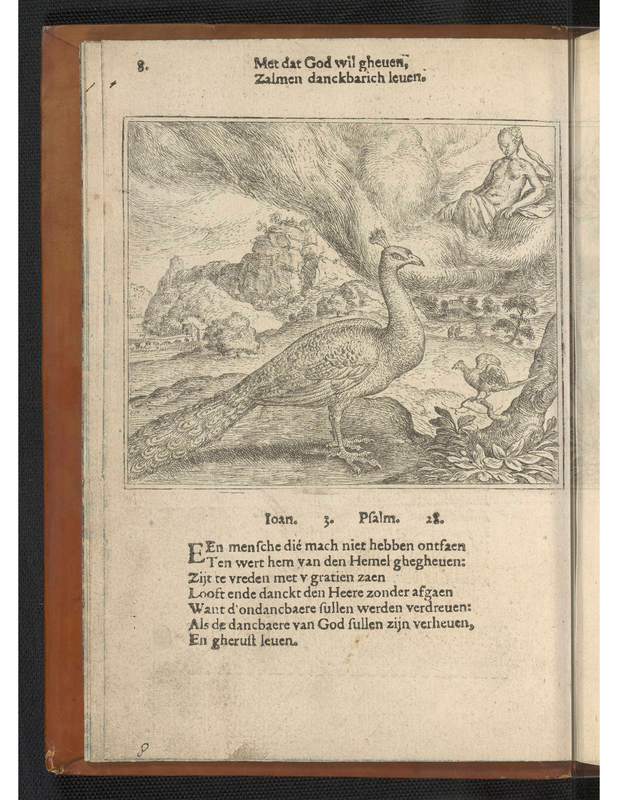
A peacock and small bird stand above a field. A topless God sits in clouds at the top right of the image, overlooking the scenery. Two people crouch over in the distance near a hut. Rocky cliffs stand in the distance. A bridge on the left side of the image extends from the cliffs across a fjord.
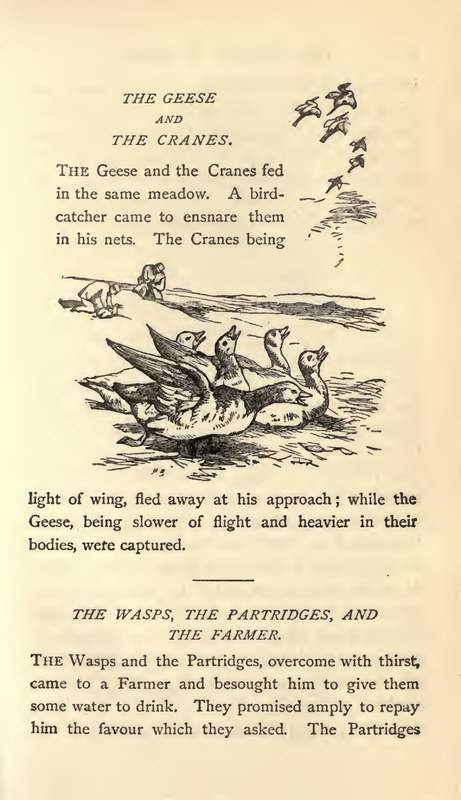
The Cranes fly away while the Geese tried to fly but cannot. And far away, there are two man also tried to force and catch all of them that makes they were scared and flied away.
While Calisto and Melibea talk in her garden, Calisto hears noise in the street and asks his servants the cause of the commotion. Tristan tells him that Thraso and his companions had come to cause a ruckus, but that Sosia managed to scare them off. Regardless, Calisto hurries up the ladder to help them. He descends the outside ladder too quickly, falling to his death. Sosia and Tristan carry him home to protect him from speculation that might posthumously damage his reputation.[None of the elements in this illustration are found elsewhere in this edition.]
A small figure in a Roman helmet and uniform holds onto a pole twice as tall as he is. The pole is tipped with a spear point and a trailing banner is tied to it with a tasseled rope. The banner itself is decorated with symbols similar to the letters A and C overlapping, while the tails curls to form the letter E from Enemies.
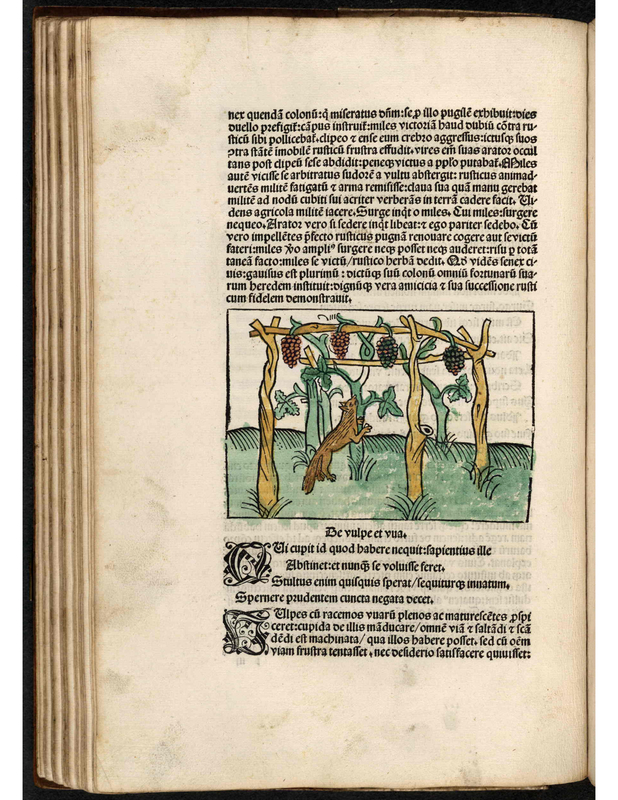
Fruit hangs from trees that have been arranged to form racks above the ground, a fox is attempting to climb one of the trees in order to reach the fruit, which are out of reach.
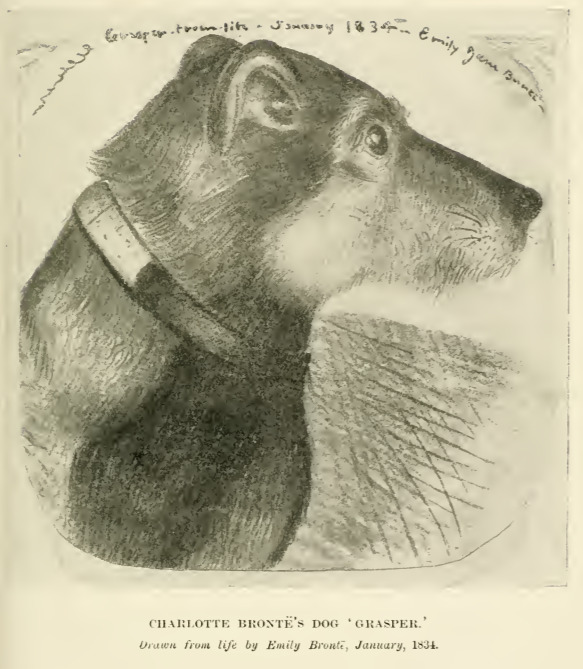
Here we see a drawing of Charlotte Bronte’s dog, named Grasper. Charlotte Bronte was Emily Bronte’s older sister. The image is a pencil drawing of an Irish terrier named Grasper, the family dog of the Brontes.
A farmer has trapped a pigeon under a net. Other birds fly in the sky freely. A church and farm are behind them. Another pigeon is sitting on the farmer's leg.
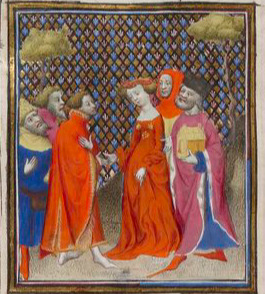
This image depicts Megulia, the woman wearing the red gown, receiving many wealthy gifts for her marriage. The name Dotata, which she was also called, was a name given to women who had anything extra added to their dowries. So, the image represents an extra-large dowry.
Here we see Gulliver encountering the farmer giant’s dogs. Two dogs stand at the edge of the table looking at Gulliver. The two dogs resemble a St Bernard and a greyhound. The St Bernard’s head is resting on the table. Gulliver stands on the table with his small bowl of food next to him. He leans back away from the dogs. This image highlights the difference in scale between the giant’s world and reality. The same image appears in both the 1839 and 1843 Krabbe editions.
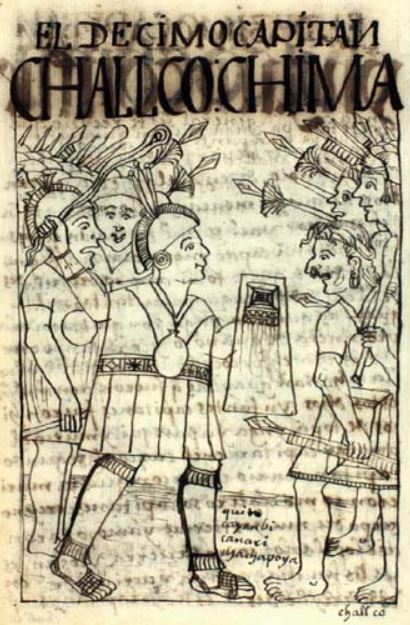
This illustration depicts the tenth captain, Chalcochima. These captains were a level of Inca authority who helped lead the conquest of the Andes. This captain was the son of Huayna Capac, the king of the Inca Empire. The captain is depicted standing in front of his army on the left side of the image as he faces his enemies who are on the right side. He is holding a long staff in his right hand and his shield in his left. The places Quito, Cayanbi, Canari, Chachapoya are written at the bottom of the image in between the left leg of the captain and the leg of his enemy, which describes the regions that this captain had conquered.
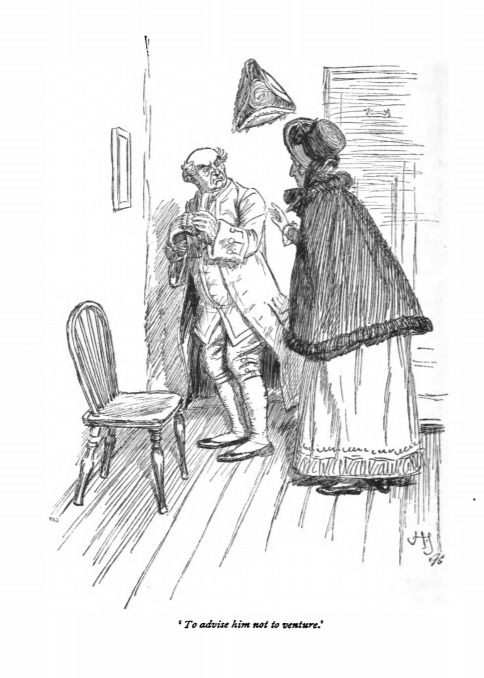
Here we see Mrs. Norris speaking with the coachman. Sir Thomas expressed his disappointment that she did not try and persuade his children not to put on the play. Not knowing how to respond to this, Mrs. Norris tells him all of the things that she handled well while he was absent in Antigua. The example seen in this image here is Mrs. Norris advising the coachman not to go out in a storm. Sir Thomas eventually gave up because she kept deflecting his reprimands.This scene occurs in chapter 20. The characters are shown in the traditional regency style. Mrs. Norris wears a regency style dress with a cloak and a bonnet. The coachman wears a waistcoat and an overcoat, with breeches and a cravat. His tricorn hat is seen on the wall behind him. The regency period dated to the early nineteenth century (1811-1820) when George, Prince of Wales, later George IV (r. 1820-1830), reigned as regent for his mentally ill father, King George III (r. 1760-1820). The regency period is associated with the rise of neoclassicism in art and fashion.

![[Tupinambá people on an island with a European man as a captive]](https://collections.cemvc.ca/files/large/4e91a4d24d79a998138770adba51bb8617399568.jpg)
![[The Armored Horse and the Donkey]](https://collections.cemvc.ca/files/large/0744cca5769fbf27768c89b3f6f7cf1675a56297.jpg)
![[Gulliver presents Captain John Biddel with a small cow from Blefuscu]](https://collections.cemvc.ca/files/large/84060d0debf5cbe6e2da4dfaf0698c8265754da9.jpg)
![[Lobsters On Grass]](https://collections.cemvc.ca/files/large/70a4f552aef954f65096acb1890ac7161810e118.jpg)
![[Act XIX (Second Illustration) – Calisto’s Death]](https://collections.cemvc.ca/files/large/eb297fff91312facbee13c30cebba6fd7003b252.jpg)
![[Vanity Fair Chapter XXII Inhabited Initial]](https://collections.cemvc.ca/files/large/a7bc17934f089fdaf9c8060ccfe6869ddcd059a9.jpg)
![[The Hawk and the Farmer]](https://collections.cemvc.ca/files/large/3db69f6b0fef82409d10e89a5593618220d10352.jpg)

![[The giant family’s dogs examine Gulliver]](https://collections.cemvc.ca/files/large/8e19bf75217ec9548d3c2ba6a9997d1a304e18b9.jpg)