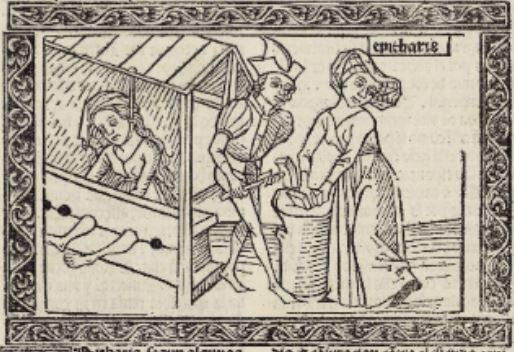
This engraving depicts the freedwoman, Epicharis, being tortured for information regarding a conspiracy to kill emperor Nero. Epicharis is depicted on the right side of the engraving with her hands in some form of torturing device as a man with a hammer tortures her. Her name, written as Epitharis is engraved above her head to identify her. Epicharis is also depicted on the left side of the image with her feet restrained in a stock. Epicharis had heard the details of the conspiracy to assassinate Emperor Nero, and when she put her faith in the wrong person, they told emperor Nero that she was involved in the plan. They tortured her many times; however, she did not reveal the names of anyone involved in the conspiracy. She ended up killing herself to avoid revealing the details to the emperor.
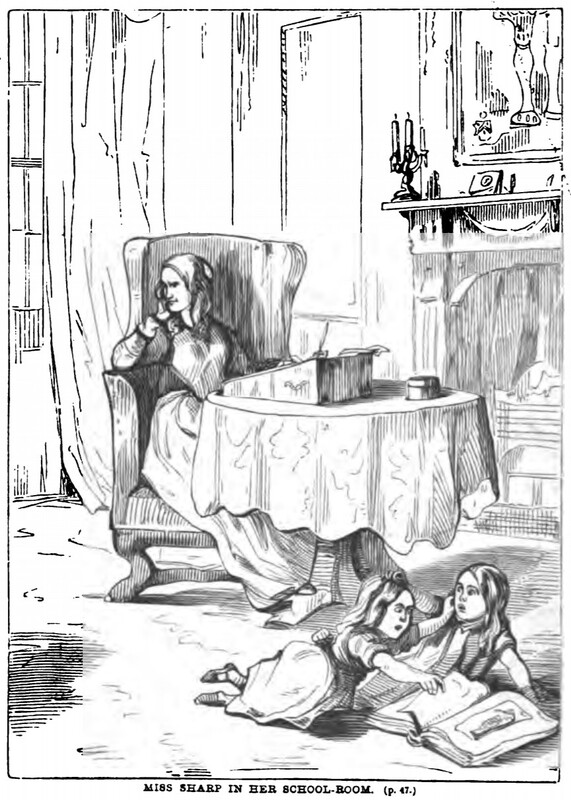
Rebecca Sharp sits in an armchair at a round table with her back to the window, looking irritated. Her table holds a writing desk and round dish. It is next to an ornate fireplace, on the mantle of which are a candelabra and clock, and above which hangs a painting. On the far side of the table Rosalind and Violet Crawley are on the floor, fighting over a very large open book. Violet is pulling on a page from the book and pushing her sister away, while Rose has grabbed her sister by the hair and looks somewhat shocked. Below the illustration is printed its title and location in the story, MISS SHARP IN HER SCHOOL-ROOM. (p. 47.).
Here we see a vehicle similar to a sleigh drawn by four yahoos. A Houyhnhnm who injured his hoof sits on the sleigh, as it arrives to the house where Gulliver is staying. The sleigh is greeted by another Houyhnhnm, while another takes the yahoos to the stables to be fed. This scene turns the world upside down, as it is now humans who pull the sleighs and the horses riding in it, rather that the reverse. The same image appears in the 1843 Krabbe edition.
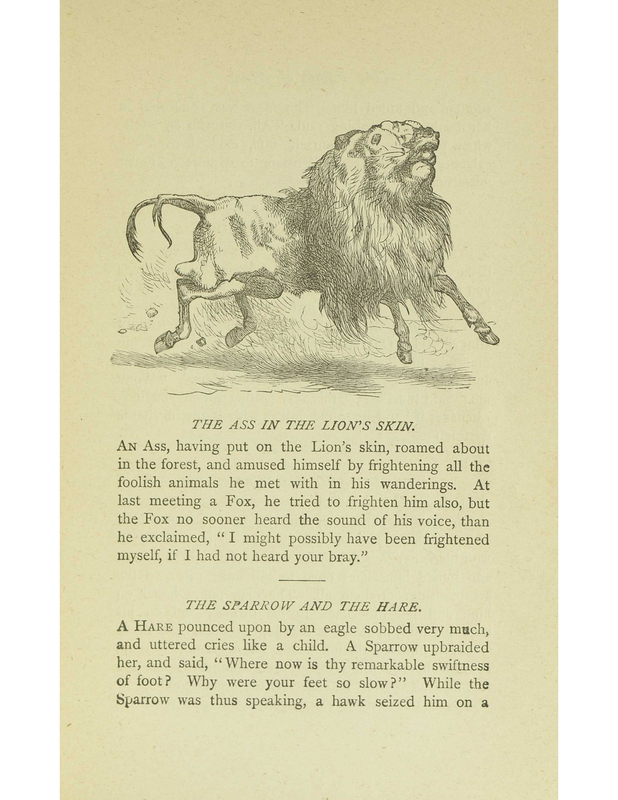
What looks like a lion is running off. When looking closely, however, it is obvious that those are the legs of an ass. Two different tails stick out at the back, and the lion’s skin finishes just above the ass’s thighs. The face of the lion is contorted. The ass is running away wearing the skin of a Lion.
At the political school at the Grand Academy on Balnibarbi, scholars work on new methods of choosing ministers and the monarch’s favourites. These methods were based on merit, intelligence, and virtue, and capacity for doing what is best for the public, rather than the old method of nepotism and bribery. These scholars, however, were largely unsuccessful. This is a commentary on the political atmosphere of England and other European countries at this time. The same image appears in the 1839 Krabbe edition.
A group of Tupinambá men return by canoe to their village. They have four male captives who are tied together with rope around their thighs and wrists. Presumably the scenes of cannibalism depict the fate of the captives. To the right a man kneels on the ground with both arms outstretched while two other men stand behind him: one with a club raised above his head poised to swing and the other with an arrow nocked and aimed at the kneeling man. Behind them a human torso lays on the ground, having had its limbs and head removed. In the background (center) and to the left there are two fires with wooden frames set over them; human limbs have been set on the frames to roast over the fire.
In this image we see Gulliver speaking to four Lilliputian pages, who were assigned to Gulliver’s household by the Emperor. The pages stand on a box, looking up to Gulliver. The pages wear conical hats with plumes coming out of the top. The same image appears in the 1839 Krabbe edition.
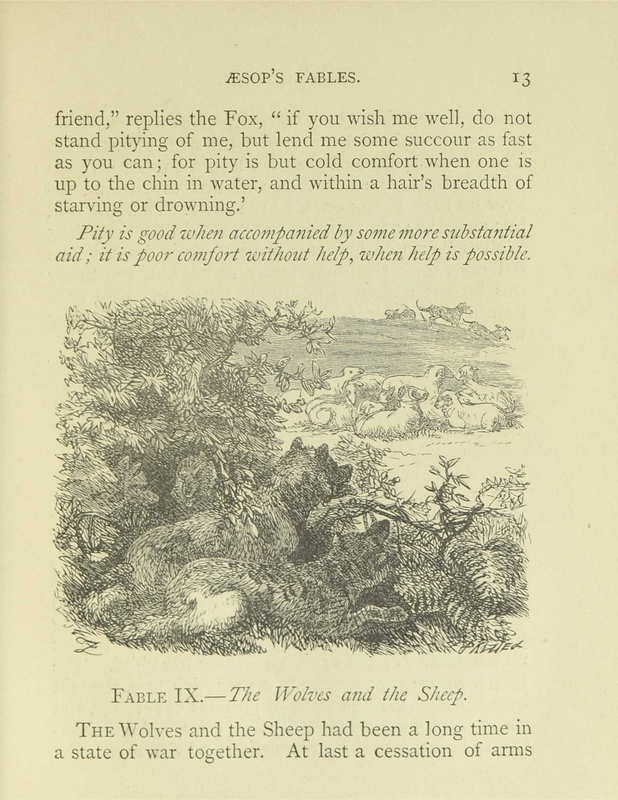
The wolves and the Sheep had been a long time in a state of war together. At last a cessation of arms was proposed, in order to a treaty of peace, and hostages were to be delivered on both sides for security. The Wolves proposed that the Sheep should give up their dogs, on the one side, and that they would deliver up their young ones.
Here we see Gulliver bringing the small boat he found overturned onto shore in Blefuscu. Gulliver saw the boat offshore and with the help of the Blefuscudians he brought it to shore where he intended to refurbish it so then he could use it to get home. In this image we see Gulliver pulling the boat up onto the dock. Gulliver stands in the water, with his pants rolled up to his knees and is barefoot. He is aided by the Blefuscudians who pull on several ropes tied to the boat. These ropes were used to drag the boat behind a warship while Gulliver pushed it from behind to get it to shore. There is a large crowd of Blefuscudians – some of whom help get the boat on shore, while other simply watch the scene. The city is visible in the background. The same image appears in the 1843 Krabbe edition.
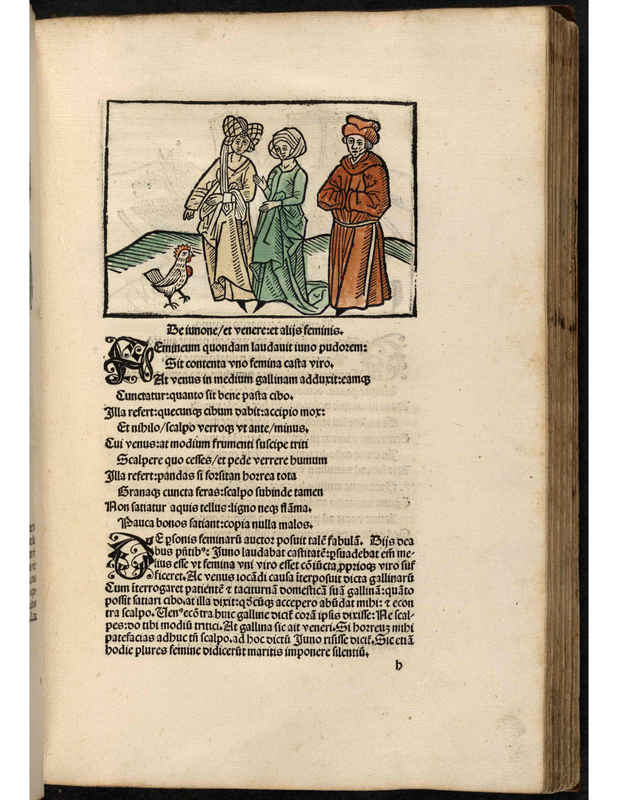
Three women all dressed in different colors and different styles walk past a cock. Two of the women exhibit hand gestures while the third keeps her hands conceiled by her clothing
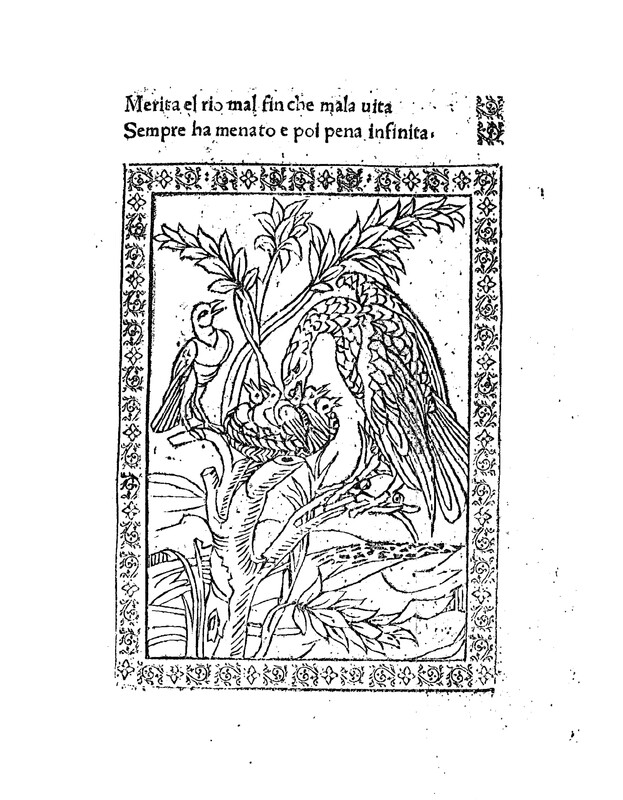
Perched on a tree, a hawk is mouth feeding its babies in a nest, there is another smaller bird to the left which is most likely a family member. The image is bordered by a vine design
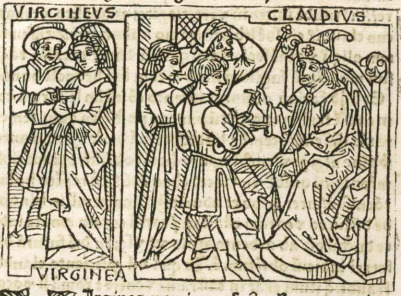
This engraving depicts the tragic fate of a young virgin woman from Rome named Verginia. Boccaccio explains that one of the decemvirs, Appius Claudius, fell madly in love with Verginia. Despite already being betrothed to another man, Claudius devised a plan to have Verginia as his own. Claudius had gotten one of his freedmen (Marcus Claudius) to capture Verginia and claim her as a slave. Verginia’s father, Verginius, went to the trial and protested the sentence of his daughter becoming a slave. Appius Claudius, however, was the judge presiding over the case, and officially decreed Verginia to be a slave. This court trial is depicted on the right side of the engraving, with Claudius sitting on the chair pointing towards Verginia, Verginius, and Verginia’s betrothed, Icilius. Claudius’ name is engraved above his head in order to identify him. After Claudius decrees Verginia to be enslaved, her father takes a knife and stabs her with it as his only way to save her. This is depicted on the left-hand side of the engraving, which illustrates Verginius (his name is engraved above his head) piercing his daughter’s chest (Verginia’s name is engraved by her feet).
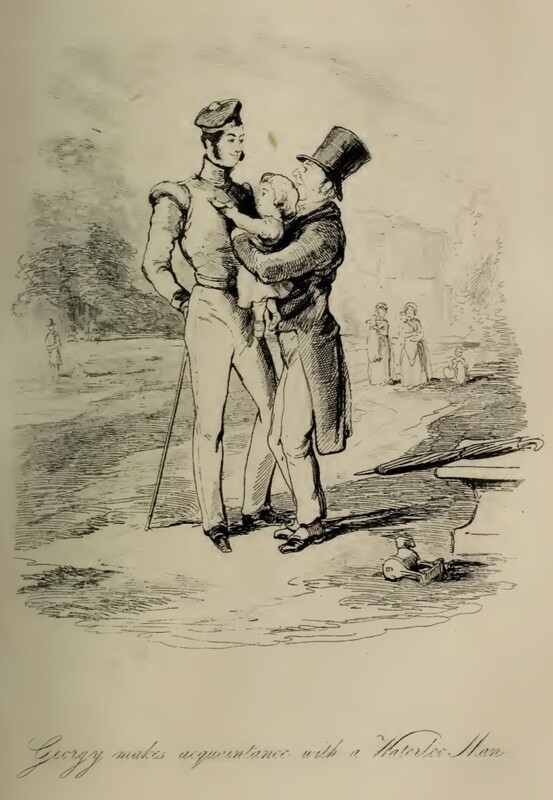
On a walk in the park, Corporal Clink, carrying a thin walking stick, is talking to John Sedley, in a top hat and coat. Georgy Osborne, held in the arms of his grandfather, has reached out to grab the Corporal’s medal. An umbrella is laying on the bench next to them, with a toy horse on the ground beneath it. In the background are a man, two women, and three small children. Below the illustration is printed in cursive its title, Georgy makes acquaintance with a Waterloo Man.
A small group of Tupinambá people greet each other in their coastal village. Five men and two children are shown. One man is emerging from an entrance in the side of a long structure holding a bow, and another of the men also carries a bow. A canoe with three people inside can be seen on the water in the background. It is nighttime, and the moon has risen in the left corner of the image
After the death of Calisto, Melibea plunges into sadness and despondency. Lucrecia hurries to Pleberio’s bedchamber to inform him of his daughter’s illness, and Pleberio rushes to her aid. She explains to him that she is afflicted by a pain in her heart that has no cure, and he asks her to join him for some fresh air. Once outside, she asks him to bring her some musical instruments, and he leaves to fulfill her request. She and Lucrecia climb to the top of her house’s tower, but she tells Lucrecia that the height is making her uncomfortable. As Lucrecia enters the staircase, Melibea slams the door and locks herself in the tower alone. From atop the tower she reveals to Pleberio (who is on the ground below) her passionate love for Calisto, and proceeds to take her own life by jumping.The left side of the image depicts Melibea and Lucrecia. Melibea is likely the figure seated on the ornate and draped bed, while Lucrecia is approaching the door with her finger pointed toward Pleberio. Each of the them is wearing a robe and a veil. The right side of the image depicts Pleberio, wearing a hat and a cloak of sorts, as he opens the door for Lucrecia. Meanwhile, Alisa sits on another ornate and draped bed, displaying an air of sadness at the thought that Melibea is unwell.The entire image is identical to the one found on page 231 of the text.


![[A vehicle for the Houyhnhnms pulled by yahoos]](https://collections.cemvc.ca/files/large/2b3407385a97f2eab82516850c7d4ad6a681c355.jpg)


![[Political scientists from the Grand Academy of Lagado attempt to modify the monarchical practices]](https://collections.cemvc.ca/files/large/68af7838f71e6cd4778c78f45af9bc6bc7790405.jpg)

![[Rebecca Purchases the Portrait]](https://collections.cemvc.ca/files/large/a3198c677a84f43c57f57549557e96a0fd57188e.jpg)
![[The Tupinambá return to their village with prisoners]](https://collections.cemvc.ca/files/large/fd1c1c8781cbba4dd2b8a3e95bed7425b7f9607a.jpg)
![[Gulliver and his pages]](https://collections.cemvc.ca/files/large/ddb22c8d46cd0ed88dc407ae7a67a07186e470ac.jpg)
![[Gulliver brings the boat onto the shores of Blefuscu]](https://collections.cemvc.ca/files/large/f22b46f4ae3fca4331d70510c090cba99194e254.jpg)


![[Tupinambá people greet each other in their village]](https://collections.cemvc.ca/files/large/58c5f6d5a88c6e7d250e9ab35cc40627ed1f813f.jpg)
![[Act XX] Pleberio](https://collections.cemvc.ca/files/large/0f06278d7b9c7eb59769af4ac557b8f79cf6f17f.jpg)