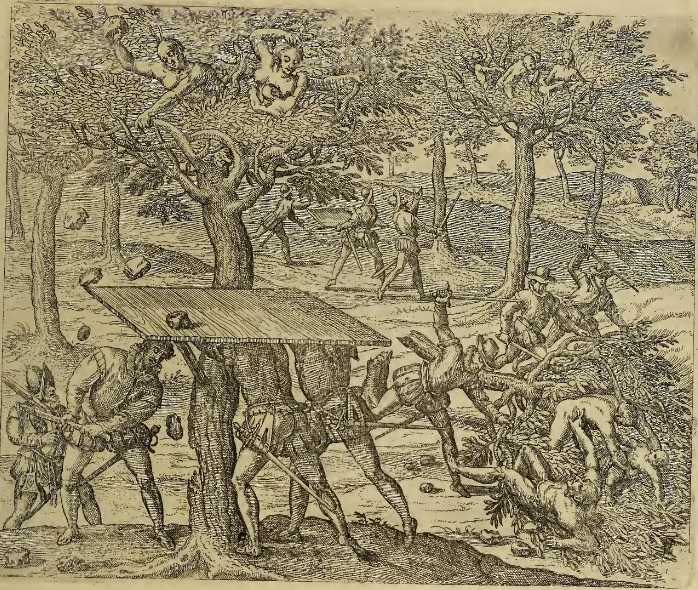
A group of Spaniards attack several Indigenous people in trees in the Atrato river region of present-day Colombia. The Indigenous people of the region built homes in the treetops because the land around the river was quite swampy. The Indigenous people throw rocks at the attackers on the ground below them and try to protect their children. The Spaniards use large wooden boards to protect themselves from the falling rocks while they try to chop down the trees with hatchets. They have successfully felled one tree and proceed to kill the family who lived among its branches with swords. This image is identical to one found on page 24 (157) of Frankfurt, 1596.
The woman illustrated in this image is Nicaula, queen of Ethiopia. She is depicted wearing a crown to signify her royal status. She is holding a small trinket in her hand as she presents it to the man sitting on the throne in front of her. This man is king Solomon of Jerusalem. He is wearing royal garbs with a crown on his head. He is depicted holding his hands out towards Nicaula as he accepts her gift and welcomes her with hospitality. Queen Nicaula had traveled from Ethiopia to Jerusalem simply to speak with him as she had heard many things of his great intellect.
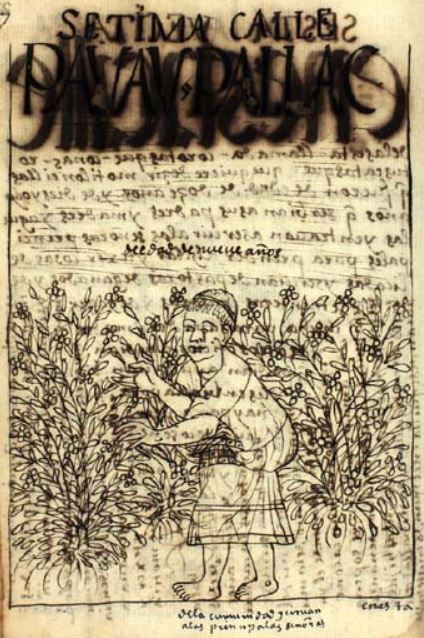
The author explains that there were ten paths for women to follow in the Inca Empire based on age division. This group was called pauau pallac [flower pickers]. These women were daughters of common people that were aged from nine to twelve years old. Their duties included flower and herb picking and aiding their parents with chores. The young short-haired girl illustrated in the image is depicted picking many flowers. The caption on the image reads de edad de nueue años, de la comunidad y ciruan a las prencipales señoras, which translates to nine years old, for the community and they serve the noble women.
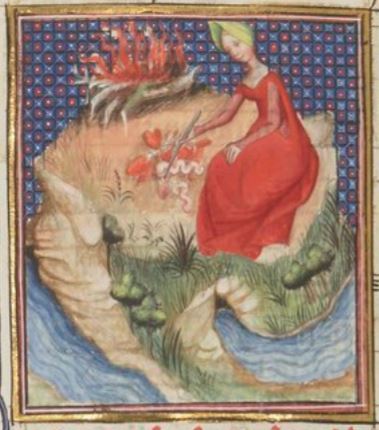
This image depicts Manto, the daughter of the famous seer Tiresias. She is depicted sitting down beside a fire as she looks through a pile of animal entrails. Boccaccio explains that Manto became an incredible seer just like her father. She used the movement and colour of the fire’s flames to tell the future, which is why there is a fire in the engraving. She also used the entrails of animals such as sheep and oxen for signs of the future. Boccaccio explains that Manto was also involved in the dark arts by summoning spirits and gods from the underworld.
In this image we see Gulliver in his house in Lilliput. One of his pages in Lilliput is in his left pocket, into which Gulliver reaches. The other is sitting on Gulliver’s right knee writing on a tablet with a stylus, recording details about Gulliver’s life and where he comes from. Gulliver’s hat and sword are on Gulliver’s right, and behind Gulliver on his left is a book, his telescope and a small box. The same image appears in the 1843 Krabbe edition.
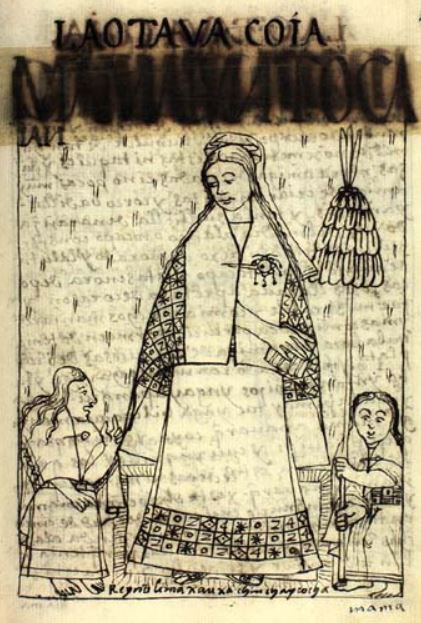
This illustration depicts Mama Runtocaya, the eighth queen to the Inca kings of the Inca Empire. She was married to Viracocha Inca, the eighth king of the Inca Empire. She is depicted standing in the centre of the image wearing traditional garbs that are embroidered on the sleeves and at the bottom of the skirt. There are two other people in the image, possibly two of her many children. The author explains that this queen enjoyed raising crocodiles. The words Reynó Lima, Xauxa, Chinchay Cocha are written at the bottom of the image, which translates to He reigned to Lima, Jauja, Chinchayqucha. These are the regions that her and her husband reigned over.
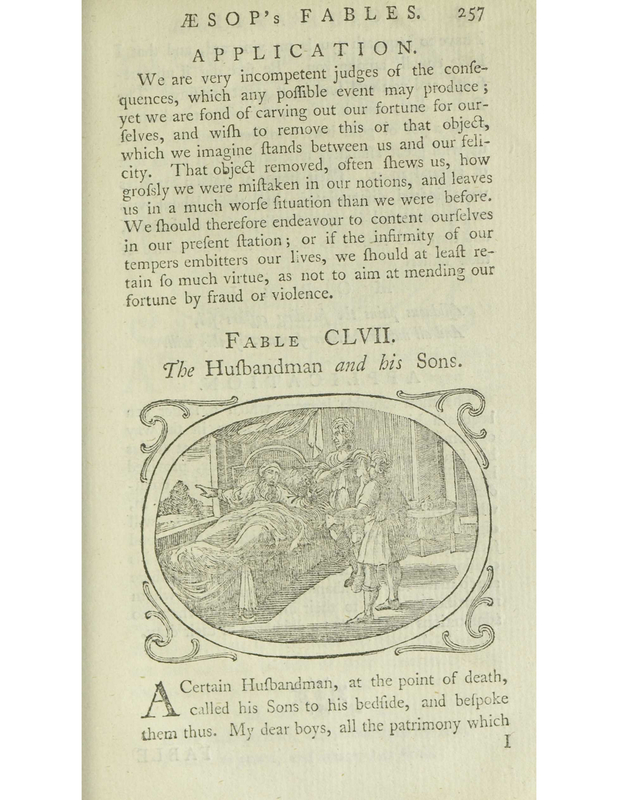
A older man lies in bed, looking at two younger men as he gestures outside the window. He looks sickly. The two men look onto the older on with interest and concern. They are all in a well furnished bedroom .
On the left side of the image, a woman is inscribing a text on a desk, while holding up another text with her opposite hand. She is wearing a hat and a robe. On the right side of the image a man is handing a woman a closed text. He is wearing a hat and she is wearing a robe and her hair is in a bun.
Argia, the daughter of King Adrastus of Argos is depicted on the left-hand side of the engraving holding the body of her husband, king Polynices of Thebes. We know that these figures are indeed Argia and Polynices as the creator engraved their names beside their bodies. Boccaccio explains that Polynices had fought in a war against his brother Eteocles and died on the battlefield. Argia snuck herself onto the battlefield after the war in order to see her husband’s body. She is depicted holding his lifeless body and kissing him on the lips. Behind Polynices and Argia are the other men who had fought and died in this war. The date 1473 is engraved on the illustration as this is the date the book was published, and most likely the date that the engraving was made.
A group of Tupinambá people are gathered at the center of their village to bury their dead. Two deceased individuals, possibly wrapped in cloth, are being lowered into holes dug in the center of the village. There are women in mourning crouched beside each of the holes, and a line of men standing to the side near the village fence, in discussion with a bearded man (likely representing Staden). The village is comprised of three long structures surrounded by a fence. In the bottom left corner there is a canoe anchored by the shore. There are stars in the sky, and a moon with a face that gazes down at the group. One Indigenous man stares up at the moon with one hand outstretched toward it.
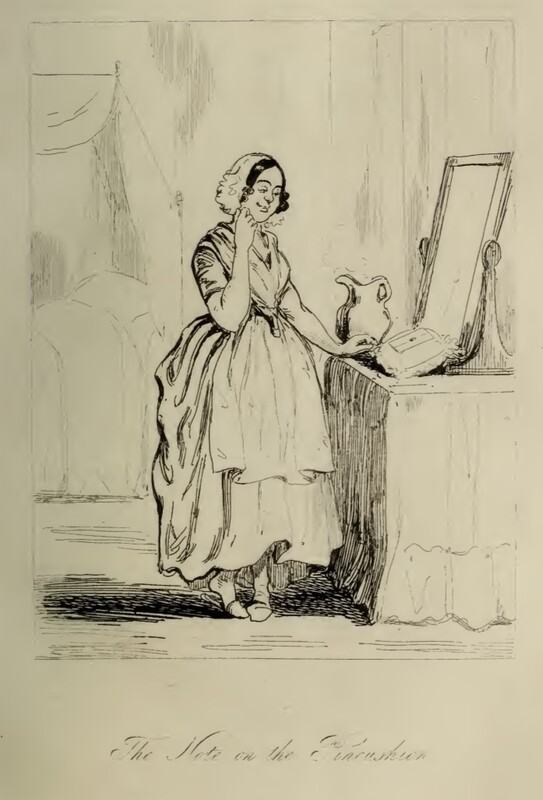
Betty Martin, Miss Crawley’s upstairs maid, smiles as she sees the note left by Rebecca Sharp for Miss Briggs. The note itself is on a pincushion on the table by the window, along with a standing mirror and a pitcher. In the background, the bed, neat and unslept-in, can be seen. Below the illustration is printed in cursive its title, The Note on the Pincushion.
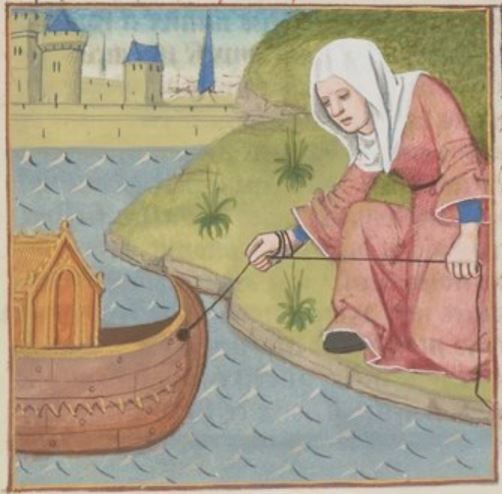
This illumination depicts Claudia Quinta, a Roman matron, standing on land as she pulls a ship towards the shore. Boccaccio explains that after Claudia Quinta was accused by other matrons of not being chaste, she prayed to the goddess Ceres to help prove her virtue. After a ship that contained a statue of Ceres had gotten stuck on a sandbar, Ceres gave Claudia Quinta the power to pull the ship to shore as proof of her chastity. The city of Rome is illustrated in the background of the image.
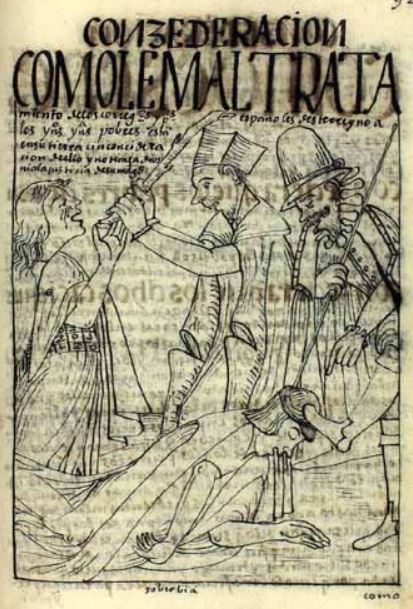
This image depicts the cruel mistreatment of the indigenous peoples of Peru by the Spanish officials and priests. There is an indigenous woman on the left side of the image with tears running down her face as she holds her hand up to stop the priest from hitting her with a stick. The indigenous man is depicted falling to the ground after being beaten by a Spanish official. The indigenous couple are dressed in traditional clothing with unkus [tunics] and cloaks around their shoulders. The priest is dressed in European ecclesiastic attire and the official is dressed in Spanish clothing. The official is depicted kicking the indigenous man in the head and holding a stick in his right hand. The author criticizes the Spanish officials for treating the indigenous peoples of Peru so poorly. The caption at the bottom of the image reads, soberbia [arrogance].
After successfully convincing Melibea to forfeit her girdle cord, Celestina returns home. While Celestina is gone, Sempronio remains in her house to spend time with his beloved Elicia. Thus, Celestina returns home to find him waiting. She claims to have good news regarding Melibea, and they depart for Calisto’s house to inform him of what has transpired (they can be seen arriving to the right of the image). In the meantime, Calisto is kept company by Pármeno while he remains immersed in despondent sadness (to the left of the image). To the right, Celestina can be seen wearing a robe and a veil. At her side, Sempronio is depicted wearing a hat and a sword mounted on his belt. Calisto, the leftmost figure, is also depicted wearing a hat. His facial expression and body language express a deep sadness. Pármeno is wearing a hat as well, and it appears as though he is trying to convince Calisto to calm himself. The entire image is identical to the one found on page 29 of the text.
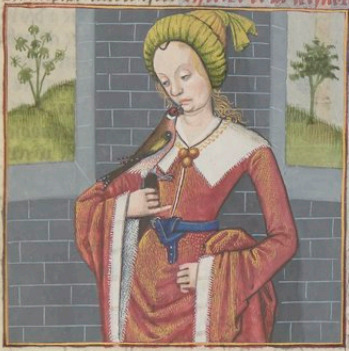
This illumination depicts a portrait of a woman named Claudia, who was a vestal virgin in Rome. She is illustrated looking down at a bird that is perched on her right hand. Boccaccio explains that Claudia is worthy of praise and renown as she had physically stopped a man who was trying to attack her consul father in a large crowd.
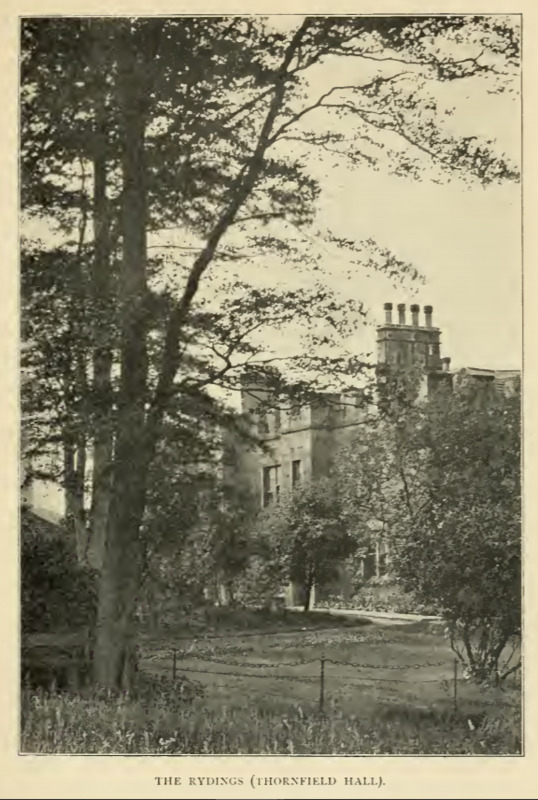
Here we see an image of the Rydings, a house in North Yorkshire. This house is supposedly that on which Thornfield Hall – the house where Jane lived under Mr. Rochester as a governess to Adele – was based. The same image appears in the 1899 Harper edition of Jane Eyre.
Here we see Gulliver looking through the window at the seated Empress of Lilliput and her maid. The Empress is seated and has her arms reaching out towards the maid who holds a cat. The same image appears in the 1839 Krabbe edition.
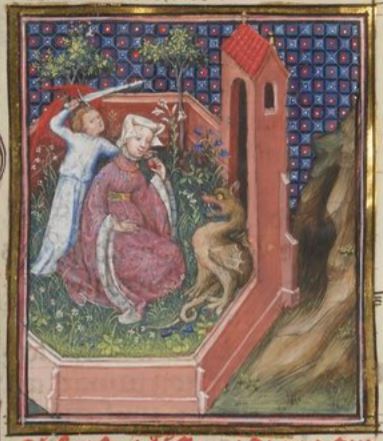
This illumination depicts Eve sitting down in the Garden of Eden. She is illustrated holding the forbidden apple from the Tree of Good and Evil. She is looking at the serpent who seduced her into taking the apple. The Garden itself appears to be a contained area with walls and an entrance door to the right of the image. Eating the apple caused the expulsion of Adam and Eve from the Garden of Eden. As a protector of the garden, there is a cherub dressed in white holding a sword above Eve’s head as it expels her from the garden. Boccaccio explains that as the world’s first mother to us all, Eve is worthy of remembrance and praise.
Several Indigenous Brazilian men and women, as well as a small child, weep together with their hands over their faces inside a dwelling. One individual sits in a hammock that has been strung between two beams of the structure with the others surrounding the hammock. A bow and bundle of arrows lie on the ground beside the hammock, and a bird sits on a beam above looking down on it. This image is identical to one found in Frankfurt, 1557.

![[Vanity Fair Volume I. Chapter XXIII Inhabited Initial, W]](https://collections.cemvc.ca/files/large/a4b22290165349190fddf31a74891699491ff025.jpg)
![[Queen Nicaula of Ethiopia Presenting a Gift to King Solomon of Jerusalem]](https://collections.cemvc.ca/files/large/8ff8c88f4a48f1ac5456a919db36f3f610b5ac27.jpg)

![[Gulliver in his house in Lilliput with two attendants]](https://collections.cemvc.ca/files/large/5d1fa5d2288f4263562666d48a3c9ad300a2e11f.jpg)
![[Woman Inscribing a Text]](https://collections.cemvc.ca/files/large/7924e6422614f413a022de03558891449c3eeba6.jpg)

![[Tupinambá people bury their dead]](https://collections.cemvc.ca/files/large/25d29064f6bac6d32ceb84d6d0ad2478e28f7f89.jpg)
![[The Lion and the Mouse]](https://collections.cemvc.ca/files/large/a57426f12fe9ee3686ea0ca4d27efac5e7e39e0c.jpg)
![[Act V] Celestina sprekende teghen haer zelven.](https://collections.cemvc.ca/files/large/3b8971018de1f2243ceeb5e8e489478f7f66ebd0.jpg)
![[Gulliver looks in on the Empress of Lilliput]](https://collections.cemvc.ca/files/large/768f2f099b646af5fa07e82abc7e4ffd3ab09f17.jpg)
![[Emotional solidarity in an Indigenous Brazilian community]](https://collections.cemvc.ca/files/large/2fdfbc406f11ce904cd21be091fb10f99733ac19.jpg)