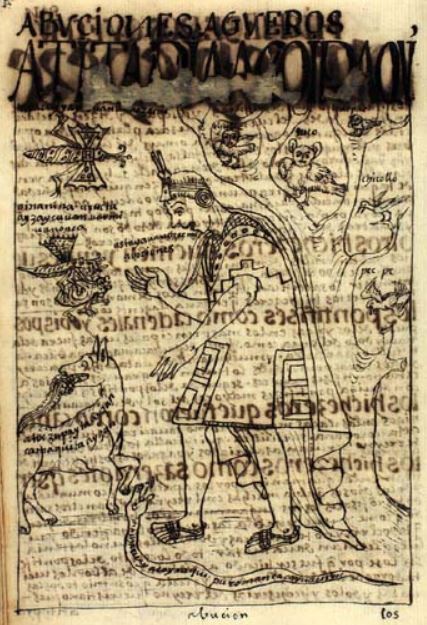
This busy image depicts many omens that were considered evil in the Inca Empire. These omens were believed to bring misfortune or death. A snake is depicted at the bottom of the image with the words machacuay acoyraqui puromanca cay uacichic [serpent of misfortune our house will be destroyed] written along the length of the snake. Above the snake is a fox looking to the left with a caption written on its body that reads El zorro arrastra al demonio, arrastra a su creador [the fox drags the demon, drags his creator]. Above the fox is a large insect and the caption above it reads nina nina curucta ayzaycuuan, uarmi uanonca [a large insect has brought a worm, my wife will die]. A butterfly is illustrated above the insect. There is a caption above the butterfly that reads tapacuy yaycuan uanazacmi [a butterfly approached]. There is a tree on the right side of the image with a chusic [owl] at the top of the tree, then a tuco [horned owl] in the middle, with a pacpac [pymgy owl] to the top right of the pygmy owl, then a chicollo [bird], and the last branch depicts a pecpe [small bird]. The man in the centre of the image has a frightened expression on his face, and the caption beside him reads astaya uanozacmi [bad luck, I will die].
Here we see Gulliver lying on the table during dinner with the giants. The Farmer serves food from a large bowl on the centre of the table, holding a spoon. Bowls are laid out on the table in front of the giants. The farmer is in the centre of the image, with an old man across from him, and his wife behind him. The other characters in the image are the farmer’s children. Everyone is watching Gulliver. The same image appears in the 1839 Krabbe edition.
Jane and Maria Osborne and their governess, all with displeased expressions on their faces. One sister is standing with her chin on one hand. She and the governess, Miss Wirt, are looking towards the right of the picture, staring in the direction in which Amelia Sedley just left. The other sister is seated on a cushioned chair, holding a piece of cloth or paper and looking back at the others. On the floor by her side there is a small dog.
After returning to England, Gulliver liked to spend most of his time with his horses. Because of his veneration of the Houyhnhnms and their virtue, Gulliver found himself more comfortable spending his time with his horses. He spent several hours each day speaking with his horses.
Four canoes bearing a group of Indigenous Tupinambá people approach the shore. They are being blown towards the shore by the wind, with clouds behind them. There is a face in the clouds in the top right corner of the image. In the top left corner of the image is the sun, also with a face. A few of the Indigenous people are looking up and waving towards the sun. A bearded man (likely representing Staden) lies captive in the bottom of the canoe on the far-left side of the row. On the shore there are two structures.
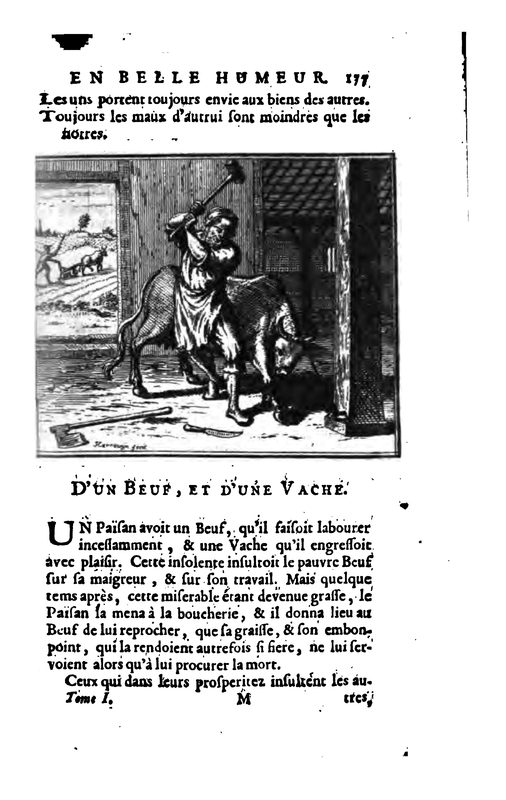
A cow in standing in a building and appears to be tied to a support pole while a man is standing next to the cow holding a large hammer above his head with both hands. Outside the door of the building another man can be seen behing an ox that appears to be plowing the field.
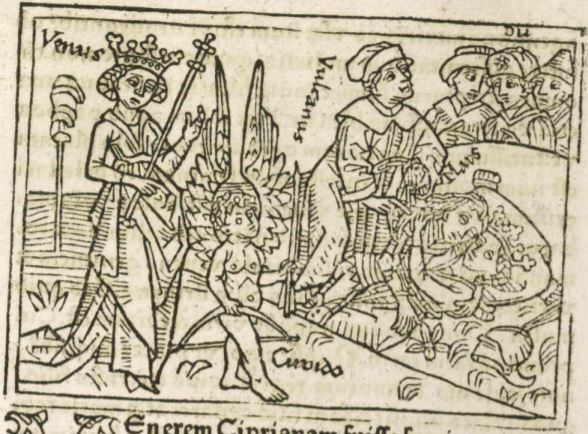
The goddess Venus is illustrated on the left side of the engraving wearing a crown and holding a long staff in her right hand. We can identify this figure as Venus as her name is engraved directly beside her in the top left-hand corner. Her son, Cupid, is depicted walking alongside her with his bow and arrows in hand and his wings erected in the air. His name is engraved by his feet. The right-hand side of the engraving depicts Venus committing adultery with her half-brother, Mars. Mars’ name is engraved just above Venus’ head. Boccaccio explains that Venus’ husband, Vulcan, had walked in on the adulterous crime, which is what the engraving is illustrating. Vulcan’s name is engraved behind him as Vulcanus. Boccaccio explains that Venus was highly adored in Cyprus as well as Rome, and he chose to write on her for her beauty. He criticizes her highly due to her invention of brothels.
This image is illustrated in a chapter that discusses the Christian priests in the colonial government in Peru. This image depicts a Spanish parish priest on the right side of the image holding a whip in his right hand and holding the hands of an indigenous man with his left. The parish priest has an angry expression as he swings the whip towards the kneeling man. The indigenous man is illustrated naked as he is shamefully punished by the priest. The indigenous man’s name, don francisco auquiquia, is written above his head. The author criticizes the parish priests in colonial Peru society for being cruel and abusive towards the indigenous peoples.
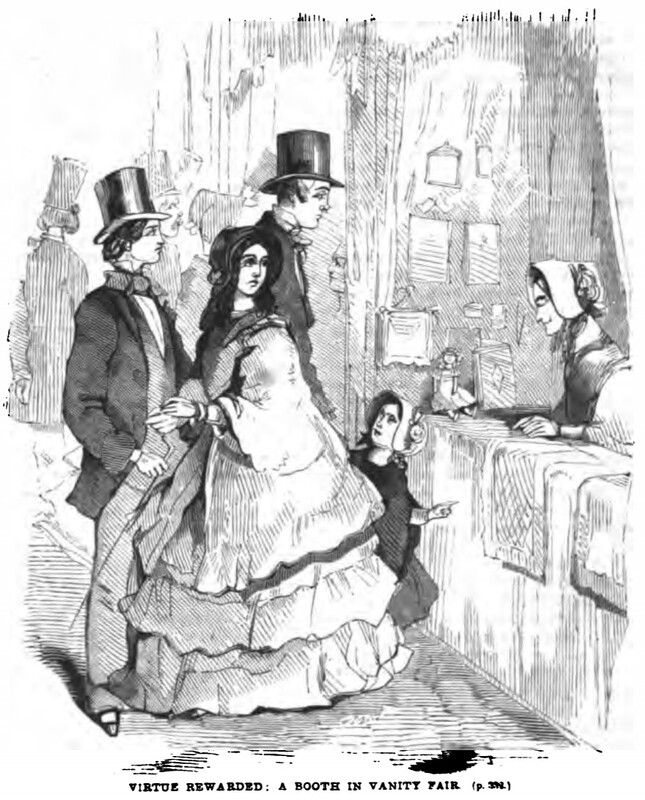
Rebecca Crawley sits behind the counter of a stall at the fair in London, selling items for charity. In front of the booth, Amelia Dobbin, holding onto the arm of her son George, is turning away upon seeing her. Behind them, William Dobbin is reaching out to pick up Janey, their daughter, who is looking up at him in puzzlement. Below the illustration is printed its title and location in the story, VIRTUE REWARDED: A BOOTH IN VANITY FAIR (p. 332.).
After being accused of betraying her husband Herod, Mariamne was sentenced to death. She was set up by Herod’s mother and sister, but despite the wrongful accusation, Mariamne went to her execution showing no fear, and in fact, had a smile on her face. She was not scared of her execution because she found out that her husband was greedy, loving her only for her beauty.
In this image we see Gulliver sitting in his cell in Lilliput where he lived for a short time before gaining his freedom. We see Gulliver’s profile through the partially open wooden doors of the cell. The same image appears in the 1843 Krabbe edition.
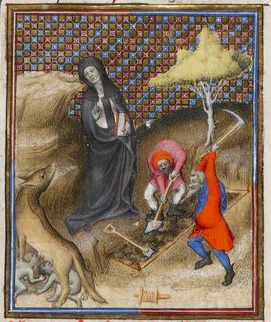
Rhea Sylvia was a Vestal Virgin that somehow became intimate with a man, resulting in a pregnancy. She gave birth to twin boys – Romulus and Remus, who would grow up to found Rome. Rhea Sylvia was punished by being buried alive, which is pictured in the center of this image. Rhea Sylvia wears a black cloak while two men dig her grave. To the bottom left corner of the image, Romulus and Remus are suckled by a she-wolf. This famous scene represents when the twins were exposed but survived as a wolf fed them.
This engraving illustrates the importance that the goddess Juno holds to the city of Samos. The background of the engraving illustrates a temple which was erected in the goddess’ honour. In the foreground of the engraving, there is a marble statue of Juno dressed in her wedding attire standing in front of the temple. We know that this is Juno as her name is engraved directly above her head. There are people standing in front of the statue of Juno, most likely engaging in a wedding ceremony as Juno is a goddess of marriage. Boccaccio explains that Juno was sent to live in Samos during her early childhood years until she hit puberty and married her brother Jupiter. The people of Samos built the temple and statue to honour their connection to the goddess.
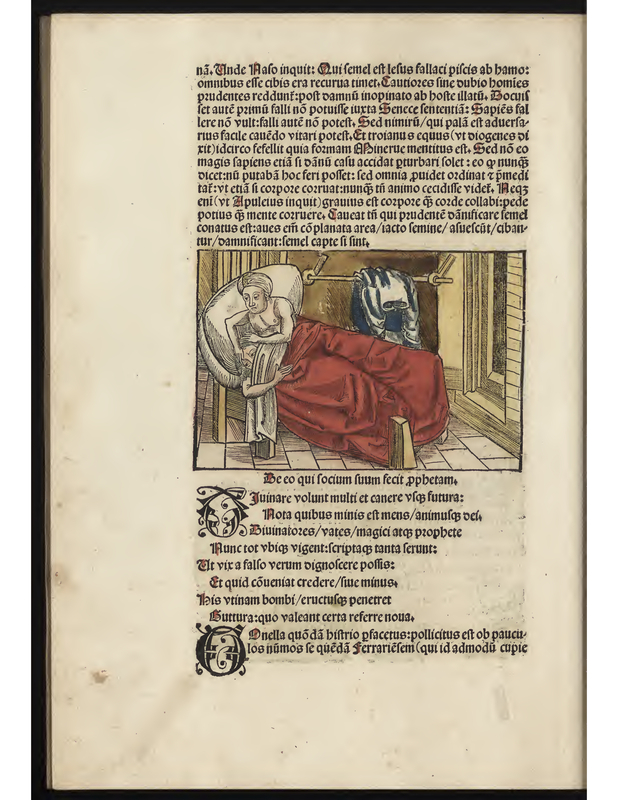
Martha Crawley sits in a chair at Matilda Crawley’s bedside, holding a cup and saucer and scowling. Miss Crawley, who is ill, can be faintly seen inside the canopy of her bed.
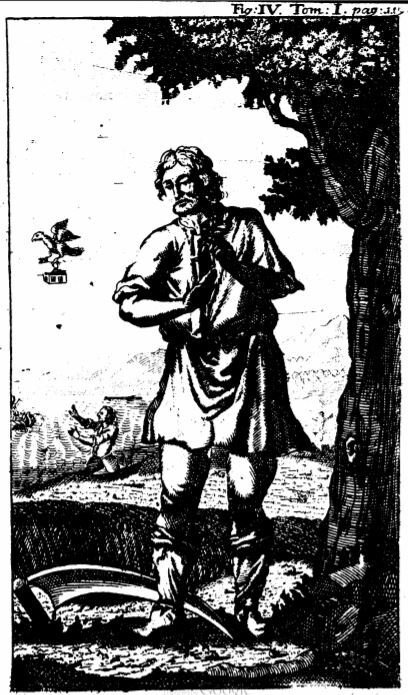
This image represents Gulliver’s adventures in Brobdingnag. The central figure is the farmer who first discovered Gulliver, standing under a tree. The Giant holds Gulliver in his hand, showing the reader the difference in size between Gulliver, and the Giants of Brobdingnag. In the background, we see an eagle carrying a box, depicting the episode in which Gulliver left Brobdingnag, as the box in which he lived and travelled was picked up by an eagle, and carried over the open water, before the eagle dropped Gulliver into the ocean, later to be discovered by a ship. We see another giant in the background, close to the water, presumably the page who left Gulliver’s box unattended, thus allowing it to be picked up by the eagle. This image is the same as that in the 1727 German von Wiering edition.
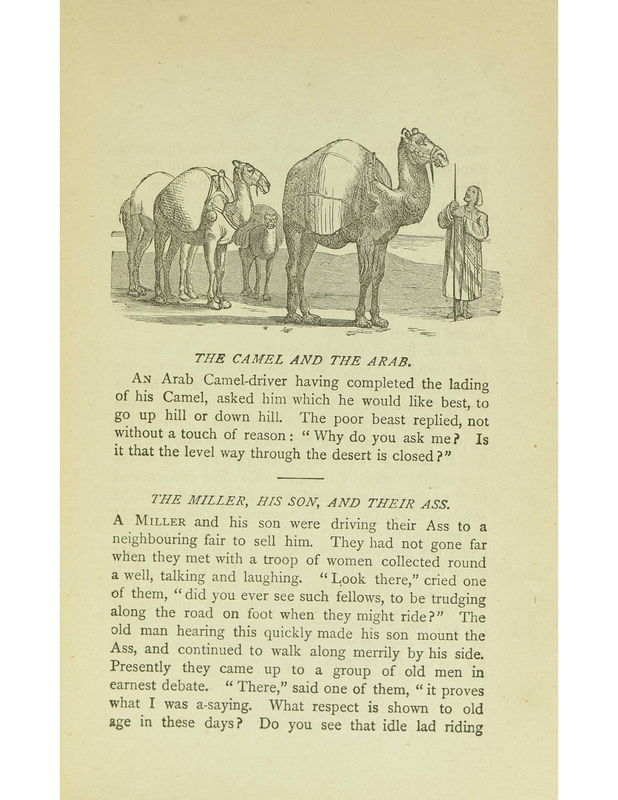
Three camels with cloths draped on their backs are standing in a group. A man stands next to the first camel, looking up at it and holding a long stick in his hands.
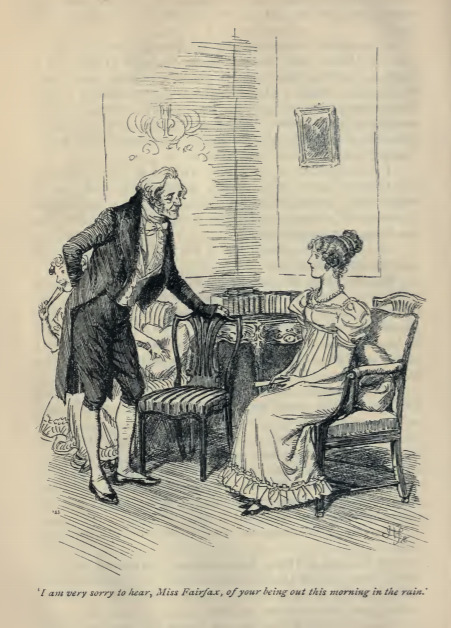
In this image we see Mr. Woodhouse speaking to Jane Fairfax. Mr. Woodhouse was telling Miss Fairfax that he was sorry she was out in the rain that day, and warned her about the risks to her health that could arise from getting caught in the rain. Overhearing this conversation, Mrs. Elton said that she would have her servant pick up Jane’s mail for her so Jane would not have to go herself. Jane said that she enjoyed picking up her own mail, but Mrs. Elton, being somewhat overbearing, insisted that her servant collected Jane’s mail against Jane’s wishes. This scene occurs in chapter 34. The characters are shown in the traditional regency style. Jane Fairfax wears the regency style dress with an empire waist. Her dress has short sleeves as was the style for women’s evening dresses. Mr. Woodhouse wears a waistcoat and tailcoat, with breeches and a cravat. The regency period dated to the early nineteenth century (1811-1820) when George, Prince of Wales, later George IV (r. 1820-1830), reigned as regent for his mentally ill father, King George III (r. 1760-1820). The regency period is associated with the rise of neoclassicism in art and fashion.
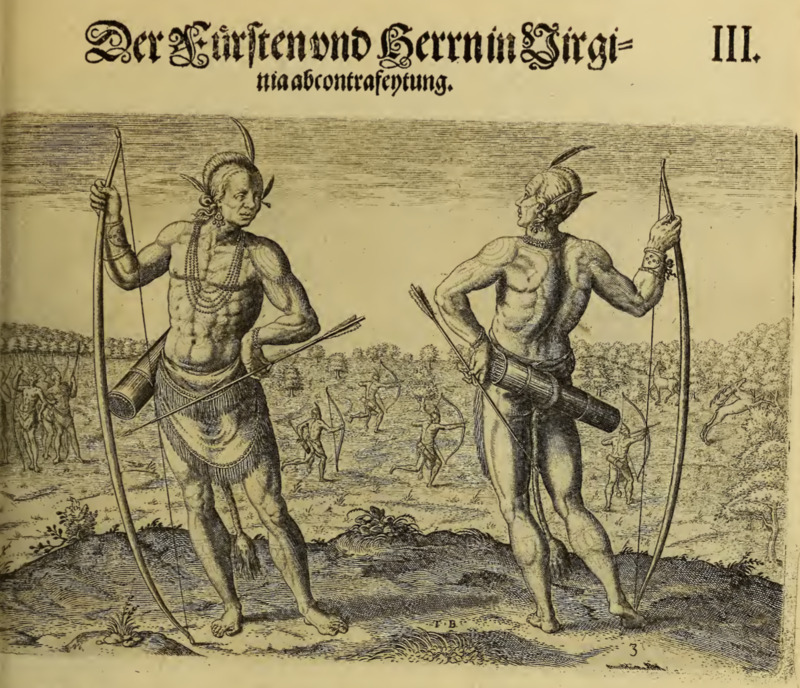
An Indigenous male is pictured standing on a hill, from the front and from behind. He wears beaded necklaces, beads around his left wrist and a cuff/wrist guard on his right, and fabric in the fasion of a fringed skirt tied around his waist. He is barefoot and shirtless, carries a longbow, and wears a quiver of arrows around his waist. In the background behind him there is a group of Indigenous people also holding longbows, and four people hunt deer. A forest is visible in the background.

![[Gulliver eats with the giants]](https://collections.cemvc.ca/files/large/c58dd89d8909fdf383b25105c277403f51446e80.jpg)
![[The Osborne Daughters and Their Governess]](https://collections.cemvc.ca/files/large/9221135e283517989dbf51b0f496169005b7680c.jpg)
![[Gulliver sits with horses in England]](https://collections.cemvc.ca/files/large/8321c71a57d2024be7164111fdbca771b0f4fdc6.jpg)
![[Tupinambá people approach the shore in canoes]](https://collections.cemvc.ca/files/large/5d171e54f5444f5fbd280b5e33e488cb2bc82b45.jpg)
![Verdvgo, P[adr]e, Castiga Adrentosamente Desnudo en Cueros cin Miramiento ci es Principal o Yndio Pobre o Yndia](https://collections.cemvc.ca/files/large/da4897bd34730d9cbdc8a839fcff649a609d3af2.jpg)

![[Gulliver in his cell in Lilliput]](https://collections.cemvc.ca/files/large/c686f3164744c4d18fa27c764019af52dfabbbca.jpg)
![[Mrs. Bute Crawley]](https://collections.cemvc.ca/files/large/0cb283675fab12062dac790de3c1e27e2975b2dc.jpg)