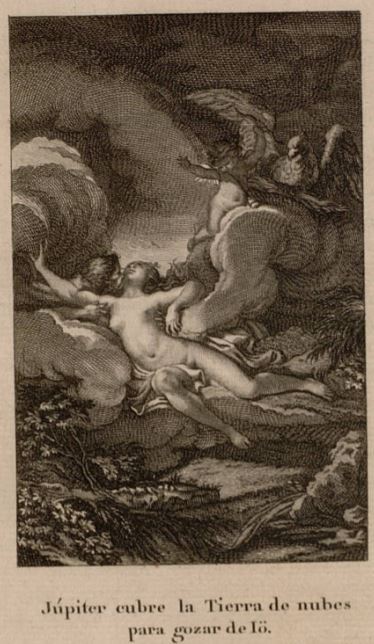
This image depicts the capture and rape of Io, the daughter of the river god Inachus. Io was walking through the woods when Jupiter saw her and was taken by her beauty. He covered the earth in a thick, foggy clouds so that Io’s vision would be veiled so that she would not see him coming. When Jupiter catches up to Io, he rapes her. The thick clouds are depicted sweeping across the image as Io’s naked body is almost in the center of the engraving. Jupiter is illustrated holding onto Io as he kisses her. There is a cherub and an eagle on the right side of the image. Eagles are often depicted in iconography connected to Jupiter as Jupiter is known to transform into an eagle.
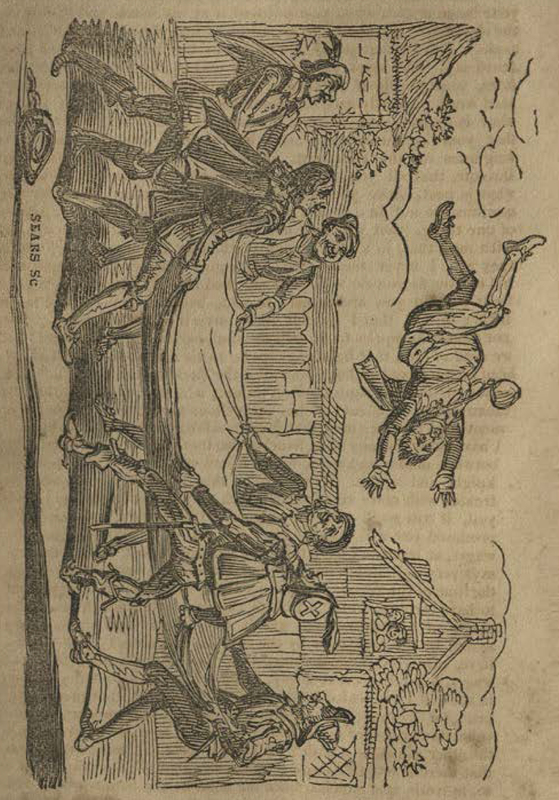
Having refused to pay the innkeeper, Sancho Panza is grabbed by guests of the inn and tossed in the innkeepers blanket in the backyard of the inn. Sancho (top middle) extends his arms in the air, yelling out in terror, his water pouch flying about as he soars. He is tossed by four cloth-workers of Segovia, three needle-makers of the horse-fountain of Cordova, and two butchers of Seville. In the background on the right two people watch the festivities from a second floor window.
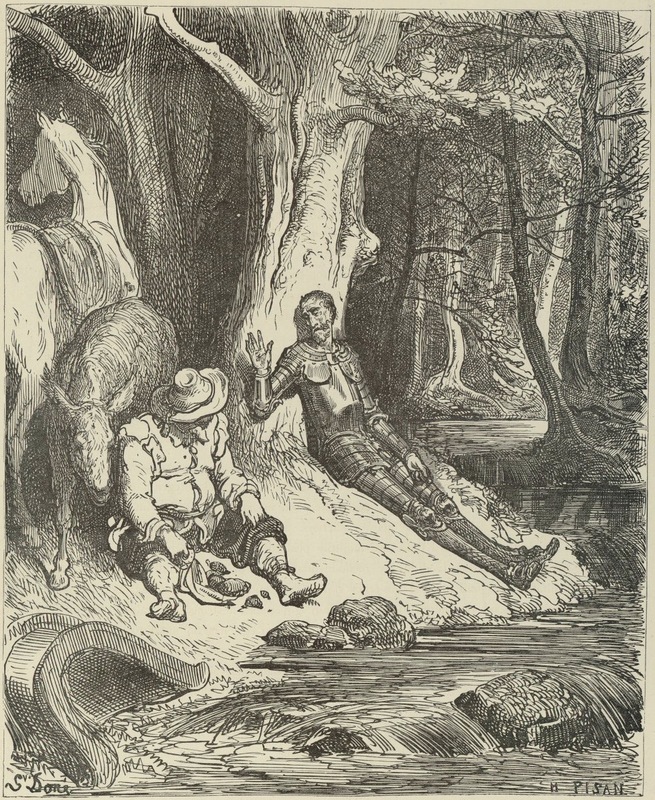
After their encounter with the bulls, Don Quixote and Sancho Panza find a clear, fresh spring in a cool grove of trees. They sit at its edge and Sancho eats some of the provisions in his saddlebags. Signed by G. Doré (illustrator) and H.-J. Pisan (engraver). Part 2, ch. 59.
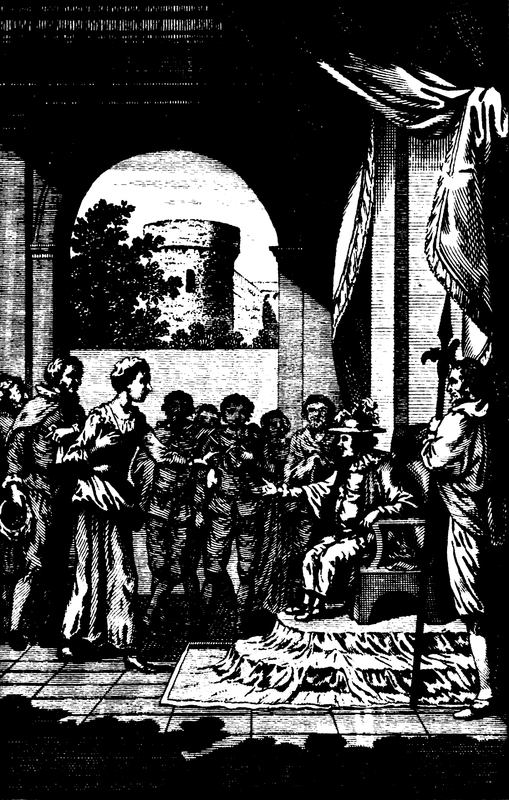
Fulfilling his role as governor of Barataria, Sancho Panza listens to the qualms of the island's inhabitants. The third case brought forth is by a stout young woman holding the arm of an opulent herdsman. She complains to Sancho Panza that the herdsman has forced himself upon her against her will. The herdsman argued that she had consented and swears by this fact. Sancho tells the herdsman to give her his purse, which he does, and then subsequently to go and take it back. When the herdsman tries to take the purse back he fails to do so, and Sancho tells her to give the purse back to the herdsman because if she had defended her chastity as she defended this purse then no man could have forced her. Engraved beneath the image are the words "the woman's strongest, but of force complains, yet for a purse of gold her part maintains, Sancho the fallacy with ease perceives, corrects the woman, and the clown relieves.
Sancho, pictured in the middle of the foreground, kneels on both knees before the duchess, his hands proffered by his side and his head down. The duchess (middle), dressed in a white courtly gown, looks down upon Sancho with her arms wrapped around the duke's right elbow. The duke (right), dressed in a black cape, plumed hat, and golden medallion, looks off into the leftmost distance, leaning towards the duchess in the middle, to whom he proffers his right arm, and upon his waist he rests his left arm. On the left, Don Quixote closes his eyes and covers his right breast with his hand. Lying next to the duke is a rapier of sorts.
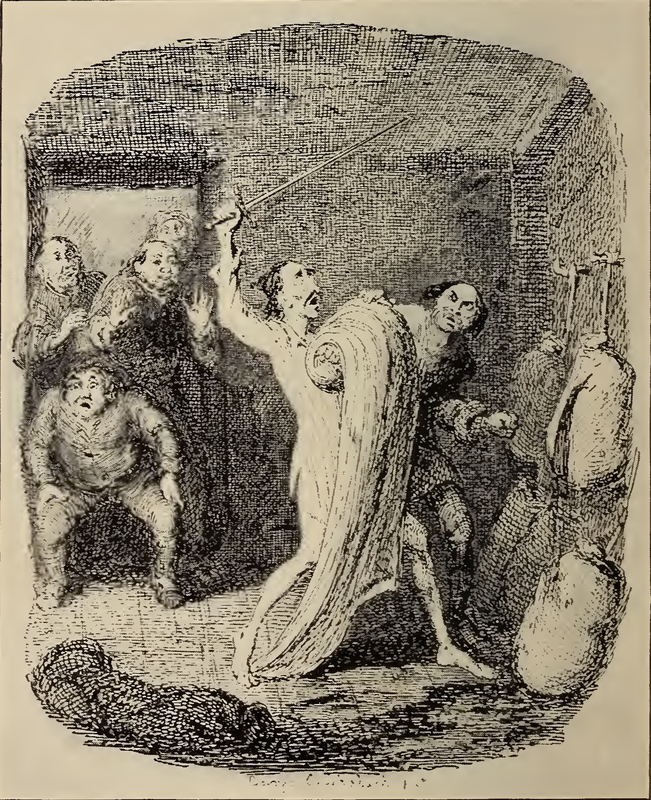
Don Quixote and Sancho Panza take up lodging in an inn, but soon after Quixote falls asleep, Panza runs to seek aid from the innkeeper. The squire explains that Quixote is doing battle with a giant in their room as they speak. Sancho Panza, the barber, the innkeeper and other residing guests all seek out Quixote to see what the commotion is about. Upon entering his room they find Quixote slashing about in all directions uttering exclamations as if he was fighting a giant. His eyes are closed for he is asleep, and his battle with a giant is nothing but a dream. Believing he was fighting with a giant he slashed all around, slashing open the wine skins so that the win pooled around his feet.
Don Quixote clad in armor, sword equipped to his hip and mounted upon Rocinante departed from his battle with the Knight of the Mirrors, hands raised in praise of himself, content, elated and glorious at having gained the victory he sought for the sake of his lady Dulcinea.
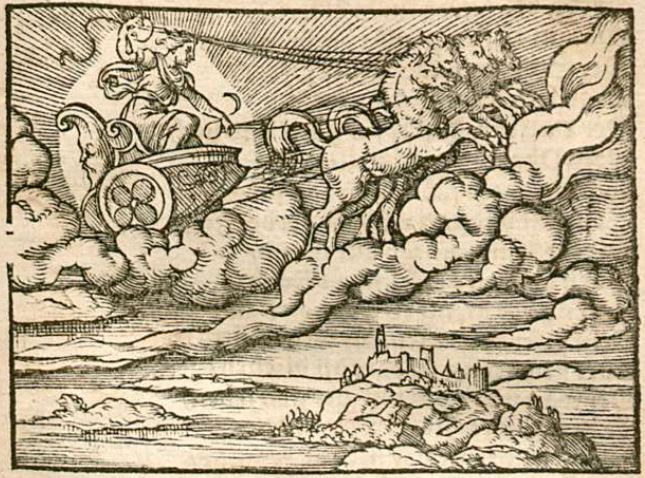
This engraving illustrates Phaethon controlling his father Phoebus’ chariot and four horses: Pyroïs, Eoüs, Aethon, and Phlegon. Phaethon asked his father to control his chariot in order to prove that he is in fact Phoebus’ legitimate son. Phoebus urged Phaethon to choose anything else but the chariot as it is incredibly difficult to control, and it would likely end in peril. Phaethon insisted on driving the chariot and Phoebus could not refuse as he had already given Phaethon his word. Phaethon is depicted flying in the clouds above a city.
Seven monsters and hobgoblins advance, a round mosquito like creature on the left holds a banner in its right hand. Behind this band of monsters many spectres and phantoms dressed in robes walk in rows upon rows in the background. The image is occasioned by Don Quixote seeing several millers run to stop him from riding a boat into the mill, and their faces and clothes being covered with meal, they had somewhat the appearance of ghosts.
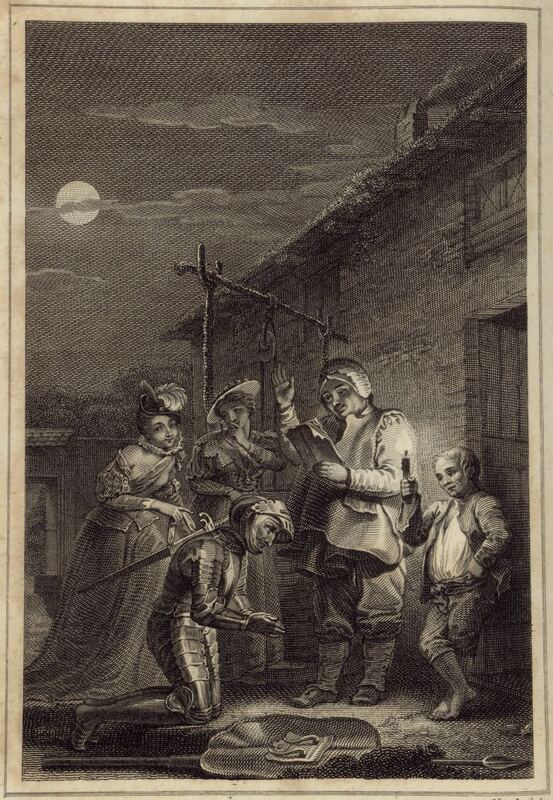
In the courtyard, the innkeeper knights Don Quixote, who kneels before him. The knight wears his armour and his helmet. Doña Molinera and Doña Tolosa (left) are also pictured, as is a boy holding a candle (right). The scene is accurately depicted at night: the characters are illuminated by the light of the boy’s candle and that of the moon, partially obscured by clouds. Signed by J. Neagle (engraver). Part 1, ch. 3.
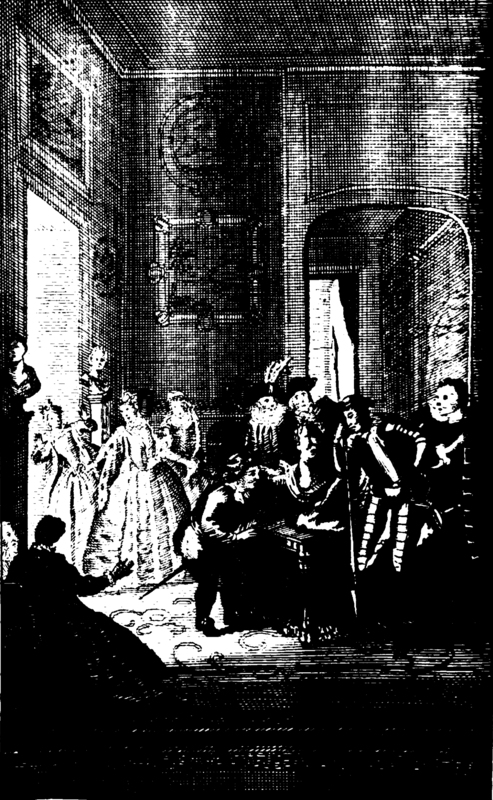
Don Quixote and the guests of Don Antonio enter Antonio's chamber which holds the enchanted head. This head is famous for its ability talk and predict the future by answering whatever question is asked of it. Quixote asks the head about Dulcinea de Toboso and Sancho Panza asks the head about whether he will ever come to govern his own house once more. The enchanted head is held in a room which is entirely barren aside from itself. The head stands upon a table and frame, the legs of which resemble four eagle claws, carved from wood and varnished to look like jasper. The head, which looked like the bust of a roman emperor was of a brass color and hollow on the inside. Don Antonio had commissioned a statuary to construct a head through which a person could channel their voice while in another room.
Don Antonio Moreno leads Don Quixote to a side room, where there is a table of jasper on a base of the same material. On it is a bronze bust made in the fashion of Roman emperors. While his friends and Sancho Panza gather in the room, Don Antonio tells Don Quixote that the enchanted head has the property and virtue of responding to any question spoken in its ear. Sancho Panza asks the enchanted head a question, but is disappointed with its response. Signed by F. Hayman (illustrator) and C. Grignion I (engraver). Part 2, ch. 62.
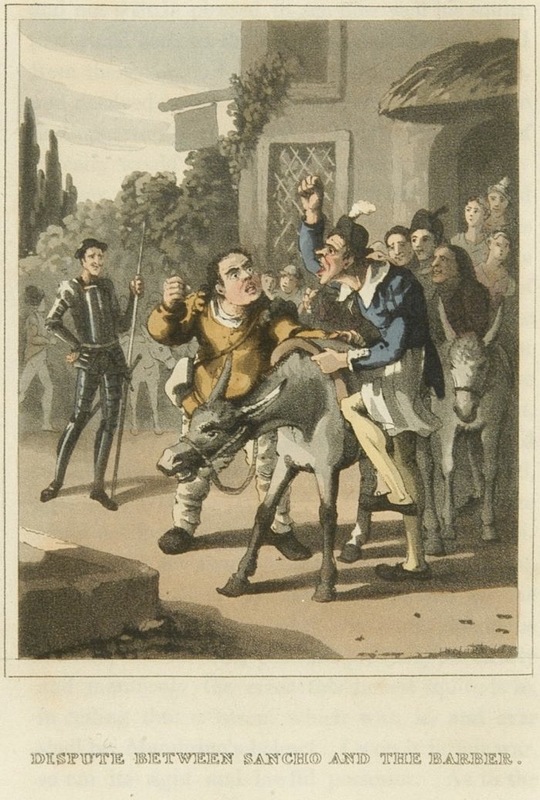
In the foreground, Sancho Panza and the barber fight over the packsaddle. In the background, Don Quixote looks on. A few of the guests at the inn are also pictured (right). Unsigned. Part 1, ch. 3.
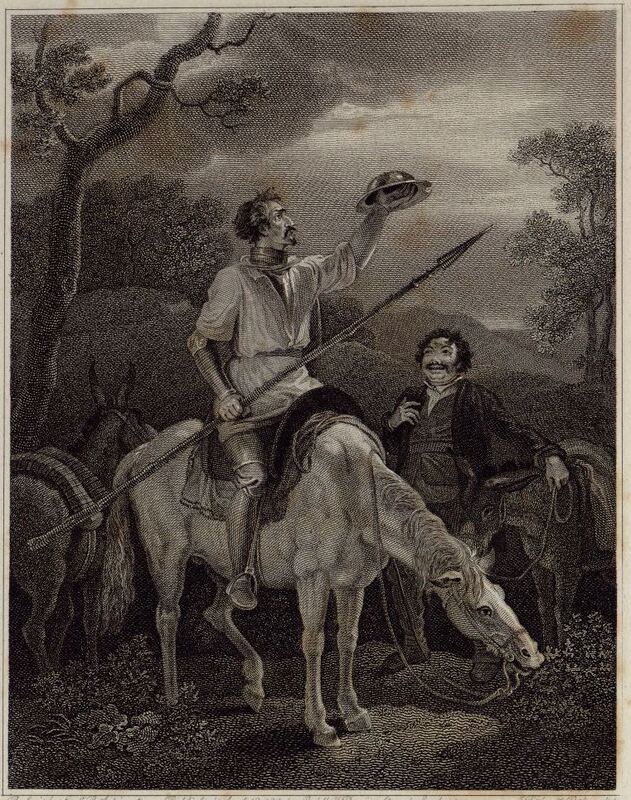
Don Quixote contemplates the barber’s basin (which he believes to be Mambrino’s enchanted helmet), mounted on Rocinante. Sancho Panza watches him, smiling. The illustrator has chosen not to depict the fleeing barber, from whom Don Quixote took the basin. Signed by R. Smirke (illustrator) and J. Fittler (engraver). Part 1, ch. 21.
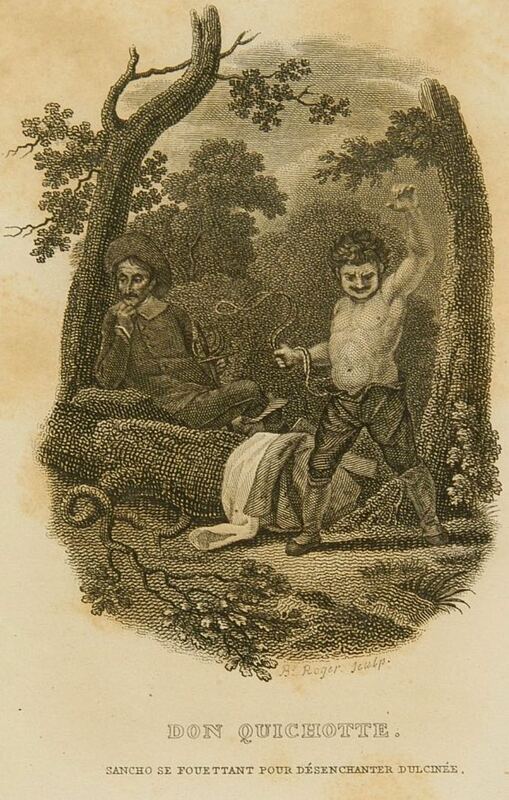
Sancho Panza gives himself lashes to disenchant Dulcinea, while Don Quixote observes him, counting the blows. Sancho’s figure is well detailed. Signed by B. J. F. Roger (engraver). Part 2, ch. 71.
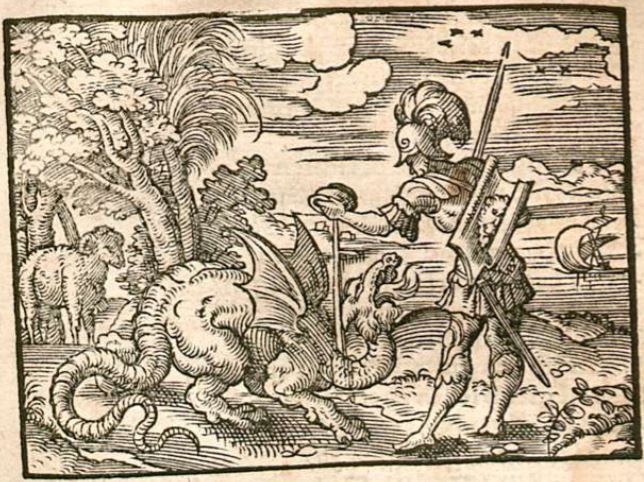
This engraving illustrates Jason, the leader of the Argonauts, pouring a Lethean herb juice over the dragon that guards the Golden Fleece. The juice, along with an incantation spoken by Jason, puts the dragon to sleep so that Jason can retrieve the Golden Fleece. Medea, the daughter of King Aeetes, had given Jason the magical herbs to put the dragon to sleep in order to help him win this challenge. Jason had promised to marry Medea so long as she helped him win the Golden Fleece from her father.
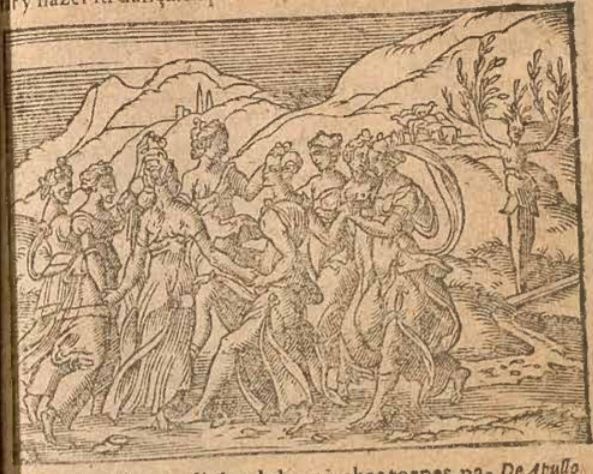
This engraving depicts a group of nymphs gathered in a circle, dancing and skipping. The nymphs had been approached by a shepherd from Apulia and he began to mock them by imitating their dancing and cursing at them. As punishment, the nymphs transformed him into an olive tree. The shepherd in his transformed state is illustrated in the background of the engraving on the right-hand side of the image. The nymphs continued to dance and enjoy themselves after the transformation of the shepherd.
Don Quixote (right), clad in armor, seeing a figure beneath a distant tree wakes Sancho (middle), who was fast asleep, and points him in the direction of the stranger (left). The stranger who is Squire of the Woods, has a lute in hand, is wearing a brimmed hat and has a large nose and moustache.
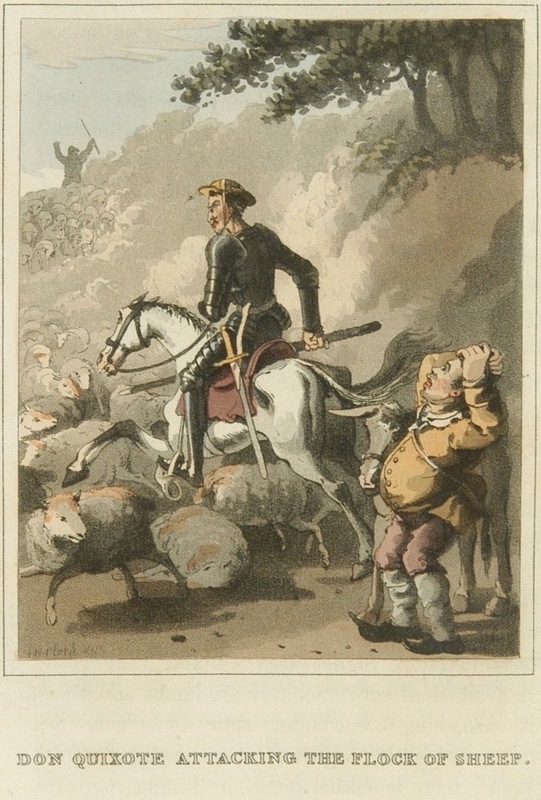
Having mistaken a herd of sheep for the army of Alifanfaron of Trapoban, Quixote races down to the plain below upon Rocinante, slaughtering many sheep , the shepherds cry out for Quixote to cease killing their sheep, but their cries fall upon deaf ears. Fearing the annihilation of their flock, the shepherds pelt Quixote with stones the size of fists, which hit him with great force in the ribs and mouth, breaking three ribs and shattering three teeth. Thinking Quixote dead, the shepherds continue on their way without further inquiry. Sancho Panza, having watched from a atop a hill, rushes to help his master once the dust has cleared. Sitting down upon a stump, Quixote lays aside his arms and opens his mouth for Sancho Panza to check the condition of his mouth and teeth. In the background, a shepherd carries his sheep to greener pastures.
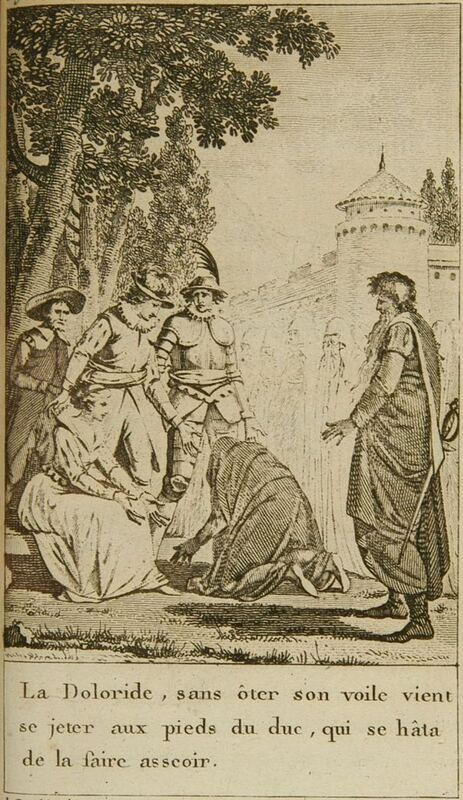
Countess Trifaldi kneels before the duke and the duchess. Don Quixote and Sancho Panza look on. Trifaldín (right) and a retinue of dueñas (background) are also pictured. In the background, the duke and duchess’ palace. Signed by J.-J.-F. Le Barbier (illustrator) and J. Dambrun (engraver). Part 2, ch. 38.
In the Duke and Duchess' backyard, five duenna are pictured following their countess Trifaldi who kneels closest to Quixote at center. Countess Trifaldi, clad in the same black robes as her companions, lifts her veil widely with both hands, revealing a full beard and moustache. All five duenna behind her to the right also lift their veils to reveal similarly luscious beards. Don Quixote, pictured standing directly before Trifaldi, raises his hands in surprise. Sancho Panza, pictured to the left of Quixote cowers in fear, shielding himself with his left hand and supporting his standing with his right hand. In the background on the left, the Duke and Duchess feign surprise.
Despite Sancho Panza’s warning (he is pictured gesticulating in the foreground), Don Quixote charges a flock of sheep. He is mounted on Rocinante and holds his lance. In the background, a shepherd is pictured, waving angrily. Unsigned. Part 1, ch. 3.
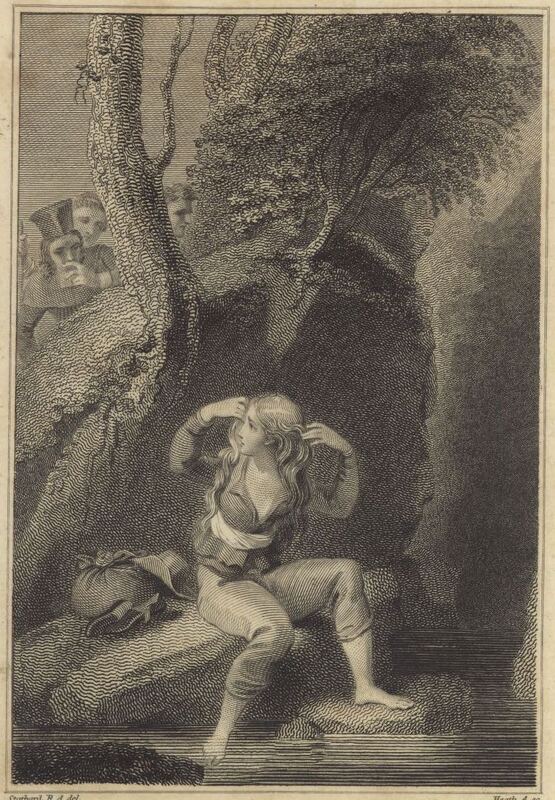
The priest, the barber, and Cardenio (background) encounter Dorotea washing her feet in a stream and combing her hair. The priest is disguised with a fake beard and the barber with women’s clothes. Signed by T. Stothard (illustrator) and J. Heath (engraver). Part 1, ch. 28.
Don Quixote, his face bandaged and marked by the cat’s claws, welcomes Doña Rodríguez, duenna to the duchess, to his room at night. She wears long and intricate white veils. One of the duchess’ maidens watches from the doorway. Signed by F. Hayman (illustrator) and C. Grignion I (engraver). Part 2, ch. 48.
Two shads lying on top of the other, the bottom fish facing the left with its mouth agape, the topmost fish facing the background. The image is occasioned by Sancho Panza saying "I must warn your worship that, to me, this same boat seems not to belong to the enchanted,but to some fishermen upon the river, for here they catch the best shads in the world" when Quixote claims the boat by the river Ebro is enchanted.

![[Sancho Panza Thanks the Duchess for Ridding him of the Chasing Cooks]](https://collections.cemvc.ca/files/large/6dc6931501d0d539cbaaf9a486b0c2f39498280d.jpg)
![[Don Quixote Departs Having Bested the Knight of Mirrors]](https://collections.cemvc.ca/files/large/aef82d921a068cbda36a9099bf9ccdd4ade74560.jpg)
![[Of How Quixote Percieved Millers as Monsters]](https://collections.cemvc.ca/files/large/94d72d2bb324f4df7dbeb1ab0cdce2abfdedcb42.jpg)
![[Episode of the enchanted head]](https://collections.cemvc.ca/files/large/894f353dade07d8751ffedabebdd510bbe14a451.jpg)
![[Of how Don Quixote Pointed Sancho Towards the Squire of the Woods]](https://collections.cemvc.ca/files/large/0a94999b47cd980a490d298123f0d5d5453a6979.jpg)
![[Sancho Checks the Condition of Quixote's Teeth]](https://collections.cemvc.ca/files/large/f77a6ee54bb1676bfe13fc8777481f3374e81cd0.jpg)
![[The Afflicted Duenna Lift their Veils]](https://collections.cemvc.ca/files/large/5397f735189dae25f32f09886501814ac076d0eb.jpg)
![[Doña Rodríguez visits Don Quixote at night]](https://collections.cemvc.ca/files/large/cb0ce9cab050298d9302707c7233d886cf6c114b.jpg)
![[Piled Fish]](https://collections.cemvc.ca/files/large/c06e8213a03a98c271778ae404e72ba9bb785871.jpg)