This image depicts an indigenous man named Don Juan Capcha, standing in the centre of the page holding cups filled with wine and other alcohols. He appears to be standing in a wine cellar as there are large vases that are labelled as, uino añejo [old wine] and chicha fresca [fresh alchohol]. The drunkard is dressed in Spanish clothing and has a beard. The author describes this man to be an enemy of all Christians for being a liar, thief, and a drunkard at the expense of poor natives. The caption at the bottom of the image reads, en este rreyno [in this kingdom].
Mr. Chopper, Mr. John Osborne’s clerk, has dressed in his best suit and frilled shirt to meet his client. He is putting on his gloves and has an umbrella tucked under one arm. Beside him, his wife is smiling with her arms folded, and one of his daughters looks up at him eagerly with her hands behind her back. Another one of his children can be seen peeking around the corner, also smiling.
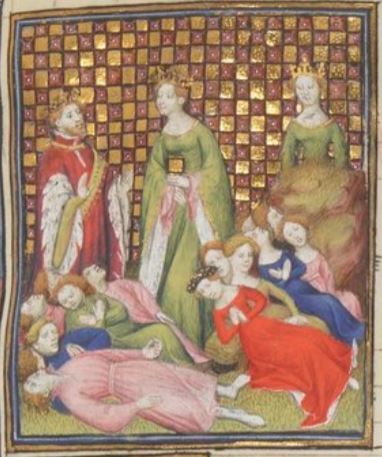
This illustration depicts Niobe, queen of Thebes, in the centre of the image with her many children lying dead in front of her. Niobe is looking over to her husband, King Amphion, who is on the left side of the image wearing a crown. Niobe had many sons and daughters with her husband which made her incredibly proud. Boccaccio explains that when the city of Thebes was making sacrifices to Latona, the mother of Apollo and Diana, Niobe declared that she was more worthy of the sacrifices than Latona because she had more children than her. Every one of Niobe’s children died of the plague as punishment for her hubris against the goddess.
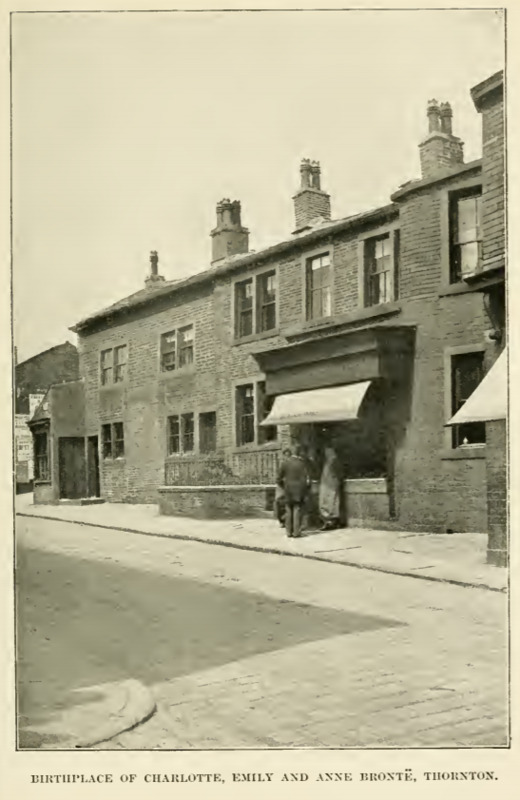
Here we see an image of the ruins of the house where Charlotte, Emily, Anne, and Branwell Bronte were born to Patrick Bronte and Maria Branwell. The house is a small townhouse in the town of Thornton in West Yorkshire. The family lived here until 1820 when they moved to Haworth. The house has been used for several purposes including as a butcher shop and a restaurant. In the 1990s it was converted into a museum that closed in 2007 and it returned to a coffee shop. This image is a reproduction of a photograph using a technique called photogravure, where photographs are taken on plates which could then be etched on to create a plate for use in a printing press.
In this image Gulliver is seated at a table looking at a Lilliputian carriage. There is a woman from the court inside the carriage that Gulliver speaks to. Two men are on the edge of the table talking to each other. These men are the driver and the finance minister. They had come to inform Gulliver that he would have to leave Lilliput as it was too expensive to keep him there and feed and clothe him. The same image appears in the 1839 Krabbe edition.
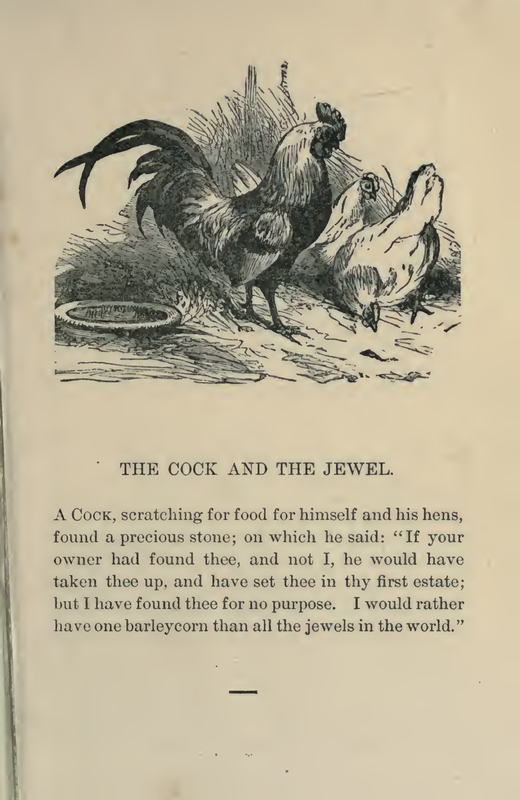
A cock stands tall in the center of the image. To the right of the image, there are two hens. The one in foreground is bent to the ground, picking at it, while the other in background is looking at the cock from the side. Behind the cock is a bow either for their water or food.
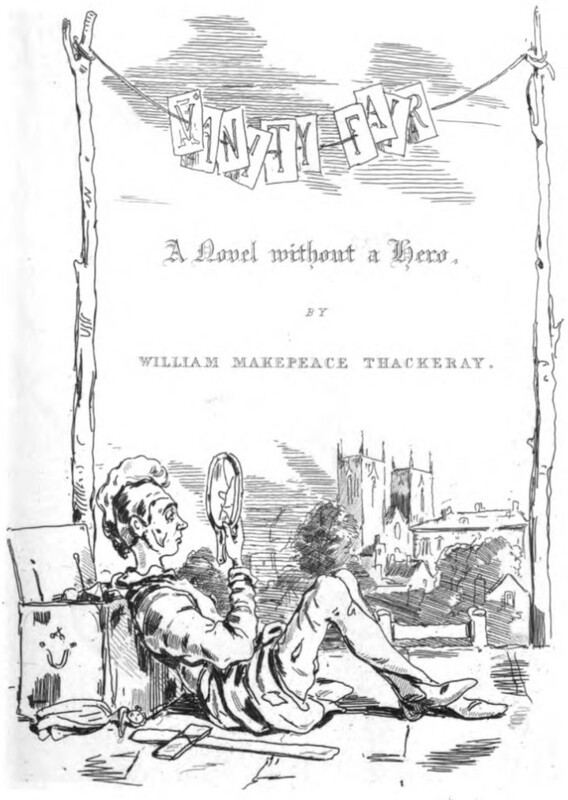
Two sticks-the left one forked, the right one pointed-hold up a banner with the title Vanity Fair. Each letter is on a separate piece of paper, connected by a string tied to the sticks. Beneath the banner is printed the subtitle and author, A Novel without a Hero. By William Makepeace Thackeray.. At the base of the banner, a haggard man with a plumed helmet is lounging against an open chest, holding up a mirror from which he peruses his reflection. By his side are a doll and what appears to be a handmade axe or hammer, with a flat rectangular stone or piece of wood tied to a longer, thinner stick. In the background can be seen trees, a fence, and several buildings.
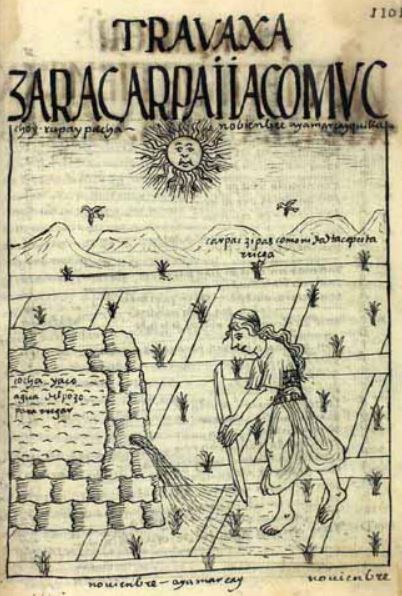
This image is reflected in the final chapter of Ayala’s chronicle where he provides a description of labours and festivals that occur in the rural areas of the Spanish colonial Andes during each month of the Inca calendar year. This image depicts the month of November which was a time for watering corn fields to ensure their growth. This was also a month of great heat which caused water shortages. The sun is shining bright above the Andean mountains with birds flying in the sky.There is an indigenous woman illustrated standing in a corn field that is organized in a grid pattern. She is taking care of the corn by watering them. The caption above her head reads carpac zipas comonidadta capcita rriega [young one who waters the community, sowing the fields]. There is a water irrigation system on the left side of the image which has water pouring out onto the field. The caption written on the water reads cocha yaco, agua del pozo para rregar [well water for irrigation]. The caption at the bottom of the image reads nouienbre, aya marcay [november, twelfth month].
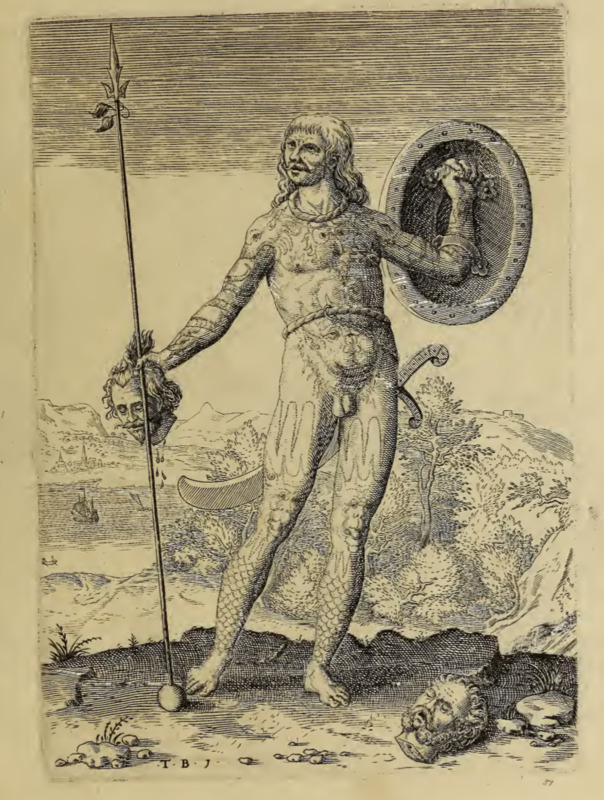
An Indigenous man is shown from the front. He carries a shield strapped to his left forearm and a long spear in his right hand. Also in his right hand is a severed human head, another head lays on the ground at his feet. His hair is long, he wears a twisted cord around his neck, and a sword with a curved blade hangs from another cord around his waist. He is nude, and his body is covered in painted designs. The Picts were an Indigenous group who lived in Britain long before the author’s time. Images of Picts were included in this book so that readers could compare their customs to those of the Indigenous people living in Virginia.
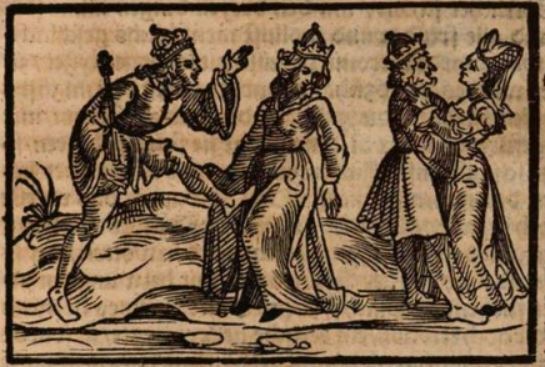
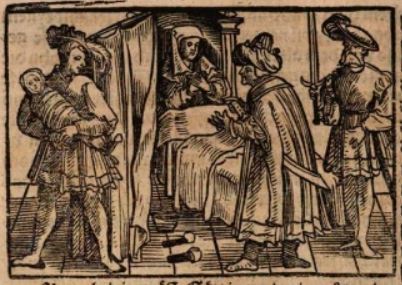
This engraving depicts two separate events. The scene on the right side of the engraving depicts a woman named Sabina Poppaea, a woman of noble birth, seducing Emperor Nero. She was incredibly beautiful, as well as cunning. She sought power and found it by marrying Emperor Nero, although she did not hold her power for long. The left side of the engraving depicts her tragic fate. Emperor Nero is depicted kicking a pregnant Sabina Poppaea out of rage, which ends up killing her.
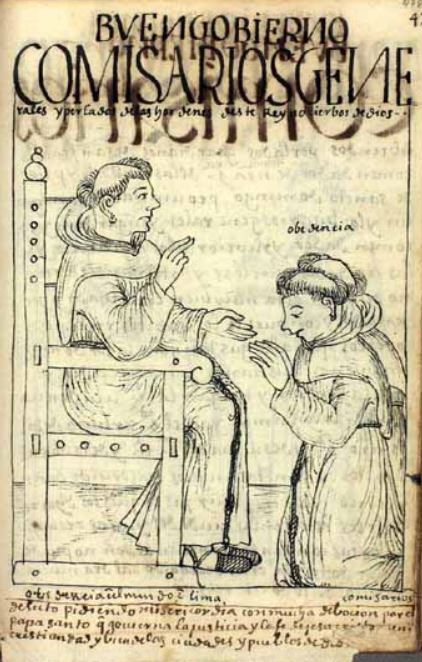
The author spends this section of this chapter discussing religious establishment in Peru and the Church’s hierarchy. This image depicts the commissary religious officials that governed in Peru. This religious order would help govern certain smaller towns and districts in Spanish conquered Peru. There is an ecclesiastic depicted sitting in a chair on the left side of the image as he speaks to two other clergymen who are kneeling before him. There is a word written above the two kneeling clergymen which reads, obedienca [obedience].
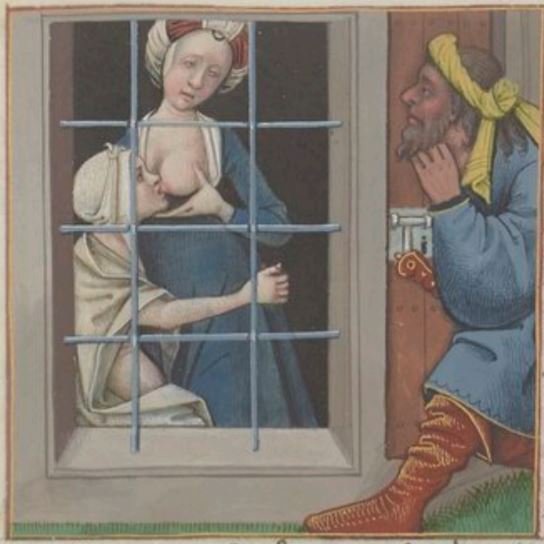
This illumination depicts a young Roman woman behind the window of a jail cell giving her mother her own breast milk. Boccaccio explains that an elderly woman had been sentenced to starve to death, and her daughter saved her by feeding her with her breast milk. There is a guard in front of the jail cell window looking at the two women. The guard told the triumvirs of the young woman’s filial devotion to save her mother and was so impressed that they freed the mother.
Ops (also known as Opis), the wife of Saturn, is depicted laying in a bed after just having given birth to her children: Jupiter, Neptune and Pluto. Jupiter is illustrated being carried away to safety by a servant on the left side of the engraving. Boccaccio explains that Saturn and Ops’ brother, Titan, planned to kill the newborn babies to avoid them growing up and defeating them. Saturn is illustrated with his hands outstretched towards baby Jupiter. Titan is at the foot of Ops’ bed with a sword in his hand.
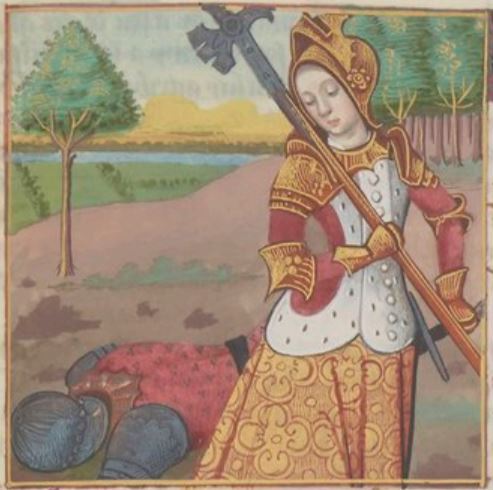
This illumination depicts Berenice, the queen of Cappadocia, wearing armour and holding an axe as she looks down at the person she just killed. Boccaccio explains that Berenice’s brother, Mithridates, had her sons killed. Caeneus, a servant to Mithridates, is the person who carried out the murder of Berenice’s sons. To avenge her sons, Berenice murders Caeneus. Boccaccio explains that Berenice ran over Caeneus’ body while driving a chariot, however, this illumination does not depict the chariot.
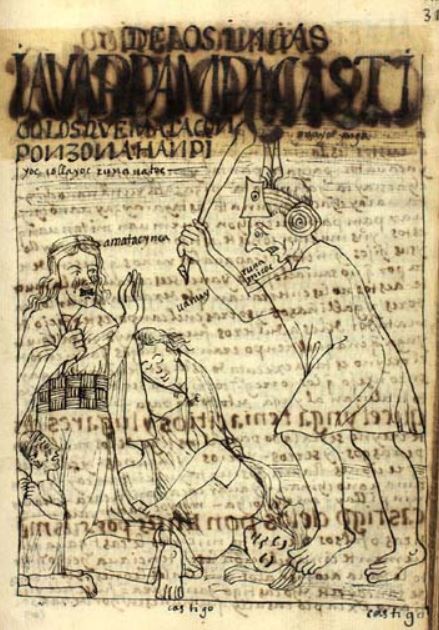
This chapter is dedicated to discussing the justice and punishment systems of the Inca Empire. The author discusses five methods of punishment in detail, and this image represents the fifth punishment. This punishment was given to those who used potions and poisons to kill others. The author describes them as sorcerers. The sorcerers who were convicted of this crime were sentenced to death. Their entire lineage, apart from babies, were also sentenced to death to avoid future sorcerers. The author explains that these people were not granted burials and were left to be eaten by animals. This image depicts a sorcerer on the left side of the image about to be killed by an executioner on the right side of the image. The executioner is illustrated holding what appears to be either a long sword or a club. The words amatac ynca [No, Inca] are being spoken by the sorcerer as they hold up their hand in fear, while the executioner says uanuy runa micoc [die, man-eaters]. The sorcerer’s family is depicted lying dead on the ground after having already been executed. There is a small child still alive and crying in the bottom left corner.
An army of soldiers wearing armor and holding spears and shields are walking out of a castle. Weeds and plants come out of the ground they are walking on. The first soldier walks by himself, while the others behind him walk in groups of two.
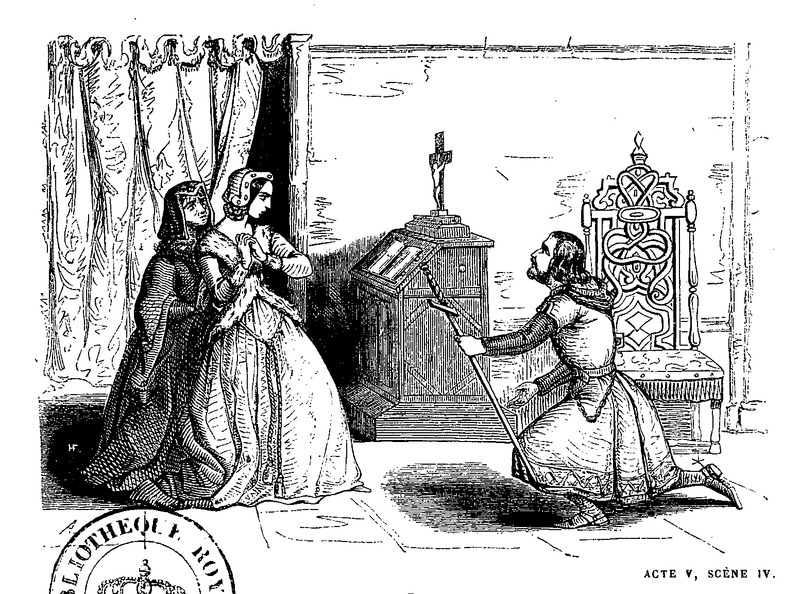
As Elvire looks on, Chimène reacts in horror to the apparent fact that Don Sanche has killed Rodrigue, prompted by Sanche’s return with blood on his blade following their duel. In reality, Rodrigue beat Sanche and let him live, which will be revealed to Chimène shortly. Sanche is seen on the right, holding out his sword, while Elvire and Chimène stand on the left in front of a lectern.
Here we see two horses pulling a carriage. The Houyhnhnms asks about the horses in Europe and how they live. Gulliver explains that humans or yahoos govern the country and care for the horses or Houyhnhnms. Gulliver tells his master that the horses in Europe were used for their strength and speed to pull carriages and chariots, racing, and travelling. The same image appears in the 1839 Krabbe edition.
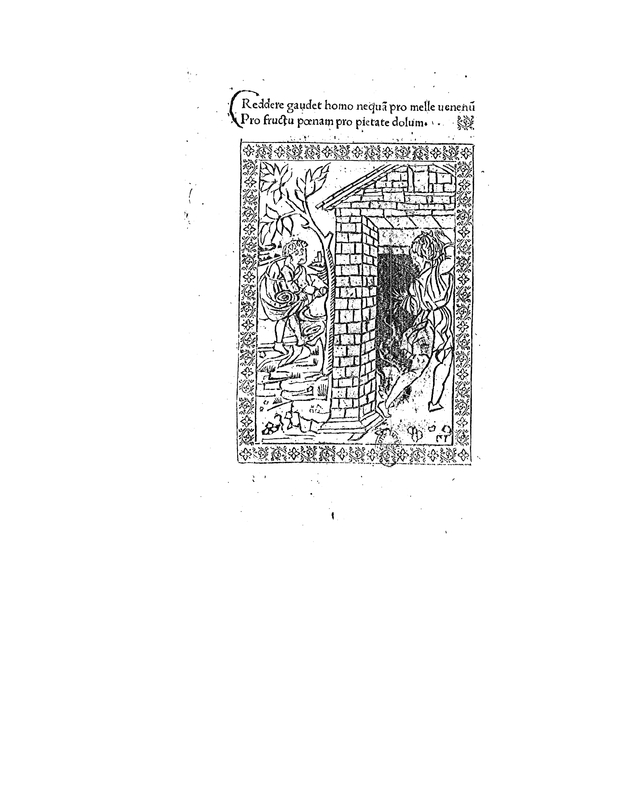
On the right side of the image there is a person who is being bitten by a snake and is in distress. On the left side of the image there is a man who appears dazed, hunched over and grabbing the bottom of his robe.
A small Tupinambá village is shown. There is a fence around part of the perimeter facing the ocean. There are four long structures arranged in a square. A path leads from the village to the ocean where several canoes are anchored along the shore. A group of Indigenous Tupinambá women with braided hair, two of whom have infants in carriers on their backs, dance in a circle around a bearded man who wears a feathered headdress in the center of the village.
In this image there is a man with a severed head named Martín Gonzáles and on top of him is El Cid. Martín is on the floor with his head severed wearing a tunic and pants. Blood is pooling out of his head and head stump. Lying next to him are his sword, helmet and shield. On top of him El Cid is addressing the crowd. He is wearing a tunic with a belt across his waist. On his chest the symbol of a lion can be spotted. Under his tunic he is wearing chainmail, which is also covering most of his head. In his hand he is holding the sword that he used to decapitate Martín. A gate made out of wood is separating the spectators from the arena and behind the spectators a castle is visible. In the arena there is also a man on his horse presumably a soldier.

![Don Jv[an] Capcha Indio Tributario, Gran Borracho, Tiene Quatro Yndios en su Pueblo](https://collections.cemvc.ca/files/large/3b309d4507c396468e48ffd175fb5971cadb27b4.jpg)
![[Mr. Chopper]](https://collections.cemvc.ca/files/large/9a2bd45d2a993483afeb5ccf5ad4922fc1b6b284.jpg)
![[Gulliver speaks with Lilliputians in a carriage]](https://collections.cemvc.ca/files/large/fdf2c99f50f16e69f48ef8e8f1cf3d182337fe21.jpg)
![[An Army of Soldiers]](https://collections.cemvc.ca/files/large/2f1742d115251a69d010b02e90039a349cbee6c1.jpg)
![[horses pulling a carriage]](https://collections.cemvc.ca/files/large/a021fe3f4a018682b1eeecb0f8674e4e1ee47260.jpg)
![[Tupinambá women dance around a bearded man in a village]](https://collections.cemvc.ca/files/large/91bf2a736d85615ad827a3b674c7ac6b5b6327d3.jpg)
![[The Cid killing Martín Gonzáles in a contest]](https://collections.cemvc.ca/files/large/115df9672ee11cee34c1178c44888ad6d50ebad9.jpg)