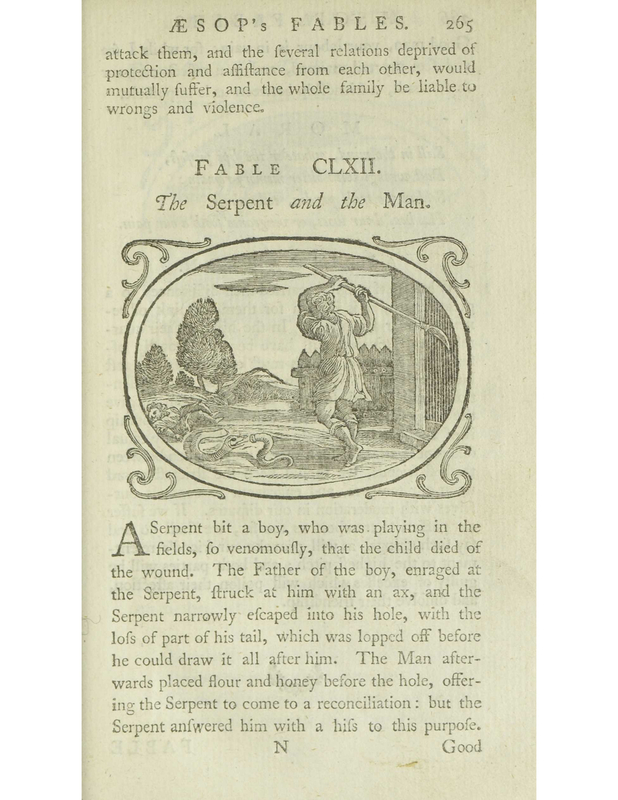
A snake whose tail has been chopped of hisses and a man. The man has a weapon raised above his head aimed at the head of the snake. Behind the snake a boy lies dead. He is the son of the man that is trying to kill the snake.
There are two animals sitting in a bush: a fox and a lion. They are both facing each other with the fox on the right side of the image and the lion on the left. The lion seems to be growling at the fox, while the fox sits confidently and upright, showing no sign of fear.
Inside of a triangle, a woman leans over a large trophy with one hand on her chin. At the base of the trophy are a cross and a shape that may be a sphinx or a large dog. Beneath the triangle, the word SACRED is printed. Above the left side is a cut-off, layered rectangle, and above the right side is the letter T from The.
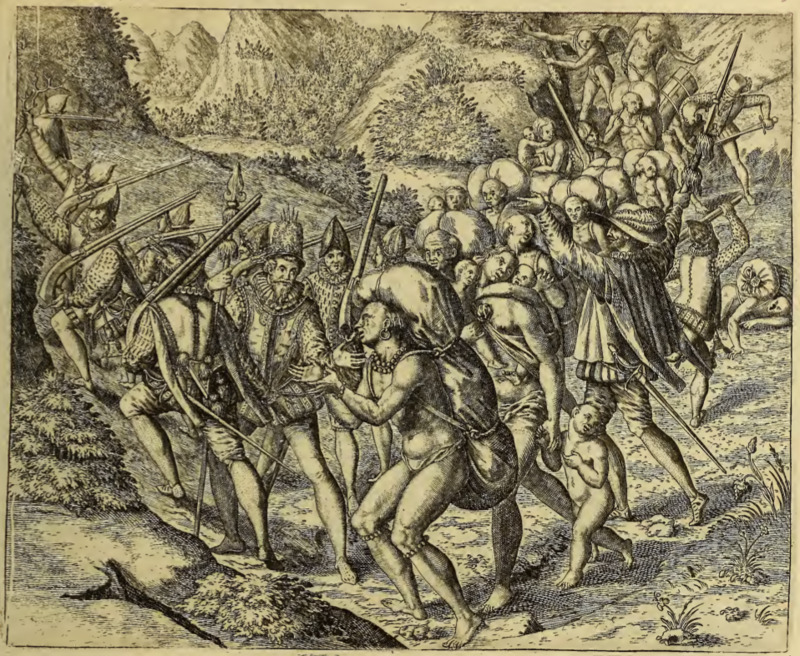
A group of Indigenous men, women and children have been captured by the Spanish and are forced to march to a new location. Many of the Indigenous men carry large bundles on their backs while the women carry the smallest children. The Indigenous people are surrounded by Spaniards carrying thin swords and muskets. Near the front of the group, an Indigenous man with strands of beads around his neck, wrists and knees converses pleadingly with a Spanish man walking near him. One Spaniard beats an Indigenous man who has fallen near the back of the group.
A boy is chasing a deer in a field. He is holding a crook in his right hand. A dog is also chasing the deer. There is a farmer in the background pushing horses along to get the field ready. A herd of sheep are around the field.
In this image, Gulliver lies on the ground, reclining, speaking to the Lilliputian Emperor. The Emperor is identified by his cape, hat with three feathers, and sword. This image comes while Gulliver gives a detailed description of the Emperor. The same image appears in the 1843 Krabbe edition.
To the left of the image, Miss Jemima is standing in front of a window, from which she is watching the arrival of the Sedley carriage. Miss Pinkerton, wearing a feathered turban, is in the foreground. She is seated at her desk with feet on a raised footrest and writing on a sloped block.
Elicia tells Sosia that Areusa wants to speak with him. Some time later, Elicia goes to Areusa’s house to see if he has visited her yet. Soon after she arrives, Sosia knocks at the door, and Elicia finds a place to hide. Areusa manages to manipulate Sosia into divulging where, when, and how Calisto enters Melibea’s garden, and he discovers to her that Calisto will be paying Melibea a visit that night. Areusa tells him that she has other matters to deal with, and Sosia departs. To the left of the illustration, we see Elicia in hiding. She is wearing a robe and a veil. In the foreground we see Sosia walking toward Elicia with his hat in his right hand. He also has a sword mounted on his belt (seen above his right leg). Areusa is wearing a robe and a veil. She appears angry in her expression, and her arms are outstretched toward Sosia.The entire image is identical to the one found on page 54 of the text.
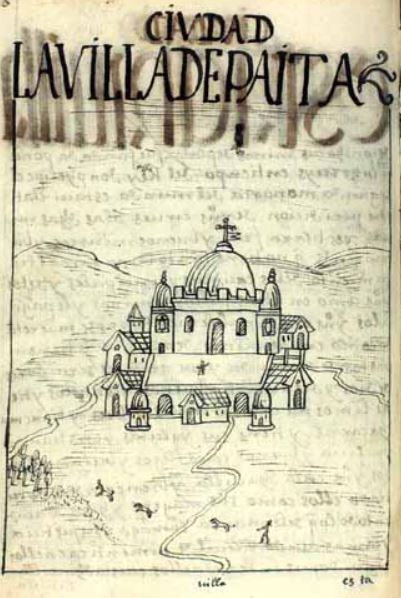
This image is depicted in the author’s chapter where he discusses cities, towns, villages, and provinces in colonial South America. This image depicts the small town of Paita in Northwestern Peru. The town is comprised of a cluster of buildings that forms a square in the centre. There is a person standing in the centre of the square. There are soldiers and dogs outside the city walls. The author explains that the city had good soldiers and horsemen, good Christians, and plenty of food and sustenance. He also explained that the city was conquered by the Spaniard Francisco Pizarro. The caption at the bottom of the image reads uilla [towns].
Here we see a statue depicting Justice in Lilliput. Justice is represented by a woman who holds a bag of coins in one hand and a sword in the other. She sits on a podium with two eyes on the front, one on either side, and another two on the back (the side and back eyes are not visible in this image) meaning that Justice sees everything. The podium is placed in a recessed archway with a set of scales on either side. Two Lilliputians stand in front of the statue looking up at it, while three guards stand on the right, in the shade of the statue. The same image appears in the 1839 Krabbe edition.
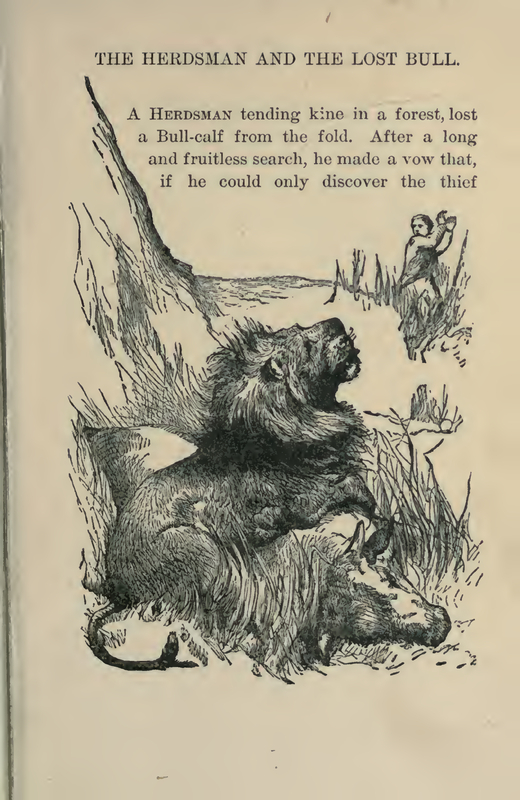
A lion lies atop a bull next to a tree. A herdsman is seen farther off in the background, and the lion is looking in its direction. The man is looking to the left, with his hands up in the air to the right, cupped as though he was calling out to someone, or attempting to grab onto something.
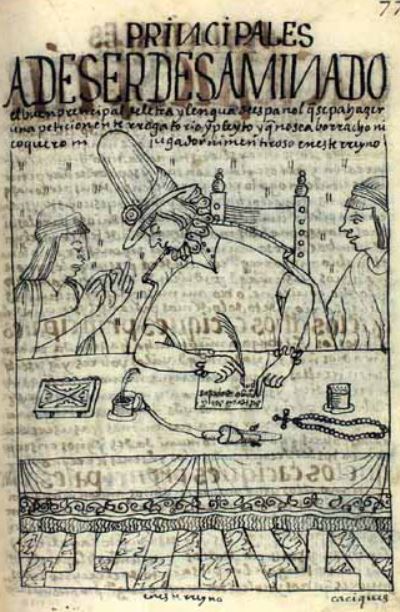
This image is illustrated in a chapter that discusses the descendants of the Inca and Andean nobles under Spanish colonial rule in Peru and their importance to a revived Andean society. This image depicts an Andean lord sitting at a table writing on a piece of paper. There is a book, a rosary, and ink for the noble’s quill on the desk. The noble appears to be writing down a grievance being proclaimed by the indigenous person standing to the right of the lord. The letter being written by the noble reads, del terzio de san juan pago 80 pesos pedro n [for the first half of the year 80 pesos were paid by Pedro N]. The author explains that noble lords should be educated in the Spanish and Quechua language in order to draw up written documents like petitions, lawsuits, and questionnaires to be able to defend native subjects.
A small figure in a Roman helmet and uniform holds onto a pole twice as tall as he is. The pole is tipped with a spear point and a trailing banner is tied to it with a tasseled rope. The banner itself is decorated with symbols similar to the letters A and C overlapping, while the tails curls to form the letter E from Enemies.
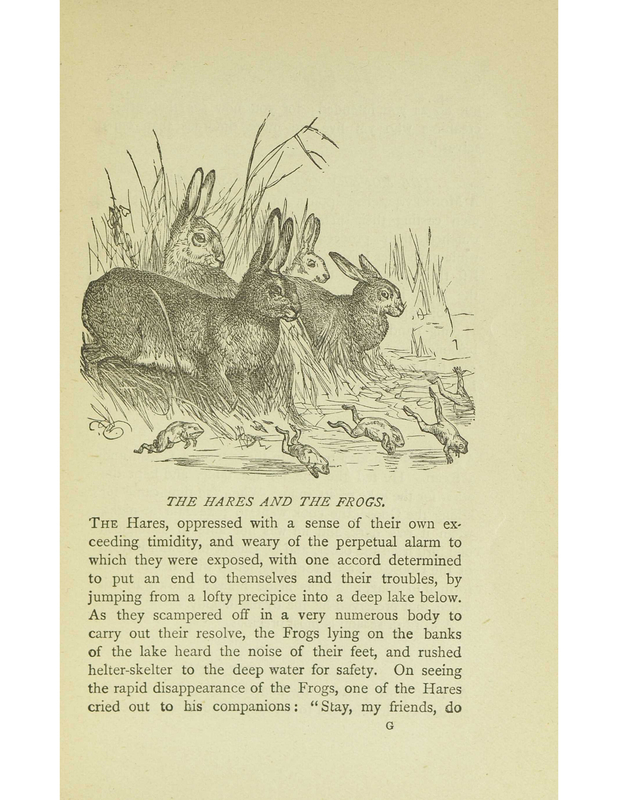
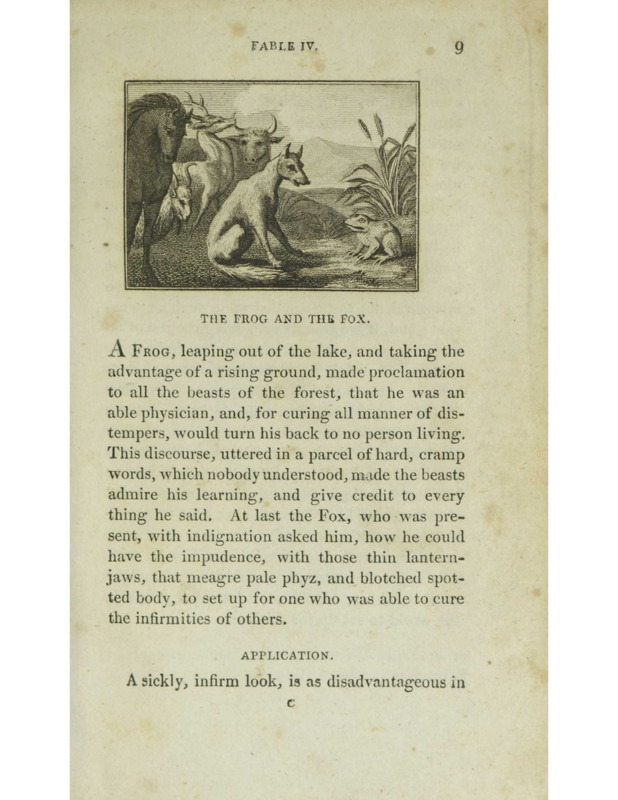
A group of four hares are hiding in tall grass near a lake. Two are bracing themselves near the border of the lake, while the other two remains hidden in the grass, looking are their two fellows. Five frogs are jumping from the dry land into the lake.
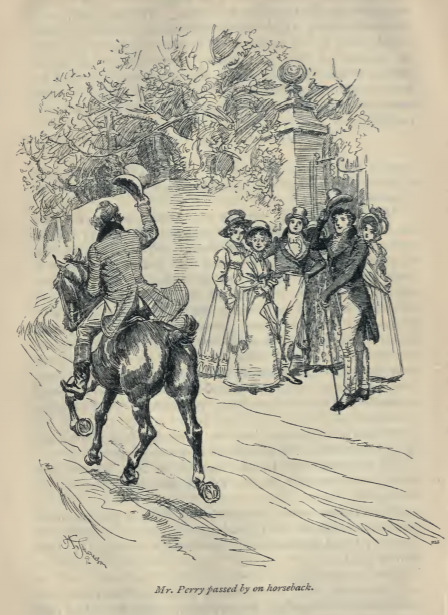
In this image we see Mr. Perry riding past Emma, Harriet, Mr. And Mrs. Weston, Frank Churchill, Miss Bates, and Jane Fairfax. Emma, Harriet, and Frank Churchill were out for a walk, and happened upon the others. They all walked back together towards Harfield. They passed Mr. Perry who was leaving Hartfield from his daily visit to Mr. Woodhouse. This scene occurs in chapter 40. The characters are shown in the traditional regency style. The women wear regency style dresses with empire waists and bonnets. The men wear waistcoat and tailcoats with top hats. The regency period dated to the early nineteenth century (1811-1820) when George, Prince of Wales, later George IV (r. 1820-1830), reigned as regent for his mentally ill father, King George III (r. 1760-1820). The regency period is associated with the rise of neoclassicism in art and fashion.
In this image we see the Lilliputian Emperor, Empress, and Prime Minister playing a game to determine the hierarchy of the court. The process involves courtier walking underneath sticks of different height. Depending on the height of the stick – held by the Emperor and Prime Minister – the participants are awarded different coloured uniforms. The uniforms are either blue, red, or green, and these colours indicate their place within the court. This episode was understood as a satire on the process of gaining knighthood in the English Court, where appointment as a Knight appeared to be based not on objective merit of the honour, but rather on the whims and bribes of King George I. The same image appears in both the 1839 and 1843 Krabbe editions.
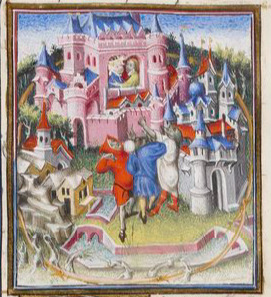
Dido purchased a piece of land on which she would create Carthage by making a deal that the size would be only as large as the area that an ox hide could cover. She was very smart, and cut the hide into thin strips, creating a much larger property than the sellers expected. The hide is represented in the image as the brown circle encompassing the people and the buildings. In the window of the palace, Dido prepares to commit suicide in front of Aeneas. Onlookers watch in despair, seeing what she is about to do.
There are two men in this image. one man is in a boat in the water blowing into an instrument. The other man is beside him on land, holding a net full of fish. One fish is on the ground out of the net.
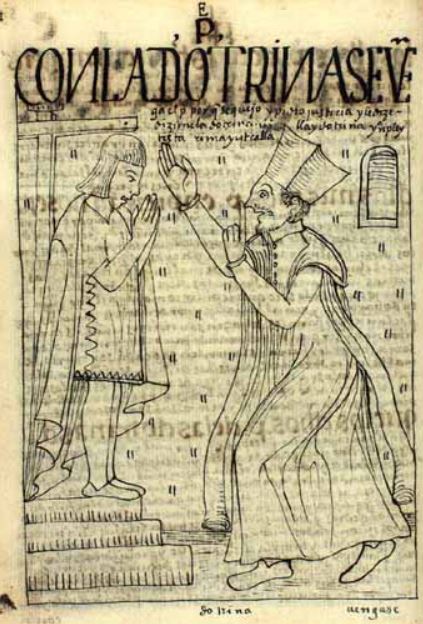
This image is illustrated in a chapter that discusses the Christian priests in the colonial government in Peru. The author criticizes parish priests for their mistreatment of the indigenous peoples of Peru. This image depicts a parish priest punishing an indigenous man for having issued a complaint against him to civil authorities. The parish priest is on the right side of the image wearing clerical adornments as he holds his arm out towards the indigenous man on the left. He is forcing the indigenous man to recite the doctrine. The indigenous man is standing on a platform with his hands together in prayer as he follows the priest’s orders.
Two sticks-the left one forked, the right one pointed-hold up a banner with the title Vanity Fair. Each letter is on a separate piece of paper, connected by a string tied to the sticks. Beneath the banner is printed the subtitle and author, A Novel without a Hero by William Makepeace Thackeray. At the base of the banner, a haggard man with a plumed helmet is lounging against an open chest, holding up a mirror from which he peruses his reflection. By his side are a doll and what appears to be a handmade axe or hammer, with a flat rectangular stone or piece of wood tied to a longer, thinner stick. In the background can be seen trees, a fence, and several buildings.


![[Vanity Fair Vol. II Chapter XXXV Inhabited Initial]](https://collections.cemvc.ca/files/large/da0b0a2ec82b45fc3df6119c5801185eeae05be5.jpg)
![[The Shepherd's Boy]](https://collections.cemvc.ca/files/large/ebaa8e880233a36e1ae5f6311a0c5d8101bec1bd.jpg)
![[Gulliver speaks with the Lilliputian Emperor]](https://collections.cemvc.ca/files/large/0670c67e073519a7e0873c51473037f01bd243b8.jpg)
![[Miss Pinkerton and Miss Jemima]](https://collections.cemvc.ca/files/large/0d3da0b1a1db069197f538a582c8676c2032e30f.jpg)
![[Act XVII] Elicia spreect teghen haer zelven.](https://collections.cemvc.ca/files/large/0994db766df98ea10914b6f950bdb3525626f693.jpg)
![[Statue of Justice on Lilliput]](https://collections.cemvc.ca/files/large/180265692cb6fab3d0323b77fce1d47c9b2c66ae.jpg)
![[Animal Eats Human]](https://collections.cemvc.ca/files/large/f9cd0f5b2b3170cbcd37f05af68a86219af49f92.jpg)
![[Vanity Fair Vol. I Chapter XXII Inhabited Initial]](https://collections.cemvc.ca/files/large/d6d6bfde087cc2987ecfa02b0632101e96286b45.jpg)

![[Lilliputian nobles play a game while Gulliver watches]](https://collections.cemvc.ca/files/large/f7b6ceccd0b9a0b12542b0613d23bab1921dc9b8.jpg)
![[Men fishing]](https://collections.cemvc.ca/files/large/6f4006bb8455cace4541c9d953d4d4d3abd29f8d.jpg)
![[Vanity Fair Vol. II Title Page]](https://collections.cemvc.ca/files/large/fe6008335cffa17a7ced29f2732b41de853d82cc.jpg)