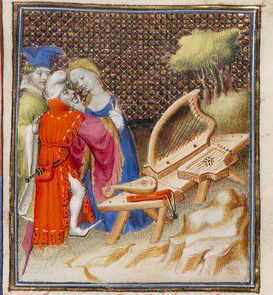
Sempronia was an excellent dancer, singer, and musician. Her musical instruments are seen on the far right of the image lying on a table. When she danced, however, she was very lustful, and sought out many men. This is represented on the left of the image, where Sempronia embraces a man and is surrounded by others.
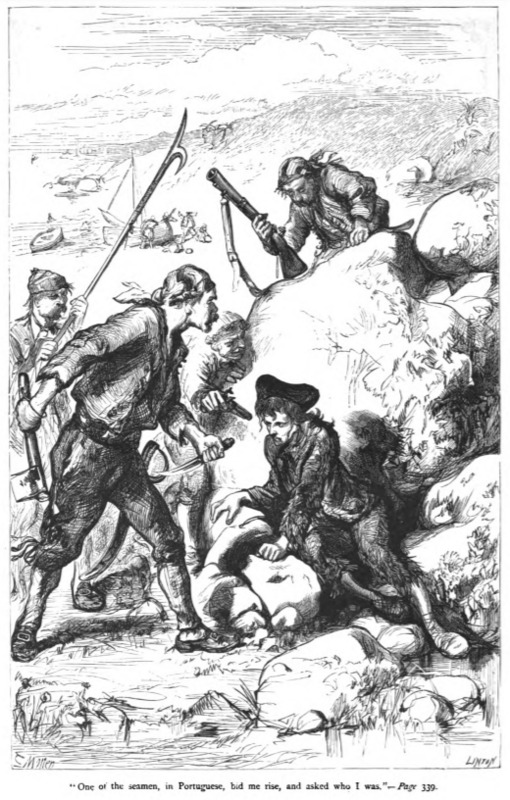
After leaving the Country of the Houyhnhnms, Gulliver arrived in New Holland. There, Gulliver met Portuguese sailors who introduced him to their captain. The captain then helped Gulliver to become acclimated to humans again and brought him to Lisbon. From Lisbon Gulliver returned to England.
Here we see Gulliver encountering the farmer giant’s cat. The cat has its eyes set on Gulliver, with its ears back and whisker’s spread, a sign that the cat is interested in something and wants to catch it. A bowl separates Gulliver from the cat. Gulliver is standing on the edge of the table, leaning back in alarm. This image highlights the difference in scale between the giant’s world and reality. The same image appears in the 1839 Krabbe edition.
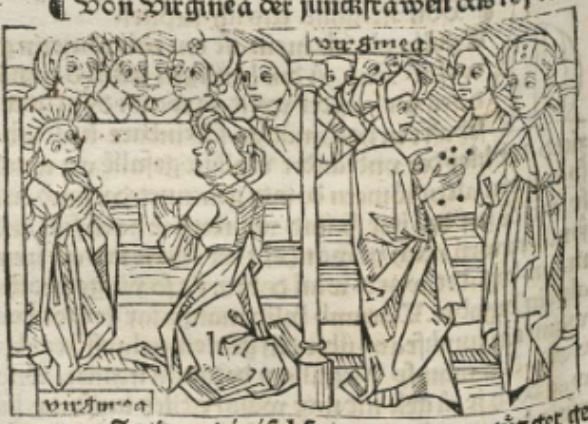
Verginia, a noble Roman woman is depicted in this engraving in both the right-hand and left-hand scenes. Her name is engraved as Virginea on both sides. Boccaccio explains that Verginia, despite being a noble woman, was cast out of a temple in Rome by the other noble patrician women due to her being married to a plebeian man. The left side of the engraving depicts Verginia at the altar with noble women surrounding her as they cast her out of the temple. The women appear to be dressed in clothing dissimilar to Verginia which is how Verginia can be differentiated. The right side of the engraving looks similar to the right side; however, the right side depicts Verginia with plebeian women. After being cast out of the Patricia Pudicitia temple, Verginia created her own temple and altar named the Plebeia Pudicitia, and opened it up to the plebeian class. The women on the right side appear to be dressed in clothing more similar to Verginia.
A scene depicting the simple and happy country life. A shepherdess is depicted sitting on a small hummock, where a man in uniform kneels before her, clasping her hand in his. Both are looking contentedly at the other. Her crook lies on the ground beside the hummock, and behind it is one of her sheep. In the background are a farmhouse and clocktower, and the top right of the image is the letter B from Besides.
In this image we see a Lilliputian seated in a sedan chair – a covered chair used in the Georgian era as a form of transportation. The sedan chair was carried by either two or four men around town. In this image, only the woman, wearing a long gown, who owns it is seen; the men who carried the chair are not shown. It is richly decorated, and the letter A is along the top. This is because it is the first letter of the word auch, which is the first word of the chapter. The same image appears in the 1839 Krabbe edition.
This engraving depicts Olympias of Macedon on the right side of the engraving approaching a man hanging on a cross. We know that this figure is Olympias as her name is engraved beside her body. The man being crucified is Pausanias, a man who helped Olympias with the murder of King Philip of Macedon (husband to Olympias). Boccaccio explains that Olympias placed the golden crown that Pausanias is wearing on his head to honour him and reward him for the assassination. Along with getting her husband murdered, she also had her husband’s new wife and child murdered out of anger. Cleopatra, King Philips other wife, is pictured on the left side of the engraving hanging by her neck on a tree. Her name is engraved above her head. Cleopatra’s child is depicted sitting on the ground as one of Olympias’ servants is bashing her head with a rock.
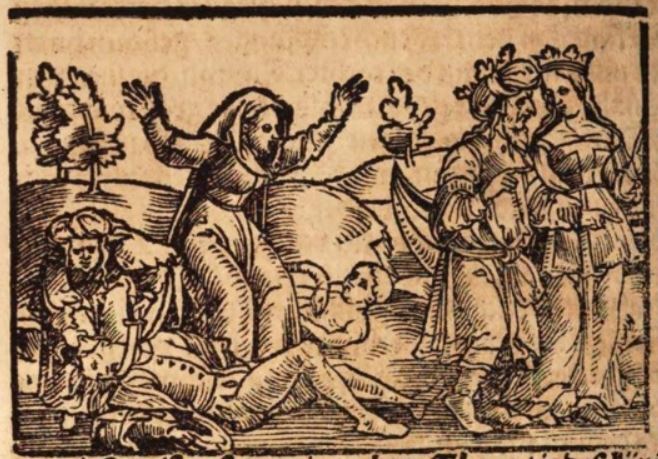
Hypsipyle and her father, King Thaos of Lemnos, are depicted on the right side of the engraving. Hypsipyle is depicted speaking with her father as she tells him that the women of Lemnos are planning to turn on all the men of the city and kill them. Boccaccio explains that Hypsipyle warns her father of the crime so that she can help him escape. There is a woman on the left side of the engraving with a sword in her left hand and a man’s head in her right as she carries out the plan to kill the men of the city. Later in life, Hypsipyle had a ward named Archemorus. He is depicted in the centre of the engraving, lying on the ground with a snake biting into his chest. This kills the child, and Hypsipyle is illustrated with her hands in the air as she grieves for him.
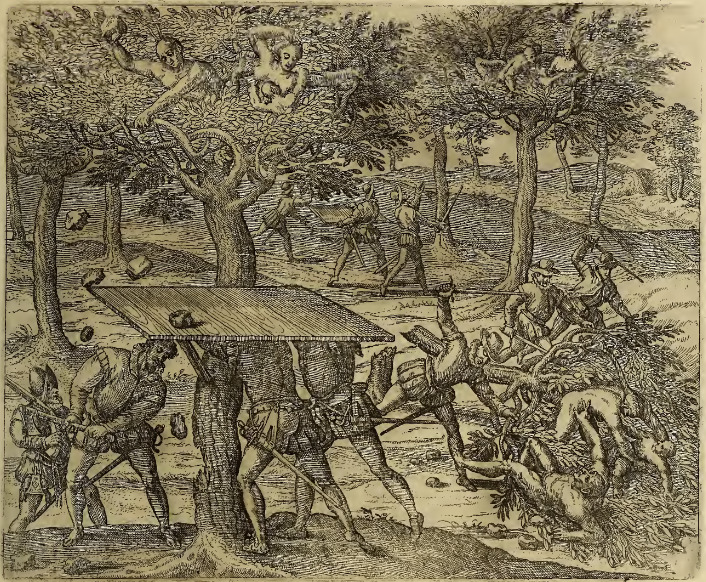
A group of Spaniards attack several Indigenous people in trees in the Atrato river region of present-day Colombia. The Indigenous people of the region built homes in the treetops because the land around the river was quite swampy. The Indigenous people throw rocks at the attackers on the ground below them and try to protect their children. The Spaniards use large wooden boards to protect themselves from the falling rocks while they try to chop down the trees with hatchets. They have successfully felled one tree and proceed to kill the family who lived among its branches with swords.
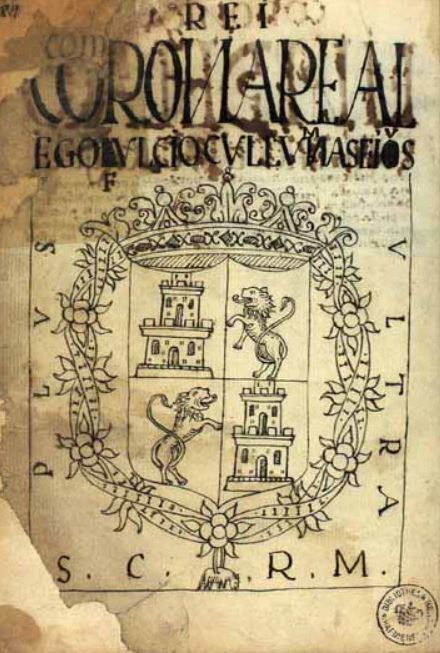
This is the final image in the author’s chronicle. It depicts the royal coat of arms of Castile. It is divided into four squares in which the top left and bottom right depict a fortification while the top right and bottom left depict lions standing on their hind legs. The coat of arms is surrounded by flowers and vines. The words plvs ultra [further beyond] are written on the sides of the coat of arms which is the motto of the country. The initials S.C.R.M are written below the coat of arms which stands for Sacra Católica Real Magestad [Holy, Catholic, Royal Majesty].
A group of Indigenous Brazilian woman, called ‘Amazons’ by the author, fight against a group of Indigenous Brazilian men who attack from the water. The women fight with bows and arrows, spears and shields, while the men in canoes use bows and arrows and clubs. The women are unadorned with their hair worn unbound. Some of the men wear feathered headdresses. This image is identical to one found in Frankfurt, 1557.
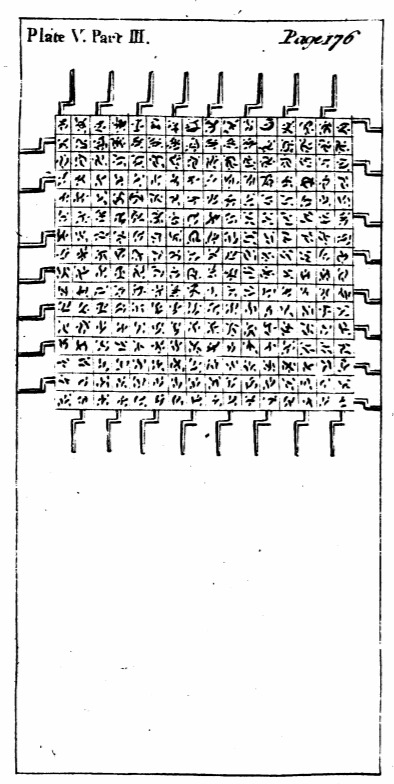
This image depicts an invention created by Laputan Projectors. The invention is to rework the Laputan language. On each of the squares is a symbol representing a phrase in the Laputan language. There are handles which would be turned to create different phrases which would then be analyzed. The same image appears in other editions of Gulliver’s Travels, including those in other languages.
Tom Stubble sits at one of the coffee-room tables at the Slaughter’s, writing a letter to his parents before his regiment leaves for Belgium. He is holding a pen against the piece of paper on which he has written only a couple of lines, and has his head drooped sadly into his other hand. On the table in front of him is an inkwell with another pen in it.
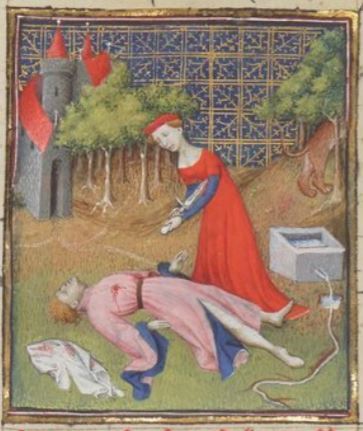
This illumination depicts a young maiden named Thisbe after finding her lover, Pyramus, dead in the forest. The lovers were meant to meet at the fountain depicted on the right side of the image where they would run away together. Boccaccio explains that when Thisbe arrived at the fountain, a lioness appeared, and she ran into the trees to hide. She left behind a cloak which the lioness picked up in her already blood-stained mouth. When Pyramus arrived, the lioness was gone, however she left the blood-stained cloak of Thisbe. Pyramus believed Thisbe to be dead, so he plunged his sword into his chest. There is a wound visible on his chest in the image as he lies on the ground. The blood-stained cloak of Thisbe is lying next to him. The lioness is illustrated in the background on the right-side walking into the forest. Thisbe is illustrated leaning over Pyramus’ body, as she reaches down towards his sword. She ends up using his sword to kill herself.
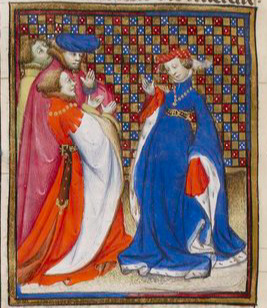
When Antonia’s husband, Drusus, died at war, Antonia locked herself away in solitude at her mother-in-law's house. There she decided she would preserve her chastity for the rest of her life. In the image, she is seen in a blue gown shooing away her suitors. Her suitors are to the left, looking on at her beauty.
Here we see a Lilliputian who is about to stick his sword into Gulliver’s nose, thus tickling Gulliver, causing him to sneeze, throwing the Lilliputian off of Gulliver. The same image appears in the 1843 Krabbe edition.
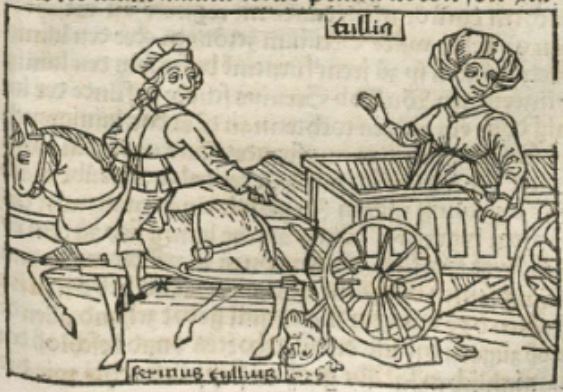
This engraving is unique as it was not an actual story included in Boccaccio’s original book. The engraver and compiler of this edition appear to have included this image and story as it relates to the following description about the Roman woman Lucretia. This image depicts Tullia, the husband of Lucius Tarquinius Superbus, and daughter of Servius Tullius. Tullia had helped her husband overthrow her father off the throne as the king of Rome in order to place her husband on the throne. Lucius Tarquinius Superbus had Servius Tullius assassinated, and his body was thrown into the streets where Tullia then ran his body over with a chariot. This image depicts this event, as Tullia is depicted riding in a horse drawn chariot as it crushes her father’s body underneath. Tullia’s name is engraved beside her and Servius’s name is also engraved beside him to identify them both.
This illumination depicts Queen Athaliah of Jerusalem on the far-left side of the image wearing a crown to symbolize her royal status. She is illustrated watching her servants holding children down as they stab them with knives. In order to gain complete control of her kingdom, Athaliah ordered her guards to kill all the descendants of David so that none could rise and take her throne. Unbeknownst to Athlaliah, a grandchild named Jehoash had escaped her wrath and grew up to overthrow her. In punishment for her cruelty, Athaliah was killed, which is illustrated in the top, right-hand corner of the image.
Amelia Sedley is seated in a one-armed chair in the corner of a room. The curtains on the window have been drawn back and she is gazing out while thinking about George Osborne.


![[A cat on Brobdingnag sees Gulliver]](https://collections.cemvc.ca/files/large/00ef057b013d3e3aa26a6afac2316fd43252a30e.jpg)
![[Vanity Fair Chapter XI Inhabited Initial]](https://collections.cemvc.ca/files/large/ef48eacee8e9d57023f2e8353638310989e5192f.jpg)
![[A Lilliputian woman in a sedan chair]](https://collections.cemvc.ca/files/large/f0c87ff6d5ae6b7b7faa43138ef6c316b2f07a90.jpg)

![[Indigenous Brazilian women on land in conflict with Indigenous Brazilian men in canoes]](https://collections.cemvc.ca/files/large/297ea5f8401f82dd6fc295a5f71a1d2c1f751b36.jpg)
![[Ensign Stubble Writing Home]](https://collections.cemvc.ca/files/large/c25e842956ad4e0800921a633741b06eee64938a.jpg)
![[A Lilliputian tickles Gulliver’s nose with his sword]](https://collections.cemvc.ca/files/large/9cc33cc7f38af72b881a4844d165acda9062fec4.jpg)

![[Amelia Watching the Moon]](https://collections.cemvc.ca/files/large/b42fcd16c6846f5db7a2c2418d32c64369285ed0.jpg)