Here we see donkeys who lived in the Country of the Houyhnhnms. This image appears when the council of the Houyhnhnms discuss the possibility of exterminating the Yahoos from the country. One argument for their extermination was that they caused considerable harm to other animals they encountered, including cows, cats, and donkeys.
Rawdon Crawley is at the saddler’s where he is receiving letters under the pen name of Eliza Styles from Rebecca Sharp. He is seated on the counter, reading his newest letter while twirling his moustache. The boy behind the counter is smiling up at him, and to his side is a saddle displayed over a beam.
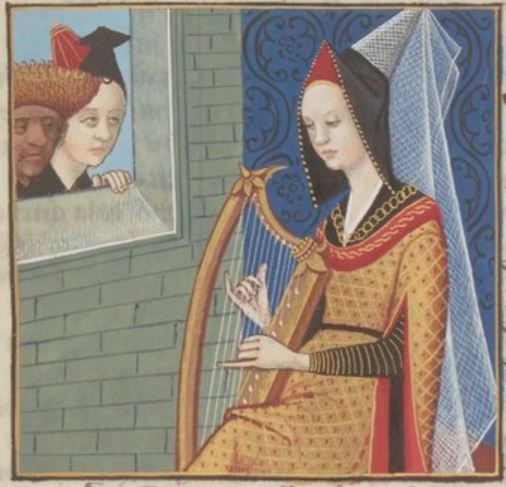
This illumination depicts a Roman woman named Sempronia as she plays the harp. Boccaccio explains that Sempronia was incredibly skilled at dancing and singing and would charm anyone that would hear her music abilities. There are two figures on the left side of the image looking into the window to listen to Sempronia’s music.
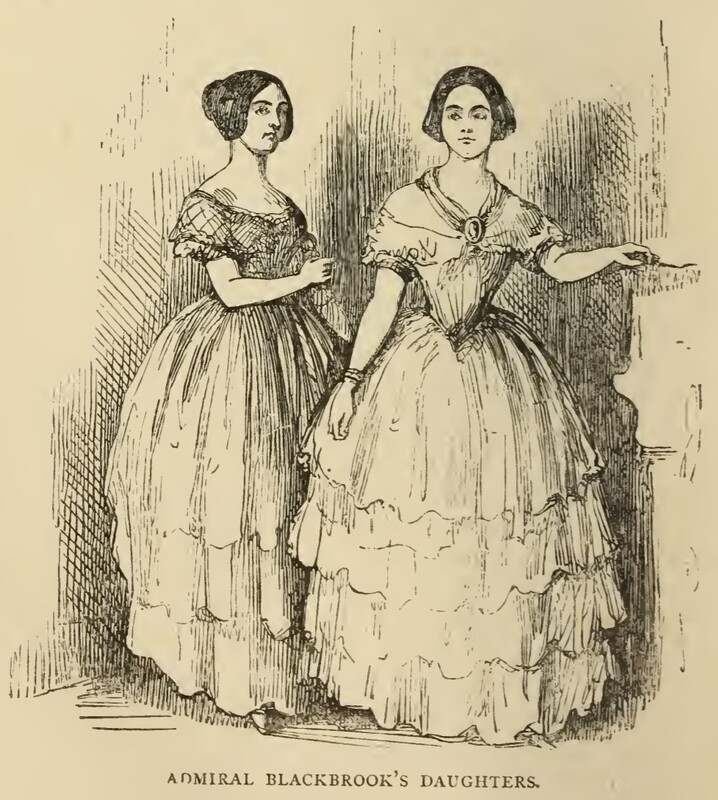
The Blackbrook sisters, daughters of Admiral Blackbrook, in dresses from London with unhappy expressions. The image is placed at the end of the chapter before their only appearance in the book.
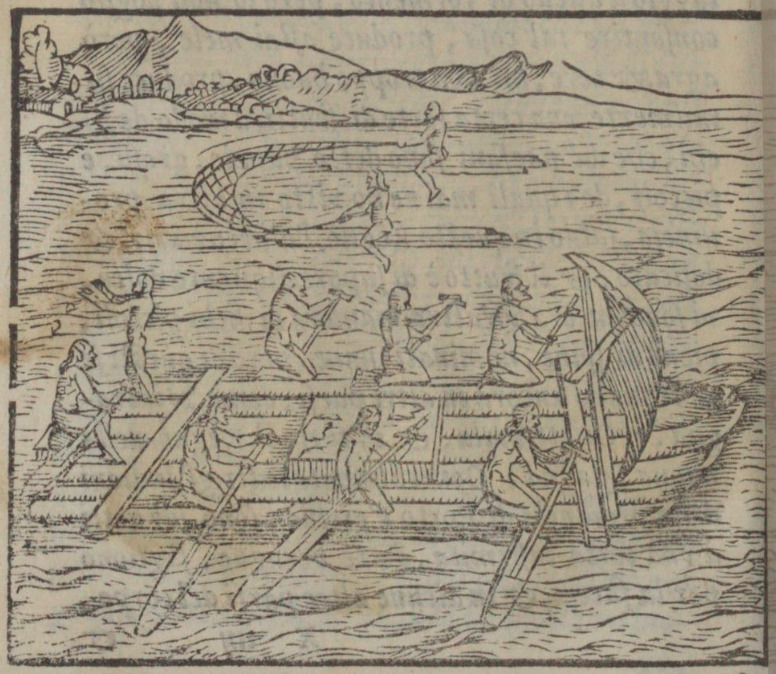
Eight Indigenous people sail near the coast on a large wooden raft. The raft has a single small sail at the fore end and a raised platform in the middle. Around the edges, six of the passengers row with large oars (three on each side). At the rear, one person sits on a raised bench with a smaller oar, and another person throws something into the water. In the background two people sit in the water on long, narrow wooden rafts. They hold a net between them to catch fish. This image is identical to one found on page 159 verso of Venice, 1565.
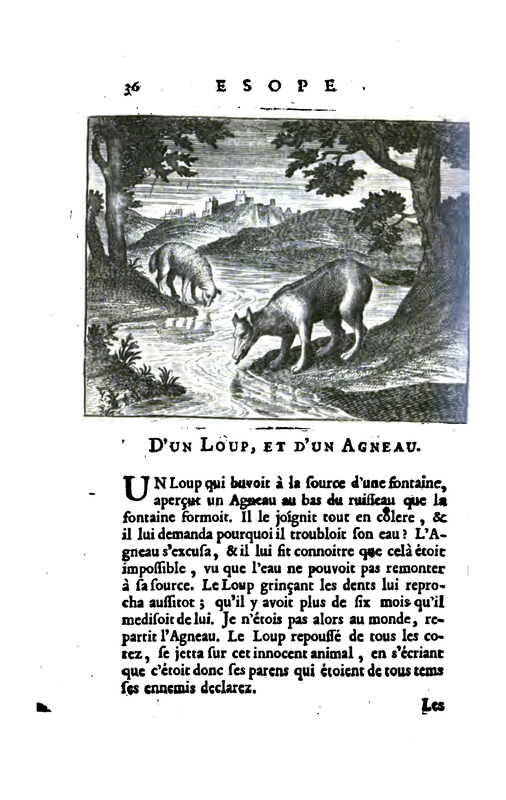
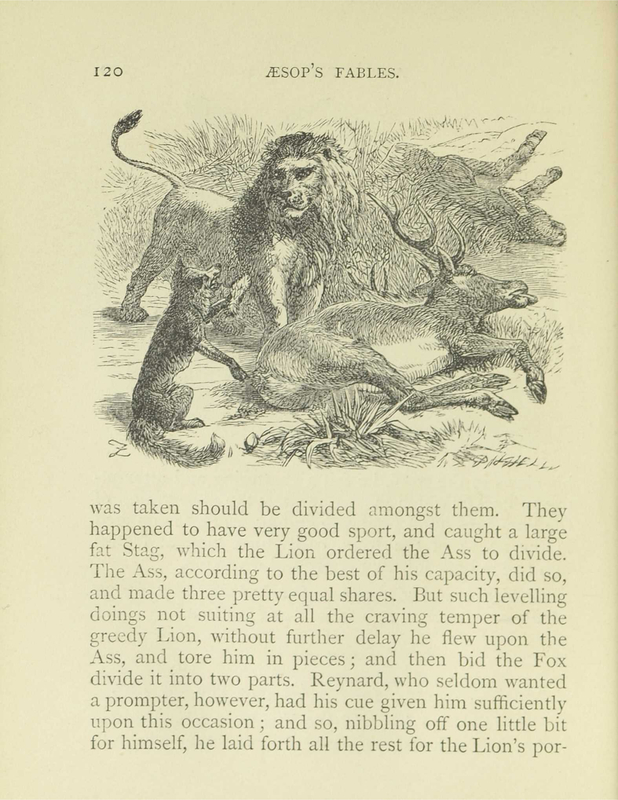
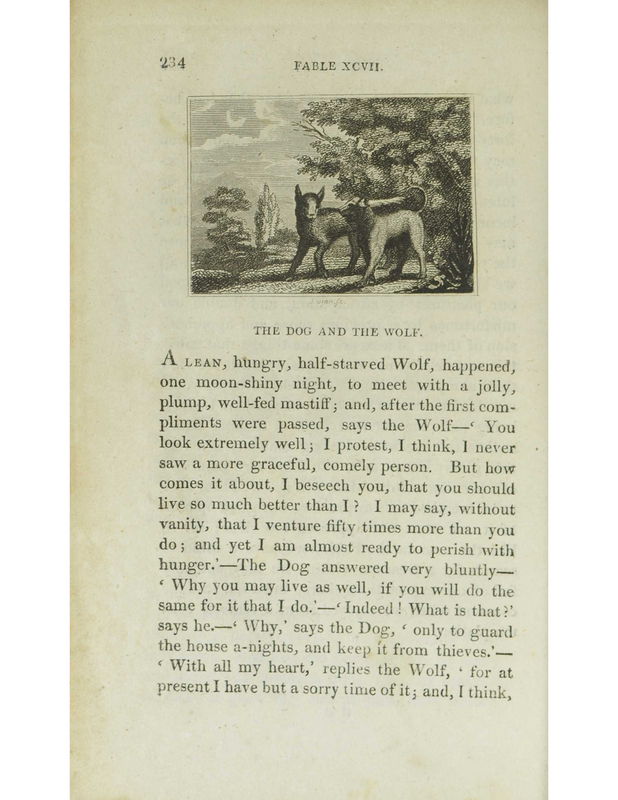
A lion gazes at a fox balanced on its hind legs. The fox occupies the left of the picture and is lifting up a paw to the lion. At the lions feet is a dead elk, to the right of the lion is a dead ass.
Here we see the Lilliputians taking an inventory of Gulliver’s belongings. In the foreground we see Gulliver’s sword and pistol. A Lilliputian is standing on a stack of paper counting bullets in the foreground. Two Lilliputians examine Gulliver’s comb, while others look at his telescope. In the background we see Lilliputians using sticks to carry Gulliver’s small box and pocket watch. In the distance we see other Lilliputians carry some other things on their heads and shoulders. The city skyline is visible in the background. The same image appears in the 1843 Krabbe edition.
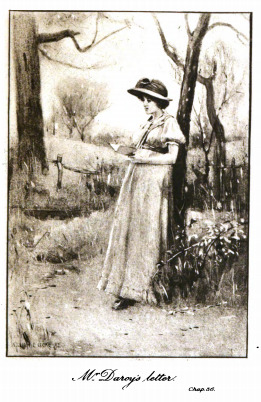
Here we see Elizabeth Bennet leaning against a tree, reading a letter from Mr. Darcy. In this letter, Mr. Darcy outlines the reality of the character and his relationship with Mr. Wickham. Mr. Wickham was a militia officer stationed in the town near Longbourn. He was very charismatic and Elizabeth’s sister, Lydia, ran away with him and got married, much to the distress of the rest of the Bennet family. Mr. Darcy disapproved of Mr. Wickham, as Wickham was Mr. Darcy's father’s godson, and Wickham tried to marry Darcy’s sister, Georgiana, in order to obtain her wealth. Wickham also inherited some money from Mr. Darcy’s father with the intention that he join the clergy, but he did not follow through with his clerical studies. In this letter he also explained why he split up Jane and Mr. Bingham, because he did not realize their mutual love. Darcy explained to Elizabeth that he thought Jane unworthy of Bingley and persuaded him to leave Netherfield. In his letter, he apologized for this misjudgment. The letter was intended to address Elizabeth’s accusations regarding his pride, and Elizabeth’s prejudices against him. The letter marks a shift in Mr. Darcy’s character and the beginning of the real love between Elizabeth and Darcy. This scene occurs in chapter 35 and is noted underneath the title of this image. The characters are shown in the traditional regency style, with Elizabeth wearing the regency style dress with an empire waist. Her hair is worn tied up, as was tradition for women after their coming out before the queen, signaling her entrance into society. She wears a bonnet to protect her face from the sun, common in regency style. These bonnets were a popular fashion because during this period one of the favourite pastimes of young women was going for walks, referenced frequently in Austen’s novels. The regency period dated to the early nineteenth century (1811-1820) when George, Prince of Wales, later George IV (r. 1820-1830), reigned as regent for his mentally ill father, King George III (r. 1760-1820). The regency period is associated with the rise of neoclassicism in art and fashion. The same image appears as an insert between pages 12 and 13 for the Dent 1893, 1894, 1895, 1896, and 1897 editions of Pride and Prejudice.
After the death of Sempronio and Pármeno, Calisto asks Sosia and Tristan (the two figures in the foreground) to accompany him to Melibea’s house. When they arrive at her house, they place a ladder on the high wall surrounding the garden (in this illustration it is depicted inside the garden, in the background to the left), and Calisto climbs over. He spends the night with Melibea (in the background to the left), and based on the dialogue, we can assume he takes her virginity. However, daylight begins its approach too quickly, occasioning his departure. He, Sosia, and Tristan return to his house, and he ascends to his bedroom to get some sleep. When he is alone, he laments the shortness of his visit with Melibea.This illustration is quite similar to the one found on page 4 of the text (folio a3v), in terms of composition.
El Cid is in front of Diego Laínez, a member of the nobility, with his son’s severed head in his hand. Diego Laínez is sitting in a chair wearing white robes and a hat. He has a beard and is sitting next to a table with a goblet and vase on it. The table is covered with a designed cloth. Under the table there is a chair. Behind Diego laínez there are two columns. El Cid is standing in front of the nobleman and is flaunting the head of his dead son. He has medium length hair and is wearing a tunic with the symbol of a lion on it. He is wearing a belt on his waist with his sword sheathed on it.
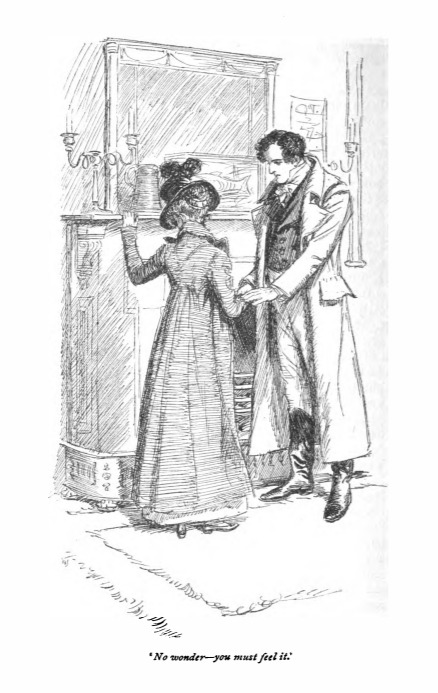
In this image Edmund comes to Portsmouth to bring Fanny and Susan back to Mansfield Park. Upon seeing Fanny for the first time in three months he notes that Fanny looks ill. He then attributes it to her worrying about the scandal with Maria and Mr. Crawford who had been pursuing Fanny. The reality was that Fanny had not been eating well due to her parents' poverty. This scene occurs in chapter 46. The characters are shown in the traditional regency style. Fanny wears a regency style dress and coat with an empire waistline and a bonnet. Edmund wears a waistcoat, tailcoat, and overcoat, with breeches. The regency period dated to the early nineteenth century (1811-1820) when George, Prince of Wales, later George IV (r. 1820-1830), reigned as regent for his mentally ill father, King George III (r. 1760-1820). The regency period is associated with the rise of neoclassicism in art and fashion.
Joseph Sedley, seated in a chair in his bed-chamber, gestures at his face to tell Isidor to shave off his moustaches. Jos is afraid of being mistaken for a military man and killed by the victorious French army. He has tried ordering a shave, but his French is not good enough to be understood.
Two men are holding onto the arms of a man who is sitting down on furnishing, while they are standing. The man who is sitting is wearing a robe, while the two men who are standing are not. The man on the left side of the image is wearing a tall hat.
This image depicts a conflict between an Indigenous group and a group of colonists. The conflict is taking place around a European settlement on the coast of Brazil. The settlement is made up of three fenced areas, the middle of which contains dwellings and several cannons. The other two fenced areas contain several individuals and what may be a hammock (left) and several individuals and a cluster of mounds on the ground (right). Indigenous people roam mostly outside of the fenced areas carrying longbows, and a few Europeans outside the fences aim long guns. In the middle of the image is an inlet, where are ship with sails sits. A fort sits on an island at the mouth of the inlet, with another in the hills to the left of the inlet. To the right, a wooden rack and a container with human limbs sit, and two bodies missing their limbs lie on the ground. The image is not to scale.
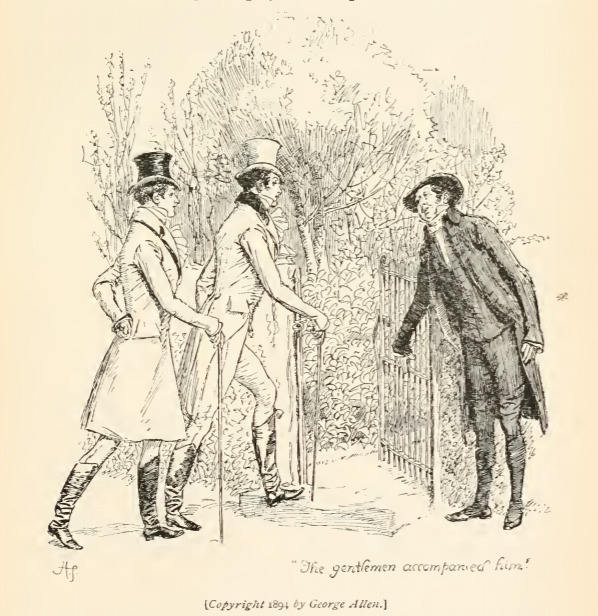
In this image Mr. Collins pays his respects to Mr. Darcy and Colonel Fitzwilliam, who had just arrived at Rosings. Mr. Darcy and Colonel were Lady Catherine’s guests, and Mr. Collins called on them soon after they arrived, as was customary. This scene occurs in chapter 30. The characters are shown in the traditional regency style. Mr. Collins, Mr. Darcy, and Colonel Fitzwilliam wear waistcoats and tailcoats. Mr. Darcy and Colonel Fitzwilliam wear top hats and carry walking sticks. The regency period dated to the early nineteenth century (1811-1820) when George, Prince of Wales, later George IV (r. 1820-1830), reigned as regent for his mentally ill father, King George III (r. 1760-1820). The regency period is associated with the rise of neoclassicism in art and fashion.
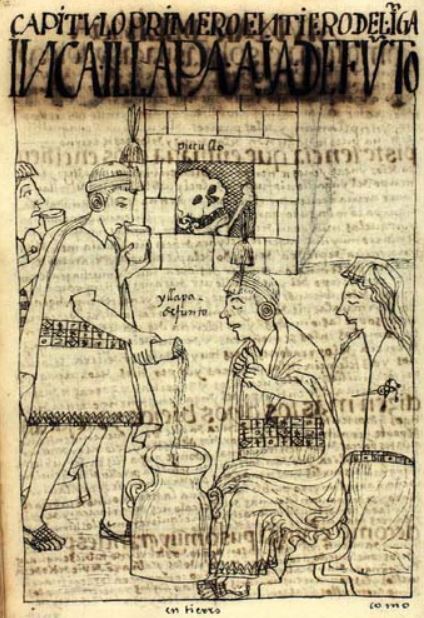
This image depicts the traditional burial ceremony of the Inca. The Inca and his coya [queen] would have their bodies embalmed and dressed in garments to make them look alive. The dead Inca and the coya are depicted sitting on the right side of the image. The author explains that the Inca would be mourned for a month and then taken to the pucullo [tomb] to be buried. The pucullo is depicted in the background of the engraving with a skeleton in the window. The figures on the left side of the image are depicted making liquid offerings to the dead Inca and his coya. The caption yllapa defunto [deceased Inca] is written beside the Inca. The word entierro [burial] is written at the bottom of the image.
Amelia Osborne stands with her head tilted slightly to one side, with one hand held to her chest and the other holding a closed fan by her side. She is framed in the letter C from Conducted.
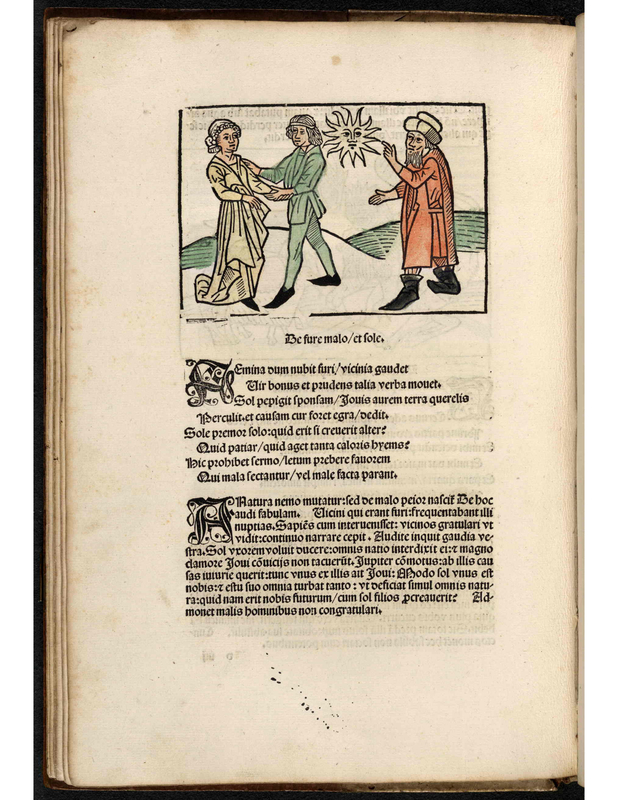
A man and women are holding hands in a field. Nearby, a man in a red robe watches them. In the background, the sun is watching the man in the red robe.
Rodrígo Díaz de Vivar(El Cid) is standing in front of the king Alfonso VI. The King is wearing long white robes and sitting on a wooden decorated chair. He has a long beard. Behind him there is a wall and two columns on either side of his throne. Rodrígo Díaz de Vivar has on a tunic and pants. To his side there is a sheath with a sword sheathed into it. He has short hair. Behind him there is another man. He has short hair and is wearing a tunic and pants. He has his arms behind his back as if pacing.

![[Donkeys from the Country of the Houyhnhnms]](https://collections.cemvc.ca/files/large/e9ba40402fd6329bf268047985fa11943bb08d16.jpg)
![[Captain Crawley at the Saddler’s]](https://collections.cemvc.ca/files/large/9bd9eee3d3da64b454e4580b7af2de42c8f23d75.jpg)
![[The Lilliputians take inventory of Gulliver’s belongings]](https://collections.cemvc.ca/files/large/aea46d07ff57f614df4bef0e8ae4bfcfc8694d2c.jpg)
![[Act XIV – Melibea and Calisto Embrace, Sosia and Tristan Stand Guard, and Lucrecia Waits at a Distance]](https://collections.cemvc.ca/files/large/4015d9b9a1434d34e1236158d2772666f9c1aa3b.jpg)

![[The Cid showing count Lozano's head to the count's father]](https://collections.cemvc.ca/files/large/8bffb217c664eaef09184ac0ac83aa73d9dfe9d7.jpg)
![[Joseph Orders a Shave]](https://collections.cemvc.ca/files/large/6620737353a1975db21feac5f460e3a01b8403b7.jpg)

![[Two Men Grabbing a Sitting Man]](https://collections.cemvc.ca/files/large/18e246c0ef113d003c22ddd8111a53eda91129d0.jpg)
![[Indigenous people armed with bows in conflict with Europeans]](https://collections.cemvc.ca/files/large/974c9a8328fcc334a4f1d516e77bcb58e7536552.jpg)
![[Vanity Fair Vol. II Chapter XXV Historiated Initial]](https://collections.cemvc.ca/files/large/0b2375f084cacfa5fea82de85b24a7faa7dd223d.jpg)
![[The Cid and the king Alfonso]](https://collections.cemvc.ca/files/large/d38687208cb43b412c6f614a437648be9c811290.jpg)