The goddess of agriculture, Ceres, is depicted in the centre of the image wearing a crown and a red dress. Boccaccio explains that after discovering agriculture, Ceres had tamed oxen and trained them to yoke. She also discovered planting seeds and then taught men how to harvest them once they matured. There is one person depicted plowing the fields with oxen, and another man behind him husking grain. Ceres also taught men how to turn flour into an edible fare. Ceres wears the crown and scepter to signify her importance linked to agriculture and harvest.
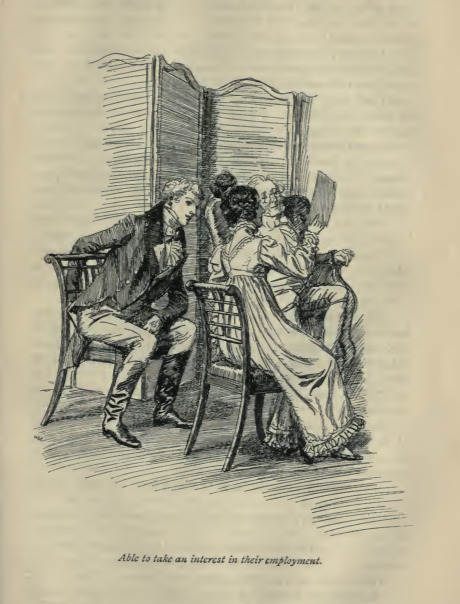
In this image Frank Churchill sits with Emma and Mr. Woodhouse looking at the books at Donwell Abbey. Frank Churchill arrived to Donwell Abbey late and in a bad mood. He was too hot and was highly unagreeable. After cooling down, Frank Churchill made himself more agreeable, joining Emma and her father in looking at Mr. Knightley’s books. This scene occurs in chapter 42. The characters are shown in the traditional regency style. Emma wears the regency style dress with an empire waist and a bonnet. Mr. Woodhouse and Frank Churchill wear waistcoats and tailcoats with breeches and cravats. The regency period dated to the early nineteenth century (1811-1820) when George, Prince of Wales, later George IV (r. 1820-1830), reigned as regent for his mentally ill father, King George III (r. 1760-1820). The regency period is associated with the rise of neoclassicism in art and fashion.
Here we see battle plans for the war between Lilliput and Blefuscu. A compass is used to calculate the attack routes, with the farthest route being 1874 units. Surrounding the maps we see barrels and bottles representing the ammunition and other provisions which were necessary. In the foreground we see a meal prepared, possibly representing the meals the Emperor would eat while his citizens were away fighting – a commentary on the divisions within society. Gulliver’s hat is seen in the background, representing the Lilliputian’s secret weapon. The image comes at the end of the third chapter. The same image appears in both the 1839 and 1843 Krabbe editions.
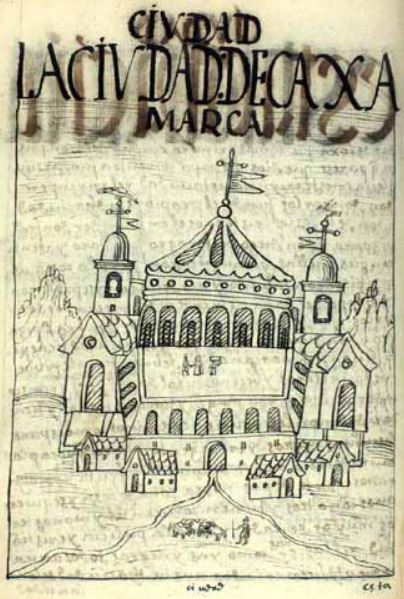
This image is depicted in the author’s chapter where he discusses cities, towns, villages, and provinces in colonial South America. This image depicts the city of Cajamarca in Peru. This city, according to the author, was the city of the last Inca Emperor, Atahualpa Inca. The city was taken from Atahualpa Inca by the conquistador Francisco Pizarro, who later beheaded the Inca. The city is illustrated as a cluster of buildings that forms a main square in the centre. There are three people depicted standing in the square. There is also a soldier standing outside of the city walls in front of a herd of animals. There are two paths drawn that lead into the city. The caption at the bottom of the image reads ciudad [city].
Melibea overhears her parents Pleberio and Alisa discussing her purity, how they should start trying to find a husband for her, and their belief that she has probably never considered having a male companion. Melibea starts to grow frustrated with their assumption that she is ignorant, and she tells Lucrecia to enter the room and interrupt the conversation. This illustration likely represents the scene in which Lucrecia interrupts Pleberio and Alisa. The left side of the image depicts Melibea and Lucrecia. Melibea is likely the figure seated on the ornate and draped bed, while Lucrecia is approaching the door with her finger pointed toward Pleberio (which is somewhat odd, since it implies a confrontation or argument). Each of the them is wearing a robe and a veil. The right side of the image depicts Pleberio, who is wearing a hat and a cloak of sorts, as he opens the door for Lucrecia. Meanwhile, Alisa sits on another ornate and draped bed while displaying an air of sadness, likely at the thought of finding someone for Melibea to marry. The entire image is identical to the one found on page 264 of the text.
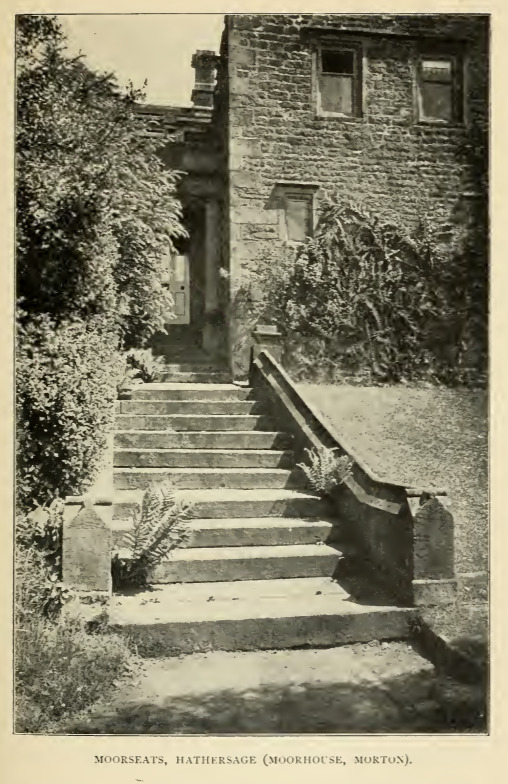
Here we see an image of Moorseats, a house in the village of Hathersage, a village in Derbyshire. After running away from Thornfield after ending her engagement to Mr. Rochester Jane ended up in Morton, which was based on the real village of Hathersage. She arrived at Moor house with Mr. Rivers and his sisters, Diana and Mary. She lived with them for several months and taught at the village school before returning to Mr. Rochester. The same image appeared in the 1899 Bigelow, Brown, and Co edition of Jane Eyre.
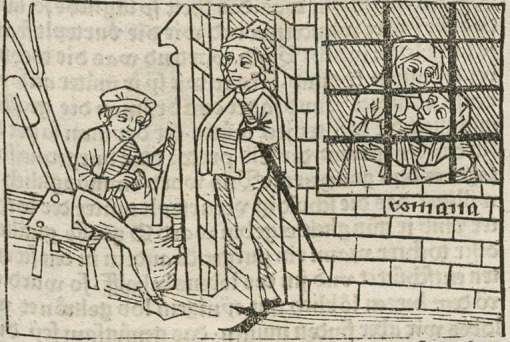
This engraving depicts a story of a young Roman woman who saved her mother from starving to death. Boccaccio explains that this unknown woman’s mother had been sentenced to death, and when she was locked away to die of starvation, her daughter saved her with her own breast milk. The girl and her mother are depicted behind the window of the jail cell as the mother drinks the milk of her daughter’s breast. The word romana is engraved below the jail cell window. The men that are standing guard outside the prison cell seem unconcerned and relaxed. They are unsuspecting of the young woman because they searched her every time she visited her mother and she never seemed to carried food with her. The young woman saved her mother’s life through her breast milk, and Boccaccio explains that he wrote on this unknown young woman due to her filial devotion.
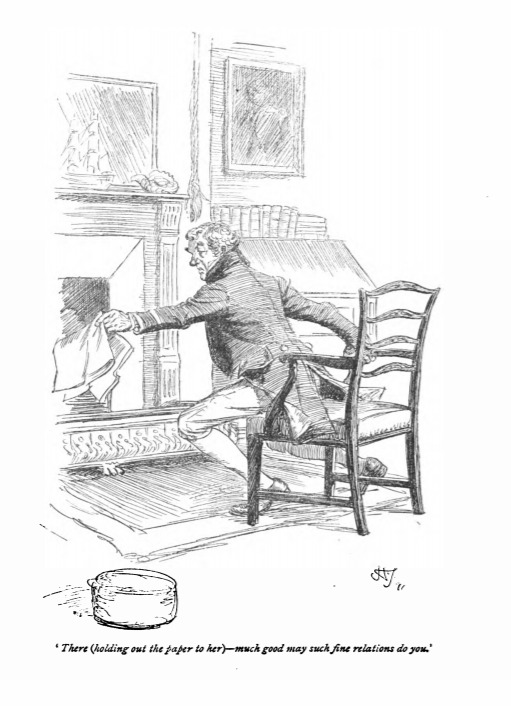
In this image Mr. Price holds out the local newspaper out to Fanny, who is not pictured. In the latest news, Fanny’s cousin Maria had run away from her London home in Wimpole Street, where she lived with her husband, Mr. Rushworth. Maria ran away with Mr. Crawford, causing a scandal. This scene occurs in chapter 46. The characters are shown in the traditional regency style. Mr. Price wears a tailcoat with breeches. The regency period dated to the early nineteenth century (1811-1820) when George, Prince of Wales, later George IV (r. 1820-1830), reigned as regent for his mentally ill father, King George III (r. 1760-1820). The regency period is associated with the rise of neoclassicism in art and fashion.
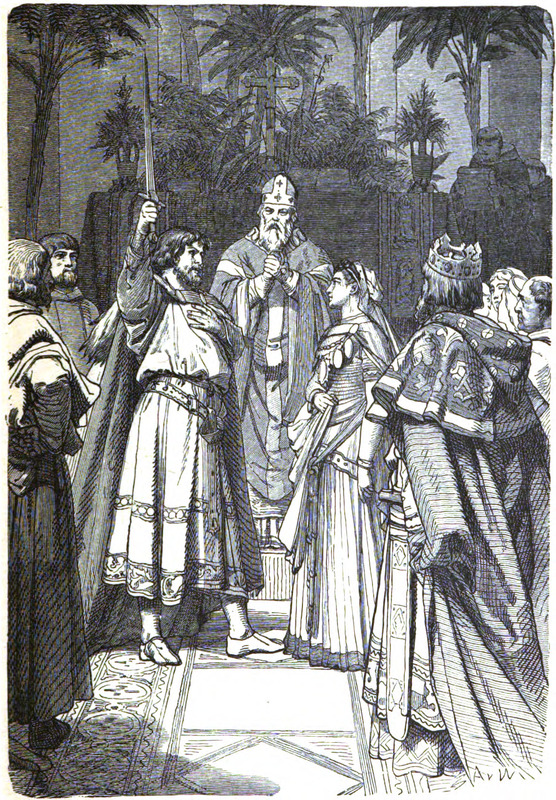
There are eight persons present in this image. The three in the middle are El Cid and Jimena with a bishop standing on the altar. The bishop is wearing a hat and robes. He has a beard. El Cid is standing in front of Jimena and he is holding his sword in the air while one of his hands is on his chest. His robes are embroidered with patterns and he is wearing a long cape. His hair is short and he has a beard. Jimena is wearing a dress with many different layers. She has lace around her waist and a headdress on her head. The two men on El Cid’s side are wearing brown robes. On Jimena’s side there is the king Alfonso VI. He is wearing many layers of robes with a sword sheathed on his side. He is wearing a crown on his head. The two other people in the back are a woman wearing a head covering and a man with very little hair on his head. In the background there are trees and shrubberies and also columns are distinguishable in the back. Behind the bishop there is a visible cross.
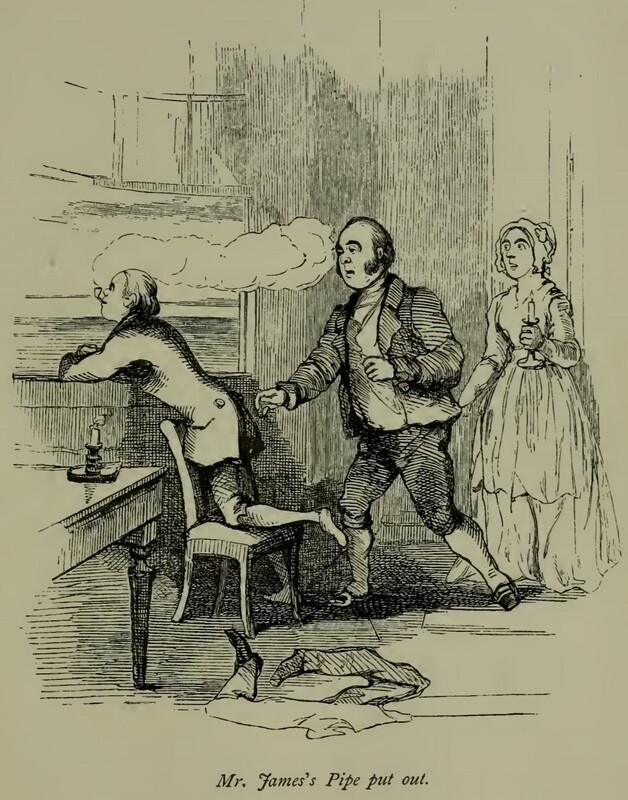
Mr. James Crawley, while visiting his aunt Miss Matilda Crawley, leans out the bedroom window while smoking his pipe. He is in his coat and breeches, with his pants and shoes in a pile on the floor next to the chair on which he is leaning. Behind him, Mr. Bowls and Mrs. Firkin have rushed into the room to stop the smoke, which is bothering Miss Crawley downstairs. Below the illustration is printed its title, Mr. James’s pipe put out.
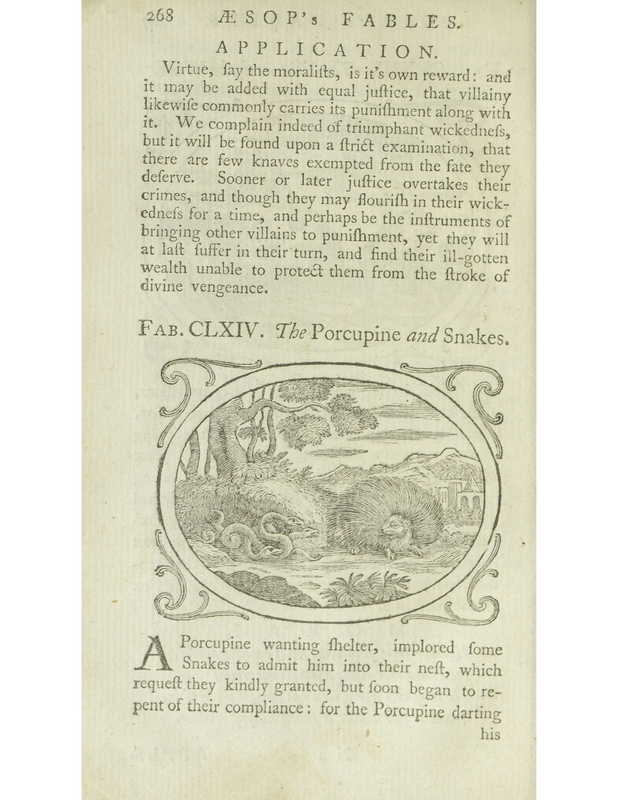
A porcupine is in the middle of the image. Their head is to the left, their quills fall around him. To the left of the porcupine there are three snakes leering towards the Porcupine. In the background there is a small town to the right, with a large tree to the left.
A scene depicting the simple and happy country life. A shepherdess is depicted sitting on a small hummock, where a man in uniform kneels before her, clasping her hand in his. Both are looking contentedly at the other. Her crook lies on the ground beside the hummock, and behind it is one of her sheep. In the background are a farmhouse and clocktower, and the top right of the image is the letter B from Besides.
This image depicts a mayor of a local indigenous town standing on the left side of the image ordering a black slave to whip a magistrate. The magistrate is being punished for falling two eggs short of his tribute. The author criticizes the mayor for shamefully punishing the magistrate without the justice of God. The dialogue written by the mayor’s mouth reads, dale [go on!]. The dialogue written by the slave’s mouth reads, tray dos guebos que falta [two eggs are missing]. The native magistrate, who is illustrated on the right side of the image tied to a post with rope, replies, ay, por amor de dios [Oh for the love of God]. The caption at the bottom of the image reads, en este rreyno [in this kingdom].
A skeleton is holding a bow and arrow while cupid is also holding a bow and arrow in the sky. An older couple are looking at one another and hugging in the left of the image. A dog is snarling at the skeleton. One man is on one knee praying towards cupid while another man sits back and watches the skeleton.
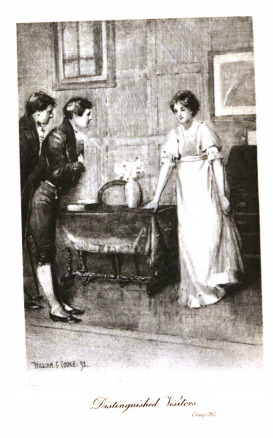
Here we see Miss de Bourgh, Lady Catherine de Bourgh’s niece visiting Mr. Collins at the parsonage. Lady Catherine was Mr. Collins's patron, and visited him on occasion, but more frequently asked Mr. Collins and his wife, Charlotte, to join her at her home called Rosings. Elizabeth Bennet went to visit her good friend Charlotte, who married Mr. Collins after Elizabeth rejected his marriage proposal. Miss de Bourgh stands with her hand on the table, as Mr. Collins bows his head to her, with Mr. Darcy standing next to him. This scene occurs in chapter 30 as noted underneath the title of this image. The characters are shown in the traditional regency style, with the men wearing waistcoats, tailcoats, and knickers that stopped at the knee. Miss de Bourgh wears the regency style dress with an empire waist. Her hair is worn tied up, as was tradition for women after their coming out before the queen, signaling her entrance into society. The regency period dated to the early nineteenth century (1811-1820) when George, Prince of Wales, later George IV (r. 1820-1830), reigned as regent for his mentally ill father, King George III (r. 1760-1820). The regency period is associated with the rise of neoclassicism in art and fashion. The same image appears as the frontispiece for the Dent 1893, 1894, 1895, 1896, and 1897 editions of Pride and Prejudice.
After murdering Celestina, Pármeno (lying dead on the stretcher) and Sempronio (on his knees in the foreground) jump from a third storey window in her house and are captured by the alguacil’s (justice’s) men. The justice then sentences them to execution by public decapitation. Crowds gather to witness the proceedings (as seen in this illustration). Sosia, one of Calisto’s servants, witnesses the event and rushes to inform his master. Tristan, another of Calisto’s servants, sees Sosia walking toward the house in tears and asks him the nature of his sorrow. Sosia explains the events that had unfolded. They ascend to Calisto’s bedroom and inform him of the tragic news, and he becomes melancholic. When he asks the cause of their execution, Sosia explains that they murdered Celestina because she would not give them their share of Calisto’s gold chain. Calisto blames the unfortunate circumstances on Celestina’s treacherous and deceptive ways.
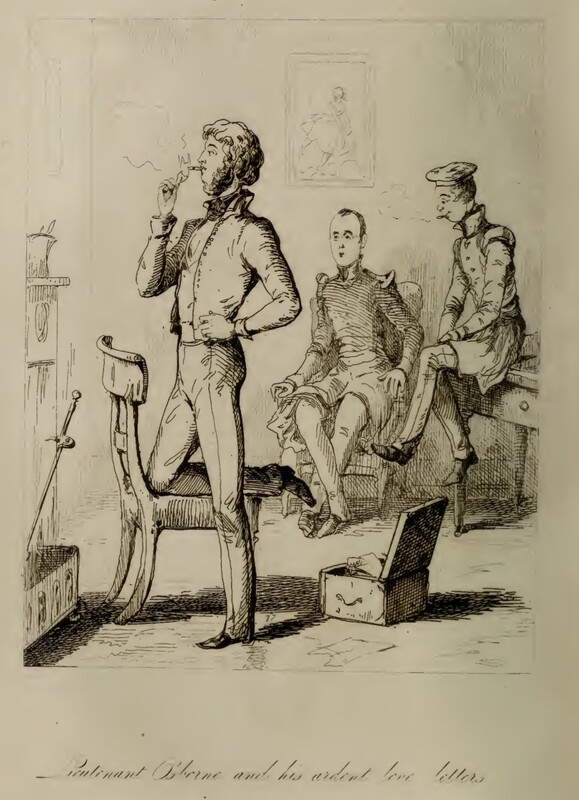
George Osborne stands facing the fireplace with one leg resting on a wooden chair, smoking a cigar which he has lit using a love letter. At the base of the chair is an open chest, filled with letters from Amelia Sedley. Two other officers are seated in the background. One is sitting on the edge of the desk, also smoking. The other is Dobbin, seated in an armchair over which a portrait of a woman hangs, looking appalled. Below the illustration is printed in cursive its title, Lieutenant Osborne and his ardent love-letters.
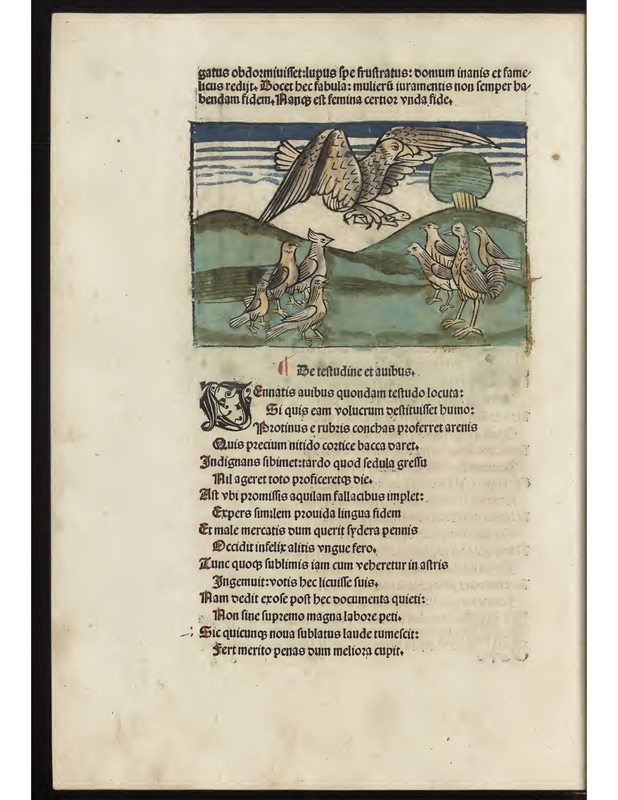
A furious man in crouching in his field, raising something in the air with his left arm while he holds onto the tail of a wolf with his right hand. The wolf is baring its teeth and has its head turned towards the angered man. Behind them, a dog (or a wolf) runs after a rabbit up a hill.

![[Ceres Creating Agriculture and Edible Fare]](https://collections.cemvc.ca/files/large/9b12e965c9e053e14a4118249007f6dc1e69007d.jpg)
![[Plans for the war between Lilliput and Blefuscu]](https://collections.cemvc.ca/files/large/3312c6496fb98bb4ad51ac4692d3b4788de30184.jpg)
![[Act XVI] Pleberio spreect tot Alisa syn huysurouwe.](https://collections.cemvc.ca/files/large/21402e79233e16a562c9bbb7a7f52677d77754ec.jpg)

![[Pots Flowing Down Stream]](https://collections.cemvc.ca/files/large/c069242c3ebe279443a03ec7f47e0bad87b822a4.jpg)
![[Vanity Fair Vol. I Chapter XI Inhabited Initial]](https://collections.cemvc.ca/files/large/00cefc2c60326bd484031d22b5eb4f4827c9386d.jpg)
![Alcaldes: Como Le Castiga el Coreg[id]or al Pobre del Alcalde Hordenario de su Magestad](https://collections.cemvc.ca/files/large/8eeeb443ab12a9156955d0795bb6facf18ae5d24.jpg)
![[Cupid and Death]](https://collections.cemvc.ca/files/large/c929ee382d490eb8f84dcb93e00c020776bc2d76.jpg)
![[Act XIII – Many Bystanders Observe as Sempronio Is Executed After Pármeno, Who Lies Dead Behind Him]](https://collections.cemvc.ca/files/large/9d83714baef277af75d1893a35f5b6a31073da02.jpg)
![[The Angry Man Chasing the Wolf and the Dog Chasing the Rabbit]](https://collections.cemvc.ca/files/large/2c61c18eb24fb04cf8d54b04bb2b3de42095f28d.jpg)