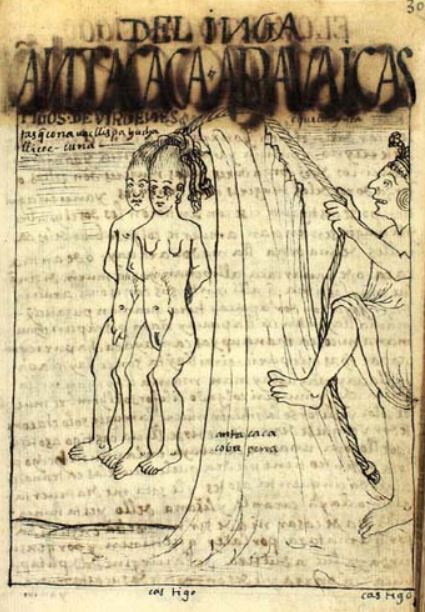
This chapter is dedicated to discussing the justice and punishment systems of the Inca Empire. The author discusses five methods of punishment in detail, and this image represents the fourth punishment. The author explains that male and female rapists, as well as those who consented, would be punished to protect the virtue of the virgin youth in the Inca Empire. They would be hanged by their hair on an anta caca [stone gallow] and left to die. This image depicts both a man and woman with a rope tied around their hair as they hang over the stone behind them. They have tears running down their face as a figure on the right holds the rope. The caption written by the two hanging figures reads tasquecona uacllispa huchallicoccuna [young ones who transgressed]. The writing on the stone reads anta caca cobre pena [stone gallow causes sorrow].
Here we see two horses grazing in a field in the summer. The Houyhnhnms asks about the horses in Europe and how they live. Gulliver explains that the horses in Europe are grazed in fields in the summer and live in stables in the winter. Gulliver explains that humans or yahoos govern the country and care for the horses or Houyhnhnms. The same image appears in the 1839 Krabbe edition.
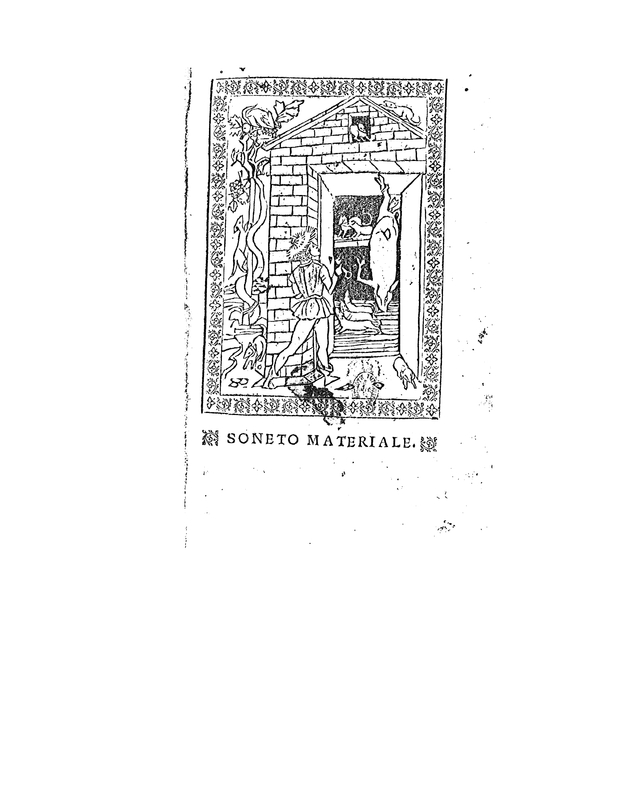
There is a man in the centre of the image looking at a mouse in the cut out of the brick building. Inside the building there is a pig hanging from the ceiling by its foot. All around the image there are mice crawling. They are crawling up vines on the left side of the image, on the ground in the building, on the roof, and on the ground outside. There even seems to be mice nibbling at the pig.
Here we see a Houyhnhnm escorting Gulliver through a crowd of Yahoos. Gulliver asked to walk around the Country to learn more about it. The Yahoos would often attack Gulliver if he was not escorted by a Houyhnhnm. The Sorrel Nag, a servant of Gulliver’s master, would often be Gulliver’s escort.
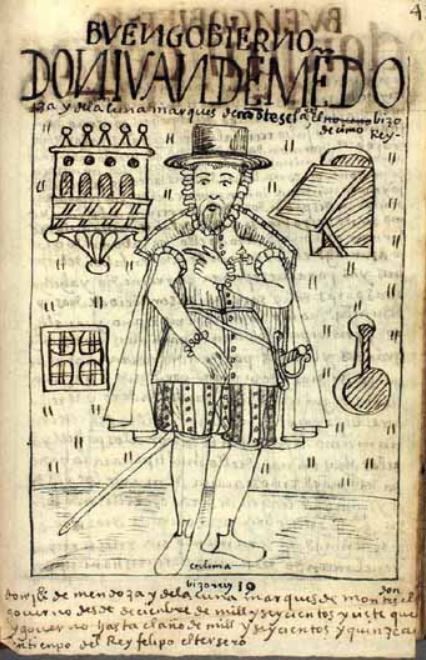
This image depicts the tenth Spanish viceroy of Peru, Don Juan de Mendoza y Luna. He is illustrated wearing traditional European/Castilian clothing with a hat, a cape, and ruffled trousers. The caption written by his feet identifies the location as it reads, en lima [in Lima]. The large caption at the bottom of the image reads, don juan de mendoza y de la luna, marques de montescl[aros], gouerno desde decienbre de mill y seycientos y ciete que [...] y gouerno hasta el ano de mill y cseycientos y quinze a[nos] en tienpo del rrey felipo el tersero [Don Juan de Mendoza y de la Luna, Marquis of Montesclaros, governed this kingdom from December 1607 until the year 1615 in the time of King Philip III].
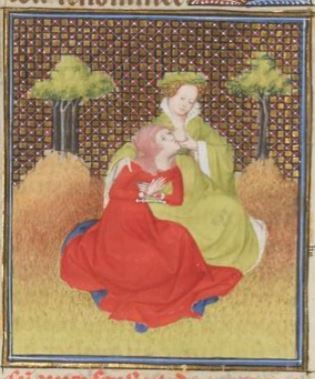
This image depicts the story of a young Roman woman who saved her mother from starving to death. Boccaccio explains that this young woman’s mother had been sentenced to death, and when she was locked away to die of starvation, her daughter saved her with her own breast milk. The young woman is depicted sitting down with her breast exposed as she provides milk to her mother. The young woman’s belly is large as she had just given birth, which is why she is able to produce the milk. Boccaccio explains that he wrote on this unknown young woman due to her filial devotion.
In this image we see three Lilliputian warships preparing for battle with Blefuscu. The warship closest to the viewer is just leaving the dock, and there are two men, one on either side, releasing the ropes holding the ship in the dock as it leaves. This ship also has the letter L on its sail. This is because it represents Lilliput – also the first word of the chapter. Two flags fly from the highest mast. Two other warships are visible in the background. The same image appears in the 1839 Krabbe edition.
This image is a satire on the licking ceremony at the court of Luggnag. The image is of the body of a person with the head of a dog licking the ground. This is showing the subservience that was expected of courtiers. This subservience was also expected in European courts and thus serves as a satire on European monarchies. The same image appears in the 1839 Krabbe edition.
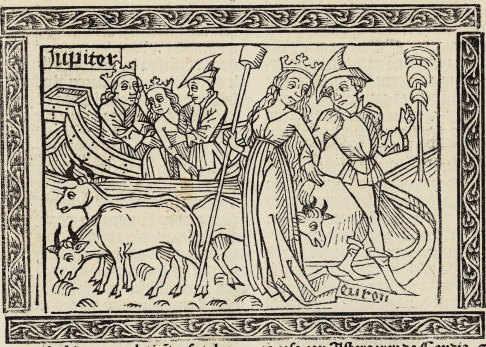
This engraving illustrates the beautiful Europa being kidnapped by Jupiter. Europa is depicted in the foreground of the engraving with a crown on her head and a long staff in her right hand. The creator engraved her name by her feet in order to be identified. Boccaccio explains that Europa was following her father's heard of cattle to the shores of Phoenicia because a panderer had convinced her to do so. The panderer is depicted with his arm linked around Europa’s left arm while guiding her to the shore. The cattle are clustered around Europa’s feet. The background of the engraving depicts the kidnapping. The panderer lead Europa to a ship which carried the god Jupiter. Jupiter’s name is engraved above his head. Jupiter’s arms are depicted around the waist of Europa as he is lifting her onto the ship to take her to Crete.
This image represents an imagined meeting and conversation between the author of the book and the king of Spain. The author prepared this book to present to the king of Spain in the hopes that they could discuss how to save the indigenous peoples of Peru. The author of the book, Felipe Guaman Poma de Ayala is depicted kneeling on the right side of the image as he presents his book to the king. The caption above his head reads, ayala, el autor [Ayala, the author]. The king, Philip III, is depicted sitting on a throne on the left side of the image wearing a crown and holding a long staff in his left hand. The caption at the bottom of the image reads, Presenta personalmente el autor la Corónica a su Magestad [The author personally presents the Chronicle to His Majesty].
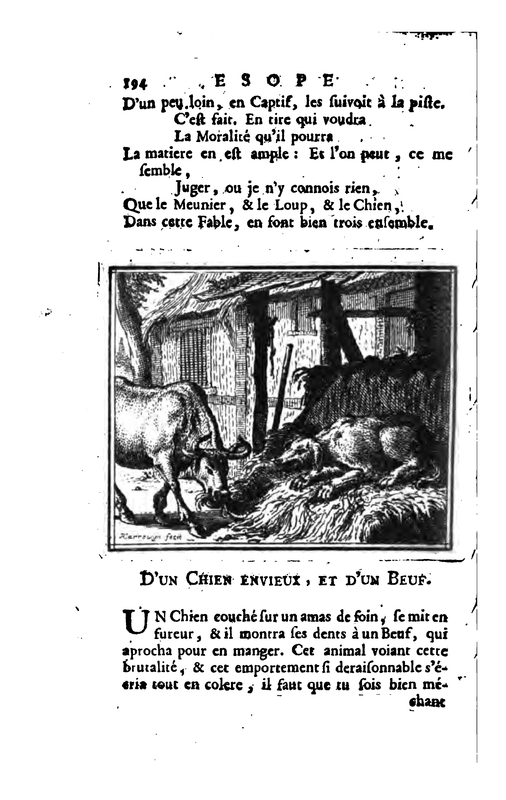
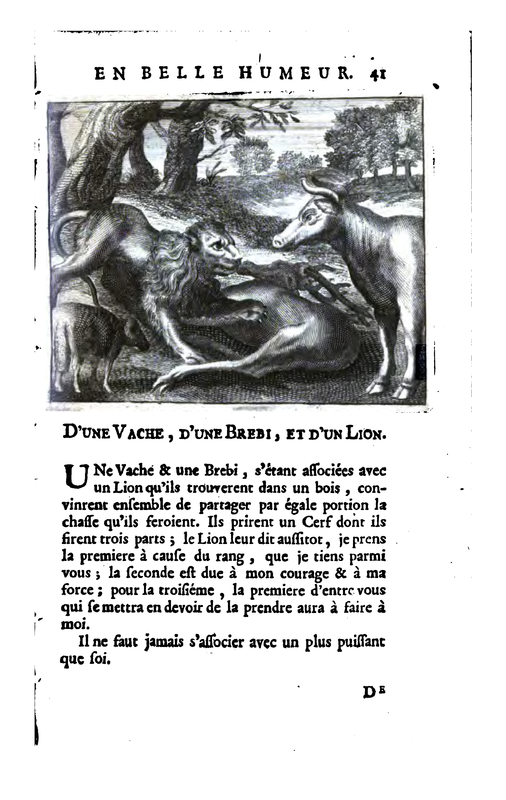
In this image there is a lion eating a cow while making eyecontact with another cow standing next to the lion. In front of them there is a sheep. While this is all happenning under a large tree, there is a river running in the horizon and trees are on either side of the river.
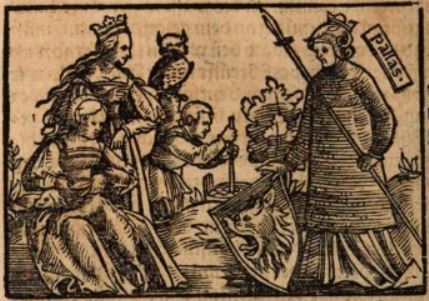
This engraving illustrates Minerva, also known as Pallas, standing on the left side of the engraving suited in armor. She is depicted holding a lance in her left hand and a shield (with a depiction of Medusa on the front) in her right. The name Pallas is engraved behind her head to identify her. Boccaccio explains that Minerva had discovered wool work and weaving. There is a woman on the right side of the engraving shearing a sheep to signify this discovery. The woman standing behind her has fabric in her hand to signify the art of weaving that Minerva had given to the world. The man in the centre of the engraving is depicted with a millstone in his hand, pressing down into a bucket of olives. Minerva had taught the world of men to do this so that they can extract and use oil from the olives. An olive tree stands in the background to further the significance. There is an owl resting on a tree stump next to Minerva, which Boccaccio explains, represents her wisdom.
In this image there are three men on horses, the king Sancho, El Cid, and a soldier. The one in the front is the king with his crown and long flowing white cloak. The one in the back is El Cid, he is wearing chainmail and a helmet. He is carrying a shield and at his waist a sword is visible. The other soldier is wearing chainmail and a helmet as well and is carrying a spear and shield. In the background of the field there are two more soldiers holding spears. The building that the king is pointing at is a stone castle protected by wooden spikes.
A tomb is shown, where the chiefs of this Indigenous group are laid to rest. The tomb sits inside a larger structure. It is set on thick logs that elevate it off the ground. The bodies of the chiefs are laid out side by side on a platform on top of the poles. Walls and ceiling enclose the bodies. At the base of the tomb a man crouches beside a fire.
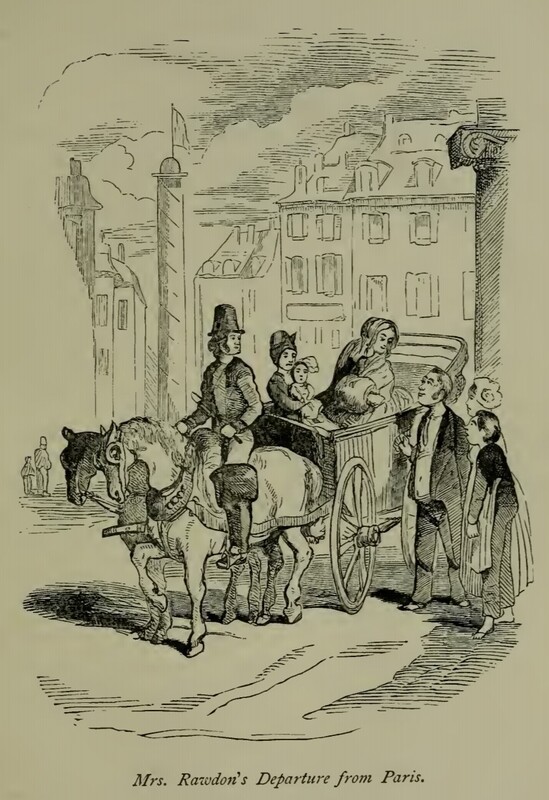
Rebecca Crawley sits grandly in a carriage, wearing a bonnet and muff and saying her farewells to the woman and two men standing beside the carriage. Opposite her sits Genevieve, the maid, holding little Rawdon. The carriage is pulled by a pair of horses, with the driver seated astride the larger of the two. In the background, the buildings of Paris and a tall tower topped with a flag can be seen. Below the illustration is printed in cursive its title, Mrs. Rawdon’s departure from Paris.
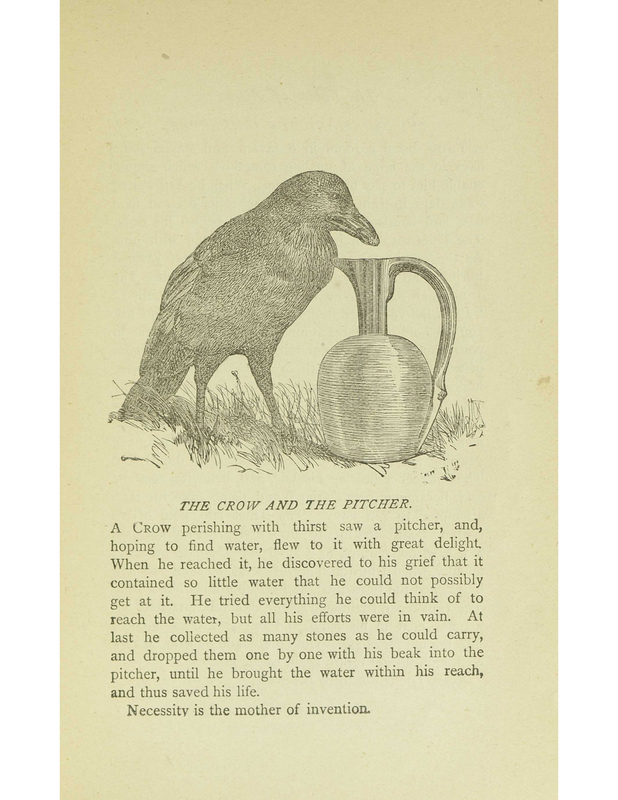
A crow is standing on grass on the left-hand side of the image. Next to it, to the right of the image, is a pitcher that reaches the crow’s chest. It has a large base, and a skinny neck that stretches out into a snout to pour out liquid. The crow is slightly bent towards the pitcher, its beak near the opening.
In the foreground, an Indigenous person lays on a hammock that has been strung up under a shelter. The shelter is simple, composed of four poles and a flat roof, with the hammock strung between two of the poles. In the background, two Indigenous people sit beside a fire. There is a second hammock, also strung between the two poles of a shelter, however this shelter is slanted, with on end resting on the ground and the other atop the poles.
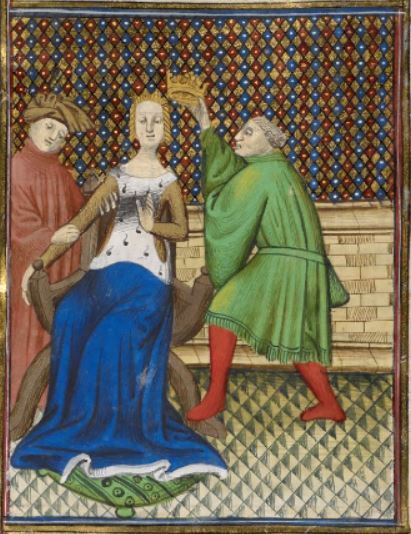
This image depicts Irene being crowned the empress of Rome and Constantinople. A man dressed in a green tunic is placing the crown on Irene’s head while another man holds her right arm. Irene was famous for being an incredibly fierce ruler. She is also famous for having competed for the throne multiple times with her son, Constantine.
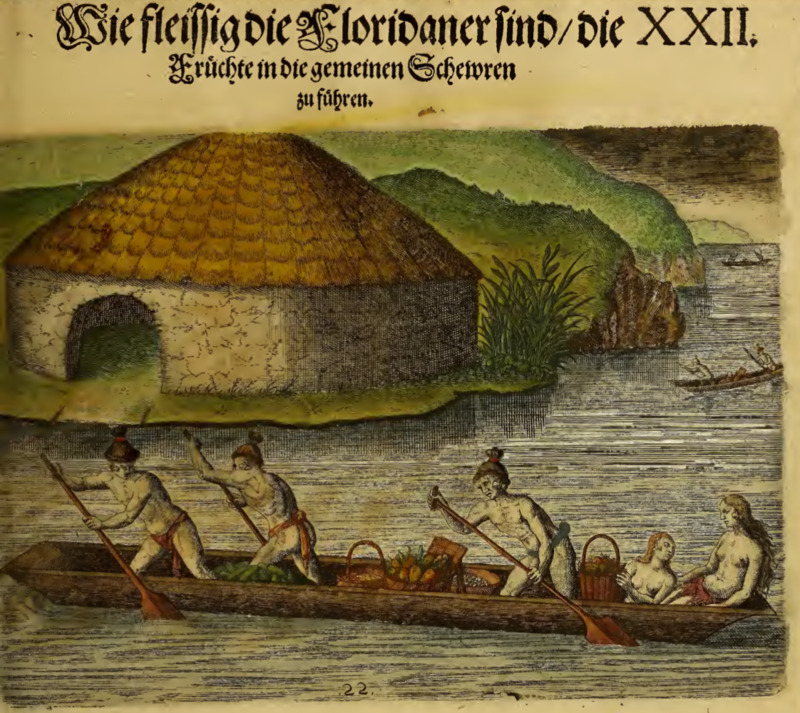
Several Indigenous people bring crops by canoe to a large storehouse. There are baskets of various types of produce in the canoe, three men stand to paddle while a woman and young person sit in the rear. The storehouse is a large round structure on the bank of the river. This illustration is identical to the one found on page 79 of Frankfurt 1591, but colored.

![[two horses grazing]](https://collections.cemvc.ca/files/large/9d96c34df9b534f6efa80ae46355ef6f059d42e4.jpg)
![[A Houyhnhnm escorts Gulliver through a crowd of Yahoos]](https://collections.cemvc.ca/files/large/c29ca64b3437c1c2a97a0fb358c22ab13457d189.jpg)

![[Three Lilliputian warship]](https://collections.cemvc.ca/files/large/3982ee71d0e935949d2c8d05e86cdfc85d61508b.jpg)
![[a satire of the licking ceremony on Luggnag]](https://collections.cemvc.ca/files/large/b8125313504ae09ff5092fa36580c7e2bed24811.jpg)
![[Vanity Fair Volume I. Chapter IX Historiated Initial, S]](https://collections.cemvc.ca/files/large/da6ac728b0a112a64aa4035800e39b3c44136305.jpg)
![Pregvnta Sv M[agestad], Responde el Avtor, Don Phelipe el Terzero, Rrey Monarca del Mundo](https://collections.cemvc.ca/files/large/b6a159b4a4c55320a72965ea5edcc474c05789b5.jpg)

![[El Cid conquering]](https://collections.cemvc.ca/files/large/1a745deded51af957331a9c60bfb3a042c777795.jpg)