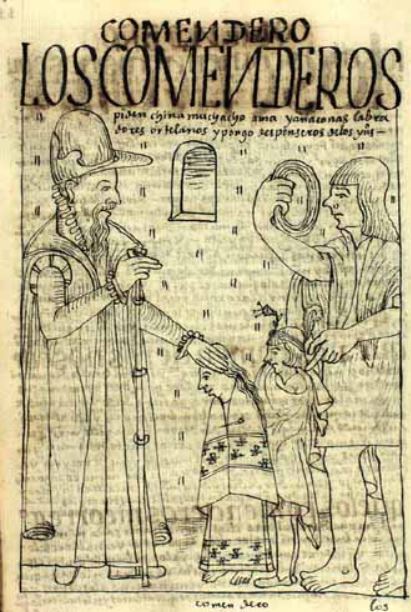
This image is illustrated in a chapter that discusses and criticizes the government and society in Spanish conquered Peru. This image depicts an encomendero [trustee] demanding for more native servants. There are two native children and a man standing in front of the Spanish encomendero as he holds his hand out towards the children. The author criticizes encomerendos for taking advantage of the labour of the indigenous peoples of Peru.
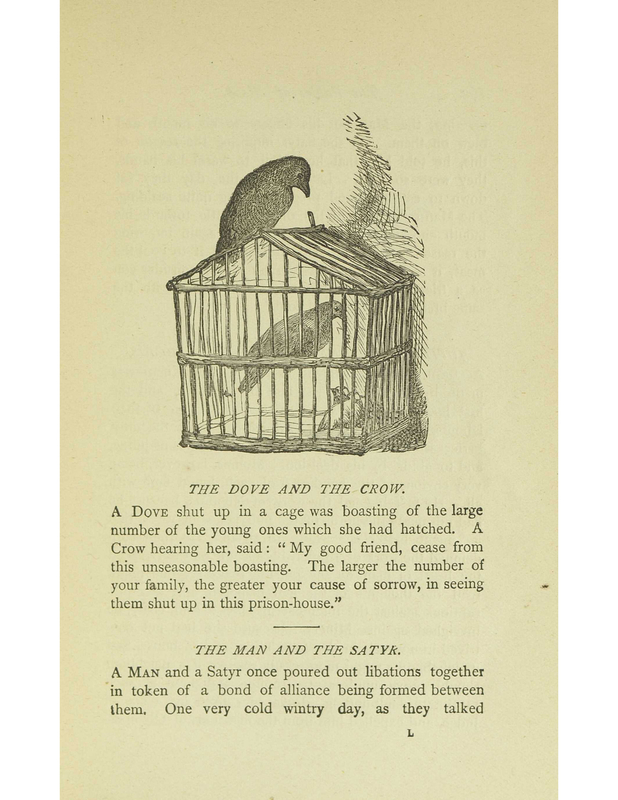
A dove is perched inside of its cage. Two young ones have hatched from their eggs and are lying on the ground of the cage in the right lower corner. Atop the dove’s cage, a crow is perched looking down at the dove and its family.
A group of Indigenous people is shown. Several men sit on wooden benches that are arranged in a semi-circle. Two men hold large shells, and two appear to be vomiting onto the ground. Three women tend to large pots on the right. To the left of the women, and individual stands with their arms outstretched. In the foreground, a group of colonists stand holding rifles. This illustration is identical to the one found on page 99 of Frankfurt 1591, but colored.
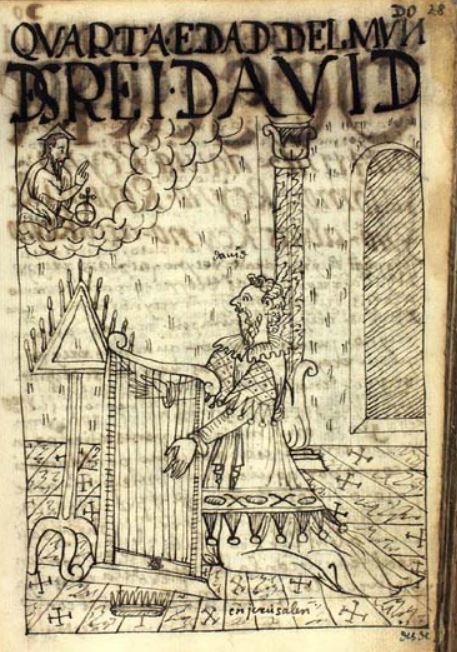
This illustration depicts David, the third king of Jerusalem, kneeling as he plays the harp. Before killing Goliath and becoming king, David was a musician, which is why he is illustrated playing it in this image. His name is written above his head to identify him. The words en Jerusalem are written below his legs to identify the location. God is visible in the top left corner as he holds the globus cruciger in his hand.
A Tupinambá village is shown, comprised of five long structures arranged in a pentagram and surrounded by two fences, with skulls mounted on ling poles at the entrance. At the center of the village a captive man is about to be executed. He is restrained by two men, each holding one end of a rope that is tied around his waist. A third man stands behind the captive with a club raised above his head. The village is located near the coast. Women fetch water in pails and carry it into the village, and several canoes are pulled up along the shore. Men also hunt and bring firewood to the village.
Here we see a herd of Lilliputian cattle walking towards the town. The cattle is attended by a Lilliputian man. Gulliver’s head and shoulders are visible over the hill where he watches the cattle. The image comes when the Emperor gives Gulliver his own household and staff, with the cattle making up a part of Gulliver’s household farm. The same image appears in the 1839 Krabbe edition.
A professor from the mathematical school at the Grand Academy of Balnibarbi conducted experiments in teaching and learning. His idea was to write concepts on a thin wafer in a cephalic tincture then have the students consume the wafers and eat nothing else except bread and water for the subsequent three days. The idea was that the tincture would travel to the student’s head and bring the concept with it. This idea is playing off of the Catholic communion wafers, and as Swift is writing from an Anglican perspective, a swipe at the Catholic doctrine of transubstantiation. In this image we see a tray with the wafers with concepts written on them. There is also a quill and a bottle of liquid that is the cephalic tincture. A young student holds the wafer in his hand, while the professor looks on. The same image appears in the 1839 Krabbe edition.
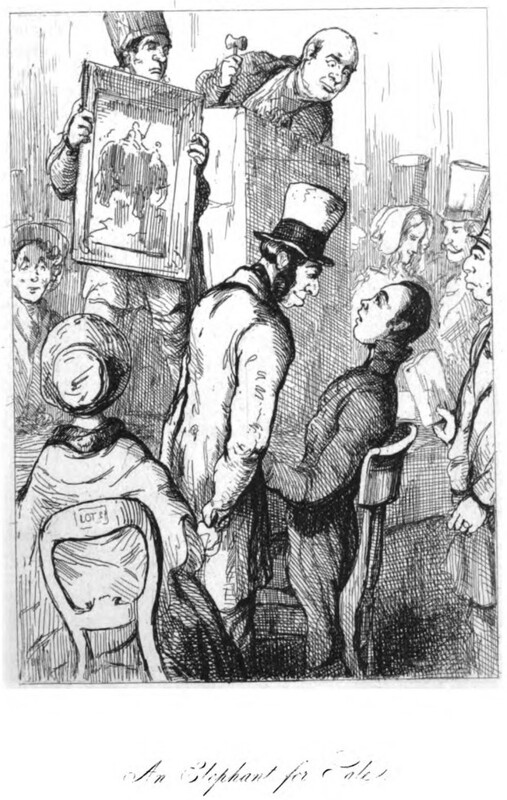
At the auction of the Sedley estate, Mr. Blowman holds up a portrait of Joseph Sedley riding an elephant to show the buyers. William Dobbin is seated directly in front of the painting, looking up with a startled expression at the bearded man looming over him. Mr. Hammerdown is peering down at the two men from the auction block, holding his mallet up. Among the figures in the background, on the right side of the picture, are Rawdon and Rebecca Crawley, who purchase the painting. Below the illustration is printed in cursive its title, An Elephant for Sale.
The night come, Calisto, Sosia, and Tristan go to Melibea’s house once more. Calisto ascends the garden wall and meets with Melibea (who is shown waiting with Lucrecia to the right of the illustration), whereupon they spend some time talking to one another. Meanwhile, Sosia and Tristan stand guard outside the wall (represented by the two leftmost figures)[This illustration is identical to the one found on page 122 of the text (folio 63r).]
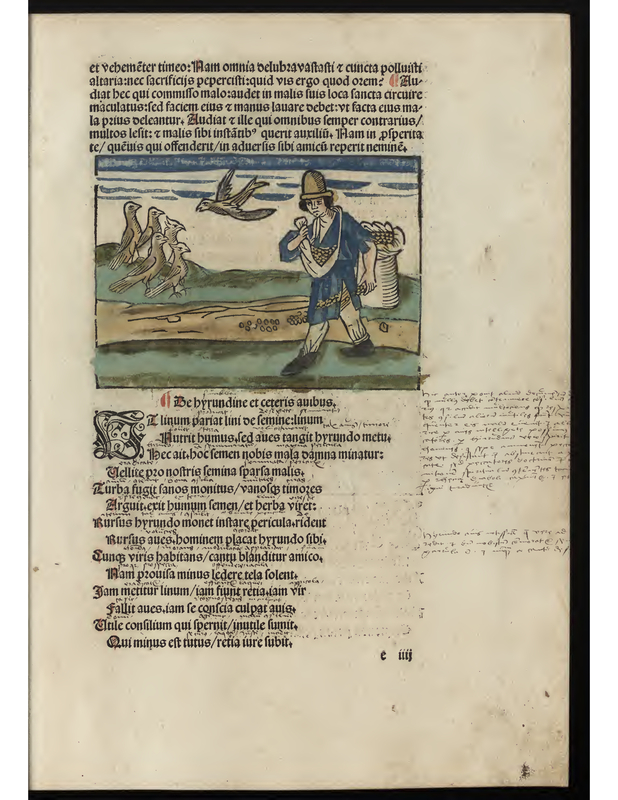
On the left-hand-side of the image, several birds can be found, one flying and the rest standing on the grass. A man stands to the right, walking away from a bag of seeds. The man has a bag of seeds carried around his neck and he is spreading seeds onto the ground below him.
This image is illustrated in a chapter that discusses and criticizes the government and society in Spanish conquered Peru. This image depicts a Corregidor [Magistrate]. Each province in Peru was governed by a Corregidor and they were able to govern and make money in their office in whichever way they saw fit. The author heavily criticizes their actions and government. The Corregidor in this image is depicted wearing traditional European clothing with a ruffled collar and matching wrist ruffles and trunk hoses. He is standing in front of his scribe who is sitting at a desk writing with his quill. He appears to be writing the Corregidor’s name, Don Diego de Avendano.
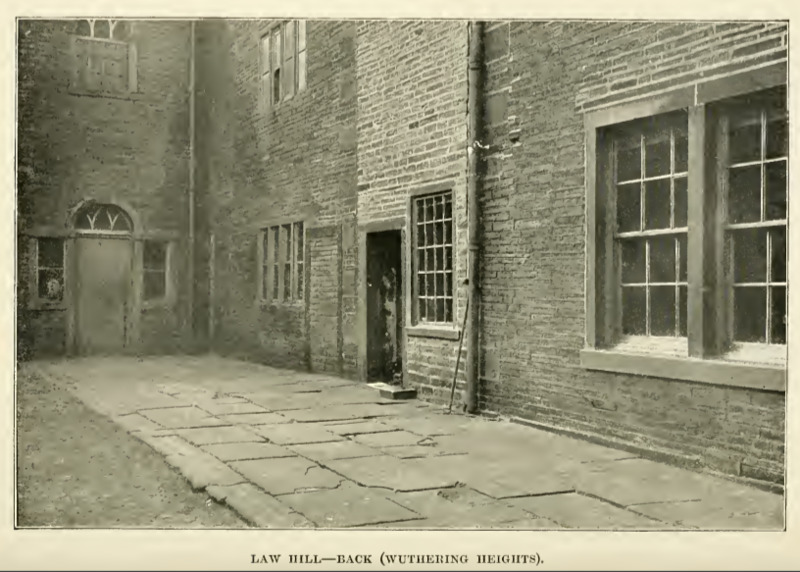
Here we see an image of Law Hill, a house near Halifax, England, on which Emily Bronte based the estate of Wuthering Heights. In this image we see the back of the house, taken from the courtyard on the back entrance to the house. This is the second in a series of photographs of the house, with others of the front and the outbuilding. The image is a reproduction of a photograph using a technique called photogravure, where photographs are taken on plates which could then be etched on to create a plate for use in a printing press.
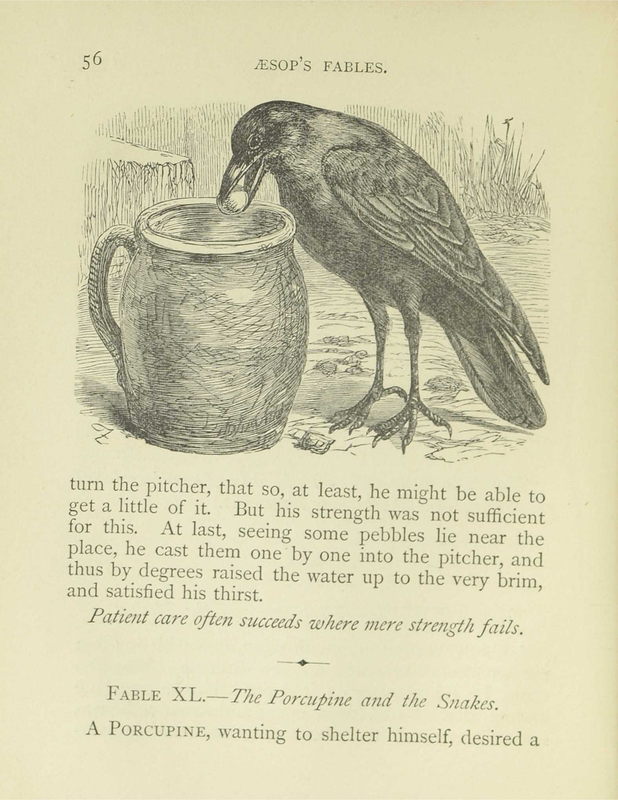
On the left side of the image there is a large pitcher in the foreground. On the right side of the image sits a crow dropping round pebbles into the pitcher, with one in its mouth ready to drop. In the background there is a bit of foliage in what appears to be a forest clearing.
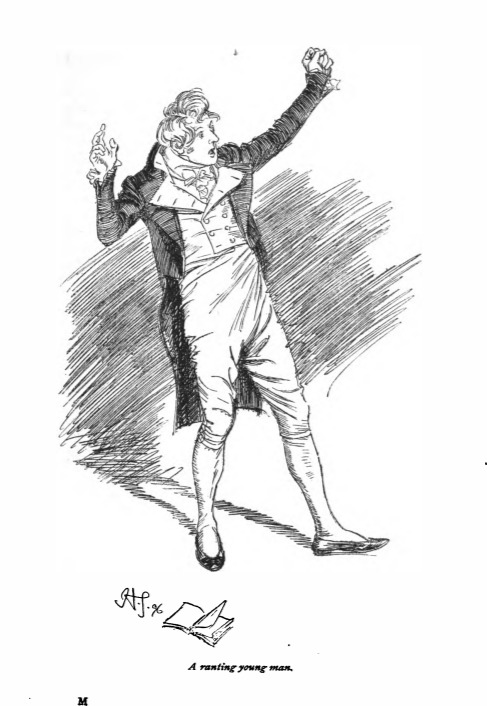
Here we see Tom Bertram’s friend, Mr. Yates, speaking to Sir Thomas about the play. Putting on a play was Mr. Yates’ idea because he had participated in a theatrical group elsewhere. Mr. Yates was very animated in telling Sir Thomas about the play, attempting to convince him that the play should continue. Mr. Yates was the only one of the acting party left in Sir Thomas’ billiards room where they were rehearsing, because Mr. Rushworth accompanied Tom, Edmund, Maria, and Julia to greet Sir Thomas with Fanny following shortly thereafter, and Mr. And Miss Crawford leaving to return to the parsonage. This scene occurs in chapter 19. The characters are shown in the traditional regency style. Mr. Yates wears a waistcoat and tailcoat, with breeches and a cravat. The regency period dated to the early nineteenth century (1811-1820) when George, Prince of Wales, later George IV (r. 1820-1830), reigned as regent for his mentally ill father, King George III (r. 1760-1820). The regency period is associated with the rise of neoclassicism in art and fashion.
Here we see Gulliver encountering the farmer giant’s cat. The cat has its eyes set on Gulliver, with its ears back and whisker’s spread, a sign that the cat is interested in something and wants to catch it. A bowl separates Gulliver from the cat. Gulliver is standing on the edge of the table, leaning back in alarm. This image highlights the difference in scale between the giant’s world and reality. The same image appears in both the 1839 and 1843 Krabbe editions.
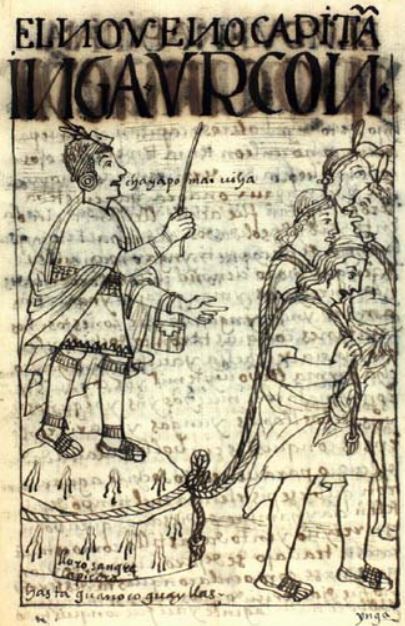
This illustration depicts the ninth captain Inca Urcon. These captains were a level of Inca authority who helped lead the conquest of the Andes. He was the son of Topa Inca Yupanqui, the king of the Inca Empire. The author explains that this captain was tasked with bringing large stones from Cusco to Huanuco (written as Guanoco at the bottom of the image). Therefore, he is illustrated standing atop a large stone on the left side of the image as his men pull the stone with rope. There is writing on the stone which says, lloro sangre la piedra which translates to the stone wept blood. He wrote this because the stone refused to move.
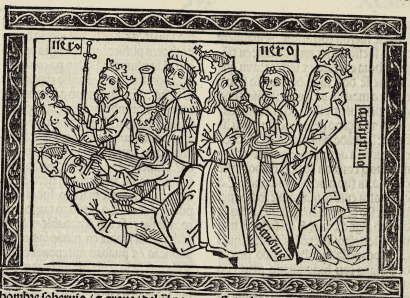
This engraving depicts multiple events. The right side of the engraving depicts Agrippina poisoning her husband Claudius with mushrooms. Agrippina is illustrated wearing a crown and holding a plate of mushrooms as she presents them to Claudius. Agrippina’s name is engraved behind her body, while Claudius’ name is engraved by his feet. Agrippina’s son, Nero, is depicted standing in between Agrippina and Claudius as he watches his step-father being poisoned (his name is engraved above his head). Agrippina poisoned Claudius to obtain power for herself and make her son emperor. The left side of the engraving in the foreground depicts Agrippina further poisoning Claudius. Agrippina is depicted on her knees while she feeds Claudius more poison, as the mushrooms did not complete the task. The background of the engraving depicts Nero as emperor, looking at his mother’s dead, naked body. He began to resent her after becoming emperor, and after having her murdered, he observed her dead body and judged it before cremating it. Nero is depicted wearing a crown and holding a scepter, with a man beside him holding a cremation urn.





![[A captive is executed in the center of a Tupinambá village while other daily tasks are completed]](https://collections.cemvc.ca/files/large/c23128363c85bd9f728bf11d0153e242ba3458f5.jpg)

![[Herd of cattle on Lilliput]](https://collections.cemvc.ca/files/large/b9943b7a18823a7ea0108088169c1e3ff1ae9520.jpg)
![[An experiment from the Grand Academy of Lagado to revolutionize education]](https://collections.cemvc.ca/files/large/27479706de30337647d30e17186c2e9ca46d13fe.jpg)
![[Vanity Fair Chapter XXIII Inhabited Initial]](https://collections.cemvc.ca/files/large/de7736c52b6ea5db4aa603ac74a502c5119c1f58.jpg)
![[Act XIX (First Illustration) – Calisto Ascends Toward Melibea and Lucrecia While Sosia and Tristan Stand Guard (Repeated)]](https://collections.cemvc.ca/files/large/ab6983fae7181305ce9d1ec463196761f82d08c8.jpg)
![Coreg[id]or de Provincias Deste Rreyno y su Escriuano Primer Historia de Ellos](https://collections.cemvc.ca/files/large/0fa5be1786ecbf6e812bd85b026c4d7f2e34e929.jpg)
![[The giant family’s cat sees Gulliver]](https://collections.cemvc.ca/files/large/97e7e6f08c857619b96baf3c523ec734eafb5b5f.jpg)