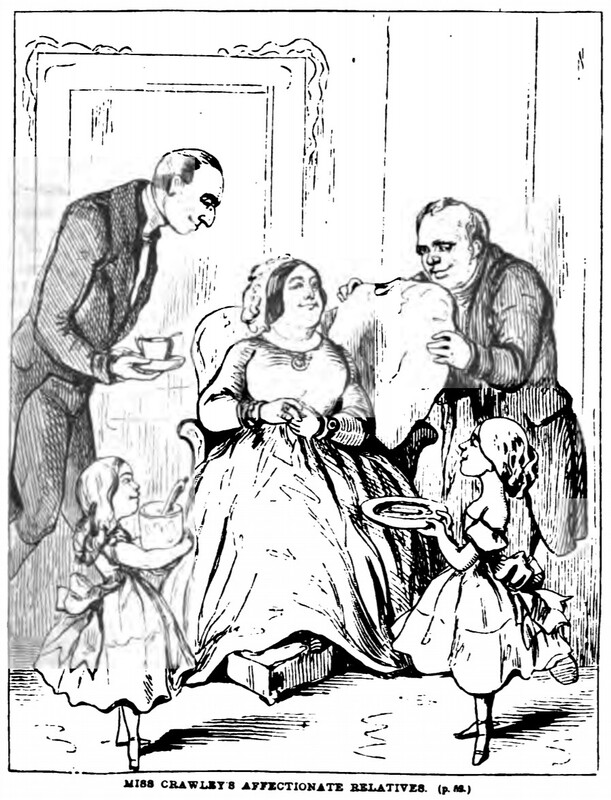
Miss Matilda Crawley is seated in a large, comfortable armchair. She is looking to the right of the image at her brother, Sir Pitt Crawley, who is adjusting one of her cushions. To the left is her other brother, Reverend Bute Crawley, who is bringing her a cup and saucer with a spoon. At her feet are Violet, holding a tall jar or vase, and Rose, holding a plate, both attired in fancy dresses. Below the illustration is printed its title and location in the story, MISS CRAWLEY’S AFFECTIONATE RELATIVES. (p. 52.).
Hercules is sitting on a cloud in the sky. A man has been thrown off a cart and is lying on the floor. The man's hat is on the road next to him. The horse is running away down a hill, pulling the wagon with it. There is a tree
This image depicts the one known honorable deed of Hippo. She was very beautiful, and was one day captured by enemy sailors. She deeply valued the purity of chastity, and knowing that the only way to preserve it was death, she threw herself into the sea. Her captors eventually revealed her identity, and a tomb built on the shore where her body was found.
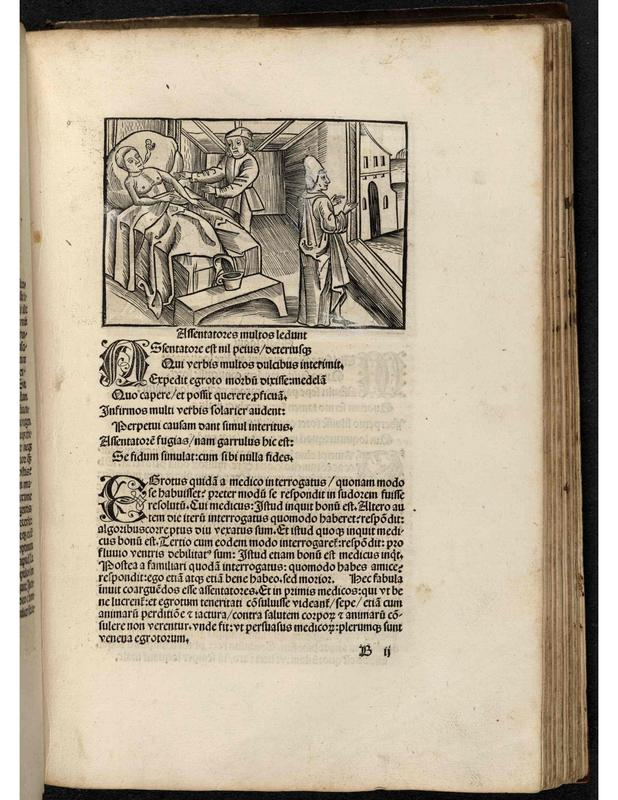
Three people are in a room. One lays shirtless in a bed, with a small entity coming from its mouth. Another person tends to the person lying down. The third person is looking out the window, with their hands up as if they are speaking.
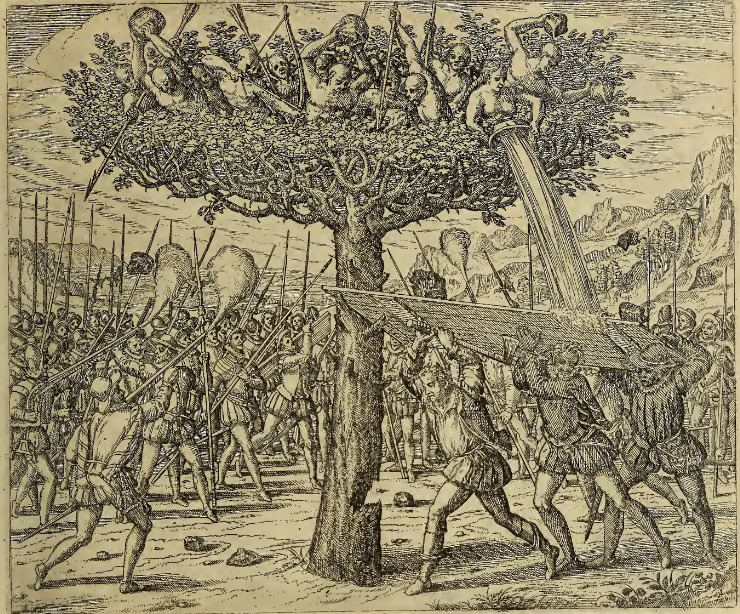
A group of Spaniards attack several Indigenous people in a tree in the Atrato river region of present-day Colombia. The Indigenous people of the region built homes in the treetops because the land around the river was quite swampy. The Indigenous people throw rocks and spears, fire arrows, and pour water onto the attackers on the ground below them, while the Spanish soldiers fire muskets up at them. Two Spaniards hold a large wooden board over the head of a third man, to protect him while he attempts to chop down the tree with a hatchet. This image is identical to one found on page 23 (155) of Frankfurt, 1596.
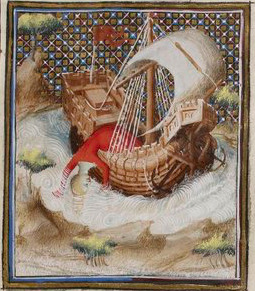
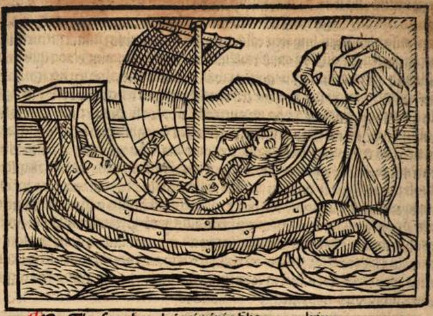
This engraving depicts Theoxena, her husband Poris, and her nephews and child killing themselves. Theoxena and her husband are depicted jumping from the ship head-first into the sea to drown themselves. They are illustrated holding each other as they die as a couple. The figures on the ship are her nephews and her son, who are also killing themselves. Theoxena had given them a choice between stabbing themselves with knives or to drink poison. There are two boys who had stabbed themselves and one child is depicted drinking the poison from a cup. Boccaccio explains that Theoxena and her family killed themselves to avoid dying at the hands of king Philip of Macedon.
Dido, the founder and queen of Carthage, is illustrated on top of the city’s walls on the left side of the image stabbing herself with a knife. After her husband, Acerbas, had been killed by her brother, she fled to Africa and founded Carthage and vowed to remain chaste in honour of her husband. When a foreign king asked for Dido’s hand in marriage and threatened to sack the city if she denied, she stabbed herself to protect her chastity. The foreign king and his subjects are pictured on the ground in front of the castle and a fire.
Lord Steyne stands in front of an ornate fireplace topped with a clock and elaborate candelabra. He is short, bow-legged, and nearly bald, and dressed in fancy clothes with a coat and sash.
This illumination depicts a portrait of a noble Roman woman named Megullia Dotata. She is famous for her enormous dowry. Boccaccio explains that her dowry was said to have been around 500,000 bronze coins, which was incredibly high during Megullia’s time.
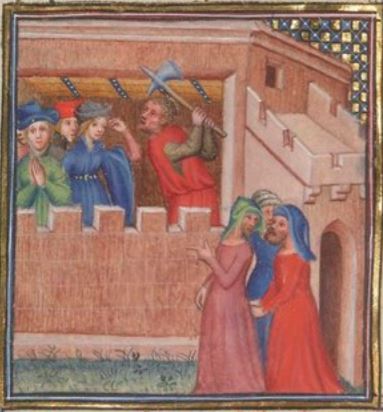
There are three figures leaving a jail in the foreground of the illustration. They are Minyan men who had been sentenced to death for their crimes against their city. They are wearing women’s clothing so they could escape the jail unnoticed. Boccaccio explains that the Minyan’s wives had gone into the jail and swapped clothing with their husbands and switched places with them. The men in disguises slipped past the guards unnoticed and into freedom, while their wives were executed in their place. The women, disguised as their husbands, are illustrated in the background of the image with an executioner about to swing his axe at them. Boccaccio explains that he chose to write on these women to demonstrate that there is no greater love than a wife’s love for her husband.
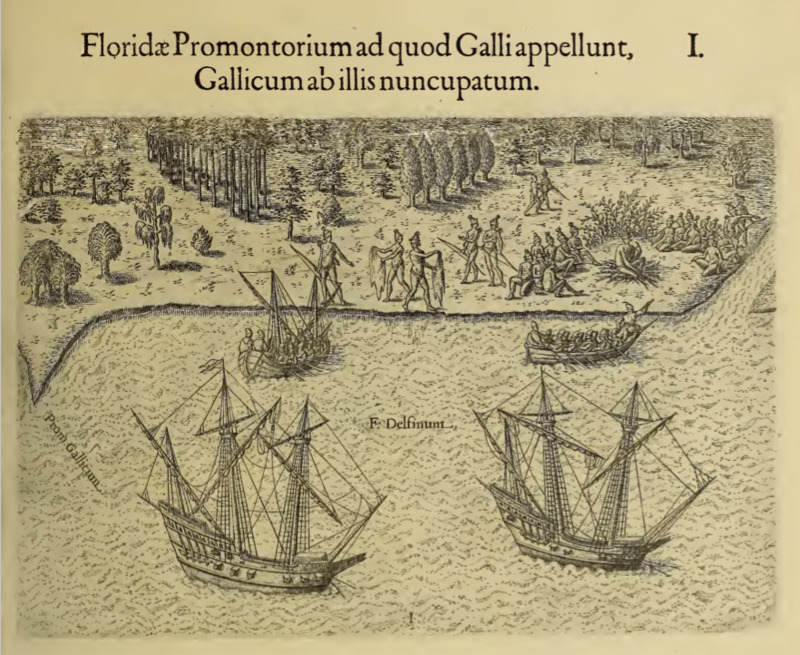
Two large ships are pictured off the coast, two smaller boats full of settlers are being rowed closer to shore. A number of Indigenous people are shown on land, several hold bows and arrows, and a few others hold large pieces of fabric. A group sits on the ground in a semi-circle with one individual at the center.
In this image we see Gulliver whittling a tree that he cut down to use as a mast for his boat. He was given supplies to refurbish the boat that he found so he could return home. Here we see Gulliver holding a tree under his arm, with the leaves and branches still attached at one end. He whittles one end to use in his boat, likely for a mast. He whittles the tree with a small handheld knife. In the bottom right, two more Blefuscudians cut down another tree, and behind Gulliver two more walk carrying a long plank. Gulliver’s hat is on the ground behind him. The same image appears in the 1843 Krabbe edition.
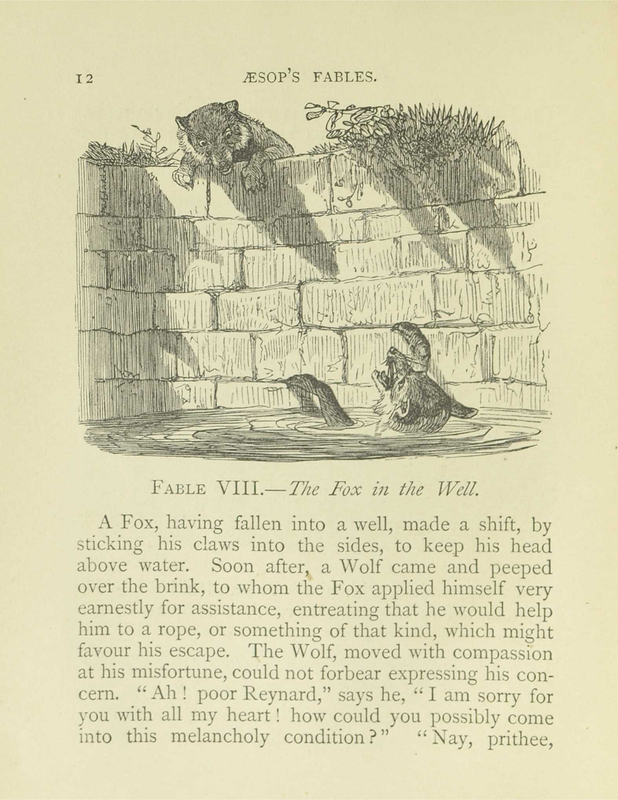
A Fox, having fallen into a well, made a shift, by sticking his claws into the sides, to keep his head above water. Soon after, a wolf came and peeped over the brink, to whom the Fox applied himself very earnestly for assistance, entreating that would help him to a rope, or something of that kind, which might favour his escape.
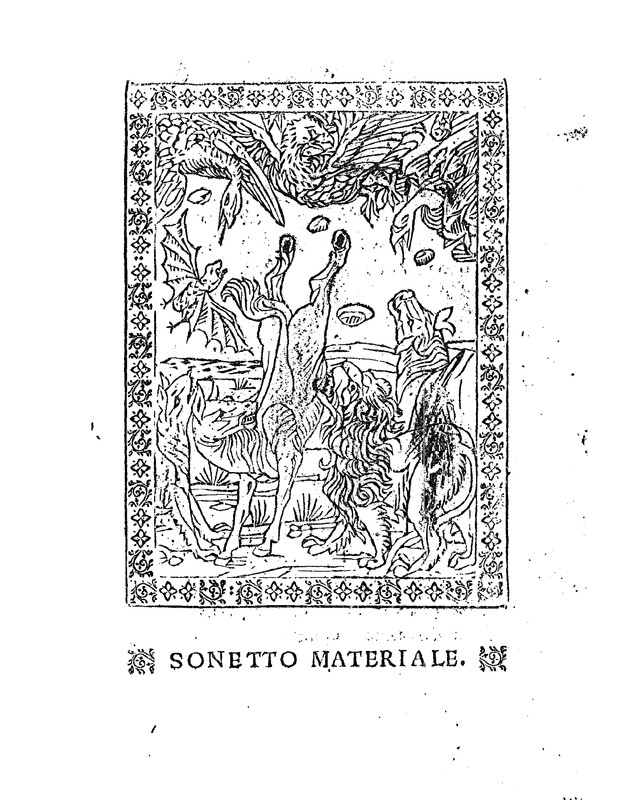
On the ground: A horse withs it hind legs going straight up and gritting its teeth, a wolf and a lion both looking ferocious towards the sky, and another animal aswell. In the sky: many birds are flying above, looking like they are attacking the quadrapeds. The image is bordered by a vine design
Two groups of Indigenous people are shown engaged in conflict along the coast of Brazil. One group attack from canoes along the shore, aiming bows and arrows at a group on land. There is one European man in the second canoe from the bottom, who shoots a gun or musket. The other group of Indigenous people stand on the shore, firing bows and arrows at the canoes. This group is joined by three European men, all of whom fire guns or muskets at the group in canoes.
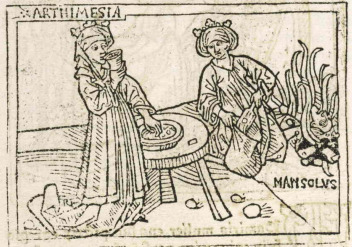
Artemisia was married to Mausolus, the king of Caria. Boccaccio explains that when he died, Artemisia was so grieved by his death that, instead of putting his ashes in an urn after his cremation, she drank the ashes in order to be closer to him. The right side of the engraving depicts Artemisia cremating her husband’s body in a fire. Mausolus’ name is engraved in front of the fire to identify him. Artemisia is illustrated scooping her husband’s ashes and putting them into a bag. The left side of the engraving depicts Artemisia drinking her husband’s ashes. We know that this figure is Artemisia as her name, written as Arthimesia, is engraved above her head.
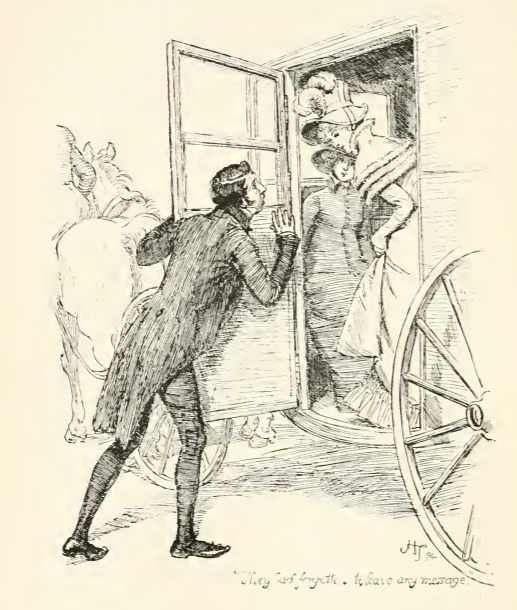
In this image Elizabeth and Maria get into the Gardiner’s carriage, leaving for London. As they got into the carriage, Mr. Collins reminded them they had forgotten to leave a message for Lady Catherine de Bourgh and her niece at Rosings. Mr. Collins said he would give the ladies their thanks and then closed the carriage door. This scene occurs in chapter 38. The characters are shown in the traditional regency style. Elizabeth and Maria wear the regency style with dresses with empire waistlines and bonnets. Mr. Collins wears a waistcoat and tailcoat. The regency period dated to the early nineteenth century (1811-1820) when George, Prince of Wales, later George IV (r. 1820-1830), reigned as regent for his mentally ill father, King George III (r. 1760-1820). The regency period is associated with the rise of neoclassicism in art and fashion.
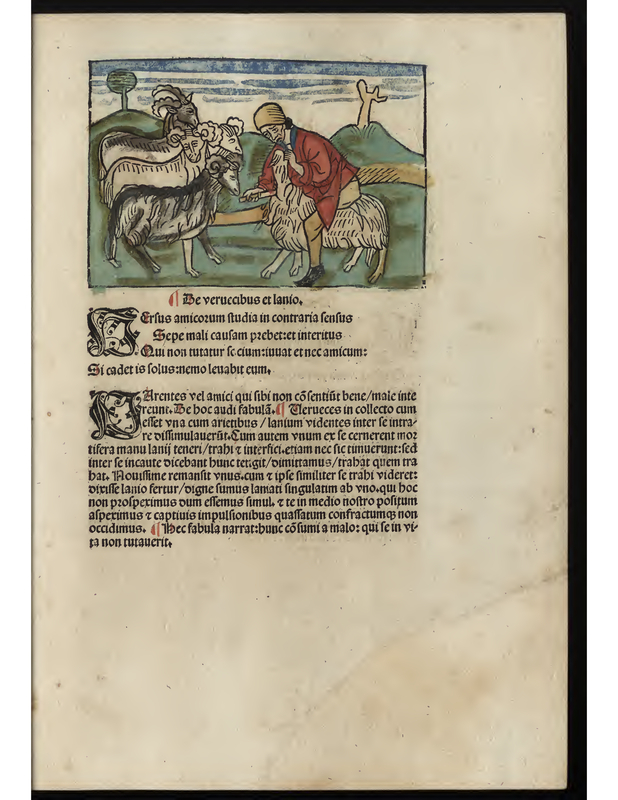
To the left of the image there are multiple rams lined up. To the right of the image is a butcher straddling one of the rams and putting a knife into its neck. In the background there are hills and two trees.
A man is kneeling on one knee while grabbing a two stork's necks, one in each hand. One stork is poking near the man's shoe while the other is pointing it's face above the man's head. There is a third stork behind the first two looking backwards. There are trees and mountains in the background.

![[Hercules and the Carter]](https://collections.cemvc.ca/files/large/f43cff3603ed9ec9d42f0cbcdb02f22da183dcc0.jpg)

![[Soldier]](https://collections.cemvc.ca/files/large/768a670ba6cc16d924eff6fc18520f50ee175e13.jpg)
![[Dido Stabbing Herself to Honour her Chastity]](https://collections.cemvc.ca/files/large/3e3ef5c576168a4e415c616410e7404179daef07.jpg)
![[Lord Steyne]](https://collections.cemvc.ca/files/large/f7be82e22f4f295d0375f006392daecbf3834d02.jpg)



![[Gulliver whittles a tree to use in his boat]](https://collections.cemvc.ca/files/large/86fe80716b354138f6b0f12bf0d7d0d50396a53e.jpg)
![[Conflict between two Brazilian Indigenous groups, one group on land and one at sea]](https://collections.cemvc.ca/files/large/84fa0b5a55411adaccd36c0624741bf2d3defaa0.jpg)
![[The Husbandman and the Stork]](https://collections.cemvc.ca/files/large/99e8d52ad6cdf9b1d9e6ba4abad9dfeb89027cc4.jpg)