Here we see a Lilliputian walking through the city of Mildendo at night. This image appears at the beginning of Chapter Six, in which Gulliver learns of the different customs for the Lilliputians. The letter A appears in the top corner as the first word of the chapter is Although.
This image depicts a portrait of a woman named Camiola. Camiola was a noble woman from Siena and the daughter of Lawrence of Torringo. She is famous for speaking up against her husband in front of a judge. She felt sympathy for Roland of Sicily who was left to rot in a jail, so she paid for his ransom in exchange for his hand in marriage. He agreed, but when he was freed, he pretended as though he did not agree to marry her. She proved herself in front of a judge and spoke out against her husband’s vile behaviour in rejecting her and his promise to her.
This illumination depicts a Roman woman named Sempronia embracing a man. Boccaccio explains that Sempronia was incredibly skilled at dancing and singing and would charm anyone that would hear her music abilities. There are harps and lyres depicted on the table behind her to signify her musical abilities. Sempronia was also known to be lustful and seek out the company men, which is why she is with two men in the image.
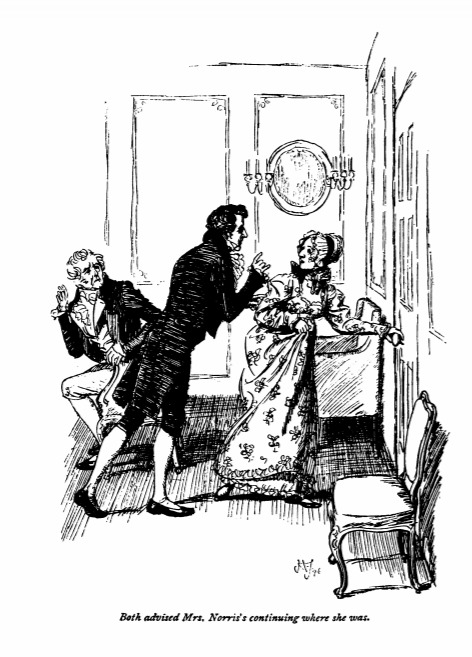
Here we see Edmund and Sir Thomas advising Mrs. Norris to stay in the drawing room rather than go out into the hall when Fanny’s brother, William, arrived. Both men advised Mrs. Norris that it would be better to let Fanny and William reunite alone, allowing them to join the rest of the group in the drawing room. This scene occurs in chapter 24. The characters are shown in the traditional regency style. Mrs. Norris wears the regency style dress with an empire waist, and a mop cap to cover her hair. Edmund and Sir Thomas wear waistcoats and tailcoats, and breeches that stop at the knee and cravats. The regency period dated to the early nineteenth century (1811-1820) when George, Prince of Wales, later George IV (r. 1820-1830), reigned as regent for his mentally ill father, King George III (r. 1760-1820). The regency period is associated with the rise of neoclassicism in art and fashion.
In this image we see Gulliver standing next to a giant’s feet, looking up at the giant. Gulliver just comes up to the giant’s ankles, showing the scale between Gulliver and the giant. There are ropes around the giant’s ankles. The same image appears in both the 1839 and 1843 Krabbe editions.
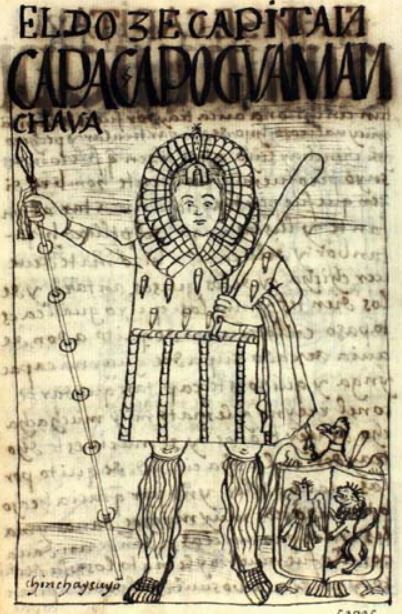
This illustration depicts the twelfth captain, Capac Apo Guaman Chaua. These captains were a level of Inca authority who helped lead the conquest of the Andes. The author explains that this man was captain general of the people of Chinchaysuyo. This is why Chinchaysuyo is written at the bottom of the image. He is depicted holding a long spear in his right hand and a club in his left, with his shield resting on the ground beside him. The author explains that this captain conquered from the province of Quito to New Grenada.
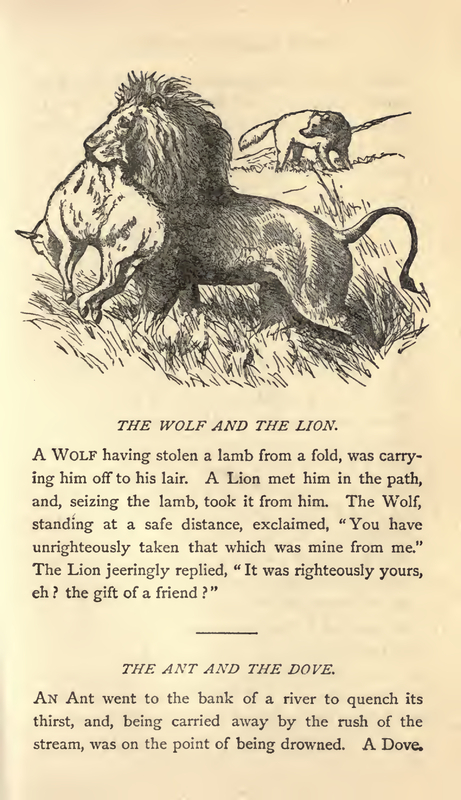
There are three animals in a field: a lion, a wolf and a lamb. The lion is in front of the wolf carrying the lamb in his mouth. And in the distance, the wolf is standing and looking at the lion.
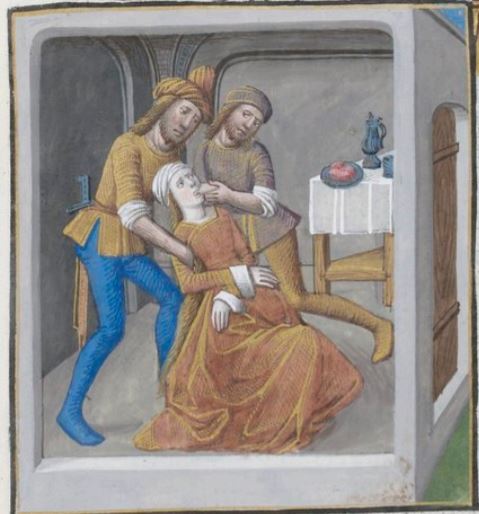
This image depicts Agrippina, the wife of Germanicus, being forced to eat food. Agrippina is depicted in the centre of the image on her knees as a man holds her arms back while the other man is forcing food into her mouth. She is being force fed under the orders of Tiberius. Tiberius is Germanicus’ father, and after he killed his own son, he sent his daughter-in-law Agrippina to prison. Agrippina decided to starve herself to death to avoid dying at Tiberius’ hands, however, Tiberius force fed her so that she would not die under her own circumstances.
Here Gulliver speaks with the king of Brobdingnag after recovering from his encounter with the monkey. The king asks Gulliver about monkeys in Europe, to which Gulliver responds there are very few monkeys in Europe unless they had been brought there from elsewhere. The king laughs at this response.
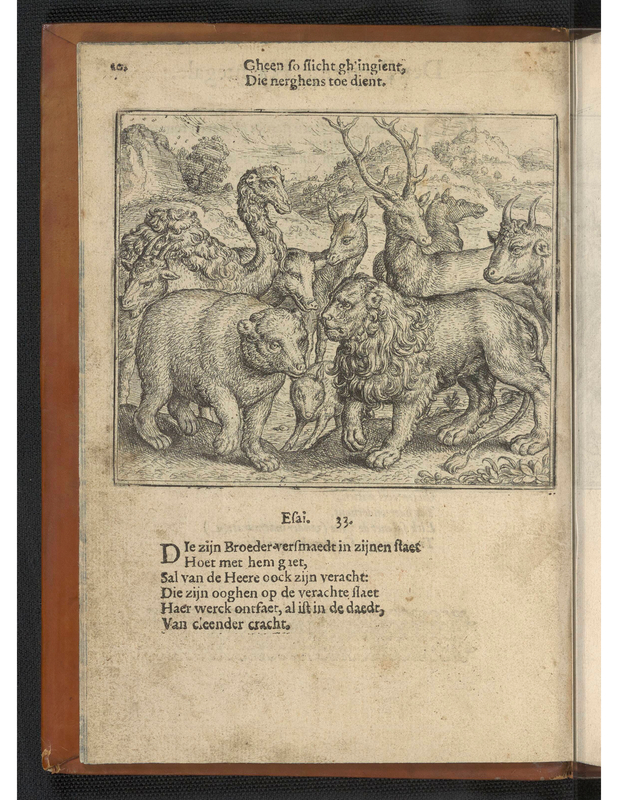
Ten animals stand together in front of a scenery of rocky hills scattered with trees. A lion on the right half of the page and bear on the left half of the page, stand in front angled towards one another. An ox and stag stand behind the lion. Behind the stag a horse is standing with its back to the rest of the animals. A goat, camel, bore, and deer stand behind the bear, facing the animals on the right. A small fox stands hunched over near the center back of the group, facing the lion and bear.
After Lucrecia guides Melibea to her bedroom, she wakes Pleberio and informs him that Melibea has been afflicted by a grave illness. Pleberio rushes to help Melibea and asks her the nature of her illness. Melibea responds that it is an illness of the heart for which there is no cure. He takes her outside for some fresh air, and Lucrecia follows (presumably the scene depicted in this illustration). Melibea says that music might help alleviate her sickness, and Pleberio goes to fetch some instruments. She then asks Lucrecia to join her in ascending the house’s tower, but once they reach the top, she claims that the height is making her uneasy. When Lucrecia begins descending the stairs, Melibea closes the door and locks herself in. As Pleberio stands at the base of the tower, Melibea reveals the true cause of her illness --the death of Calisto-- and tells him that she had been meeting with Calisto for months. She then jumps from the tower, taking her own life.[The figures in this illustration are used in multiple other illustrations throughout this edition.]
Two groups of Indigenous people engage in battle from canoes. Both groups are armed largely with bows and arrows and fire at each other, and members of both groups wear feathered headdresses and adornments around their waists. There are also a few individuals blowing into an object, perhaps a wind instrument or blow gun. Two European men stand in the prow of the canoe farthest from the viewer on the right, aiming long guns at the opposing group. There are several men in the water between the two groups of canoes.
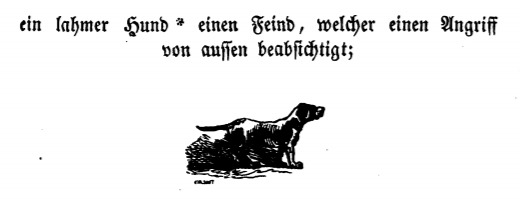
This image is of a lazy dog. A lazy dog was code for an invader. This image comes in a description of a conspiracy found by a professor from the Grand Academy on Balnibarbi. This idea is representing code word for terms in the conspiracy that Swift is satirizing. The professor advises that those named in the conspiracy papers be closely monitored at all times, naming specifically while they were using the bathroom, as this is when men were most thoughtful. This conspiracy is thought to be an allusion to the trial of Francis Atterbury, the bishop of Rochester for allegedly plotting with the Jacobites. Atterbury was charged with treason in 1722 and was exiled to France. During Atterbury’s trial, his dog was used as evidence against him as the dog was a present from the French. Other interpretations of this image see the dog as the crown pretender Jacob Stuart or Jacob III. The same image appears in the 1839 Krabbe edition.
Sir Pitt Crawley kneels on the ground in his sister’s parlour, one hand extended towards Rebecca Sharp, who stands in front of him looking slightly startled. In the background are two life-sized portraits of women.
A group of French traders stand in a small boat near the coast while one of their group stands on the shore speaking with a group of Tupinambá men. The French appear to be trading for monkey, parrots, and possibly brazilwood, and they have a large bird cage on their boat. There is a Tupinambá village nearby and a group of people stand near the shore, some holding bows and arrows. A European man, captive of the Tupinambá, swims out to the French boat but is prevented from boarding so swims back to shore.
In this image Gulliver demonstrates his pistol to the Lilliputians. Gulliver’s right arm is visible, holding his pistol. A cloud of smoke emerges from the pistol. A crowd of Lilliputians cower on the ground, scared by the bang of the gunpowder. Two horses rear also scared by the noise. This image comes at the point in the story where Gulliver demonstrates his weapons to the people of Lilliput, including his rapier and his pistol, which he loaded with gunpowder to demonstrate its use. The town is visible in the background. The same image appears in the 1839 Krabbe edition.
Here we see the Houyhnhnm’s house. Gulliver describes it as a long building made of timber with a low, straw roof. The house has a smooth clay floor and a rack and manger that extends the entire length of the house. The letter A is on the house because this image appears at the beginning of chapter two, and A is the first letter of the chapter. The same image appears in the 1843 Krabbe edition.
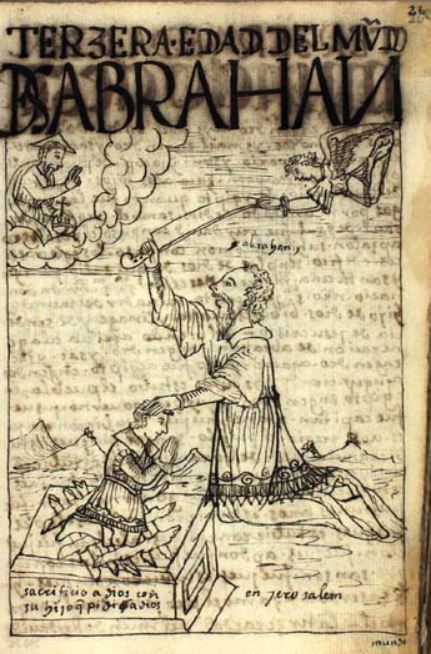
This illustration depicts the biblical story of Abraham and his son Isaac. Abraham is kneeling as he holds a sword above his head in his right hand and his left hand is holding his son’s head. Abraham is depicted looking up to the sky, where God is pictured in the top left corner. Isaac is pictured kneeling with his hands bound together. Abraham was about to sacrifice his son to God, but the fact that Abraham was willing to do it was enough. There is a winged angel holding onto Abraham’s sword to stop him from killing his child. The word Abrahan is written above Abraham’s head to identify him. The words Sacrificio a Dios, con su hijo que pidió a Dios which translates to Sacrifice to God, with his son who asked God. The words en Jerusalem are written below Abraham’s legs to identify where they are.
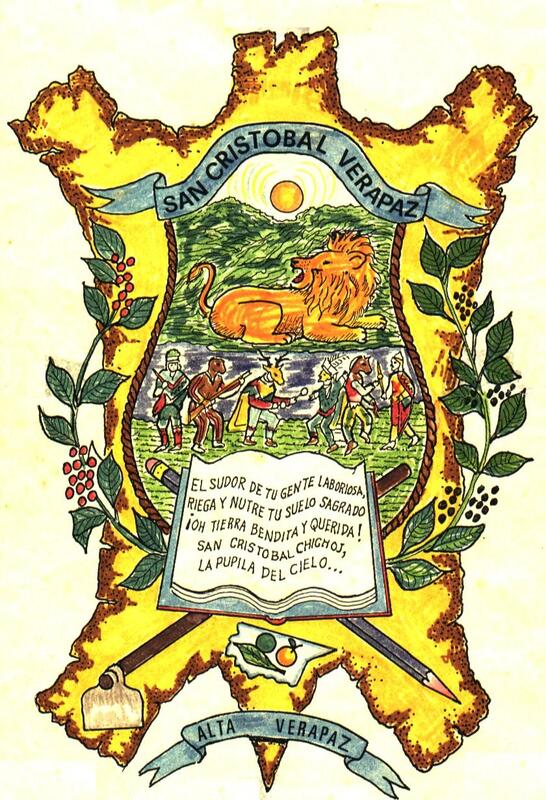
SAN CRISTOBAL VERAPAZ EL SUDOR DE TU GENTE LABORIOSA, RIEGA Y NUTRE TU SUELO SAGRADO ¡OH TIERRA BENDITA Y QUERIDA! SAN CRISTOBAL CHICHOS, LA PUPULA DEL CIELO... ALTA VERAPAZ


![[A Lilliputian walks through the streets of Mildendo]](https://collections.cemvc.ca/files/large/854727ce2fd8961ae6ea895646d7bfe617f5a8a3.jpg)
![[The Widow Camiola]](https://collections.cemvc.ca/files/large/04ded0c16dcfd25be0893c2158a8ae134fb339ec.jpg)

![[Gulliver standing next to a giant’s feet]](https://collections.cemvc.ca/files/large/e8254116304e3dd9b67424d52420f0851e0fbe1c.jpg)
![[Gulliver speaks with the King of Brobdingnag after his encounter with the monkey]](https://collections.cemvc.ca/files/large/da31c1ab18ec4409131f61e3f7967e29f04a4a54.jpg)
![[Act XX – Melibea, Lucrecia, and Pleberio]](https://collections.cemvc.ca/files/large/71628bddf2c1c5090a94b0fb2f82a44cf7ad8aab.jpg)
![[Vanity Fair Chapter XXIV Inhabited Initial]](https://collections.cemvc.ca/files/large/5f2cdd51c4cf4543224dcbb7ad7c8eaf33736990.jpg)
![[Two Brazilian Indigenous groups engage in a naval battle]](https://collections.cemvc.ca/files/large/c5199adb540cc3046d126ede76b26f8d388092ec.jpg)
![[Sir Pitt Proposes to Rebecca]](https://collections.cemvc.ca/files/large/8e1f0fc73d716173a5c1f0ecda1e9a70fca14404.jpg)

![[A group of Frenchmen trade with the Tupinambá]](https://collections.cemvc.ca/files/large/d9148b571ceceb5b9c08d134375699591c260a03.jpg)

![[Gulliver fires a pistol]](https://collections.cemvc.ca/files/large/fb70a2b4a8f48d9f2a88c36eb2983535eaecf2cb.jpg)


![[the Houyhnhnm’s house]](https://collections.cemvc.ca/files/large/cde2192bfade4f8eb88beb6c88cbbb34fbe8dc3a.jpg)