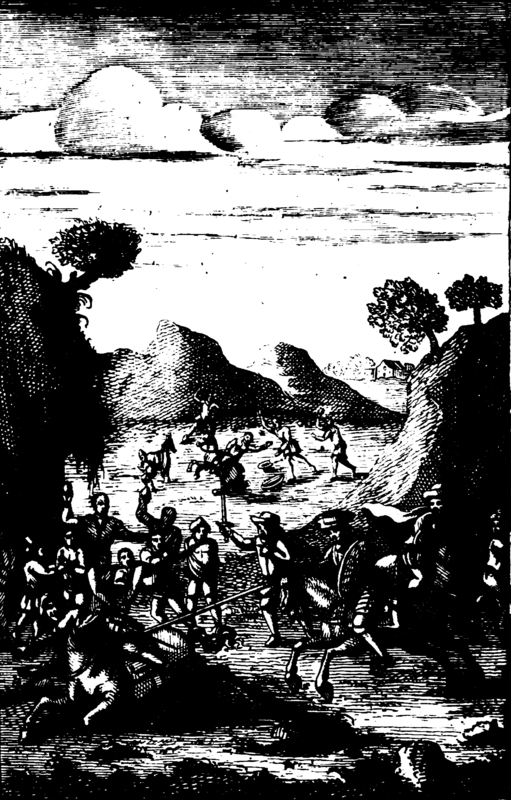
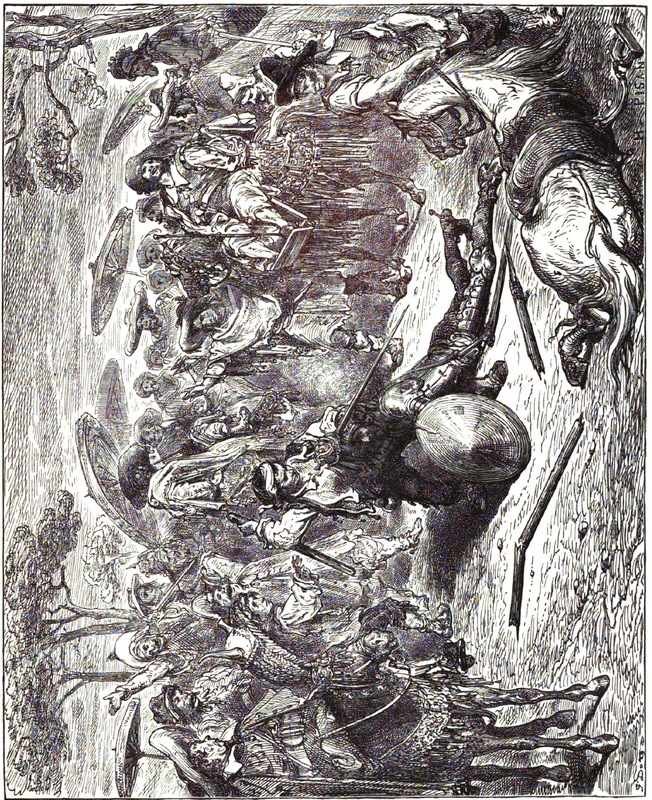
Galley slaves rejoice as Don Quixote attacks one of the kings horsemen with a lance and shield. Sancho Panza raises a sword in celebration to the right of the slaves in response to this victory. In the background, a second horseman falls in defeat as the slaves throw rocks at him. Behind Quixote, a third caped horseman flees the scene.
A woman sits on a grassy hill in a white dress and satin belt, with her right hand on her chest and her left leaning against the ground. She looks off into the distance on the right as a woman standing behind her places a garland of flowers on her head. On the left two more women aid the virgin dress lavishly, one wears a bun and points towards the one on the right while the other with shoulder length hair fiddles with a string of acorns. The image is occasioned by Don Quixote saying "Poetry, Signor hidalgo, I take to be like a tender virgin, very young and extremely beautiful, whom divers other virgins, namely, all the other sciences, make it their business to enrich, polish and adorn; and to her it belongs to make use of them all, and on her part to give lustre to them all."
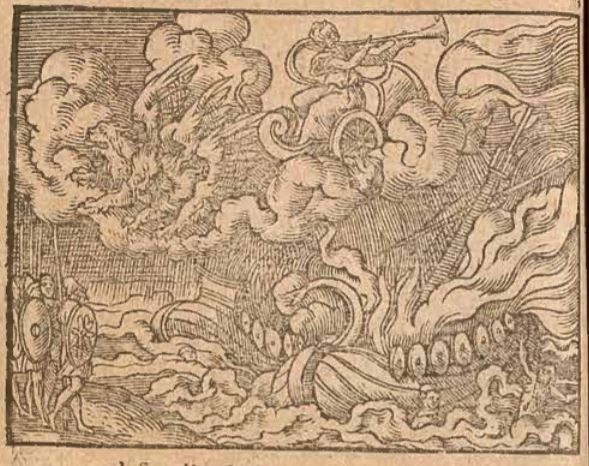
This engraving depicts a battle between Aeneas’ army and Turnus’ army. Turnus conjures a plan to attack by burning Aeneas’ ships. As depicted in the engraving, the ships are engulfed in flames. The goddess Cybele was furious as Aeneas’ ships were made from her favourite trees. Cybele interferes by riding past the battle in her lion-drawn chariot, as illustrated at the top of the engraving. She makes it rain enough to put the fires out, and to save the ships even further, she transforms them into nymphs. There are nymphs depicted in the water beside the ships to illustrate the transformation.
Sancho Panza is given the island the Barataria to govern as a gift from the Duke. Barataria is populated by around 1000 inhabitants and one of the Duke's best towns. Sancho Panza (clad in robes and an expensive hat) sits in a grand chair at the head of the tribunal of justice to bestow verdicts upon the citizens of Barataria and their plights. Having successfully deduced an old man's trick, who had tried to hide 10 gold coins in his staff, a woman seeks Sancho's attention, holding a rich herdsman in hand (left of Sancho Panza). Sancho jumps from his chair to stop any violence from occurring and the woman explains that she has brought him to the tribunal after he has sexually assaulted her and taken her virginity while the rich herdsman claims their relationship was consensual.
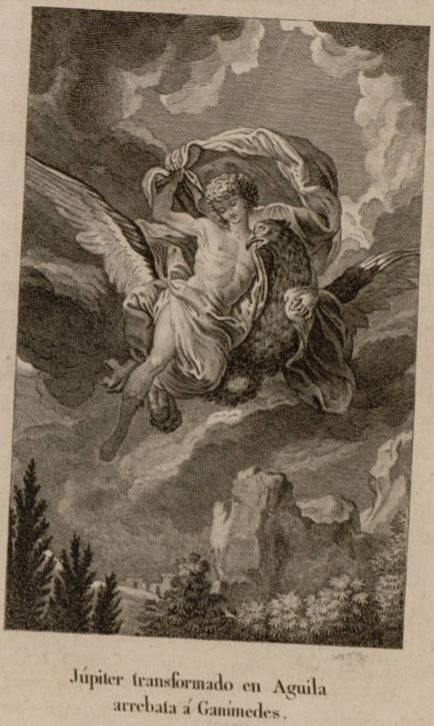
This image depicts Jupiter disguising himself as an eagle to abduct a boy that he was in love with. The engraving illustrates Jupiter in the form of a giant eagle, carrying away the Phrygian boy named Ganymede. Ganymede has his left arm wrapped around the eagle’s neck and the other arm is holding a piece of fabric that is blowing in the wind. Jupiter took him away from Phrygia and brought him up to the heavens to handle his mixing cups.
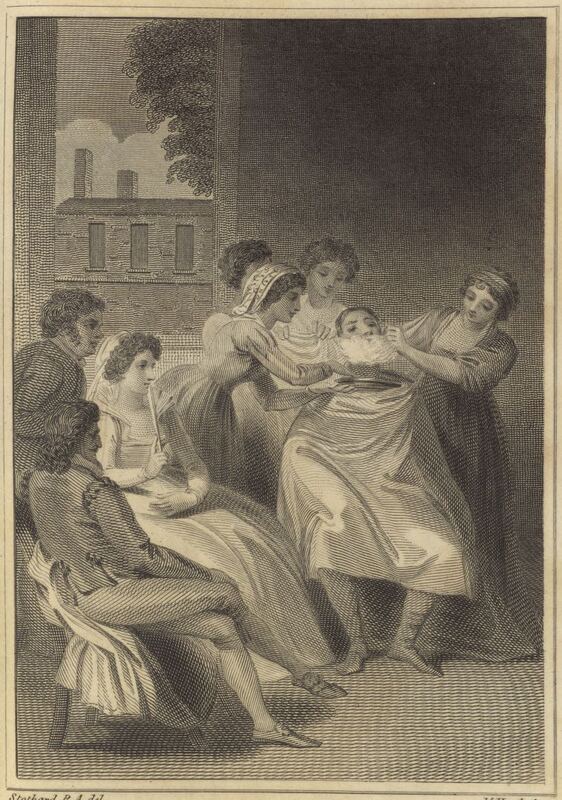
The duchess’ maidens wash Don Quixote’s beard while the duke, the duchess, and Sancho Panza watch. Signed by T. Stothard (illustrator) and J. Heath (engraver). Part 2, ch. 32.
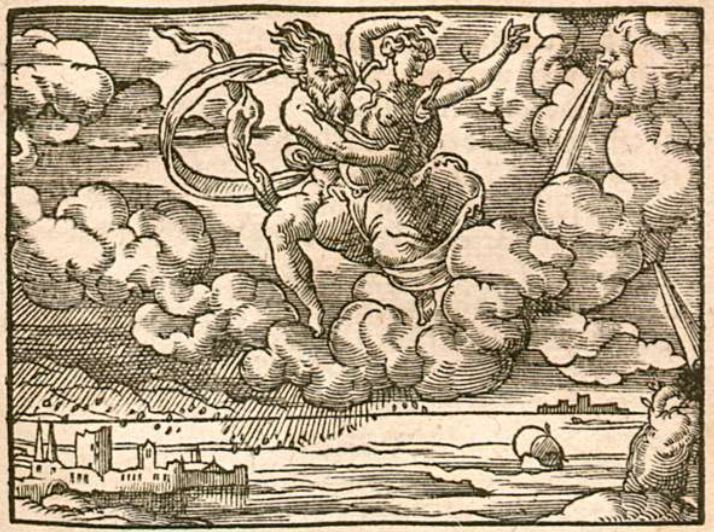
This image depicts the abduction of Orithyia by Borea, the god of wind. There is a face in the top right corner of the image blowing wind to symbolize that he is the god of wind. Borea is depicted at the top of the image floating in the sky as he grabs Orithyia by the waist. Orithyia is depicted trying to get away from Borea as her arms are in the air and she is looking away from him. Borea was taken with Orithyia and her beauty, and when she rejected his charming advances, he became aggressive and abducted her.
Don Quixote delivers a speech about the golden age to a group of goatherds. The goatherds are gathered around Don Quixote, whose figure is at the centre of the composition. Sancho Panza appears in the right foreground, drinking wine from a cup. The goatherd in the left foreground is drawn with a classical figure. Plate no. 8, signed by J. Vanderbank (illustrator) and G. van der Gucht (engraver). Vol. 1, book 2, ch. 3.
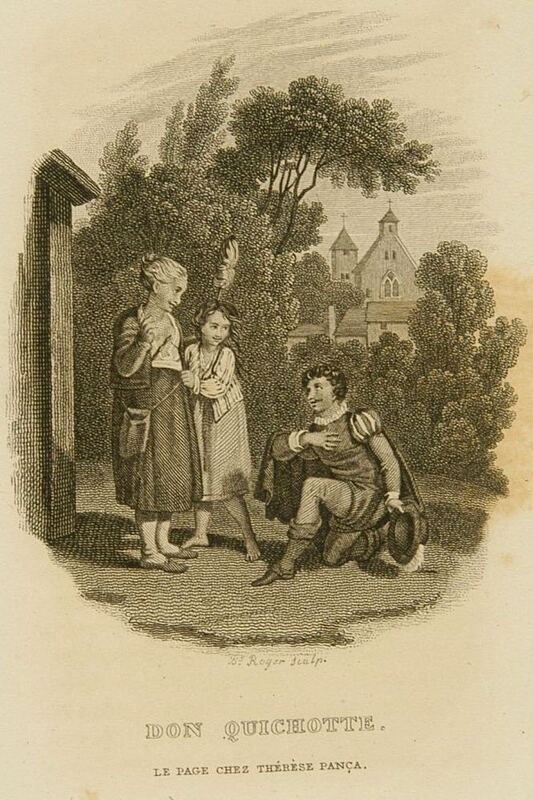
The duchess’ page kneels before Teresa Panza and her daughter Sanchica. He presents them with letters and gifts from the duchess and Sancho Panza. In the background, the church of El Toboso. Signed by B. J. F. Roger (engraver). Part 2, ch. 50.
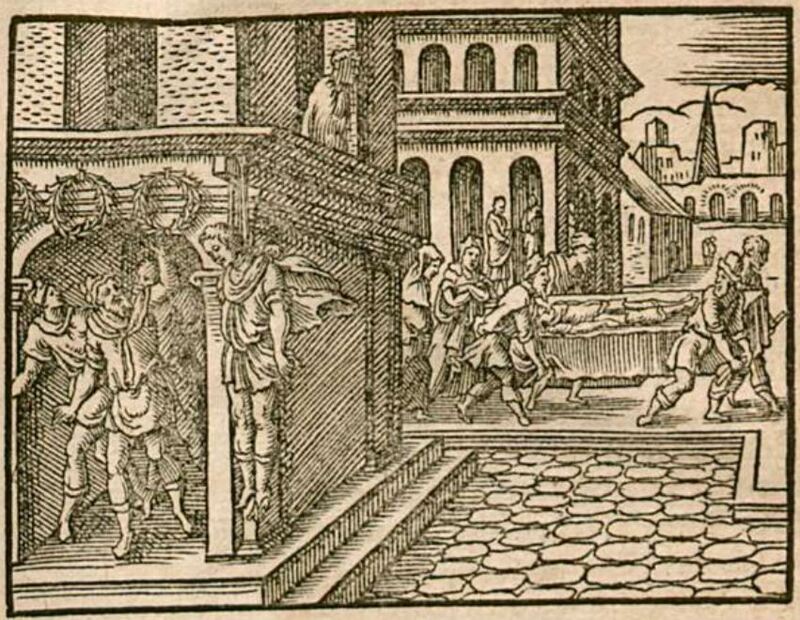
This engraving depicts the story of Iphis and Anaxarete. A young man named Iphis had fallen in love with a young noble woman named Anaxarete. Unfortunately for Iphis, Anaxarete’s feelings were not mutual. Iphis hung himself outside of Anaxarete’s room out of grief for the unrequited love. This is depicted on the left side of the engraving. There are servants emerging out of the doorway with shocked expressions as they see Iphis hanging. The background of the engraving illustrates the funeral ceremony for Iphis, as he is carried away on a funeral bier with his mother walking directly behind the bier. Anaxarete is depicted looking out of her window as she watches the funeral processions.
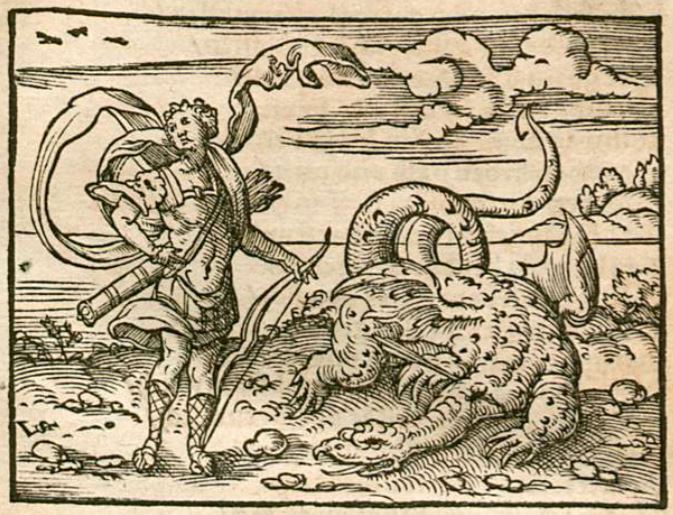
This image illustrates the archer god, Apollo (also referred to as Phoebus), in the foreground of the image holding his quiver in his right hand and his bow in his left hand. Apollo has a face riddled with pride, as he had just slayed the great snake that lays beside him. His arrow is shown in the neck of the serpent. This serpent was created from the new mud of the earth, and when Phoebus slayed the python, the Pythian games were then created to honour this glorious kill done by the god.
A muleteer beats Don Quixote with his own lance. Don Quixote has attempted to charge the muleteers to avenge a perceived slight against Dulcinea, but fell on the ground after Rocinante tripped. The muleteer’s master calls for him to stop, but the man refuses to let up the beating until he had vented all of his anger. Rocinante lies on the ground in the bottom left corner. In the centre, the man beats Don Quixote who is trapped by his armor. The rest of the muleteers surround them, some laughing, some attempting to stop the man. This scene can be found in Part I, Book 1, Chapter 4.
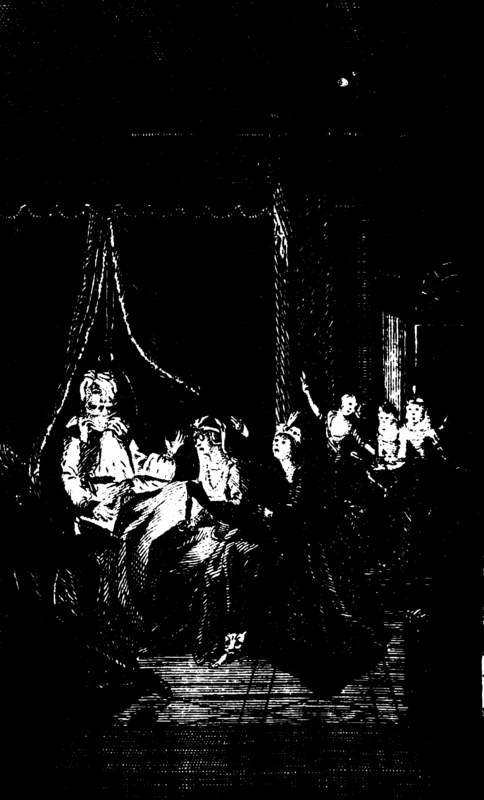
Due to an unfortunate run-in with a cat, Don Quixote is confined to his apartment for six days. Lying awake in bed, he is visited by Donna Rodriguez, the Duchess' woman. To heal his wounds, Quixote wrapped himself from head to foot in a yellow satin quilt , with a woolen cap on his head, his face and his moustache bound up; his face was bound to heal his scratches, and his moustache to keep from hanging down and looking silly. Donna Rodriguez approached Quixote in a white veil, that covered her from head to foot. In her right hand she carried a lighted candle , and held her left hand before her face to keep the blaze of the flame from her eyes, which were hidden by a huge pair of spectacles. Donna Rodriguez regales Quixote with the story of how she came to work as a servant for the Duchess despite having been born a noble. However, they are interrupted by unknown assailants who barge into the room to punish Quixote and Rodriguez.
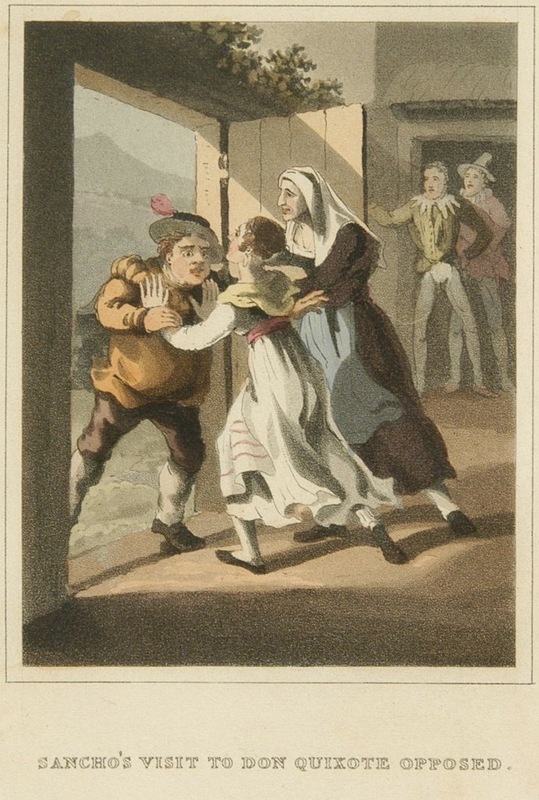
In the foreground, the housekeeper and the niece prevent Sancho Panza from entering the house and visiting Don Quixote. In the background, the barber and the priest hear Sancho’s shouts and appear in the doorway of the house. Unsigned. Part 1, ch. 3.
Having capsized Quixote's boat, two millers pull the drenched passengers from the river. The miller on the right pulls Sancho Panza's arm whilst kneeling on the bank, his sleeves rolled up past his elbows. Sancho grasps for air as he surfaces, his hands reaching for something solid to hold. On the left another miller pulls Don Quixote from the river by his ankles, the knight's leg armor is all that's visible to identify him with. In the background to the left a third miller looks at Quixote's lower half combatively with a wooden pole in hand, and two more figures in the middle of the background approach the newly submerged men.
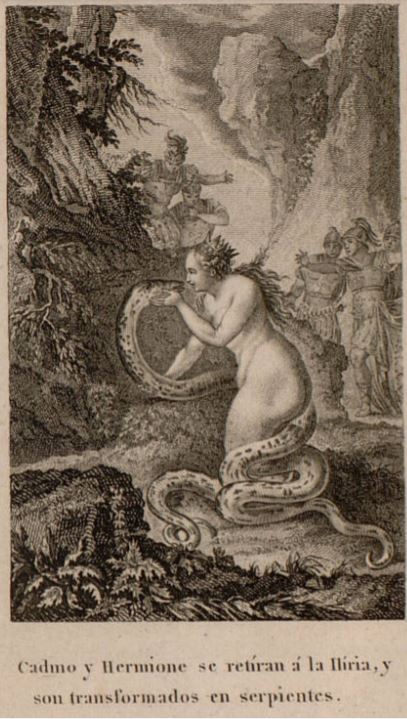
This image depicts Cadmus, the king of Thebes, transformed into a snake. His wife Harmonia is depicted holding him while she wishes to be transformed into a snake as well in order to be with him. Cadmus was transformed into a snake as punishment for slaying a serpent sacred to the god Mars. There are soldiers in the background of the image watching the scene unfold.
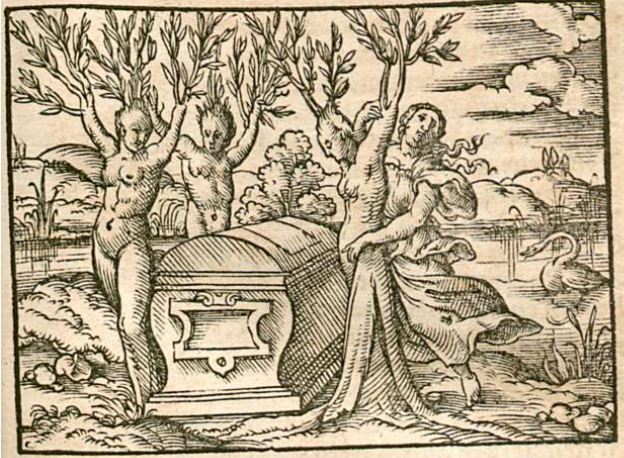
This engraving depicts the three sisters of Phaethon, the Heliades, transforming into poplar trees. The sisters had just learned of the death of their brother and are illustrated standing around his tomb. When they begin to mourn for his death, the sisters notice that their legs have stiffened and begin turning into trunks of trees and their arms into branches. The Heliades’ mother, Clymene, is depicted fearfully clinging onto one of the sisters to stop the transformation from happening. Another relative that deeply grieved for Phaethon was Cycnus. He too had a transformation after hearing the news of Phaethon's death, but instead of a poplar tree like the Heliades, Cycnus transformed into a swan. Cycnus in the form of a swan is illustrated in the background of the engraving, resting on the water.
Four damsels stand around Don Quixote, one to the left with a basin of silver, a second behind him with her sleeves rolled up to her elbows and a necklace adorned on her neck went at Quixote with two hands on his beard, a third still, stood on the right with fine clean towels in her arms, and the fourth damsel merely peaked over the second's shoulder. The damsel behind Don Quixote claps her hands under Quixote's beard with a genteel air and assurance, raising great flakes of white lather over the the face beneath the nose. As Quixote gets washed, he shuts his eyes tight so as not to have them infiltrated by the soapy suds.
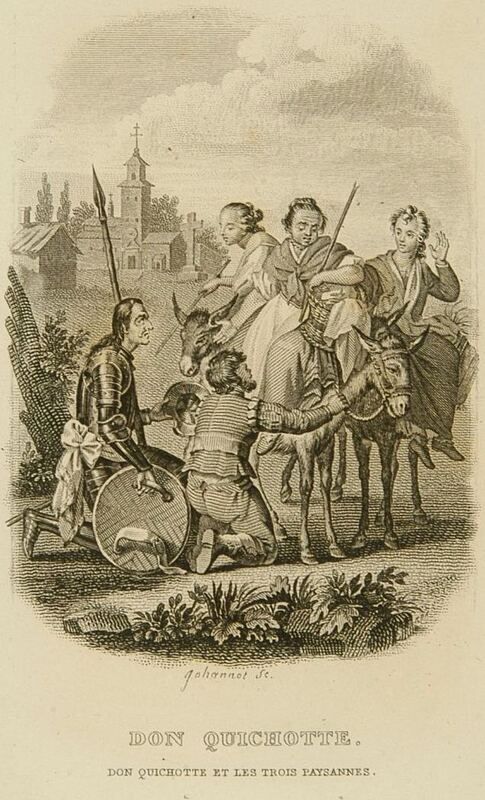
In the foreground, Don Quixote and Sancho Panza kneel before three peasant girls. Sancho introduces one of them as Dulcinea. In the background, the church of El Toboso. Don Quixote is dressed in his armour and carries his lance and buckler. Signed by Johannot (engraver), no given name. Part 2, ch. 10.
Don Quixote mistakes Maritornes (centre) for a maiden and grabs her by the wrist. The muleteer (left) draws near, before striking Don Quixote. A fight ensues. There are differences between the representation of Maritornes in this plate and plate no. 10 which precedes it. Plate no. 11, signed by J. Vanderbank (illustrator) and G. van der Gucht (engraver). Vol. 1, book 3, ch. 2.
Having been trampled in the battle of Barataria, Sancho Panza (center) returns to the stable and embraces Dapple, kissing his donkey on the forehead. He is followed by all his attendants (left), foremost among them two bearded men, one in long robes, and the other in a merchant's garb. They enter the stable door, followed closely by the rest of the attendants to see why Sancho Panza has alighted to the stable.
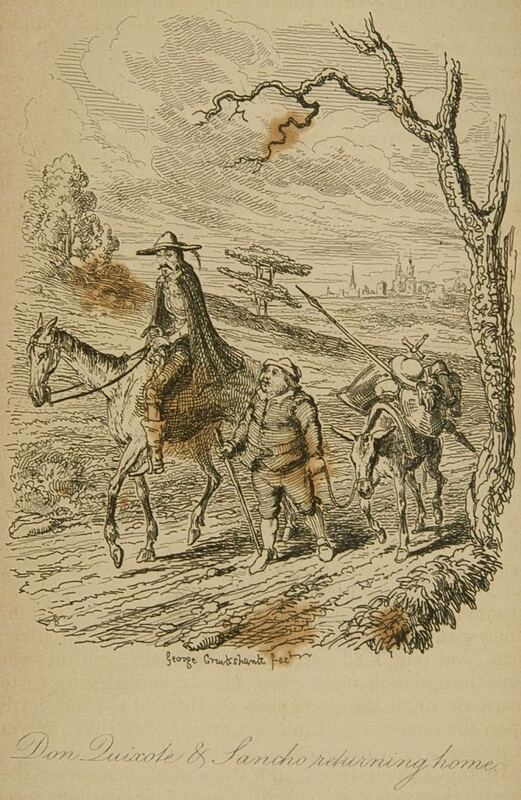
Don Quixote and Sancho Panza make their way home from Barcelona (pictured in the background). Don Quixote is mounted on Rocinante and is no longer wearing his armour. Sancho Panza’s donkey carries Don Quixote’s armour and lance. Signed by G. Cruikshank (illustrator and engraver). Part 2, ch. 66.
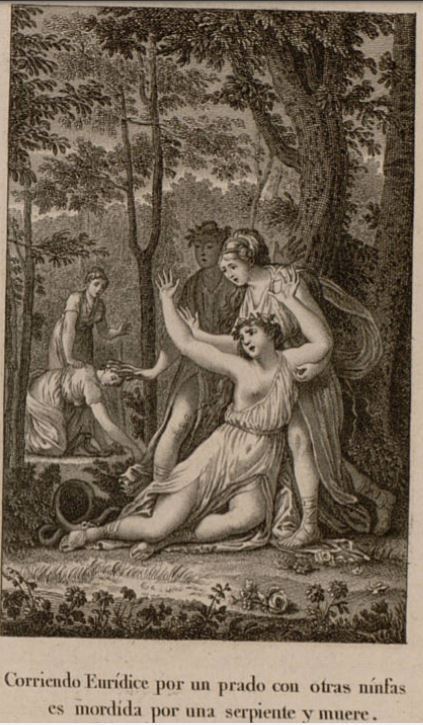
This engraving depicts the new wife of Orpheus, Eurydice, surrounded by naiads. While taking a walk with the naiads one day, Eurydice had stepped on a poisonous snake that had been hiding in the grass. This is depicted in the engraving, with Eurydices’ hands in the air in shock, with her head facing the snake to look at what had bit her. One of the naiads is depicted catching Eurydice as she falls and the other naiads look shocked. The snake bites Eurydice and the venom kills her, which results in her husband, Orpheus, going to the Underworld to try to save her.

![[Of the Polishing of Virgins]](https://collections.cemvc.ca/files/large/187b38bef3b1e2f5375f15bf50fcc8be7a1242ce.jpg)
![[Of how Sancho Panza Governed his Island]](https://collections.cemvc.ca/files/large/0a7b4e73c2295fdf6ff92b992e83659d33128b18.jpg)
![[Golden age speech]](https://collections.cemvc.ca/files/large/cccb52e2009c1ec5a6aef622f32d47972e207174.jpg)
![[Of How Don Quixote and Sancho Panza are Pulled From the River]](https://collections.cemvc.ca/files/large/eefdcd7ff49b69bdf40b9ac24f17324096297430.jpg)
![[Of How Don Quixote's Beard Was Lathered By Four Damsels]](https://collections.cemvc.ca/files/large/a0fbb4c786245aecd7a3abd86b259bd5f358792d.jpg)
![[Fight between Don Quixote, Maritornes, and the muleteer]](https://collections.cemvc.ca/files/large/99e6fa1f5a6903d883bc470ad52f086d9daefa86.jpg)
![[Sancho Panza Revokes his Governorship]](https://collections.cemvc.ca/files/large/21ac13bc65d0455d0d388ccdc3851be9d04a74f5.jpg)