To the left of the image there is a man with his foot on the panther. The panther is in between the man and two other people. The two people to the right are facing the panther.
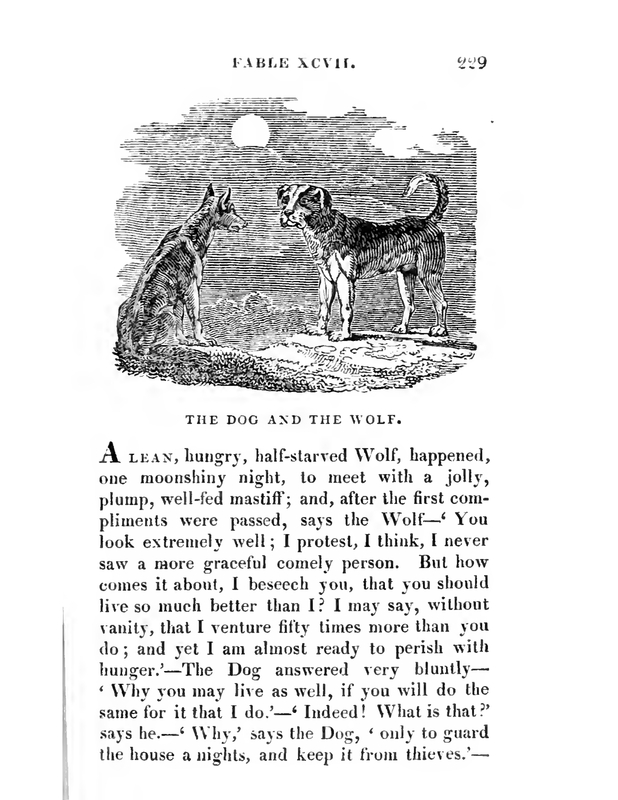
On the right side of the image the backside of a wolf is depicted. On the right side of the image there is a dog which is facing the wolf. There is a moon depicted in the upper portion of the photo.
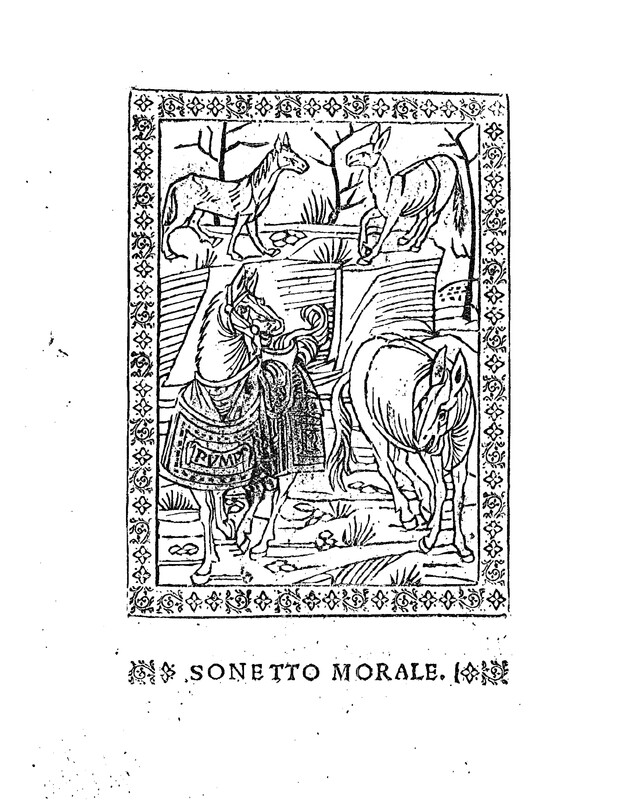
At the front of the image, there are two horses side by side, one has a very fancy saddle on, and the other a plain saddle. In the back on a hill is what looks like a young horse being nudged closer to the edge by a wolf. The image is bordered by a vine design
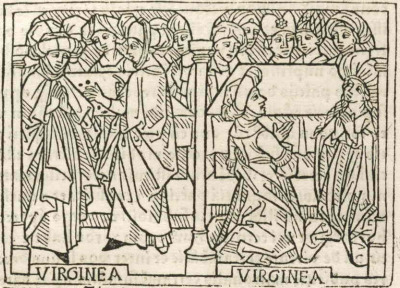
Verginia, a noble Roman woman is depicted in this engraving in both the right-hand and left-hand scenes. Her name is engraved as Virginea at the bottom on both sides. Boccaccio explains that Verginia, despite being a noble woman, was cast out of a temple in Rome by the other noble patrician women due to her being married to a plebeian man. The right side of the engraving depicts Verginia at the altar with noble women surrounding her as they cast her out of the temple. The left side of the engraving looks similar to the right side; however, the left side depicts Verginia with plebeian women. After being cast out of the Patricia Pudicitia temple, Verginia created her own temple and altar named the Plebeia Pudicitia, and opened it up to the plebeian class.
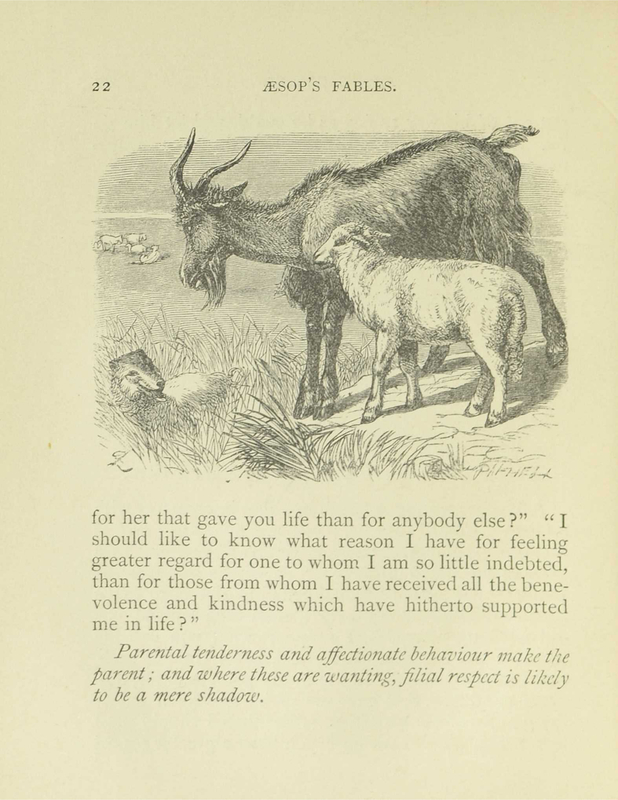
A wolf meeting a Lamb one day in company with a Goat, Child, says he. you are mistaken: this is none of your mother; she is yonder; pointing to a flock of sheep at a distance.
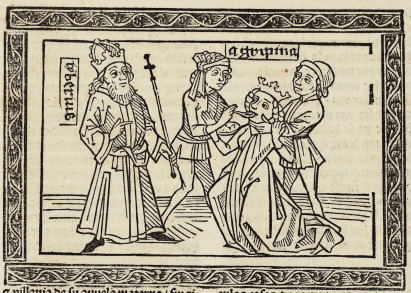
This engraving depicts Agrippina, the wife of Germanicus, being forced to eat food. Agrippina is depicted on the right side of the image on her knees as a man holds her head back while the other man is force feeding her with a spoon. The man on the left side of the image is Tiberius, the one who is ordering her to be fed. Tiberius is Germanicus’ father, and after he killed his own son, he sent his daughter-in-law Agrippina to prison. Agrippina decided to starve herself to death to avoid dying at Tiberius’ hands, however, Tiberius force fed her so that she would not die on her own. The creator engraved Agrippina’s name above her head, as well as Tiberius’ name, which is engraved beside his body.
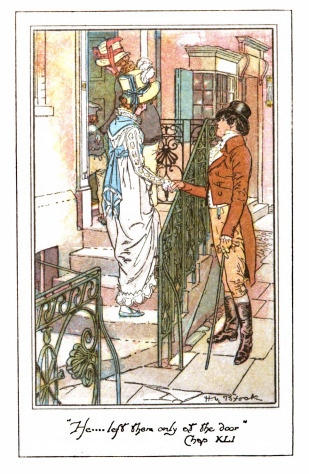
Here we see Mr. Crawford and Fanny outside her home in Portsmouth. Still trying to convince Fanny to fall in love with him, Mr. Crawford travelled to Portsmouth to see her. He stayed for a few days, visiting her every day. They went on daily walks with her family and walked them home to their door. Before leaving Portsmouth, Mr. Crawford assured Fanny that should she ever want to return to Mansfield and Sir Thomas was unable to send someone to get her, she need only write to Mary Crawford, and he would come directly himself to bring her home. This scene occurs in chapter 41 as noted underneath the title of this image. The characters are shown in the traditional regency style. Fanny wears the regency style dress with an empire waist. Her hair is worn tied up and wears a bonnet. Mr. Crawford wears a waistcoat and tailcoat, top hat, and knickers that stop at the knee. In his hand he holds a walking stick. The regency period dated to the early nineteenth century (1811-1820) when George, Prince of Wales, later George IV (r. 1820-1830), reigned as regent for his mentally ill father, King George III (r. 1760-1820). The regency period is associated with the rise of neoclassicism in art and fashion.
Here we see a pair of hands – likely Gulliver’s - pulling on a glove. The glove has a man embroidered on the cuff. The man was ruffles around his wrists. The image comes at the end of the first part, before Gulliver leave Blefuscu and returns to England. The same image appears in the 1843 Krabbe edition.
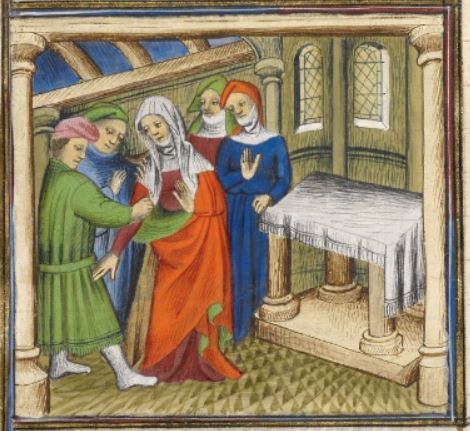
This illumination depicts the noble Roman woman named Verginia getting cast out of the Patricia Pudicitia temple. Verginia was born into a noble family, and married a former consul named Lucius Volupinus. Because her husband became a member of the plebeian class when he was no longer a consul, Verginia was cast out of the temple by noble women. Verginia is famous for having created her own temple for the plebeian women called the Plebeia Pudicitia. Verginia is depicted in saddened manner as she is escorted out of the temple.
A character in a short robe with their left arm clasping a baton approaches an excited long-robed figure in the doorway of a home, the long-robed figure reaches out with a bowl which the short roped figure reaches for as they lurch forward. In the background, a bound body hangs from a rope amidst a tree.
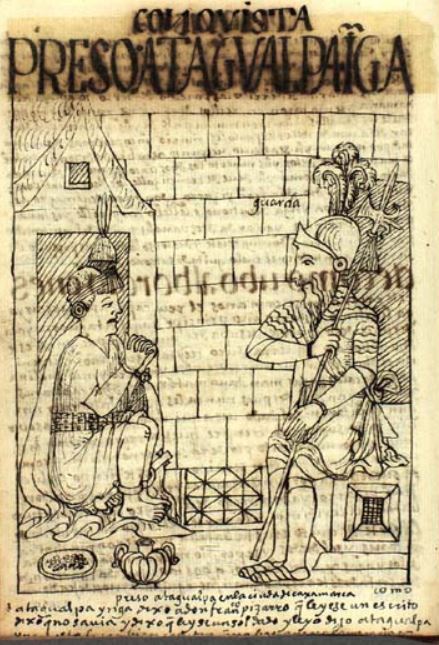
This chapter focuses on discussing the arrival of Spaniards and the Spanish conquest of Peru. This image depicts the imprisonment of the Inca emperor, Atawalpa Inca, after the Spaniards attacked and stole all the gold and silver they could take. Atawalpa Inca is illustrated sitting in a prison on the left side of the image with his hands and feet shackled together. There is a plate of food and water in front of him, but the author explains Atawalpa Inca would not eat due to the grief he had for the ransacking of his city and the capture of his wife. The soldier on the left is identified as the guarda [guard], who is illustrated watching and conversing with the Inca. There is a caption at the bottom of the image that identifies the location of the image as it reads, preso atagualpa en la cuidad de caxamarca [prisoner Atawalpa in the city of Cajamarca]. There is another description at the bottom of the image which reads, Atagualpa ynga dixo a don francisco pizarro que leyese un escrito, dixo que no sauia y dixo que leyse un soldado y leyo, dijo atagualpa … [Atawalpa Inca asked Don Francisco Pizarro to read him a letter, he said he did not know how to read and he told a soldier to read it, which he did. Atawalpa said …]. The rest of the caption is cut off.
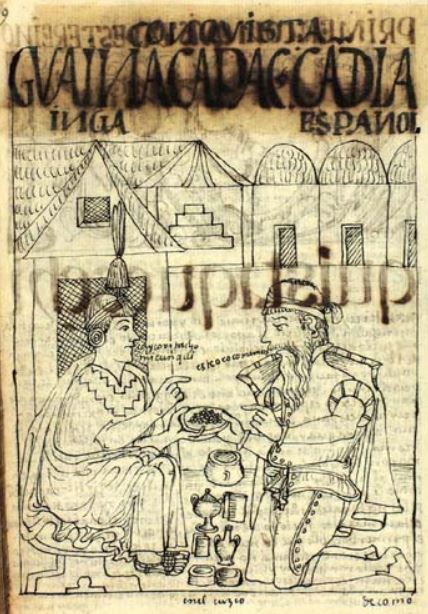
This chapter focusses on discussing the arrival of Spaniards and the Spanish conquest of Peru. This image depicts Huayna Capac Inca, the ruler of the Inca Empire, sitting on the left side of the image on a small chair. Huayna Capac is illustrated meeting and speaking with Pedro de Candia, a conquistador who had landed on the shores of Santa, Peru on behalf of the Spanish. Huayna Capac is depicted in traditional Peruvian regalia while Candia is dressed in European clothing and has a long beard. Due to the language barrier between the Inca and Candia, the Inca used items to point to in order to communicate with the Spaniard. These items are depicted in between them on the ground. Huayna Capac Inca asks Candia, cay coruncho micunqui [is this gold what you eat?] as he points to a plate of gold. Candia replies, este oro comemos [this gold is what we eat]. Huayna Capac proceeded to give the Spaniard gold and silver and other materials and ordered him to return to his ship. Candia returned to Spain with his treasures. The caption at the bottom of the image reads en el cuzco [in Cusco].
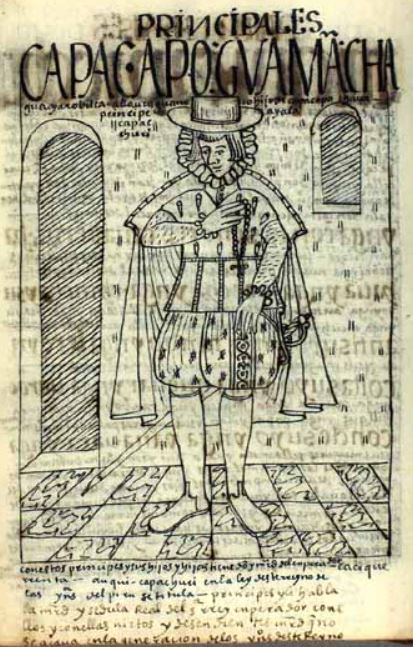
This image is illustrated in a chapter that discusses the descendants of the Inca and Andean nobles under Spanish colonial rule in Peru and their importance to a revived Andean society. This image depicts a standing portrait of Capac Apo Guaman Chagua, He is dressed is Spanish attire rather than indigenous traditional garbs. The author explains that Capac Apo Guaman Chaua was a descendant of Capac Apo Chaua. The large caption at the bottom of the image reads, con estos principes y sus hijos tiene don y merced del enperador rrenta, auqui capa[c] churi en la ley deste rreyno de las yndias del piru se titula principes y le habla la merced y sedula rreal del senor rrey enperador con ellos y con ellas, nietos y desendientes, merced que no se acaua en la generacion de los yndios deste rreyno [These princes and their children will have the gift of mercy from the emperor. The princes in the law of this kingdom of the Indies of Peru has the mercy and royal certificate of the emperor with him as well as his descendants and grandchildren].
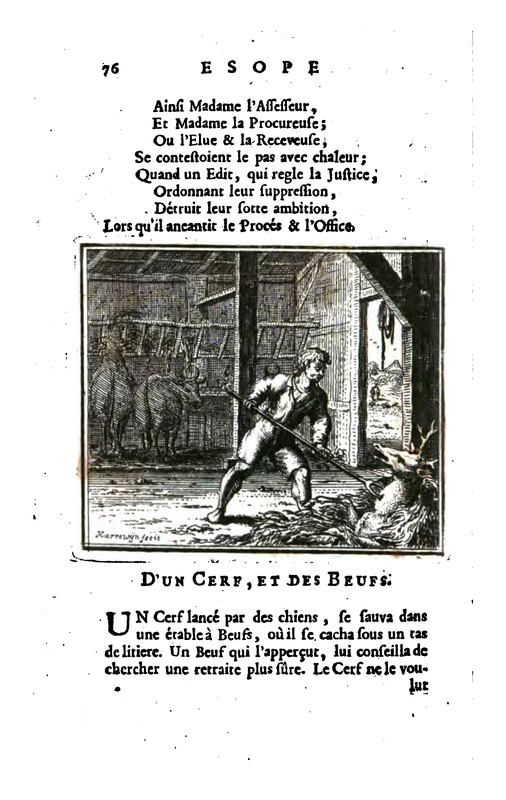
The image depicts a stag who escaped a group of hunters and hid in hay in a stable being found by the master of the barn and being killed. In the background there are two oxen who warned the stag the pile of hay would not be a safe place to hide.
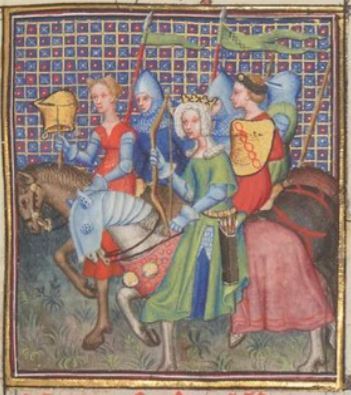
This illumination depicts Penthesilea, the queen of the Amazons, riding a horse while holding a bow. She is illustrated wearing a green dress and a crown at the foreground of the image. She has companions riding on horses beside her, which are other Amazon women. Penthesilea, as Boccaccio describes, was a great warrior. She wanted to secure a strong heir for the Amazons, so she sought out Hector of Troy to provide her with an heir. She fought in a battle against the Greeks to prove herself worthy of bearing Hectors child. She died in battle trying to impress Hector.
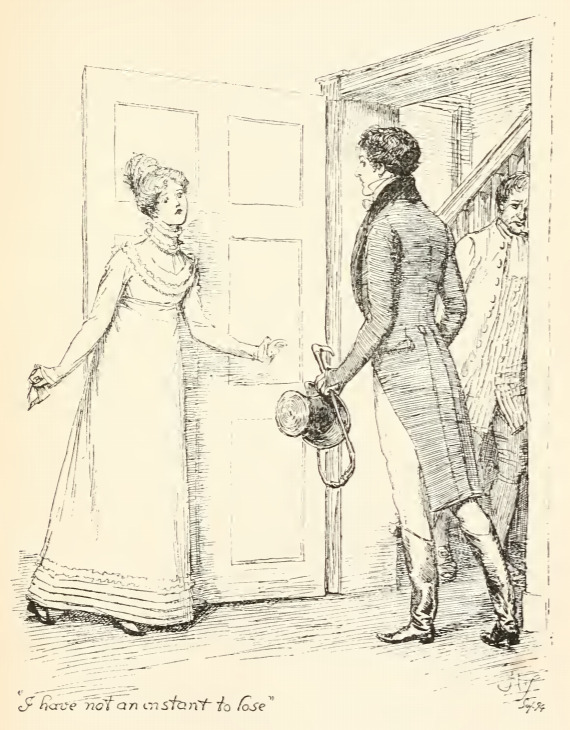
In this image Elizabeth tells Mr. Darcy that Lydia ran away with Mr. Wickham. Mr. Darcy came to Lambton after Elizabeth received a letter from Jane explaining the situation. Elizabeth and the Gardiners had to cut their trip to Derbyshire short and return to Longbourn. Mr. Darcy also left Pemberley, going to London to help find Lydia and Mr. Wickham and pay Lydia’s dowry. This scene occurs in chapter 46. The characters are shown in the traditional regency style. Elizabeth wears the regency style dress with an empire waistline. Mr. Darcy wears a waistcoat and tailcoat with a cravat. He holds his top hat and walking stick in his hand. The regency period dated to the early nineteenth century (1811-1820) when George, Prince of Wales, later George IV (r. 1820-1830), reigned as regent for his mentally ill father, King George III (r. 1760-1820). The regency period is associated with the rise of neoclassicism in art and fashion.
This illumination depicts the prostitute Leaena being violently tortured for information regarding a conspiracy. She is depicted with her elbows bound by rope which is attached to a ceiling. There is a man pulling on her hair and pushing her head into a burning fire as a torturing method. He is also holding a club above Leana’s head. Boccaccio explains that she is being tortured for being involved in a conspiracy to overthrow a tyrant.
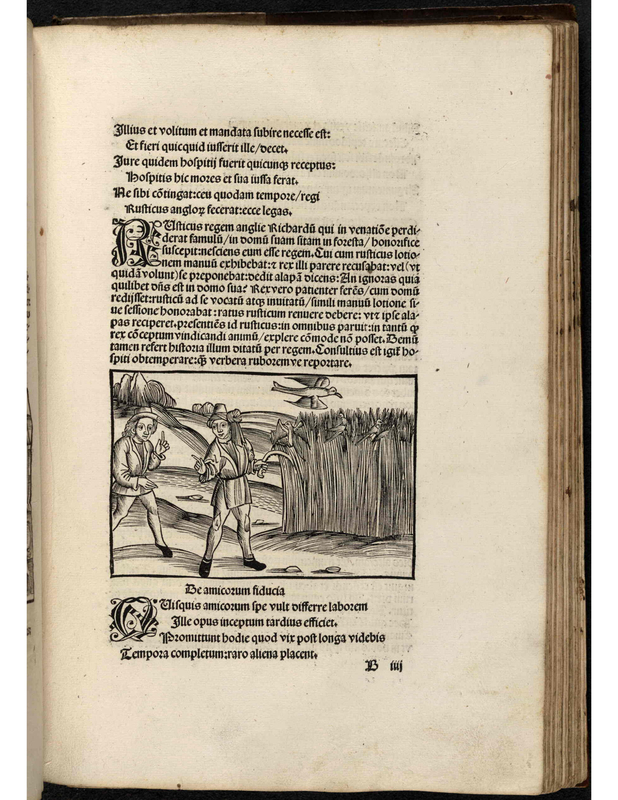
Two men speak while one of the men is holding a scythe. There is tall grass with birds perched upon it next to the man with the scythe. A bird flies over the tall grass.
Calisto hears Sosia shouting in the street, and he climbs the garden wall to see the cause of the commotion. By the time he reaches the top of the wall, Sosia has already scared off Centurio’s men. Nonetheless, Calisto starts to descend the ladder on the outside of the wall, but he falls to his death. In this illustration, Calisto can be seen lying lifeless on the ground. His hat has fallen off and is now in the bottom left corner of the illustration. Sosia and Tristan are trying to rouse him, but death has already taken hold. In the background, we can see a shield (to the left) and, leaning against the wall, the ladder that proved to be Calisto’s demise.
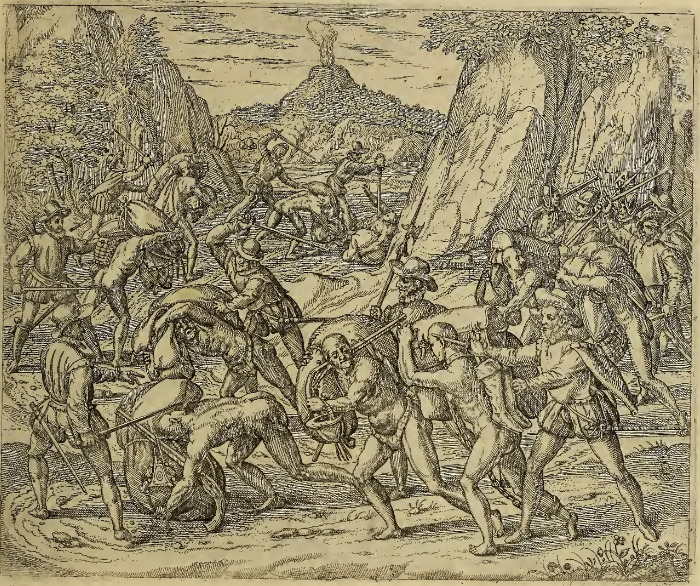
A group of Spaniards travel through Peru with several Indigenous men who have been forced to accompany the Spaniards to carry their packs. Every Indigenous man in the group carries at least one large pack, and sometimes multiple items. The Spaniards are merciless, beating or killing any Indigenous man who tires and slows or can no longer continue. They use wooden canes to beat the men, and in the background one Indigenous man who has fallen or been knocked to the ground is killed with a sword. In the distance, a volcano erupts. This image is identical to one found on page 20 (149) of Frankfurt, 1596.
Polyxena, the daughter of king Priam of Troy, is depicted kneeling on the tomb of Achilles in the background of the illustration with her hands together in prayer as she looks down. There is a man holding a sword up to Polyxena’s neck, ready to behead her. The man is Neoptolemus, the son of Achilles. He is the one beheading Polyxena as he believes her to be responsible for his father’s death. Polyxena accepted her fate in an honourable way as she leans her head over in preparation for the sword.
Here we see cherubs blowing the winds in the four directions of the compass. This image comes at the beginning of chapter seven, when Gulliver leaves Balnibarbi and arrives at Luggnagg. He travelled to Luggnagg to find a ship to take him to Japan, then back to England, however, upon his arrival there was not a ship ready, so Gulliver took a short trip to Glubbdubdrib. The same image appears in the 1839 Krabbe edition.
A drummer boy glances fearfully around the battlefield as he plays a beat upon his drum. The background is of low hills and clouds of smoke, with the letter T from Thus in the top right corner.


![[Hands pull on a glove]](https://collections.cemvc.ca/files/large/bddcd99723a267b43f9904334cb66d559b4f968b.jpg)

![[Act XIX – After Calisto Falls to His Death, Sosia and Tristán Try to Help Him]](https://collections.cemvc.ca/files/large/b87524dccc2fe8eb989ba529c5da7de2d34ce2ae.jpg)
![[Polyxena Being Executed by Neoptolemus]](https://collections.cemvc.ca/files/large/91a9b4cc0da4282276d8161bcb52209d2452bc86.jpg)
![[Cherubs blowing the winds in the four directions of the compass]](https://collections.cemvc.ca/files/large/6e8a3fff38f4ca6fbba72e981cd6c5513bf81de0.jpg)
![[Vanity Fair Volume I. Chapter XXXI Historiated Initial, T]](https://collections.cemvc.ca/files/large/242af49f3efb06107171fb658e1d6fd0f2aa0317.jpg)