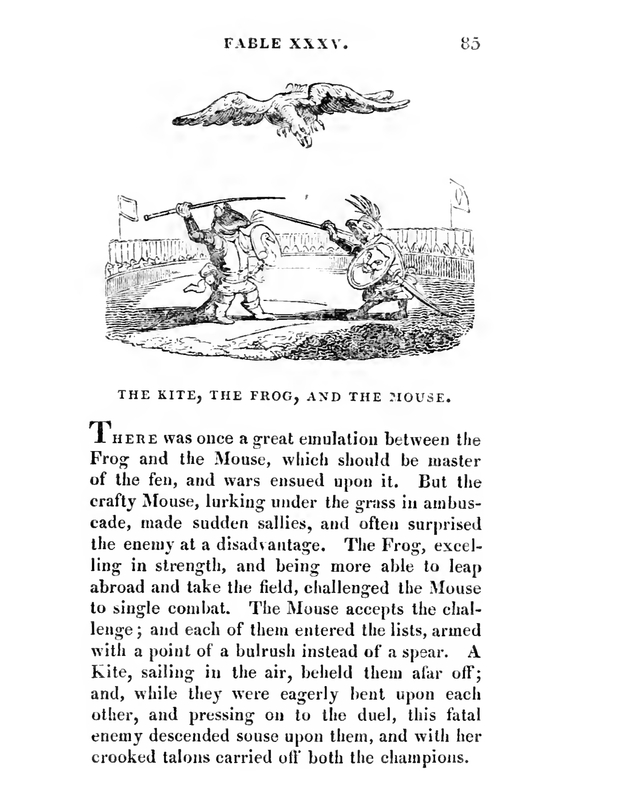
In a gladiator style arena, there is a mouse fighting a frog. The mouse is on the left holding a spear in its right arm above its head and a shield, with a flamingo head on it, in its left arm. The mouse is facing the frog, who is on the right side. The frog is wearing a helmet with five feathers on top and holding a spear in its right hand and a shield, with a tiger head on it, in its left. The frog has a sword in its holster around its waist. Above them is a vulture in flight, looking down at the frog with its beak open. In the background, there are spectators in the arena and a flag with a rectangle on it flying on the left side and a flag with a diamond flying on the right.
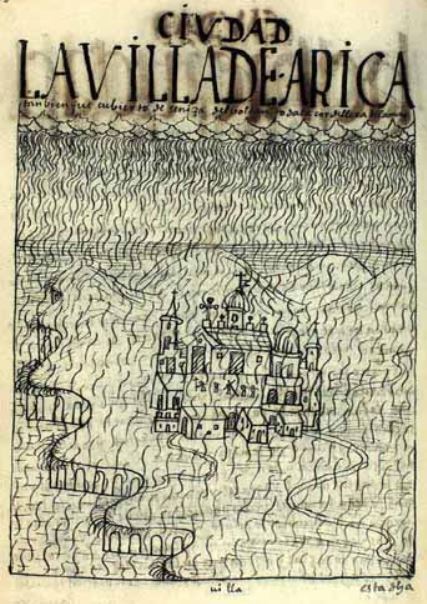
This image is depicted in the author’s chapter where he discusses cities, towns, villages, and provinces in colonial South America. This image depicts the town of Arica in Chile. A local volcano erupted and devastated the town with ash, which is why the town is difficult to see in the image. The town is arranged in a cluster of buildings that forms a square in the centre where people are illustrated holding crosses. There are two winding paths that lead directly to the city. The town appears to be located on the coastline as the ocean is on the left side of the image and behind the buildings. The caption at the bottom of the image reads, uilla [town].
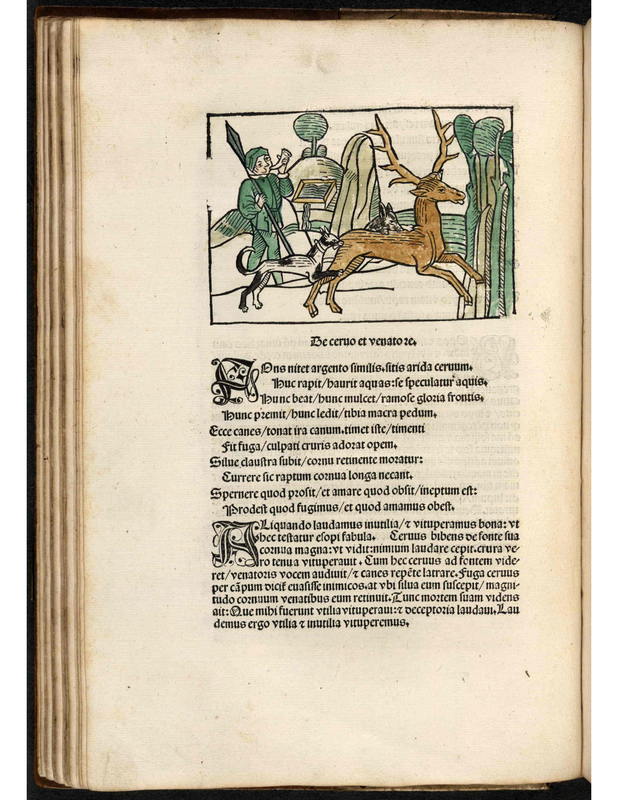
A tracker, dressed in green, holds a spear and a horn which he blows, instructing two dogs to attack a fleeing deer. The background is comprised of a hilly forest with an unknown structure in the distance.
Miss Matilda Crawley sits in her wheelchair, bundled up in a bonnet and muff. The chair is being pushed by a thin man in a coat and tall hat. In the top right of the image is the letter T from The.
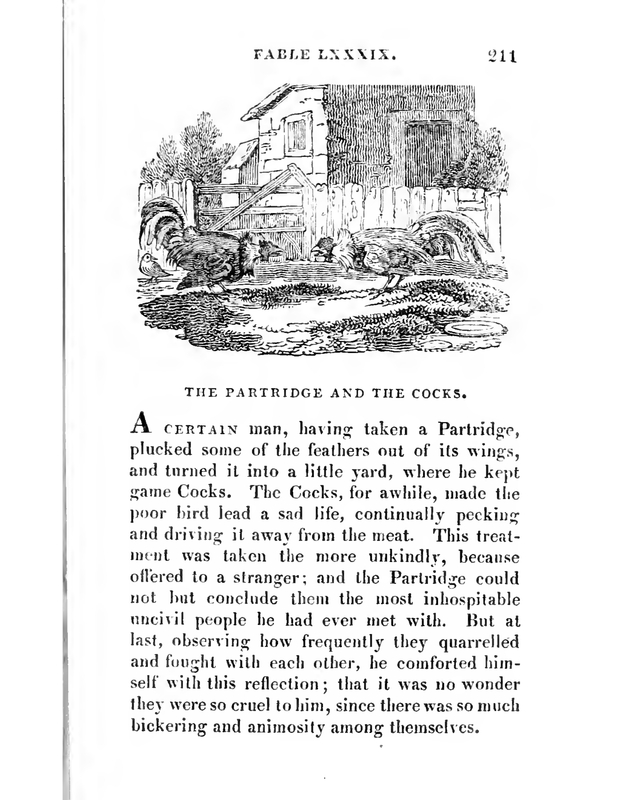
The image depicts a yard landscape where a partridge and cock stand, one on each side. They are facing one another, and their tails are tuned upwards. Behind them is a fence, a building, and various trees.
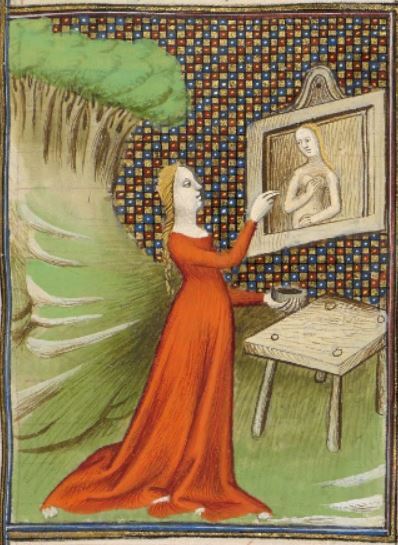
This illumination depicts a young woman named Thamyris standing in front of an easel as she holds a brush with her right hand and a pallet in her left as she paints a portrait of woman. Boccaccio explains that Thamyris was renowned for her exceptional painting skills and was the daughter of a famous painter (Micon).
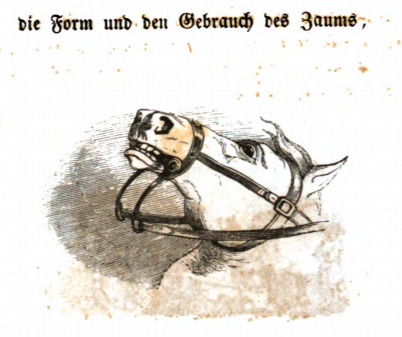
Here we see a saddle on a horse’s back. The Houyhnhnms asks about the horses in Europe and how they live. Gulliver explains that humans or yahoos govern the country and care for the horses or Houyhnhnms, and how humans use their horses, including how humans use saddles on horses. The same image appears in the 1843 Krabbe edition.
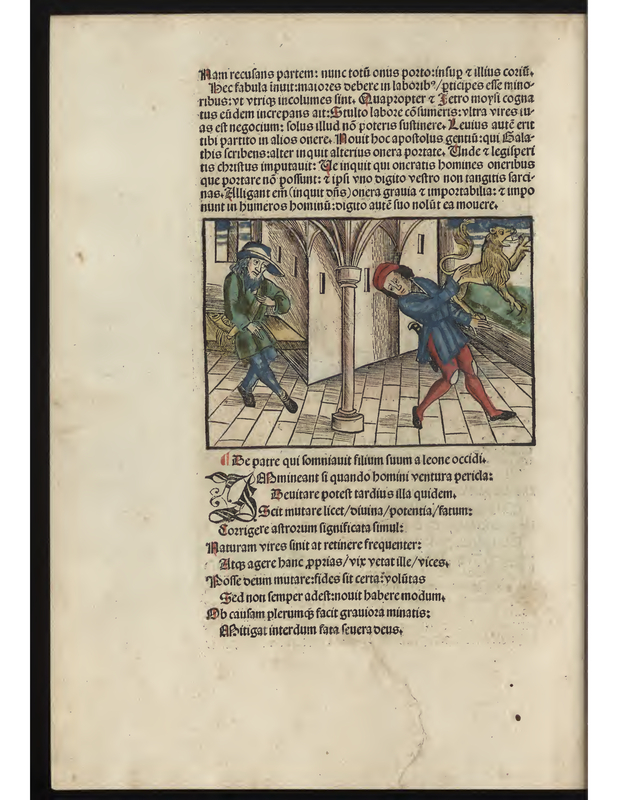
There is an illustration in the center of page, above and below this illustration are bodies of text. In the illustration, a normal sized man and a short man are bringing a man who is unwell to a holy person. This un-well man is vomiting in the picture. The holy person is pointing towards the un-well man.
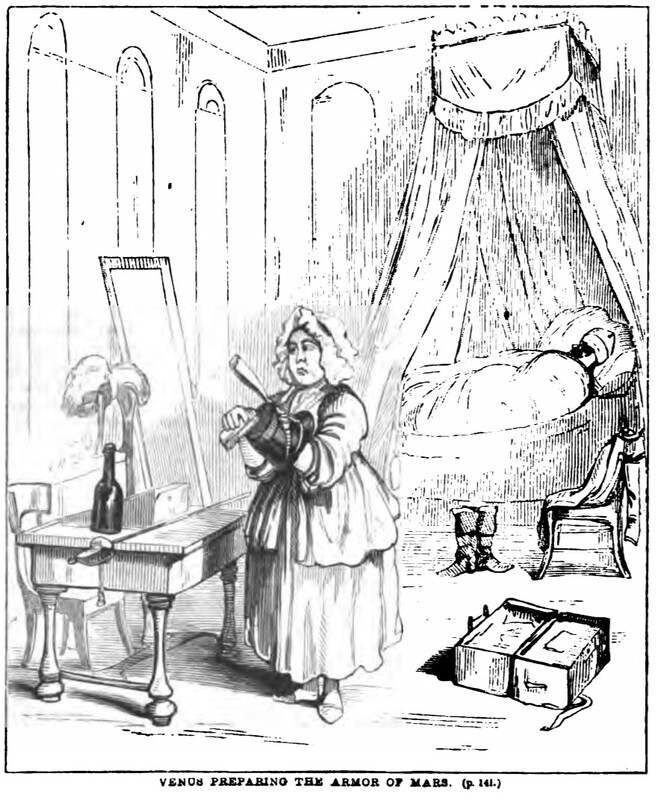
Peggy O’Dowd stands in her bedroom, polishing her husband’s helmet. His sword lies on the table in front of her, along with a bottle and a large mirror. She has already packed his travelling-valise, which lies open on the ground next to her. Major O’Dowd himself is sleeping in the background, with his boots next to the bed and his coat thrown over a chair. Below the illustration is printed its title and location in the story, VENUS PREPARING THE ARMOR OF MARS. (p. 141.).
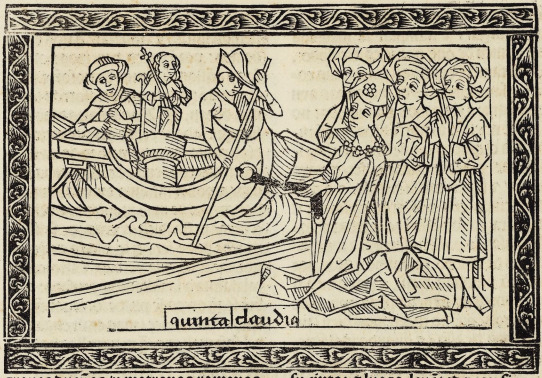
This engraving depicts Claudia Quinta, a Roman woman, standing on land as she pulls a ship to shore. Her name, written as Quinta Claudia, is engraved at the bottom of the image. Boccaccio explains that after Claudia Quinta was accused by other matrons of not being chaste, she prayed to the goddess Ceres to help prove her virtue. After a ship that contained a statue of Ceres had gotten stuck on a sandbar, Ceres gave Claudia Quinta the power to pull the ship to shore as proof of her chastity. The women who accused Claudia Quinta of being unchaste are standing behind her in the engraving as they watch her pull the ship to shore. The statue of the goddess is illustrated on top of a platform on the ship. Claudia Quinta’s name is engraved below her body to identify her.
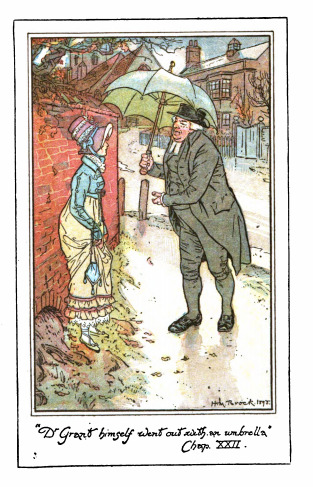
Here we see Mr. Grant going out in the rain with an umbrella to compel Fanny to come into the Parsonage. Fanny went into town on an errand for her aunts and got caught in the rain. She took shelter underneath a tree by the Parsonage. Mrs. Grant and Miss Crawford tried to convince her to come in and visit with them while she waited for the rain to pass, but she refused, not wanting to visit with them and be an inconvenience. Mr. Grant finally came outside and convinced her to come in. She waited with Miss Crawford until the rain passed. Fanny spent most of the visit watching the window for the rain to pass, wanting to leave as soon as the sky cleared. Miss Crawford entertained them by playing her harp for Fanny, who had never heard her play. This scene occurs in chapter 22 as noted underneath the title of this image. The characters are shown in the traditional regency style. Fanny wears the regency style dress with an empire waist. Her hair is worn tied up and wears a bonnet. She carries a small purse, hung on her wrist. Mr. Grant wears a waistcoat and tailcoat, and knickers that stop at the knee. The regency period dated to the early nineteenth century (1811-1820) when George, Prince of Wales, later George IV (r. 1820-1830), reigned as regent for his mentally ill father, King George III (r. 1760-1820). The regency period is associated with the rise of neoclassicism in art and fashion.
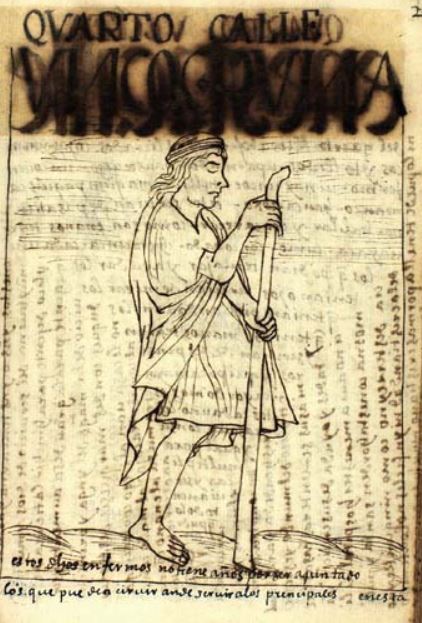
The author explains that there were ten paths for men to follow in the Inca Empire based on age division. This fourth path was called oncoc runa [the sick]. This was a group of people with disabilities such as illnesses, injuries, loss of limbs, and blindness. Those who were capable of work would have duties such as serving, jesting, or farming. The man depicted in the image is illustrated with only one leg and a walking stick. The caption at the bottom of the image reads Estos dichos enfermos no tiene años por ser ajuntado los que pueden ciruir an de seruir a los prencipales which translates to these sick people were not grouped by age, those who can are to serve the nobles.
Here we see Gulliver sitting on the leaves of a flower in Brobdingnag, where everything is giant compared to Gulliver. In the centre of the flower is the letter A because the first word of the chapter is auch. The same image appears in the 1843 Krabbe edition.
Here we see a human grooming a horse in a stable. The Houyhnhnms asks about the horses in Europe and how they live. Gulliver explains that humans or yahoos govern the country and care for the horses or Houyhnhnms, including brushing the horse. The same image appears in the 1843 Krabbe edition.
This image depicts six animals that are feared by indigenous peoples in the kingdom of colonial Peru. They are allegories for the people who govern the kingdom. There is an indigenous person in the centre of the image kneeling with their hands together in prayer as they are surrounded by the six animals. The small mouse at the bottom left corner of the image is labelled as a rraton, cacique prencipal [mouse, noble chief]. The animal above the mouse is labelled as, leon, comendero [lion, trustees]. The animal in the top left corner is labelled as corregidor, cierpe [magistrate, serpent]. The animal at the top right corner is labelled as tigre, espanoles del tanbo [tigre, Spaniards of the tambos]. The smaller animal below the tiger is labelled as zorra, padre de la dotrina [fox, priest of the doctrine]. The animal in the bottom right corner is labelled as gato, escriuano [cat, notary]. The dialogue written above the indigenous person’s head reads, ama llapallayque llatanauaycho [do not all of you strip me naked, for the love of God]. The script below the person’s legs reads, estos dichos animales, que no temen a dios, desuella a los pobres de los yndios en este rreyno y no ay rremedio [these animals, which have no fear of God, skin the poor indians of this kingdom and there is no remedy].
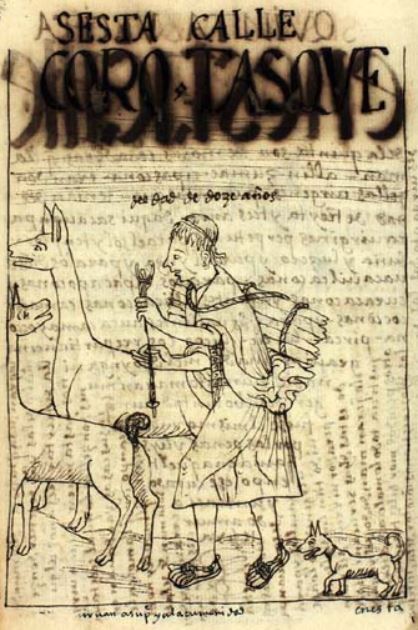
The author explains that there were ten paths for women to follow in the Inca Empire based on age division. This group was called coro tasque [short-haired young girls]. These women were aged from twelve to eighteen years old. Their duties included serving their parents and noble women, learning to spin and weave, and herding livestock. The young girl in the image is depicted with short hair, herding llamas, carrying firewood on her back while also spinning yarn. A small dog is walking by her feet. The caption on the image reads de edad de doze años, ciruan a su padre y a la comunidad, which translates to twelve years old, they serve their father and the community.
Miss Rhoda Swartz, seated on the stool in front of the piano in the Osborne drawing-room, is turned towards the reader with an expression of joy on her face. She has just seen Amelia Sedley’s name on the sheet music she was using and is hoping for news of her friend.
A European sailing ship is anchored off the coast of Brazil. A group of Europeans go ashore in rowboats. A group of people on horseback, many of whom carry spears, ride in a group along the coast. There is a large settlement further along the shore in the distance, labelled Cap de Gell.
This illustration depicts Rhea Ilia (also known as Rhea Silvia) laying in a bed, looking fatigued as she had just given birth to twin boys named Remus and Romulus. There are two nuns illustrated in the image, one with a blue cloak and one with a black cloak. The nun wearing the blue cloak is holding Romulus in her arms and the nun wearing the black cloak is depicted holding Remus. The names Romulus and Remus are partially written in white letters beside the babies’ heads to identify them. Remus and Romulus grow up to be the legendary founders of Rome.
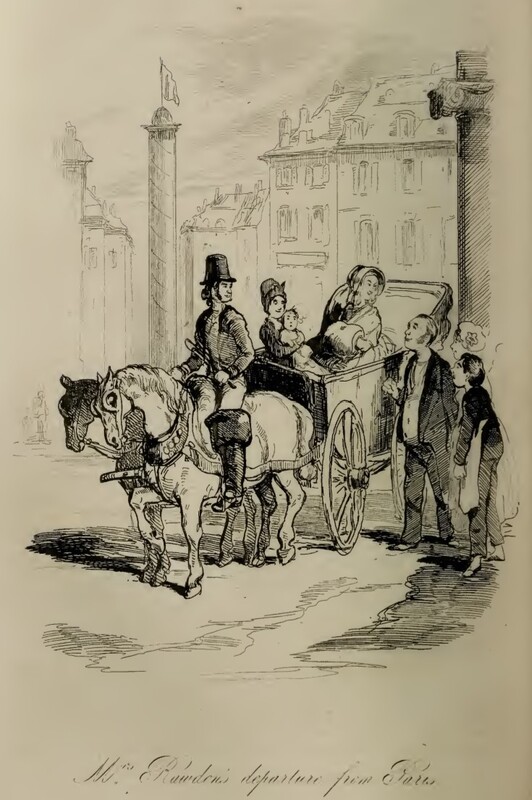
Rebecca Crawley sits grandly in a carriage, wearing a bonnet and muff and saying her farewells to a group of people standing beside the carriage. Opposite her sits Genevieve, the maid, holding little Rawdon. The carriage is pulled by a pair of horses, with the driver seated astride the larger of the two. In the background, the buildings of Paris and a tall tower topped with a flag can be seen. Below the illustration is printed in cursive its title, Mrs. Rawdon’s departure from Paris.
![[Vanity Fair Chapter XXXIII Historiated Initial]](https://collections.cemvc.ca/files/large/ff338b4b17f35e8b0edf7aa743eb49b86274684c.jpg)
![Vita et Fabulae [Two men take a sick person to a man in Holy attire]](https://collections.cemvc.ca/files/large/740839c1eb52f25db7c300800b874218a3348708.jpg)

![[Gulliver sits on the leaves of a flower in Brobdingnag]](https://collections.cemvc.ca/files/large/0fc9da890f242ba4ee6367a3f8fd1042fdbd0b78.jpg)
![[a human grooms a horse]](https://collections.cemvc.ca/files/large/66083d56c038a6c2ca8345480d0545c7e8f8e05d.jpg)
![Pobre de los In[di]os: de Seis Animales Q[ve] Come que Tenemen los Pobres de los Yndios en Este Rreyno](https://collections.cemvc.ca/files/large/fed88aa76d216194149f779831c8a3e05374e098.jpg)

![[Rhoda Swartz at the Piano]](https://collections.cemvc.ca/files/large/8bde1046a69557d76643cd84d1aebea9976a7f7f.jpg)
![[Europeans come ashore in rowboats, leaving their ship anchored]](https://collections.cemvc.ca/files/large/f6df31808ba7f28271992ead301a4a3c7e6f537f.jpg)
![[Rhea Ilia Gives Birth to Remus and Romulus, the Founders of Rome]](https://collections.cemvc.ca/files/large/ec6e5cbce33928894d8a5f7cff738ae81b67b309.jpg)