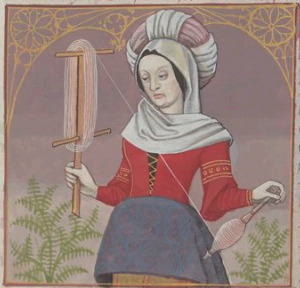
This illumination depicts a portrait of a woman named Veturia. Veturia was a famous Roman matron who saved Rome from what would have been a violent attack on the city. Her son had been exiled from Rome, and to exact his revenge, he planned an attack on the city with the Volscian enemies. Veturia went and spoke to her son and convinced him to call off the attack. Women began to gain more respect from men in Rome due to Vetruria’s actions.
A man wearing a crown is sitting on a thrown. He is holding an axe in his left hand. In front of him is another man who has his hands up over his head in fear. There is a third man standing behind the man with his hands up.
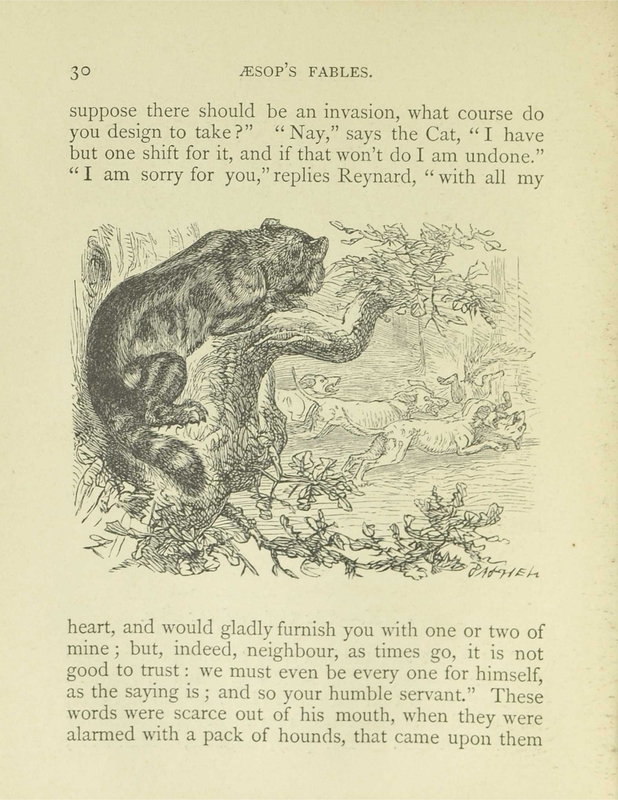
As the Cat and the Fox were talking politics together, on a time, in the middle of a forest, Reynard said, let things tum out ever so bad, he did not care, for he had a thousand tricks for them yet, before they should hurt him.
In this image we see the two types of eggs at war with each other. Those on the left are cracked on the top, while those on the right have been cracked in the middle. This difference as to the correct way to crack an egg was the reason for the tensions between Lilliput and Blefuscu. This is a thinly veiled reference to the religious wars of the sixteenth and seventeenth centuries, where Swift insinuates that the correct religious beliefs – like the correct way to crack an egg – is a personal decision, and not one worth going to war over. The same image appears in the 1843 Krabbe edition.
In the shipwreck, Gulliver lost his hat. Several days later, the Lilliputians found it, not knowing what it was since it was so large. They climbed over it, trying to figure out what it was, before determining it must belong to Gulliver, and brought it to him.
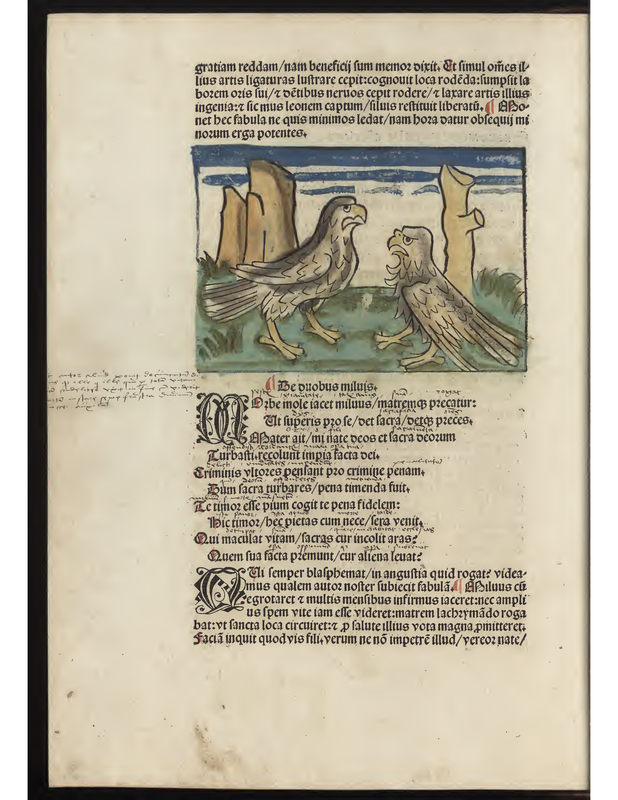
A person is seated on a bench, wearing long robes that covers all their body other than their head. It is difficult to confirm whether this person is fully human or mixed with an animal due to the look of their nose and hair. What seems to be a fox is at the feet of this person, its head has been erased with time. To the right of the person is a wolf with its head slightly turned towards the ground.
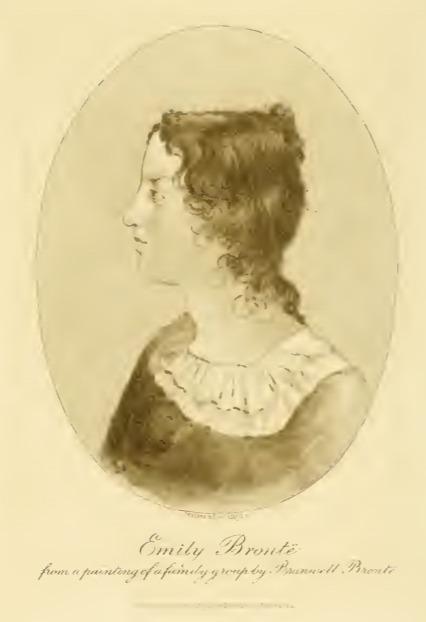
Here we see a portrait bust of Emily Bronte. According to the list of illustrations, this is the only portrait of Emily Bronte that exists. The portrait comes from a larger image of the entire Bronte family, taken by Branwell Bronte, Emily’s brother. The list of illustrations says, The Rev. A. B. Nicholls, her brother-in-law, considers it a good likeness.
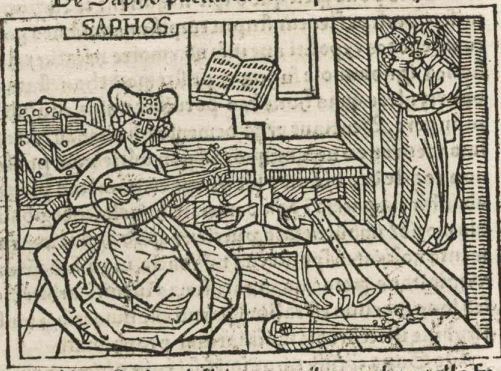
This engraving depicts Sappho, the famous poetess from Lesbos, sitting in the foreground while playing a stringed instrument. We know that this is Sappho as her name is engraved above her head. There are other stringed instruments and sheet music surrounding her. Sappho was in love with a man (depicted on the right-hand side of the engraving) who did not share the mutual feelings. Boccaccio explains that this is the reason as to why her poems and music verses were so somber.
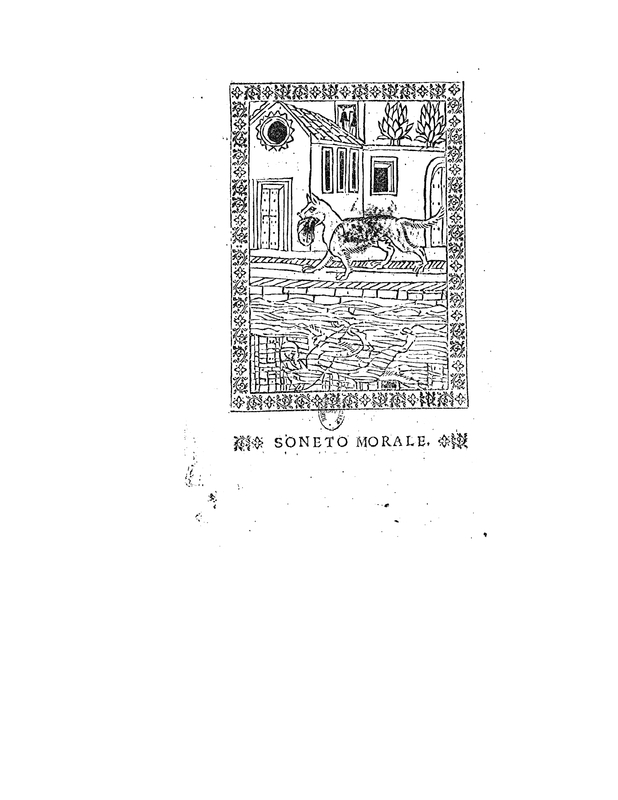
In the centre of the image there is a dog that is walking across a bridge or some kind of platform above water. The dogs reflection is depicted below it, the dog is looking at its reflection.
Two methods of fishing used by the Indigenous Tupinambá group are shown. Three Indigenous people fish from a canoe using a bow and arrow to aim at the water. Two other people stand on a wooden bridge and fish using nets on the end of long poles. Beside them on the shore a bearded man stands watching them fish. There is a small pile of fish on the ground beside him. On the left side there is a village comprised of four long structures arranged in a square and surrounded by a fence.
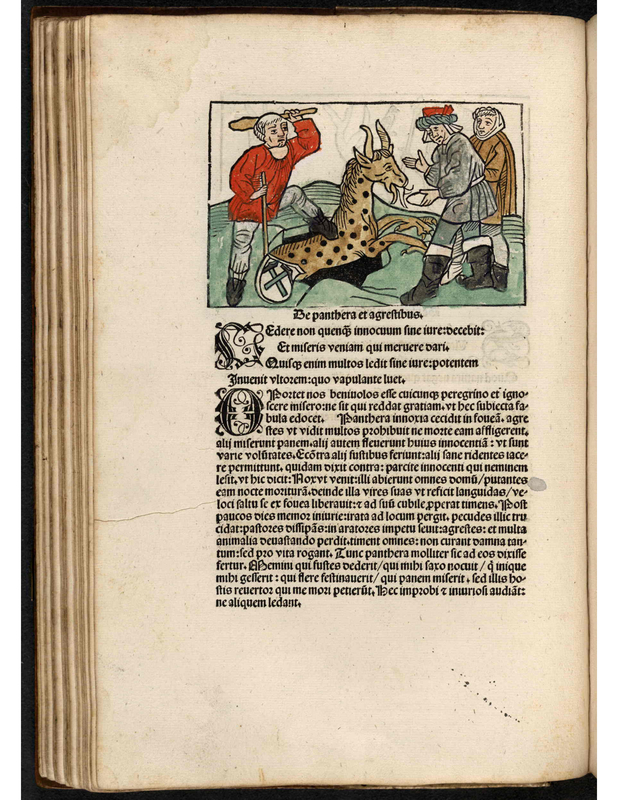
A man holding a bowl, lures an animal out of a hole in the ground, another man waits with a club in his hand to attack the animal, the man with the club also holds a long stick, there is a shield at his feet. Another man stands behind the man with the bowl.
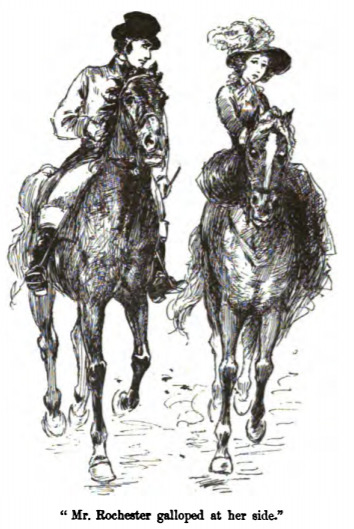
Here Mr. Rochester and Miss Ingram ride on horseback. Miss Ingram and her friends and family came to visit Mr. Rochester at Thornfield. They stayed for several weeks. Mr. Rochester and Miss Ingram were engaged, however, after he started a rumor that he was not as wealthy as she believed. After finding out about this Miss Ingram lost interest in Mr. Rochester and they broke off their engagement.
A satisfied looking boy standing on a rectangular box or platform holds in front of him a stick. On it are a turnip disguised as a head and a ragged sheet or coat, forming the semblance of a ghost. A terrified looking man is on his knees with his arms raised in front of the ghost, a shovel dropped beside him. A tall fence in the background forms the letter W from We.
Soon after Celestina visits Calisto’s house, Calisto becomes impatient and orders Sempronio to pay her a visit and hasten her along in accomplishing her task. He does not want to leave Calisto alone, so Calisto asks Pármeno to keep him company in order to alleviate Sempronio’s concerns. Pármeno once again tries to dissuade Calisto from trusting Celestina, but he is again unsuccessful. In the top left corner there is a veiled woman perched in a window observing the other figures. Because the rightmost figure appears to be quite sad, it is likely meant to represent Calisto. Because Sempronio is consistently depicted as a bearded figure, we can infer that he is likely represented by the central figure. The leftmost figure would therefore represent Pármeno. This figure is shown looking at Celestina while also reaching out toward Calisto and Sempronio, perhaps intended to represent his desire that Calisto should avoid her. All three figures are shown wearing hats and have swords mounted on their belts.The entire image is identical to those found on pages 93 and 171 of the text.
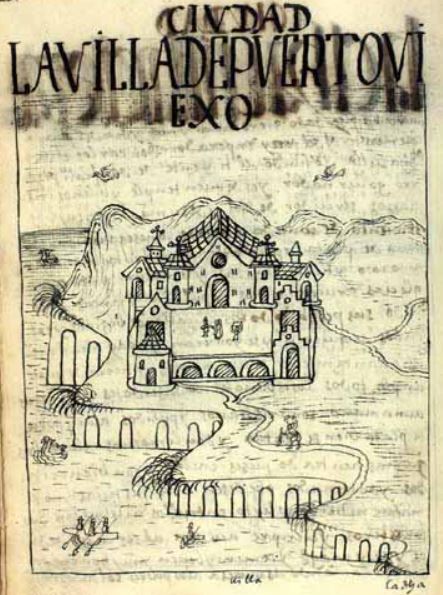
This image is depicted in the author’s chapter where he discusses cities, towns, villages, and provinces in colonial South America. This image depicts the down of Puerto Viejo in modern Costa Rica. The author describes this town to be the first Christian port of the kingdom. The city is illustrated on the edge of a coastal region. There is long beach grass sticking out on the side of the edge to further demonstrate that the city is located on the edge of water. There are four boats depicted in the water on the left side of the image. The town is illustrated as a cluster of buildings which forms a square in the centre. There are three people walking in the square. There is a long winding path that leads into the city where a soldier is illustrated walking. The caption at the bottom of the image reads, uilla [town].
In the centre of the illustration, we see a female figure wearing a robe and a veil. There are two male figures to the left and one to the right. Because there are two female characters (Elicia and Areusa) and one male character (Sosia) in Act XVII, we can say that this illustration does not relate to the events contained within the act.[This illustration is identical to those found in Acts IV (folio 32r), V (folio 42r), VI (folio 45r), VIII (folio 62r), X (folio 74r), XIII (folio 93v), and XV (folio 102r).]
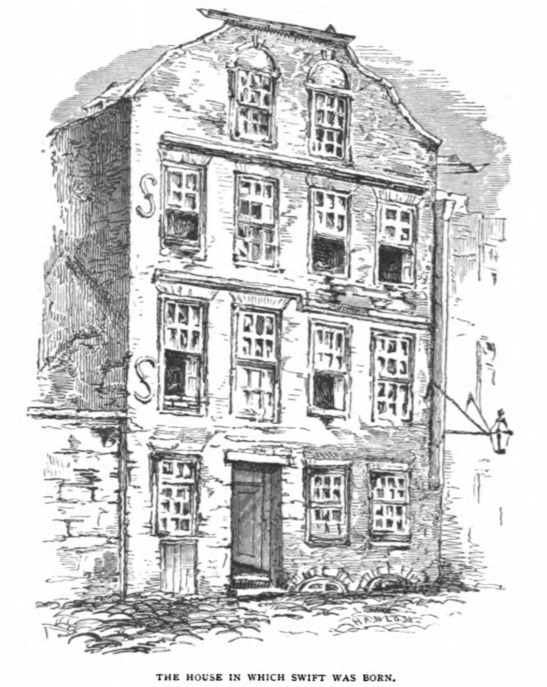
Here we see the birthplace of Jonathan Swift, the author of Gulliver’s Travels. Swift was born in Dublin, Ireland. This image appears as part of the biography of Jonathan Swift.
Here we see one of the Houyhnhnms preparing dinner. The Houyhnhnm stands on its back legs, holding a bowl of warm oats, boiled in milk, between its front legs. Gulliver kneels on a pile of hay, which is another element of their meal. The same image appears in the 1843 Krabbe edition.
A Brazilian Indigenous group attacks the Tupinambá village 'Uwattibi'. The attcking group have arrived in canoes, which are pulled up along the shore on the right. They have surrounded the village and shoot arrows through and over the fence. These men wear feathered headdress and adornments around their waists, most carry bows and have arrows quivers slung around their shoulders, and a few also carry a shield. Several people, both in the attacking group and inside the village, blow into an object, perhaps a wind instrument or blow gun. Inside the village, Tupinambá men stand just inside the fence shooting arrows out towards the attacking group. The women and children in the center of the village run in panic.



![[King Threatens Man]](https://collections.cemvc.ca/files/large/068dc65ad8c5f1a7b84c448011bfc3c37671df69.jpg)

![[Wars of religion depicted through the correct way to crack an egg on Lilliput]](https://collections.cemvc.ca/files/large/70d899949e5353d788edbf235e76f5bc665b2a32.jpg)
![[Lilliputians discover Gulliver’s Hat]](https://collections.cemvc.ca/files/large/96cd665af1f2c235bdeaebb72aad7f1d4cebf10d.jpg)
![[The Fox, the Wolf, and the Person in Robes]](https://collections.cemvc.ca/files/large/2f39072986b710c7fe7c418d90a9a598927ab524.jpg)
![[The Tupinambá group’s manner of fishing]](https://collections.cemvc.ca/files/large/2ff61ce68c68ae57dcdf562d0915a102398f032b.jpg)

![[Vanity Fair Volume I. Chapter XIX Inhabited Initial, W]](https://collections.cemvc.ca/files/large/8a37728e0445400b4722f064805f4fa8df827652.jpg)
![[Act II] Calisto spreect tot beyde syn dienaers.](https://collections.cemvc.ca/files/large/f6d54301cf3d7b5e8c7dc4b2f76d68bb01d48fc1.jpg)
![[Act XVII]](https://collections.cemvc.ca/files/large/26f2cd0ef5719f3387d449c6702cc179ba14f7c8.jpg)
![[A Houyhnhnm prepares dinner]](https://collections.cemvc.ca/files/large/31695eb20bc413e39b15b941942452f2a1a1c3bc.jpg)
![[A group of Indigenous people attacks the Tupinambá village called 'Uwattibi']](https://collections.cemvc.ca/files/large/5cdced70b42ec7a54d85b6dc34ad5fda7fc254a8.jpg)