The garden’s wife stands outside her house, with the cityscape in the distant background. In front of her is young Rawdon Crawley, to whom she is the nurse, making mud pies in the dirt. Behind a low gate in the doorway of the house are two other young boys, either her own sons or other children over whom she is watching.
Two small children peer into the holes cut in a cabinet. Behind the cabinet stands a man in a long jacket and tall hat with one hand raised. Behind his head, the letter W from Without is formed by four sticks.
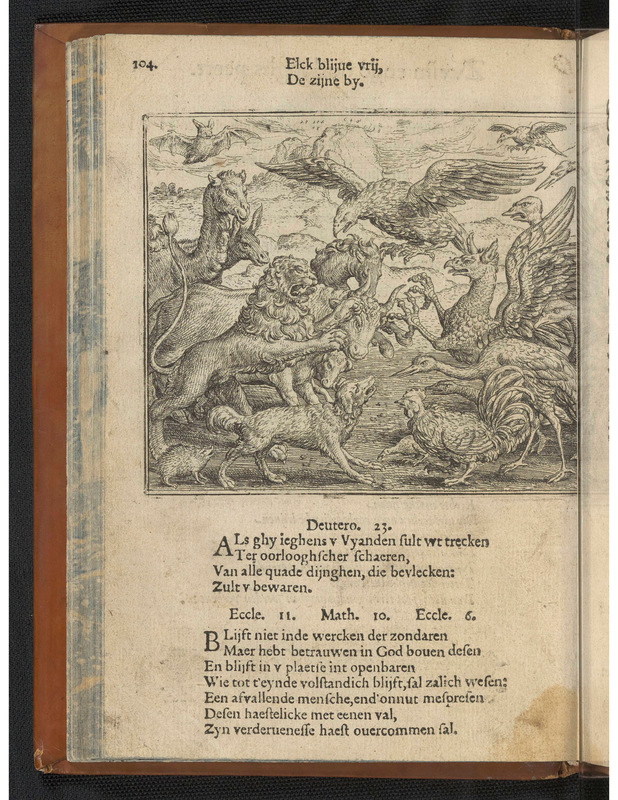
Landscape with a various animals standing in two camps opposite each other, the left side led by a griffin, the right side led by a lion; copy in reverse after Marcus Gheeraerts' illustrations to 'De Warachtighe Fabulen der Dieren'Etching
Three Indigenous people, two men and a woman, pick bananas from a tree and place the fruit in a basket that the woman carries on her back. Two birds swoop down and take fruit from the tree, and a third bird has been shot with an arrow. A bow and arrows rests on the ground behind the man standing on the left and the two men wear feathered headdresses. Bananas were introduced to Brazil by the Portuguese in the early 16th century. This illustration is a simplified and mirrored version of the one found on page 62 verso of Paris, 1557.
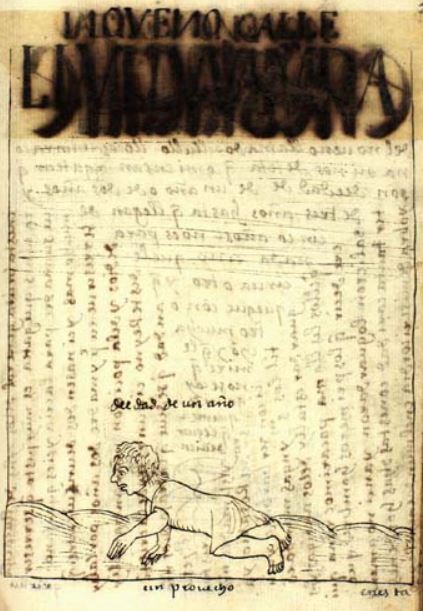
The author explains that there were ten paths for men to follow in the Inca Empire based on age division. This ninth group was called llullu uamra [baby]. The group refers to small children aged from one to five years old and were not at an age range where they are able to work yet. The author expresses that these children are cared for and played with by older boys and are raised by their parents. This image depicts a baby crawling on the ground. The caption reads de edad de un año cin prouecho which translates to the age of one, unable to work.
The Houyhnhnms were astonished that the only skin visible on Gulliver was on his hands and face, as the yahoos were completely naked. This served as a distinction between Gulliver and the other yahoos. It was Gulliver’s custom to undress at night and cover himself with his clothes. His master’s valet walked in on Gulliver while he was sleeping, and his clothes had fallen off and discovered that Gulliver’s body was the same as the yahoos. His master was astonished by this, and Gulliver explained how clothing worked. Gulliver asked him to keep this information to himself. The same image appears in the 1843 Krabbe edition.
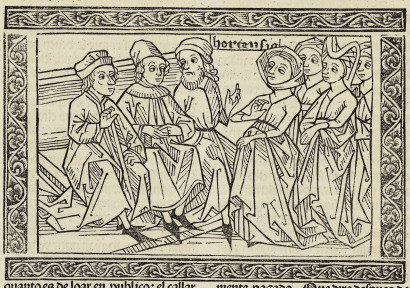
This engraving depicts Hortensia, the daughter of famous orator Quintus Hortensius, speaking in front of the triumvirs. Hortensia inherited the gift of oration from her father, and when the triumvirs raised taxes unbearably high, she spoke so eloquently to them that they revoked the taxes. The triumvirs have pleasantly surprised looks on their faces as they are impressed with Hortensia’s abilities. Hortensia appears to look confident as she speaks to them. There are other women standing behind her in support of her approaching the triumvirs.
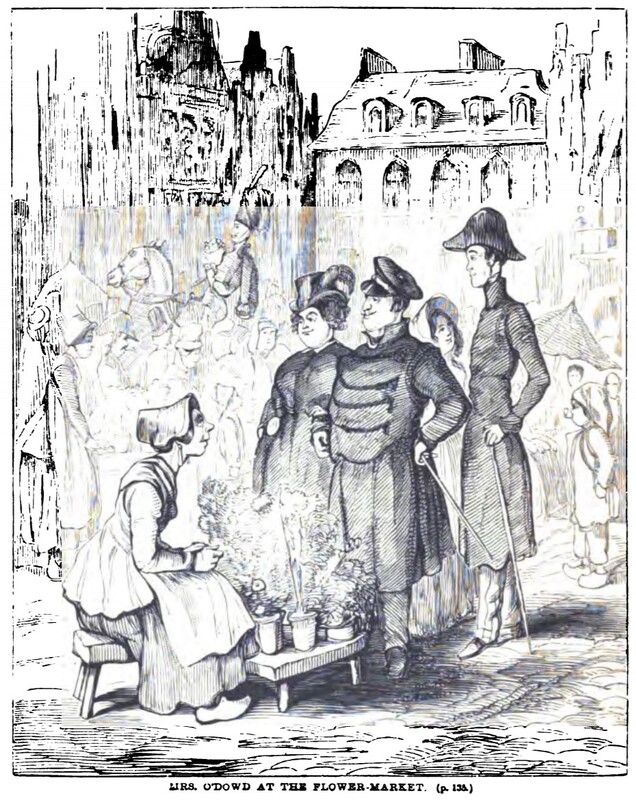
Peggy O’Dowd, in a feathered hat, stands in front of a flower seller at the market in Brussels. She is holding onto the arm of her husband, Major Mick O’Dowd, who has on a cap and is wearing his sword at his hip. Behind the pair are William Dobbin, also with his sword, and Amelia Osborne, who is in a bonnet and looking up at Dobbin. The flower seller is in a bonnet and clogs, seated on a low stool behind the table which holds her rows of potted plants. In the background of the image are the crowds of shoppers, another flower seller standing at her table of plants, a mounted officer holding a bouquet, and the tall buildings that surround the market square. Below the illustration is printed its title and location in the story, MRS. O’DOWD AT THE FLOWER-MARKET. (p. 135.).
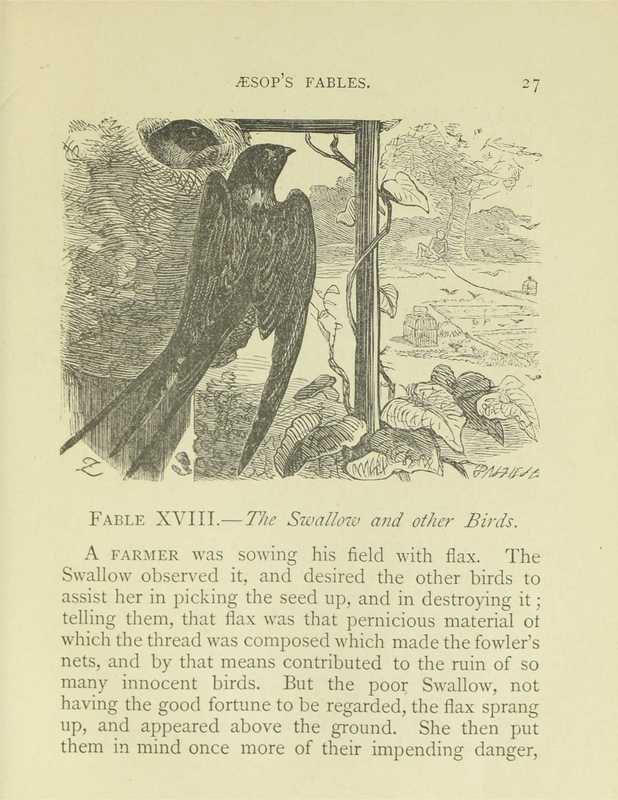
A farmer was sowing his field with flax. The swallow observed it, and desired the other birds to assist her in picking the seed up, and in destroying it; telling them, that flax was that pernicious material of which the thread was composed which made the fowler's nets, and by that means contributed to the ruin of so many innocent birds.
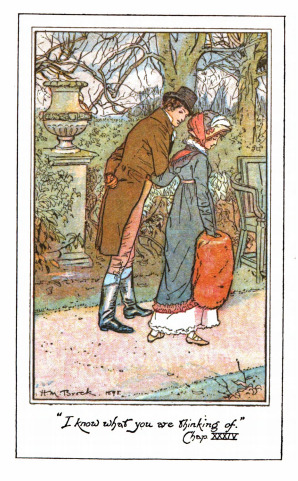
Here we see Fanny and Edmund walking through the grounds of Mansfield Park. Edmund was absent from Mansfield when Mr. Crawford proposed to Fanny, and she refused. Mr. Crawford said he would continue to try and convince Fanny to marry him, despite her refusal. Sir Thomas wanted Edmund to talk to Fanny and try and convince her to marry Mr. Crawford because it would be an advantageous marriage for her. Edmund here walks with Fanny trying to get her to tell him why she refused to marry Mr. Crawford. She finally confessed that she did not approve of his character, seeing that he flirted with both of her cousins, Maria and Julia, despite Maria’s being engaged at the time. This scene occurs in chapter 34 as noted underneath the title of this image. The characters are shown in the traditional regency style. Fanny wears the regency style dress with an empire waist. Her hair is worn tied up and wears a bonnet. She holds a fur muff, used to warm her hands. Edmund wears a waistcoat and tailcoat, a top hat, and knickers that stop at the knee. The regency period dated to the early nineteenth century (1811-1820) when George, Prince of Wales, later George IV (r. 1820-1830), reigned as regent for his mentally ill father, King George III (r. 1760-1820). The regency period is associated with the rise of neoclassicism in art and fashion.
Map of Switzerland. The terrain is very mountainous and there are many bodies of water. Parts of France, Germany, and Italy can be seen on the map. The border of the map measures latitude and longitude.
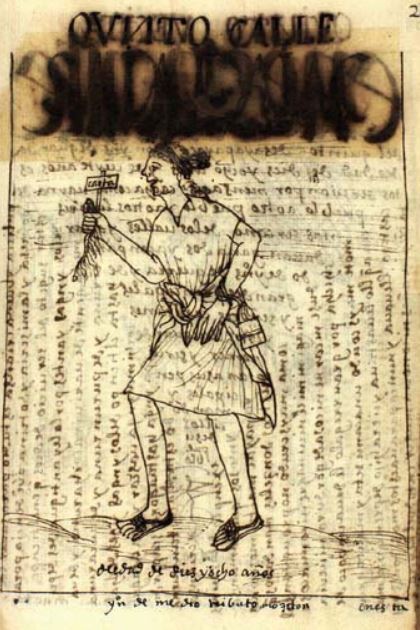
The author explains that there were ten paths for men to follow in the Inca Empire based on age division. This fifth group was called the sayapayac [helper]. They were young men aged eighteen to twenty years old who would serve as cachacuna wayna [messenger boys] between nearby towns. The author explains that they would also herd farm animals and aided warriors in battle. The young man depicted in the image is illustrated running with a message in his hand to demonstrate his messenger duties. The message has the word carta written on it which translates to letter. The caption at the bottom of the image reads de edad de dies y ocho años yndio de medio tributo mozeton which translates to eighteen years old, Indian who pays half tribute, strapping youth.
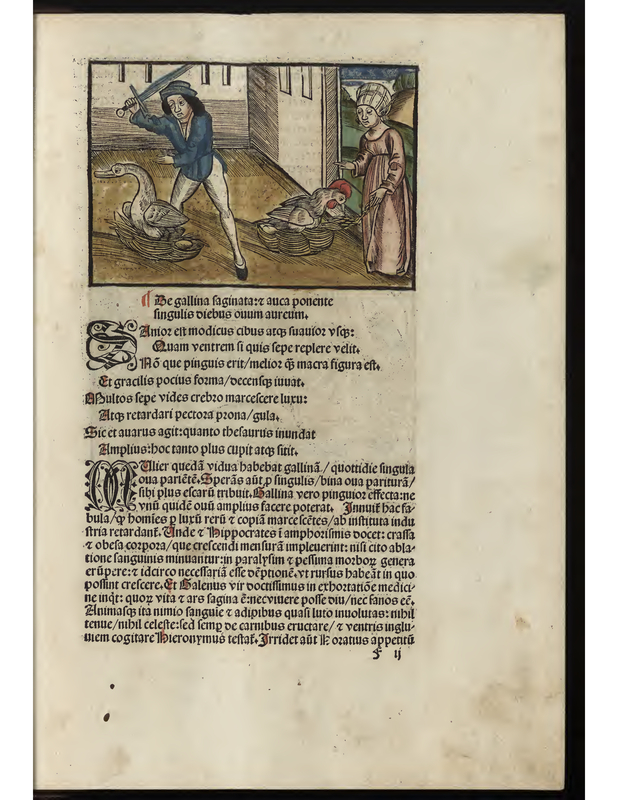
This image appears in the chapter that treats Soaemias of Emesa. Soaemias was the mother of Emperor Varius Elagabalus and the concubine of Emperor Caracalla. She was so revered by her son that he insisted that she attend meetings of the Senate, which was significant as women had never attending these councils. The image itself does not seem to reflect any part of Boccaccio’s telling of this story. There is a man on the left side of the image holding a sword and an object in his hand as a younger man stands in front of him with a stick over his shoulder.
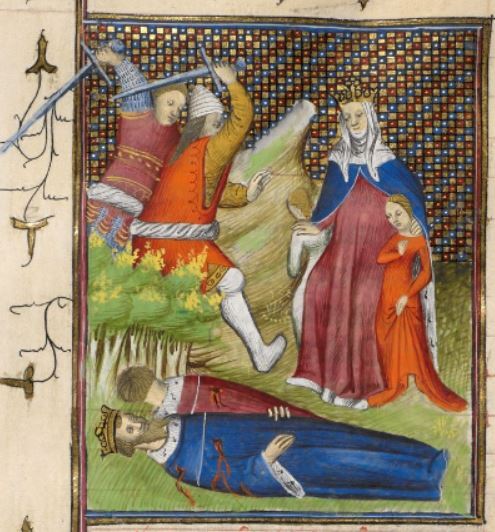
This illustration depicts Olympias, queen of Macedon and mother to Alexander the Great, being approached by men swinging their swords at her. These men are approaching her up because she had surrendered to Cassander after he besieged the city of Pydna. The men are taking her to await her execution. Olympias’ husband, King Philip, is depicted dead on the ground in the foreground of the image. He is wearing a crown to identify him as king.
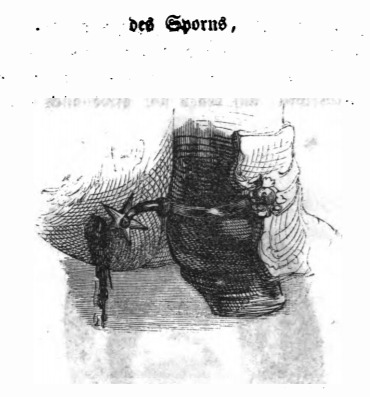
Here we see a spur on the back of a boot. The Houyhnhnms asks about the horses in Europe and how they live. Gulliver explains that humans or yahoos govern the country and care for the horses or Houyhnhnms, and how humans use their horses, including how humans use the spurs on the back of boots to control horses. The same image appears in the 1843 Krabbe edition.
A man points to his palm while looking in front of him, and can be seen wearing only a robe that covers his upper part of his body till above his knees. The background is filled with various things such as a skull, bird, broom, dog, ring and so on. At the top of the illustration are the letters ESOPVS placed centrally at the top middle of the illustration.
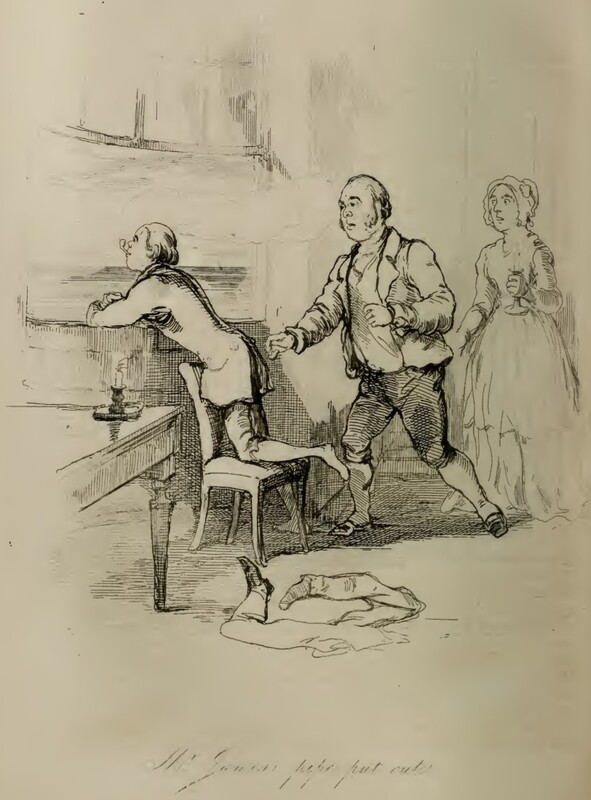
Mr. James Crawley, while visiting his aunt Miss Matilda Crawley, leans out the bedroom window while smoking his pipe. He is in his coat and breeches, with his pants and shoes in a pile on the floor next to the chair on which he is leaning. Behind him, Mr. Bowls and Mrs. Firkin have rushed into the room to stop the smoke, which is bothering Miss Crawley downstairs. Below the illustration is printed in cursive its title, Mr. James’s pipe put out.
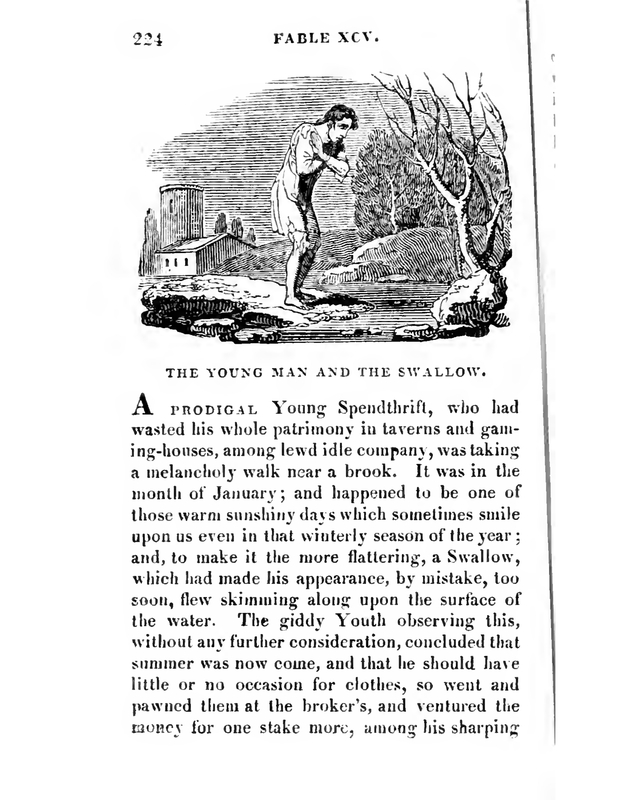
In the middle of the image there is a man facing towards to right side of the image. The man is staring down towards a brook. Behind and next to the brook are various rocks, and trees. On the left side of the image there are two buildings, as well as various trees and rocks.

![[The Gardener’s Wife]](https://collections.cemvc.ca/files/large/4cef17f58a58e7c1f479b8fea4e1f74bb04f0dd4.jpg)

![[Vanity Fair Volume I. Chapter XX Inhabited Initial, W]](https://collections.cemvc.ca/files/large/9d8d3c540b8a8d3a27875b6b3c77888a3052732a.jpg)
![[Indigenous Brazilians pick bananas from a tree]](https://collections.cemvc.ca/files/large/d7bd5a7134d794a17a7698c4a2b2051af19def19.jpg)
![[Gulliver’s master discovers the truth about Gulliver’s clothes]](https://collections.cemvc.ca/files/large/7070870401a1350c512254a2dccac5bf526a4f75.jpg)

![[Soaemias of Emesa]](https://collections.cemvc.ca/files/large/e83a07f14ad54e4fe916ce028b36ff2a5d1231bd.jpg)
![Vita et Fabulae [ESOPVS]](https://collections.cemvc.ca/files/large/675b84fcd5a4aa3db684570ad73d5f2c314f007e.jpg)