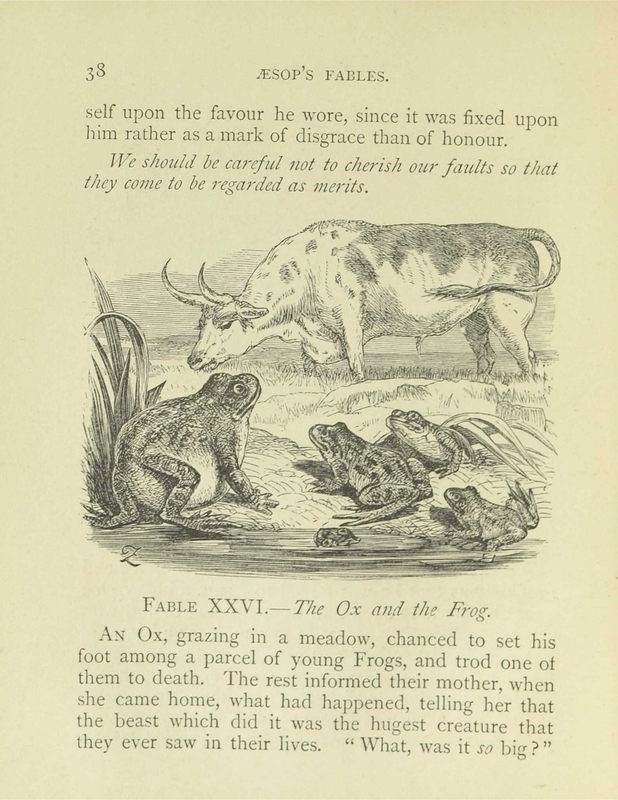
An Ox, grazing in a meadow·, chanced to set his foot among a parcel of young Frogs, and trod one of them to death. The rest informed their mother, when she came home, what had happened, telling her that the beast which did it was the hugest creature that they ever saw in their lives.
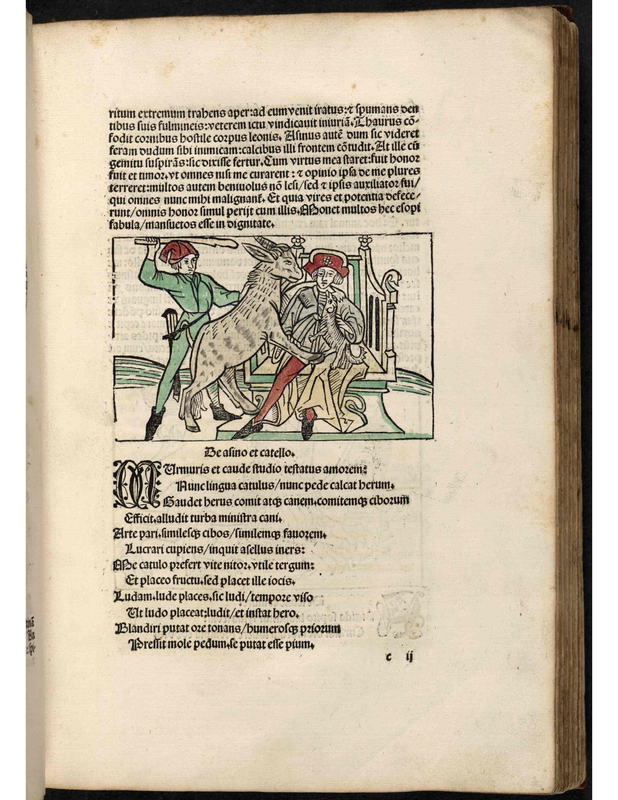
A man sits on a throne, on his lap, a puppy and the hoof of a donkey. One of his hands is on the donkeys leg and the other is on the puppy. Towards the left we see a man with his hand on the back of the donkey about to strike him with a stick.
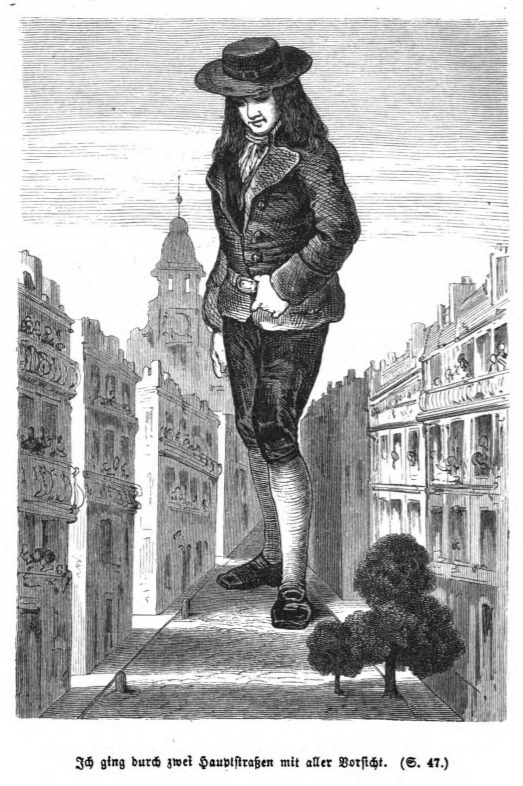
Here we see Gulliver walking through the streets of Mildendo, the capital city of Lilliput. Gulliver turns sideways to squeeze through the streets. Gulliver stands taller than most of the buildings. Lilliputians look out their windows at Gulliver. The streets are empty because the Lilliputians were told by officials to remain indoors while Gulliver explored the city.
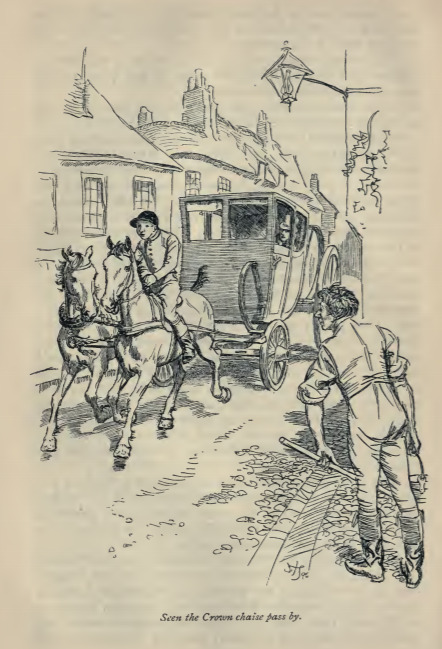
In this image Frank Churchill passes through the streets of Highbury in the Crown Inn’s chaise. He was on his way visiting his father and stepmother, Mr. And Mrs. Weston, at Randalls, to Richmond. He had been summoned to Richmond by his aunt who was becoming increasingly ill. This scene occurs in chapter 44. The characters are shown in the traditional regency style. Frank Churchill wears a top hat, and is seen through the carriage window. A boy in the street sees the carriage pass. He wears a waistcoat and breeches. The regency period dated to the early nineteenth century (1811-1820) when George, Prince of Wales, later George IV (r. 1820-1830), reigned as regent for his mentally ill father, King George III (r. 1760-1820). The regency period is associated with the rise of neoclassicism in art and fashion.
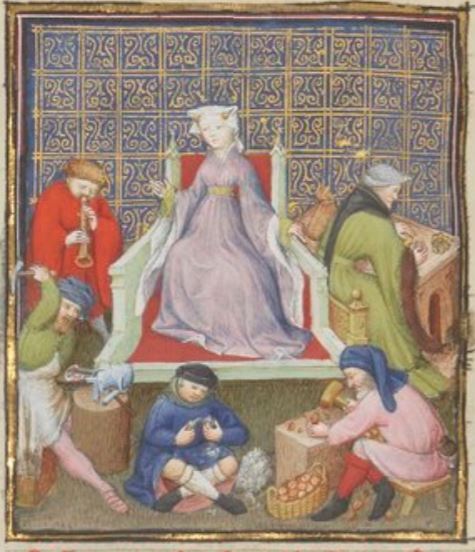
This illumination depicts the goddess Minerva sitting in the centre of the image on a throne. The people surrounding her represent the inventions and discoveries Minerva introduced to the world. There is a man on the left side of the image playing a flute, and another man creating iron weapons, which are both creations of Minerva. There is a person sitting on the ground who is spinning wool with their fingers, which is something Minerva discovered and showed humans how to do. There is also someone crushing olives with a hammer in order to create olive oil, which is another discovery of Minerva’s. There is a man sitting at a desk on the right side of the image who appears to be counting objects, which would signify Minerva’s discovery of numbers,
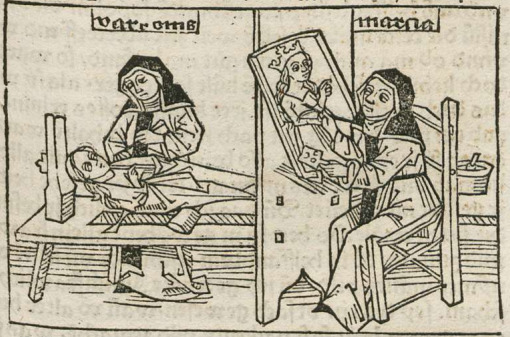
Marcia, a Roman woman who remained a virgin her entire life, is depicted on the right side of the engraving painting a portrait. Boccaccio explains that Marcia is worthy of renown for her chastity and for her painting and sculpting abilities. She is known to have mostly painted and sculpted figures of women, which is why there is a portrait of a woman wearing a crown in her painting. The left side of the engraving depicts Marcia sculpting a figure of a woman. Her sculpting tools are illustrated on the table in front of her. Marcia’s name is engraved at the top of the engraving on the right side to identify her. The name Varronis is engraved at the top on the leftt side of the engraving, which refers to her father, Varro.
A man and a woman are embracing each other while sitting at the dining room table. There’s food and dishes on the table. The man has a long beard. The woman is covered with a head wrap. They are both wearing long robes.
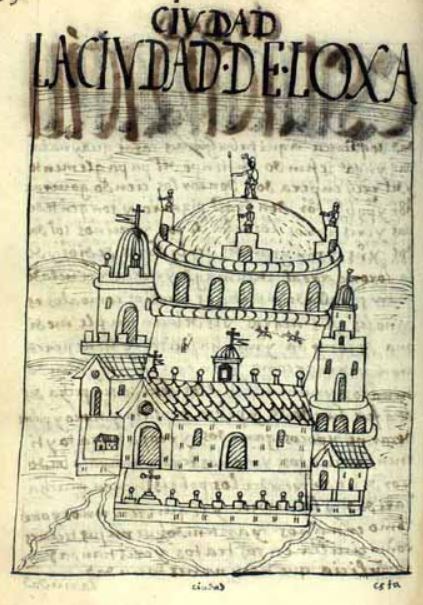
This image is depicted in the author’s chapter where he discusses cities, towns, villages, and provinces in colonial South America. This image depicts the city of Loja in Ecuador. The city is illustrated as a cluster of buildings that forms a square in the centre. There is a soldier standing on the left side of the square and two men riding horses on the other side of the square. There are also soldiers standing atop a large building in the city keeping watch. The author explains that the people who lived in this city were good Christians. The caption at the bottom of the image reads ciudad [city].
In this image Charlotte, her sister, Maria, and Lizzy sit at church. They sit together as Mr. Collins leads the sermon. They are in a private pew, and other members of the congregation walk by. This scene occurs in chapter 31. The characters are shown in the traditional regency style. Charlotte, Maria, and Lizzy wear the regency style dress with empire waistlines. The regency period dated to the early nineteenth century (1811-1820) when George, Prince of Wales, later George IV (r. 1820-1830), reigned as regent for his mentally ill father, King George III (r. 1760-1820). The regency period is associated with the rise of neoclassicism in art and fashion.
Calisto hears Sosia shouting in the street, and he climbs the garden wall to see the cause of the commotion. By the time he reaches the top of the wall, Sosia has already scared off Centurio’s men. Nonetheless, Calisto starts to descend the ladder on the outside of the wall, but he falls to his death. In this illustration, Calisto is seen lying lifeless on the ground. His hat has fallen off and is now in the bottom left corner of the illustration. Sosia and Tristan are trying to rouse him, but death has already taken hold. In the background, we can see a shield (to the left) and, leaning against the wall, the ladder that proved to be Calisto’s demise.
A Tupinambá man lounges in a hammock while appearing to eat part of a human foot. On the right side of the image a wooden rack is positioned over a fire, and human legs are suspended over the fire on the rack.
Here we see a pile of brooms used to sweep the floor in the court of Luggnag. It was a custom on the island of Luggnag where someone who wanted to be accepted into the court would be required to lick the floor in front of the King. If the person licking the floor was a stranger, as was the case for Gulliver, the floor would be swept beforehand to remove most of the dust. The same image appears in the 1839 Krabbe edition.
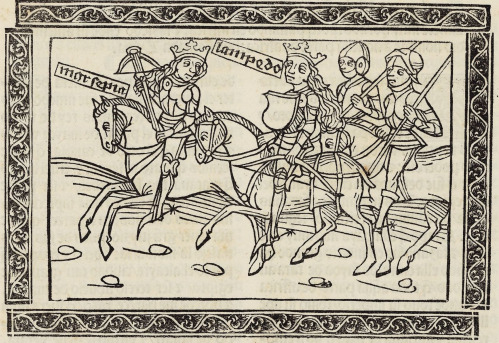
This engraving depicts the queens of the Amazons, Martesia and Lampedo. The Amazons, as described by Boccaccio, were a group of widows who decided to take up arms and fight to avenge their husbands’ deaths. They began dedicating their lives to training in riding horse-back, archery, and other military skills. The Amazons elected Lampedo and Martesia to be their queens. Lampedo is depicted with a bow and arrow in her left hand as she rides her horse, with her name engraved beside her head. Martesia is illustrated looking back at Lampedo with a sword in her hand. Her name is engraved to the right of her sword. The women riding behind them are other Amazon women.
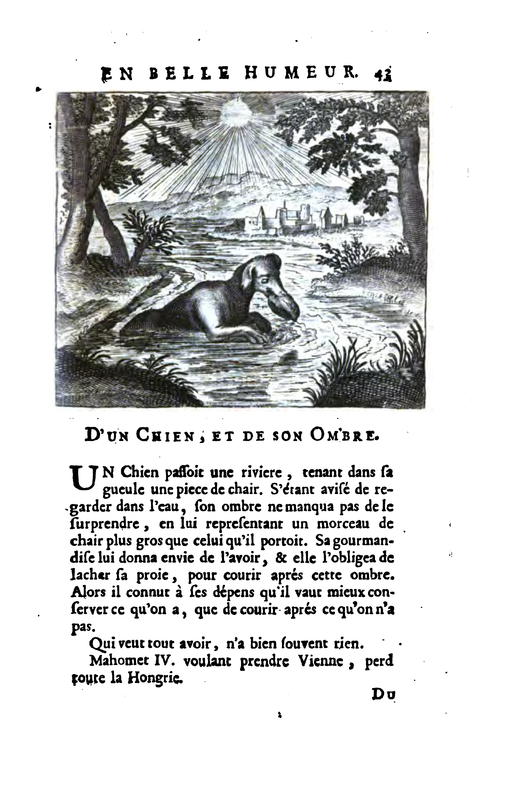
There is dog swimming in the river and the dog has a fish in his mouth. The majority of the image is the river running through the town and there are trees on either side of the river. In the vast distance there are houses and behind that a mountain range. ON top of the image, there is a sun rising and the rays are shining through the mountain range.
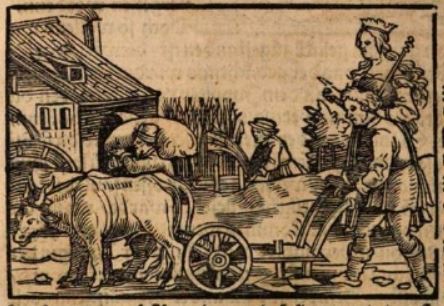
The goddess of agriculture, Ceres, is depicted on the right side of the engraving wearing a crown and holding a scepter. Boccaccio explains that after discovering agriculture, Ceres had tamed oxen and trained them to yoke. She also discovered planting seeds and then taught men how to harvest them once they matured. There is one man plowing the fields with the oxen, and another in the background husking grain. There is another man with a bag of flour over his head, as Ceres also taught men how to turn flour into an edible fare. Ceres wears the crown and scepter to signify her importance linked to agriculture and harvest.
This image is drawn over two full pages of the author’s book. It depicts a map of Tahuantinsuyu, the name that the Inca’s gave to their empire. It comprised of four regions: Chinchasuyu, Antisuyu, Condesuyu, and Collasuyu. Starting from the top left corner, the caption that runs around the frame of the image reads, Un reino llamado antisuio hacia el derecho de la mar de norte. Otro reino llamado collasuio sale so[l]. Otro reino llamado condesuio hacia la mar de sur, llanos. Otro reino llamado chincaisuio puni[en]te sol [A kingdom called Antisuyu to the right of the North Sea. Another kingdom called Collasuyu is in the sun. Another kingdom called Condesuyu is towards the South Sea. Another kingdom, Chinchasuyu in the setting sun]. The figures and words are difficult to make out as they are written and drawn small. There is a moon in the top left corner and a sun in the top right. Within the four regions that the author described, there are drawings of coat of arms, ships, animals, trees, and people.
A massive statue on a pedestal, with vertical, pointed ears, wearing a crown and holding a staff. The upper part of the staff forms the letter A from And topped with a crown. At the base of the statue there are many seated figures, and in the silhouettes of buildings are in the background.
![[Couple in dining room]](https://collections.cemvc.ca/files/large/71a3e7aeac5d89af488bedb33cb05fa1c2042181.jpg)

![[Act XIX – After Calisto Falls to His Death, Sosia and Tristán Try to Help Him]](https://collections.cemvc.ca/files/large/251ec1448f0364e5494771f4793e547c09656af5.jpg)
![[Tupinambá man in hammock eats a human foot while other human limbs roast over a fire nearby]](https://collections.cemvc.ca/files/large/827f103b3831c1ccf8f94969d3f1138741d69634.jpg)
![[Vanity Fair Vol. II Contents Page Decoration]](https://collections.cemvc.ca/files/large/d0e2e64d75b793bfef30dce0755533c53e34b416.jpg)
![[Brooms used in the court of Luggnag]](https://collections.cemvc.ca/files/large/473dae202023319773191b7d07e4bb0098ea0e1d.jpg)
![Mapa Mvndi Del Reino de las In[di]as](https://collections.cemvc.ca/files/large/0ae06ef68cfb2d8f4742e9dff05e00355a90406c.jpg)
![[Vanity Fair Volume I. Chapter X Inhabited Initial, A]](https://collections.cemvc.ca/files/large/aec4251d20a48f19192e34d25aebd537a20b03bd.jpg)