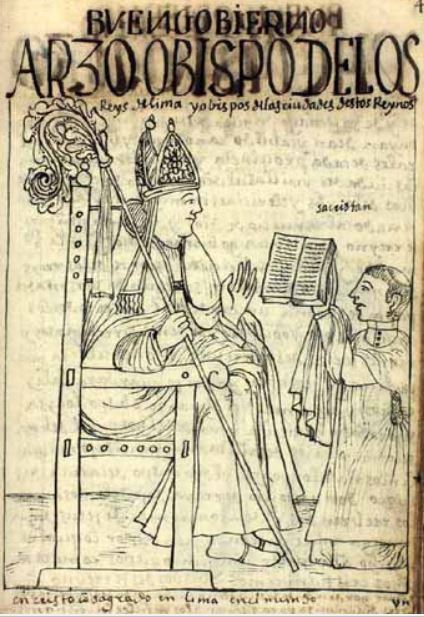
The author spends this section of this chapter discussing religious establishment in Peru and the Church’s hierarchy. This image depicts the Archbishop of Lima sitting on a large chair as he looks at his Sacristan. He is depicted wearing a mitre on his head, a pallium, and holding a staff in his right hand. The Sacristan is depicted kneeling in front of the Archbishop as he presents a book to him, most likely the Bible. The caption at the bottom of the image reads, en cristo consagrado en lima, en el mundo [Christ consecrated in Lima, in the world].
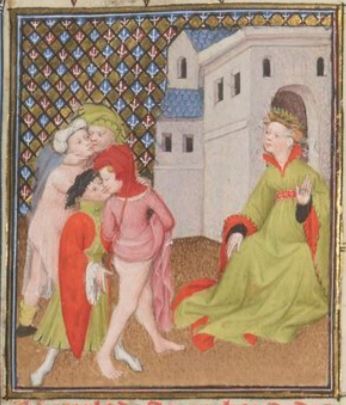
This illumination depicts the famous, wealthy prostitute Flora sitting on the right side of the image. She is depicted looking to the left of the image where there are people engaging in sexual relations with one another, which symbolizes her life as a prostitute. Boccaccio explains that Flora used her wealth to have annual games held in her honour. He also explains that the Roman senate did not want a prostitute being honoured, so they fabricated a story which describes Flora being married to the wind, Zephyrus, who made her a goddess of flowers and trees.
In this image we see the two types of eggs at war with each other. Those on the left are cracked on the top, while those on the right have been cracked in the middle. This difference as to the correct way to crack an egg was the reason for the tensions between Lilliput and Blefuscu. This is a thinly veiled reference to the religious wars of the sixteenth and seventeenth centuries, where Swift insinuates that the correct religious beliefs – like the correct way to crack an egg – is a personal decision, and not one worth going to war over. The same image appears in the 1839 Krabbe edition.
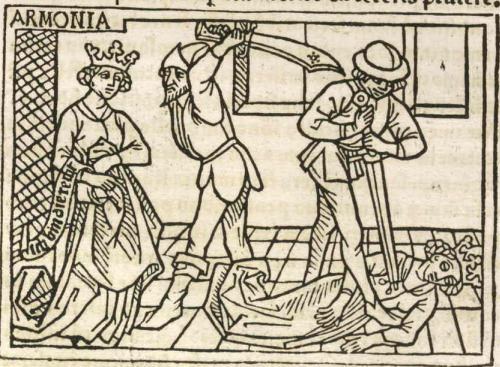
This engraving depicts a young servant girl getting stabbed in the chest with a sword by a man standing above her. This young servant girl is disguised to look exactly like Harmonia, the daughter of Gelon (brother to the king of Syracuse). Boccaccio explains that there was a rebellion in Syracuse against nobility, and before the murderers could get to Harmonia, her nurse disguised this young woman to look like Harmonia. The real Harmonia is depicted on the left side of the engraving. Her name, written as Armonia, is engraved above her head in order to identify her. There is a man swinging a sword above his head which appears to be heading in Harmonia’s direction, however, Boccaccio explains that Harmonia hid from the murderers until they killed the look-alike servant.
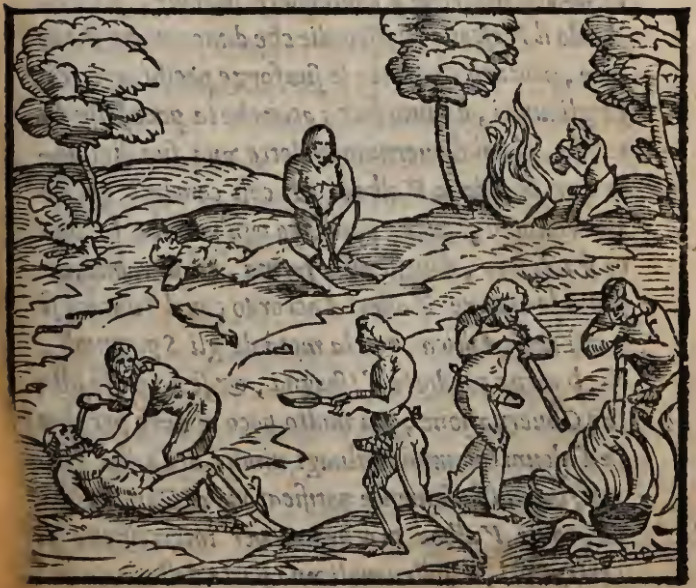
A group of Indigenous people melt gold over a fire and then pour the molten gold into the mouth of a Spaniard who lays tied up on the ground. In the background, the body of a second Spaniard is being dismembered for cannibalism. One individual kneels beside a second fire that has been built to roast the limbs. The men in this group wear a garment tied around their waists that covers their genitals.
Here we see the seal of the King of Luggnag. The seal shows the king helping a lame beggar to stand up. The beggar is lying on the ground holding a cane. A dish is on the ground in front of him. The King stands in front of the beggar, extending his arm to help the beggar. Along the bottom of the seal is the phrase Lugg. Rex., meaning King of Luggnagg. The seal would be used when sending official letters. The seal appears when Gulliver presents a letter with this seal to a customs official in Japan, asking the Japanese to grant Gulliver passage to Europe. The same image appears in the 1843 Krabbe edition.
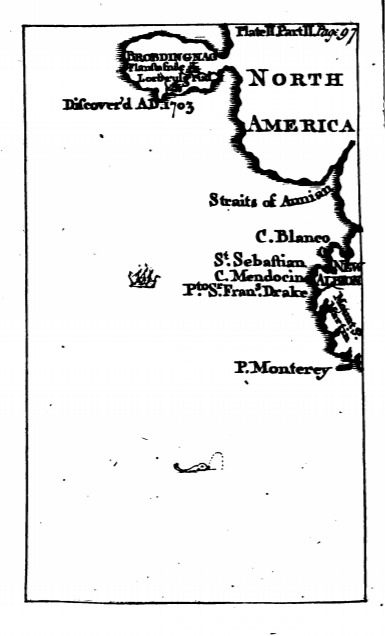
The image depicts the fictional land of Brobdingnag, off of North America. The cities of Flagnlamic and Lorbrulgrud are shown in Brobdingnag. Underneath Brobdingnag reads Discovered AD. 1703. The bottom half of the map includes New Albion. A ‘man-of-war ship is shown off the coast of New England, and a dolphin is near the bottom of the image. The same map is featured in several other editions of the text, including those in other languages.
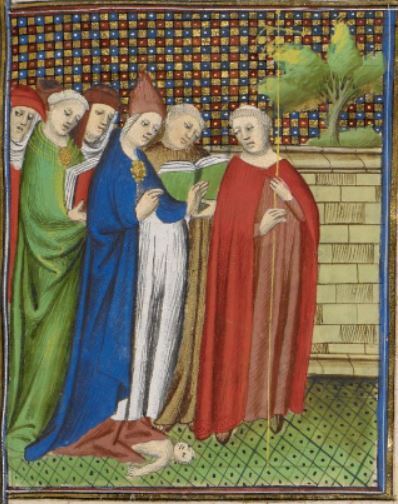
A maiden named Joan had disguised herself as a man in order to follow her lover to England while he attended school. Joan had excelled in academics and became incredibly knowledgeable while attending school. Continuing to dress as a man, Joan went to Rome and was elected to succeed as Pope, known as Pope John. No one had known she was a woman, however, she ended up having a love affair which resulted in pregnancy. This image depicts Joan, dressed in her papal regalia standing as she gives birth to a child under her clothes. The birth happened during a public procession which revealed her identity as a woman. The other ecclesiastics in the image are all depicted looking down at the child that Joan had just given birth to. According to Boccaccio, Pope John (Joan), was thrown into a dungeon to die as punishment for posing as a male while holding the title of Pope.
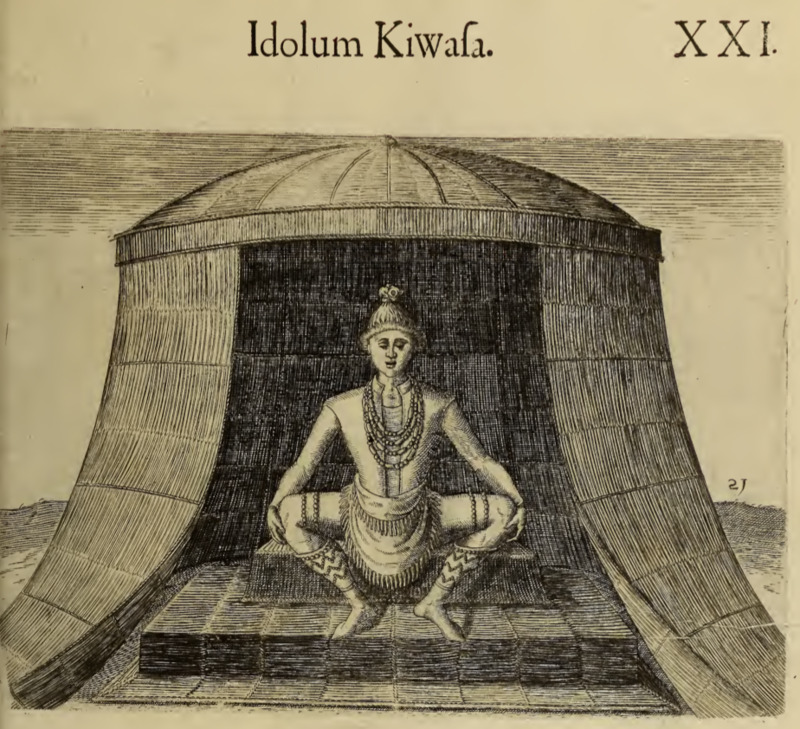
An idol carved of wood is pictured. It is shaped like a human man in a seated position and sits inside a hut-like structure. The idol bears a hat, strands of beads around its neck, a fringed skirt around its waist, strands of beads around each of its thighs, and decorated cuffs around each of its calves.
In this image the lady Urraca is sitting in front of El Cid and his soldier. She is wearing dress with a crown on. She has her elbow on the desk with books and papers. She also has her eyes closed. El Cid is the one who has his arm outstretched in front of him. He has a beard and moustache. He has his armour on with a cloak. At his waist there is sheathed sword. Next to El Cid is his soldier. He is wearing a tunic with chainmail underneath it. He also has a sheathed sword at his waist. Behind the three main focuses of the image there is a blur of people. The blur of people seem to be a mixture of soldiers and the people.
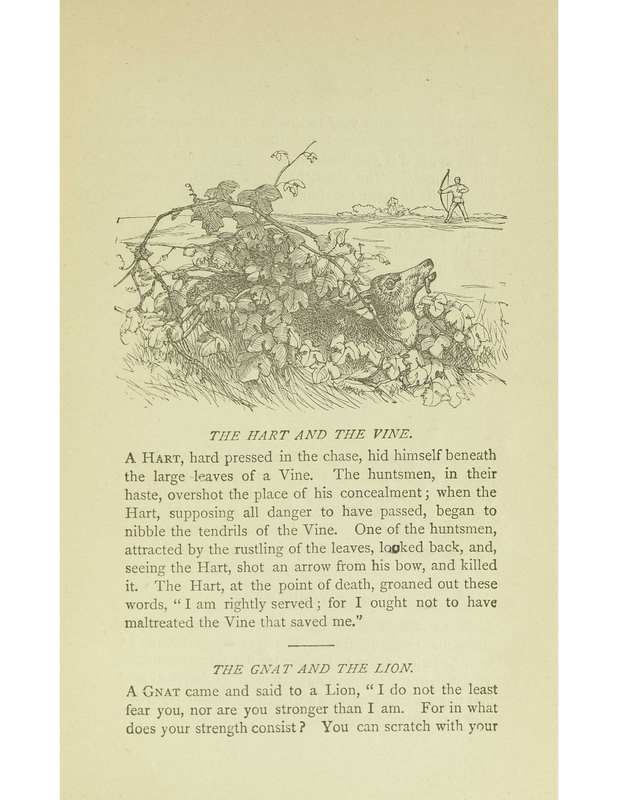
In the foreground, a large bush of vines lies in the center of the image. Underneath all those vines, the head of a hart can be seen sticking out to the right. The hart’s eyes are big, and its tongue is sticking out of its mouth hanging to the right. In the background, a lake separates the hart from another piece of land. Across the lake, a man can be seen hunting with a bow and arrow.
The garden’s wife stands outside her ivy-covered house, with the cityscape in the distant background. In front of her is young Rawdon Crawley, for whom she is the nurse, making mud pies in the dirt. Behind a low gate in the doorway of the house are two other young boys, either her own sons or other children over whom she is watching.
A tiny mouse sits on a portion of a mountain. People are gathered around on the right side of the image. Books are open and on the ground. One man is outreaching an arm as if to grab a book.
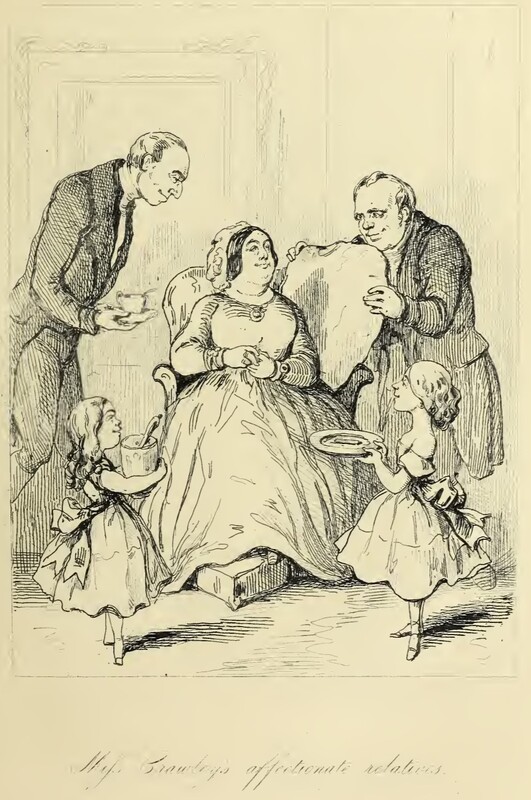
Miss Matilda Crawley is seated in a large, comfortable armchair. She is looking to the right of the image at her brother, Sir Pitt Crawley, who is adjusting one of her cushions. To the left is her other brother, Reverend Bute Crawley, who is bringing her a cup and saucer with a spoon. At her feet are Violet, holding a tall jar or vase, and Rose, holding a plate, both attired in fancy dresses. Below the illustration is printed in cursive its title, Miss Crawley’s affectionate relatives.
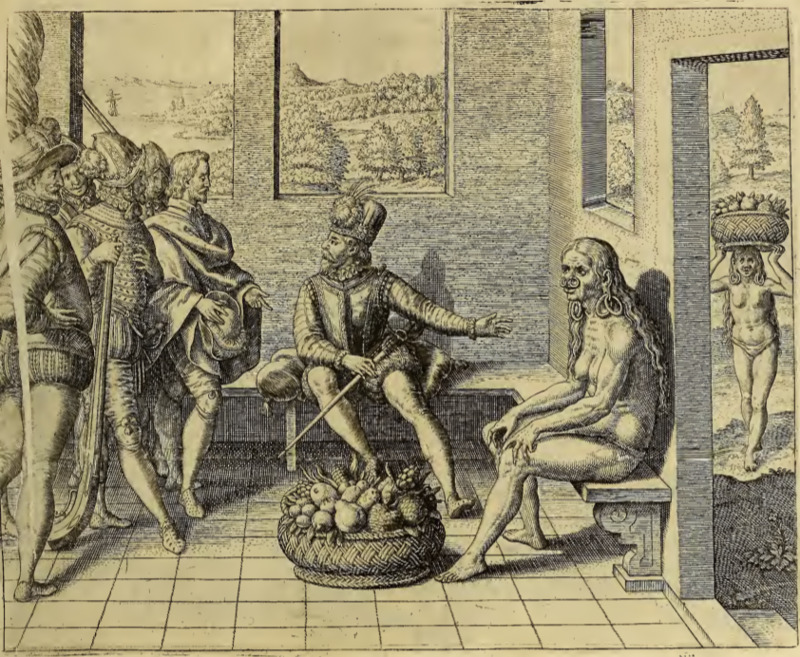
Inside a structure, and Indigenous woman and a European man sit on a bench, while several other European men stand nearby in conversation. The woman is nude with long, unbound hair. She wears two hoop earrings in each ear and two smaller hoops in her nose. The European men are all finely dressed in doublets and hose, and several wear fine hats or helmets. The man on the bench is seated on a cushion and gestures towards the Indigenous women while conversing with the other men. He carries a thin sword, while one of the other men holds a musket. In the center of the group on the floor there is a large basket of fruit, a gift presented by the Indigenous woman. Another woman can be seen on the right, approaching the building with another large basket of fruit.
Sempronio (figure with his sword raised) and Pármeno (rightmost figure) go to Celestina’s house. They ask Celestina (figure lying on the ground) to fulfill her promise and give them a share of the gold chain given to her by Calisto. She refuses, making up countless excuses and lies in order to escape her obligation. Sempronio draws his sword and threatens her, but she refuses to forfeit part of her reward and calls on Elicia (figure between Sempronio and Pármeno) for help. Sempronio begins striking her, and both she and Elicia scream in horror, calling for the alguacil’s men (the soldiers in the left panel of the illustration). Sempronio and Pármeno hear the men approaching the door and flee upstairs to the third storey. Realizing they have no other recourse for escape, they jump from the window.
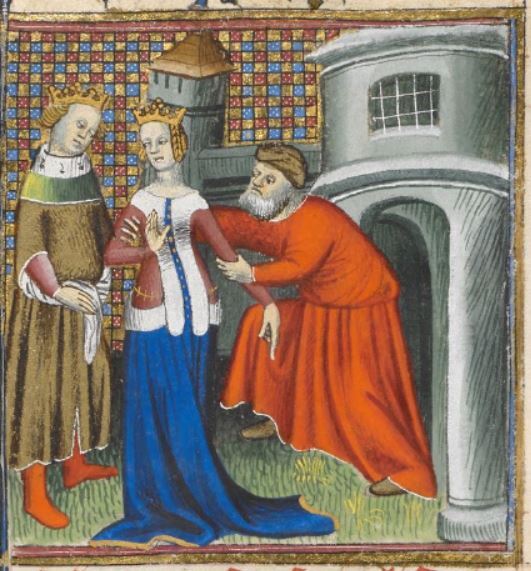
This illumination depicts Hypermnestra, daughter of King Danaus of The Argives, helping her lover escape from her father’s wrath. Boccaccio explains that King Danaus wanted to secure his throne by eliminating any possible heirs. He married each of his daughters off to his many nephews and instructed them to kill their grooms after the wedding. All but Hypermnestra followed through on these orders, as she fell in love with her new groom and cousin. She helped him escape, as illustrated in the image. Her husband, Lynceus (also known as Linus), is depicted in a brown outfit looking at his wife after being led out of the castle to escape. Hypermnestra’s father is illustrated coming out of the castle door about to grab onto his daughter. She was put into prison by her father for disobeying him, however, Lynceus eventually defeats his father-in-law and releases his wife from prison.
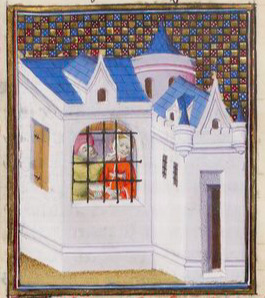
Knowing that her imprisonment was undeserved, Agrippina decided that committing suicide was the only escape to her persecution. When she found that she had no instruments, she realized that starving herself was the most effective way to commit suicide. She is seen inside the prison wearing a red gown. She is being force-fed by a man in green on the left, attempting to prolong her life.
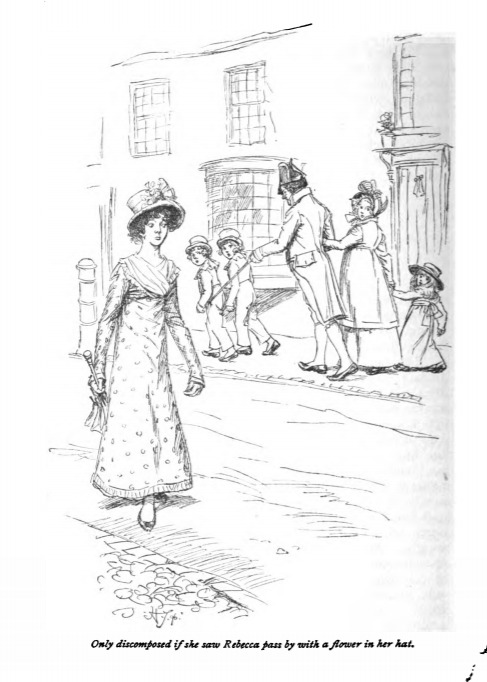
In this image Mr. And Mrs. Price walk through the streets at Portsmouth on Sunday after church. Mrs. Price looks at her servant, Rebecca, walking with a flower in her hair. Mrs. Price often complained about the quality of servants in Portsmouth, and she thought seeing Rebecca with a flower in her hair to be improper. Mrs. Price holds Betsey’s hand, and Mr. Price uses his walking stick to keep the young boys in line. This scene occurs in chapter 42. The characters are shown in the traditional regency style. Mrs. Price and Rebecca wear regency style dresses with empire waistlines and bonnets. Mr. Price wears a waistcoat and tailcoat with breeches and a bicorn hat. The regency period dated to the early nineteenth century (1811-1820) when George, Prince of Wales, later George IV (r. 1820-1830), reigned as regent for his mentally ill father, King George III (r. 1760-1820). The regency period is associated with the rise of neoclassicism in art and fashion.
The main focus on this image is the three characters in the front, Jimena, El Cid, and the Jester. El Cid is wearing a hat and tunic, with a cloak covering half of his chest. He has his hand on Jimena’s shoulder. He has a moustache. Jimena is wearing a dress and a headdress. The jester much closer to the fron of the image is wearing a jester hat with horns on top and little orbs at the end of it. He seems to be grinning. The other people in the background our soldiers wearing helmets and gear. The one nearest to El Cid is carrying a sword with him.
Mr. Bowls sits in a chair at the kitchen table, reading Fire and the Frying Pan aloud to his assistant, who sits opposite him, holding onto a jug. Through the door in the background, Mrs. Firkin is entering, holding a candle in front of her.

![[Cracking eggs depicting religious wars]](https://collections.cemvc.ca/files/large/cbc874e38789559cd8357ff6bbbea6b77c72d037.jpg)
![[the seal of the King of Luggnag]](https://collections.cemvc.ca/files/large/a44eafa8f9649550d6a4bd3be9e3b014d0187fa8.jpg)


![[The Cid speaking with the queen Urraca]](https://collections.cemvc.ca/files/large/389700f5cfad9a5f2022d1ab4c1e442955ef68f6.jpg)
![[Little Rawdon’s Nurse]](https://collections.cemvc.ca/files/large/8bd36275f49116ac1f6d3a9d93aae824f083179d.jpg)
![[The Mountains in Labour]](https://collections.cemvc.ca/files/large/ac505c71ba7a8bc34db5c1fb2eca48516ca6a4a8.jpg)
![[Act XII (Second Illustration) – The Alguacil’s Men Knock on the Door as Sempronio Murders Celestina]](https://collections.cemvc.ca/files/large/cc668e50a3a2b3648fb7522d83648bff0381feae.jpg)

![[The Cid and Jimena celebrating their wedding]](https://collections.cemvc.ca/files/large/d8b54881206938be927826d8a035d8761ecd35ba.jpg)
![[Mr. Bowls and his Assistant]](https://collections.cemvc.ca/files/large/6226975d4ef9b3fb5f04b1433b585e50de4a6990.jpg)