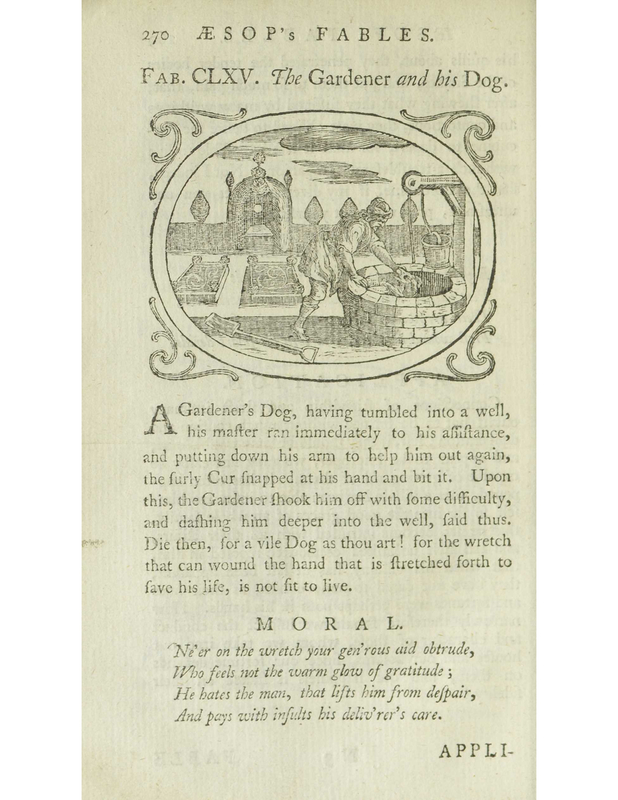
A man leans over a well. A dog is in the well. The man is grabbing onto the dog, trying to help him out of the well. To the of the man there is a shovel on the ground. In the background there is a large and well maintained garden.
Here we see a hoof of Gulliver’s master. This image appears at the beginning of the fourth chapter, in which Gulliver’s master explains the Houyhnhnms philosophy on truth and falsehood. The letter M appears on the hoof is the first letter of the chapter. The same image appears in the 1839 Krabbe edition.
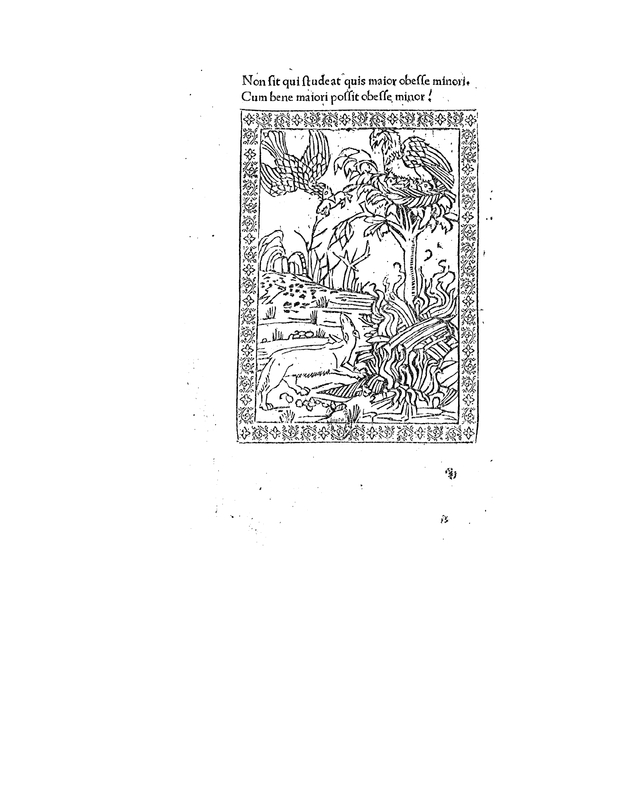
The left side of the image depicts and eagle flying with a fox's pup towards its nest, the fox which is presumably the mother is looking up at the eagle. The right side of the image shows the eagle sitting in its nest with its eaglets, the base of the tree is engulfed in flames.
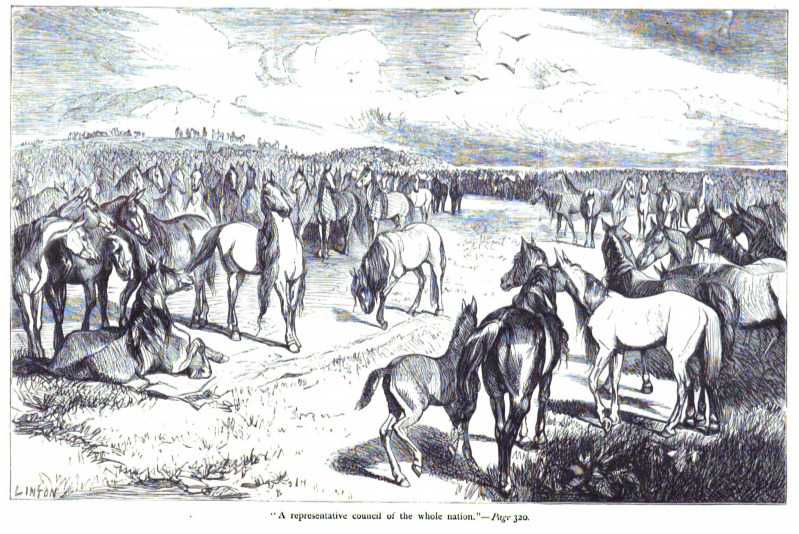
Every five years Houyhnhnms meet from all over the country in a general council. In this image we see this meeting, with a large crowd of Houyhnhnms in a field. At this council it was determined that Gulliver could no longer live with the Houyhnhnms, and either had to live with Yahoos or leave the country.
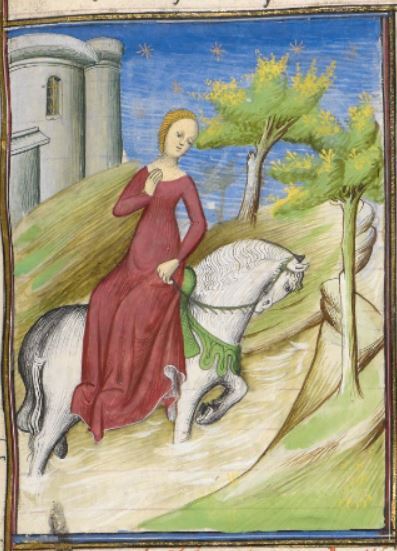
This illumination depicts Cloelia, a young Roman woman, riding a horse through a deep river. Boccaccio explains that Cloelia was given to a foreign king as a hostage, and when she escaped, she took many other hostages with her back to Rome. While escaping, she came across a river that was too treacherous to pass. She found a horse, and despite never having ridden one, she got herself and the other women across safely by means of this horse.
A boy in a uniform and triangular hat with a pair of tiny angel wings holds a packet of sealed correspondence out to a doorway. He has a bag in his other hand and more letters tucked under his arm.
In a field, two goats, their kid, and a wolf are facing off. The wolf is baring its teeth at the kid, while the two adult goats are bent slightly forward, ready to charge towards the wolf.
In this image we see Gulliver being brought into the town from the shore on a gurney. This is to remove the arrows. The gurney is drawn by a large team of horses. Soldiers with spears walk alongside the gurney with their weapons. A crowd lines the streets to see Gulliver. The silhouettes of Lilliputians can be seen on the rooftops, while others in the foreground are sitting on posts. The same image appears in the 1843 Krabbe edition.
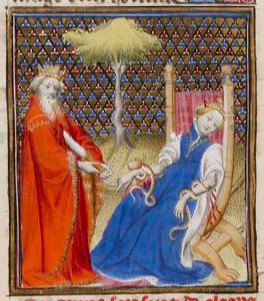
Antony walks in to find his wife, Cleopatra, dead. She committed suicide by placing two snakes on her arms to poison her. She is seen to the right of the image, dead in a throne. Antony is to the left, and kills himself with a sword upon finding her body.
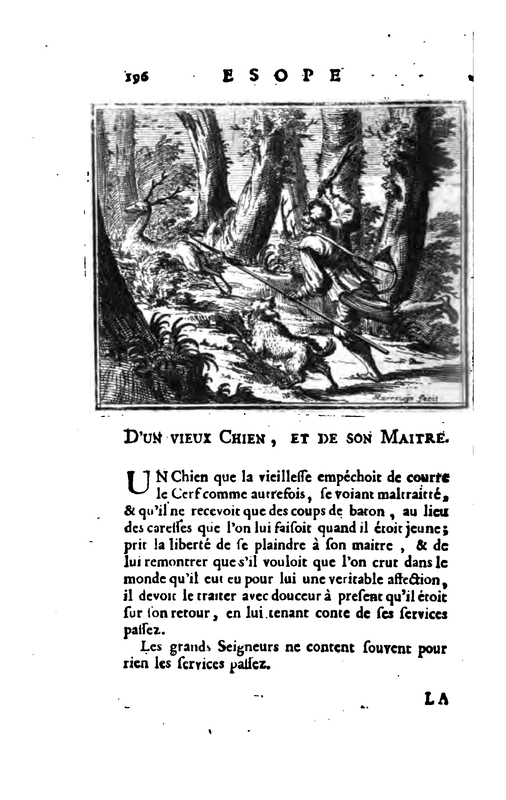
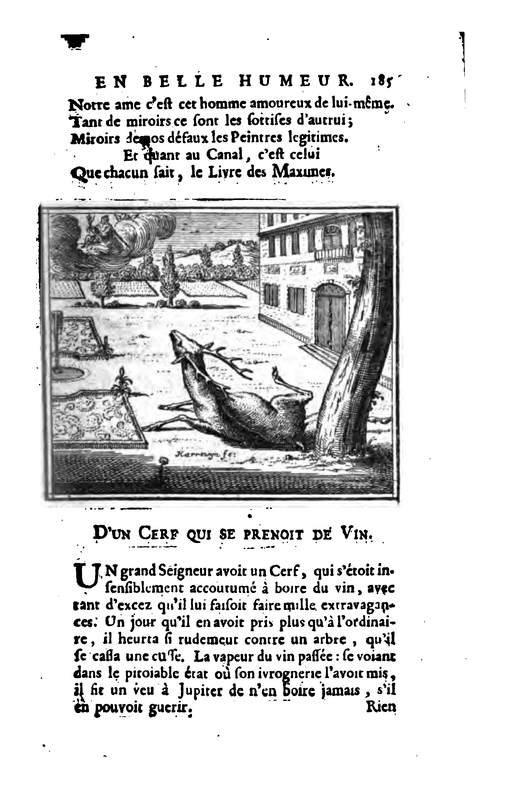
A deer is laying on the ground with its legs in the air at the base of a tree to the side of a building. Fields of crops can be seen in the background.
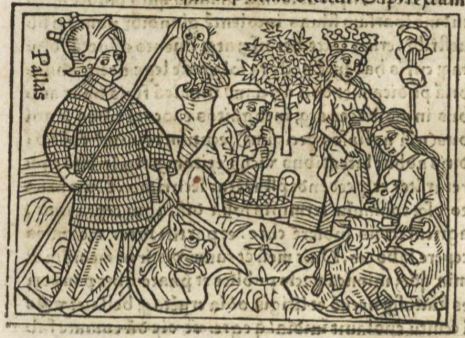
This engraving illustrates Minerva, also known as Pallas, standing on the left-hand side of the engraving suited in armour, holding a lance in her right hand and a shield (with a depiction of Medusa on the front) in her left. We know this is Minerva as the name Pallas is engraved directly beside her. This engraving represents the importance of Minerva and what she brought to the world. Boccaccio explains that Minerva had discovered wool work and weaving. There is a woman on the right-hand bottom corner of the engraving shearing a sheep to signify this discovery. The woman standing behind her has fabric in her hand to signify the art of weaving that Minerva had given to the world. The man in the centre of the engraving is depicted with a millstone in his hand, pressing down into a bucket of olives. Boccaccio explains that Minerva had taught the world of men to do this so that they can extract and use oil from the olives. An olive tree stands in the background to further the significance. There is an owl resting on a tree stump next to Minerva, which Boccaccio explains, represents her wisdom.
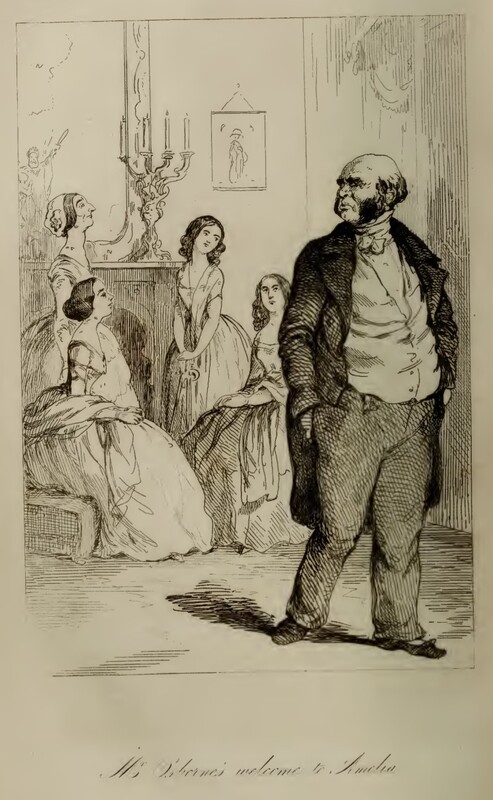
Jane and Maria Osborne are seated on two low chairs in front of the fireplace. Upon it are a very large mirror, a statue of a warrior, and a candelabra; to the side of the mirror hangs a small portrait. Amelia Sedley is standing between the sisters, looking uncomfortable and holding her hands clasped together. Miss Wirt is standing opposite Amelia, looking haughty. In the foreground of the image is Mr. Osborne, mostly turned away from the others as he walks away with a scowl on his face. Below the illustration is printed in cursive its title, Mr. Osborne’s welcome to Amelia.
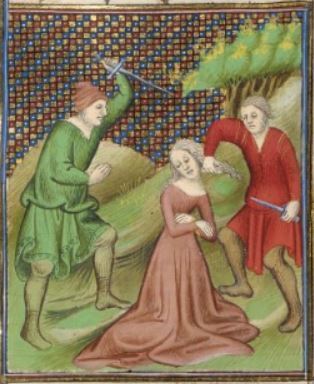
This illumination depicts the prostitute Leaena being violently tortured for information regarding a conspiracy. There is a man on the right side of the image pulling on Leaena’s hair, and a man on the left side holding a knife above her head. Boccaccio explains that she is being tortured for being involved in a conspiracy to overthrow a tyrant.
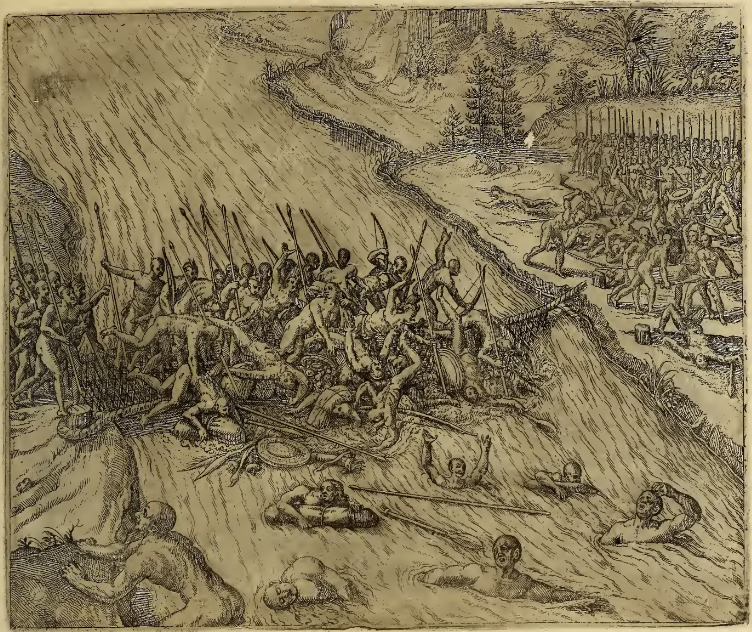
A group of Inca people braided ropes together to make a bridge across a river, in order to confront a rival group. However, as they were crossing, warriors on the other side of the river cut the ropes that anchored the bridge to the riverbank with a hatchet, sending the men crossing the bridge into the water. Several warriors are being carried downstream by the river current along with their weapons, although one man has managed to climb out of the water. Men in both armies are armed with bows, spears, and shields.
This engraving depicts Niobe, the daughter of King Tantalus of Phrygia, on the right side of the engraving wearing a crown. Niobe became proud of the fact that she had more children than Latona, the mother of Diana and Apollo. As punishment for her hubris against the goddess, all of Niobe’s children had been killed by the plague. Her children are depicted dead in the centre of the engraving. Grieved by the loss of all their children, Niobe’s husband, King Amphion of Thebes, killed himself with a knife. Amphion is depicted on the left side of the engraving as he pierces his body with the knife.
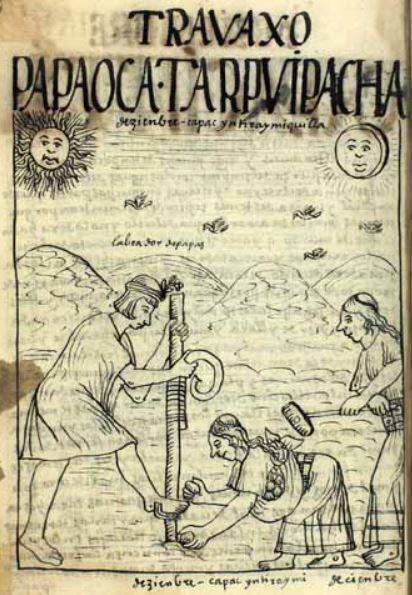
This image is reflected in the final chapter of Ayala’s chronicle where he provides a description of labours and festivals that occur in the rural areas of the Spanish colonial Andes during each month of the Inca calendar year. This image depicts the month of December which was important for the planting of potatoes and other vegetables such as quinoa and oca. There is an indigenous man and two indigenous women illustrated sowing a field with seeds. The man is holding an agricultural tool and pressing his foot down on it to make a hole for the seeds. There is a caption written above his head which reads labrador de papas [potato labourer]. One woman is planting the seeds and another woman behind her is holding a hammer. There is a sun in the top left corner and a moon in the top right corner of the image with the mountainous Andean landscape beneath it. The caption at the bottom of the image reads dezienbre capac ynti raymi [december, first month].
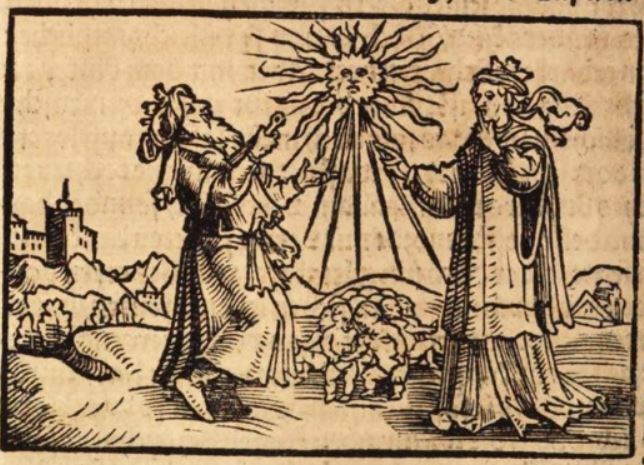
Here we see the Lilliputian Emperor and Finance Minister discussing what to do about Gulliver, as it was very expensive to continue to feed and clothe him due to his size. The two ultimately came up with a plan to charge him with treason among other charges to force him to leave. The same image appears in the 1839 Krabbe edition.
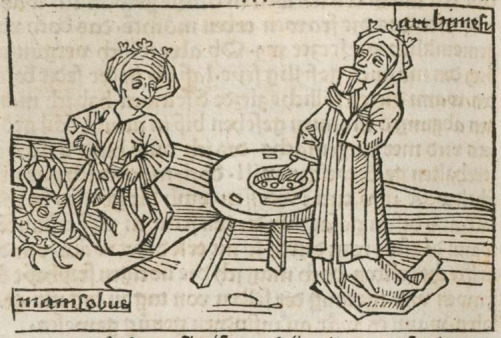
Artemisia was married to Mausolus, the king of Caria. Boccaccio explains that when he died, Artemisia was so grieved by his death that, instead of putting his ashes in an urn after his cremation, she drank the ashes in order to be closer to him. The left side of the engraving depicts Artemisia cremating her husband’s body in a fire. Mausolus head is visible in the fire. Artemisia is illustrated scooping her husband’s ashes and putting them into a bag. The right side of the engraving depicts Artemisia drinking her husband’s ashes. The name Mausolus is engraved at the bottom left corner of the image, and Artemisia’s name, written as Arthimesia, is engraved at the top right corner.
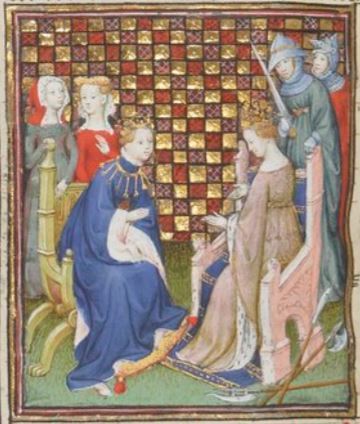
This illuminated image depicts Marpesia (also known as Martesia) and Lampedo, sister queens of the Amazons. They are wearing crowns to demonstrate their royal status; however, they also have weapons by their chairs to signify their illustrious military skills and achievements. The Amazon women are known to have lived their lives dedicated to war and military pursuits. Boccaccio explains that after all the Amazon women were all widowed, they took up arms to avenge their husbands, and continued to thrive off battle. Marpesia and Lampedo were elected by their fellow Amazons to become queens. There are other Amazon women in the image.
Amelia Osborne stands with her head tilted slightly to one side, with one hand held to her chest and the other holding a closed fan by her side. She is framed in the letter C from Conducted.

![[a hoof of Gulliver’s Houyhnhnm master]](https://collections.cemvc.ca/files/large/ab60000676942affbcf2816d2b48d5893c3b1401.jpg)
![[Letter Delivery]](https://collections.cemvc.ca/files/large/1d6d6f535a3723644423c2c2d0ebb6865a6cabfa.jpg)
![[The Goats and Their Kid Against the Hungry Wolf]](https://collections.cemvc.ca/files/large/27a3ebd737d45a620c6d86eae2c43bdf936fb7ef.jpg)
![[Gulliver being brought into the town from the shore on a gurney in Lilliput]](https://collections.cemvc.ca/files/large/c29f2cce8a6a60cfb800236ae674c1fc20405af5.jpg)
![[The Lilliputian and Finance Minister discuss Gulliver]](https://collections.cemvc.ca/files/large/37d7aba729ff84486a0db08b1443d094eac63b24.jpg)
![[Vanity Fair Vol. I Chapter XXV Historiated Initial]](https://collections.cemvc.ca/files/large/b080d152973ae6de4be484b2a6ff8ccb9745cbe3.jpg)