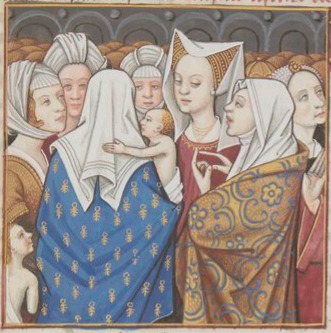
This illumination depicts the many wives of the Cimbrian men. They are all standing side by side in a large group looking at one another. There is a woman in the foreground who is holding her child in her arms, and a woman on the left side of the image with her child standing beside her. These women are famous for killing themselves and their children to save their honour. After their husbands were defeated in war against the Romans, the wives pleaded to their enemies for mercy and to let them become vestal virgins. When the Romans denied their request, they decided to kill their own children and hang themselves to save their virtue and to not die at the hands of their enemies
Mrs. Firkin and Miss Briggs stand outside the parlour door, listening in on the conversation between Sir Pitt Crawley and Rebecca Sharp. Mrs. Firkin has her eye to the key-hole, and both look worried.
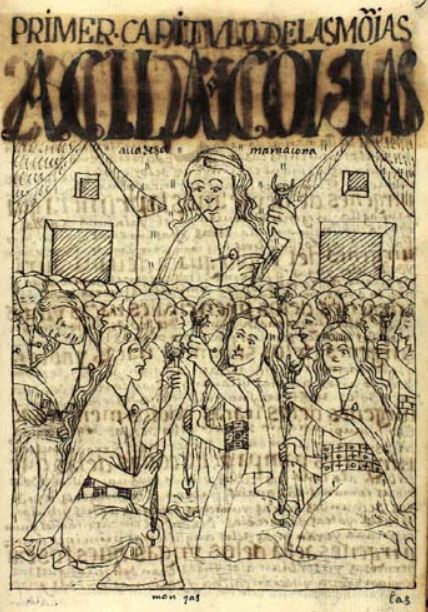
This image depicts the acllaconas [chosen women] of the Inca Empire. The author explains that nuns were cloistered during the Inca Empire, which is why the image depicts the nuns grouped all together. There were six groups of nuns all dedicated to serving different gods and idols and another six groups of common nuns, all ranging in ages from twenty years old to fifty years old. There are two houses illustrated in the background of the image, which might be to house the two separate groupings of nuns. The woman standing above all the other nuns in the image is labeled as mamacona [high priestess] and there is a caption at the bottom of the image, monjas [nuns], to label the large group of women. Many of them are depicted spinning.
Here we see a bust of Charles V. This image appears when Gulliver describes the language of the Houyhnhnms. Gulliver describes the language as something similar to Dutch or German but is more delicate or expressive. Charles V allegedly said that he spoke to his horse in German, insulting the language. Charles V was the Holy Roman Emperor between 1519-1556. He was also Archduke of Austria, King of Germany, Archduke of Austria, King of Italy, Lord of the Netherlands, and King of Spain. The same image appears in the 1839 Krabbe edition.
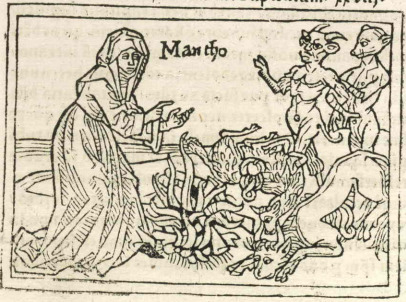
This engraving depicts Manto, the daughter of the famous seer Tiresias. She is depicted with her body leaning over a burning fire. We know this figure is Manto as the creator engraved her name beside her head to identify her. Boccaccio explains that Manto became an incredible seer just like her father. She uses the movement and colour of the fire’s flames to tell the future, which is why there is a fire in the engraving. She also used the entrails of animals such as sheep and oxen for signs of the future. There is an ox and a sheep illustrated in the engraving with their organs sticking out from their bodies. There are two distinct looking characters in the background of the engraving, which signifies Manto’s involvement in the dark arts in summoning spirits and gods from the underworld.
A group of Tupinambá people in four canoes approach a large European ship. Most of the Tupinambá carry a bow and arrows, although one man in a canoe alone holds a fish, and there are more fish in his canoe. There are two European men on the ship. In the background there is an Indigenous village on the shore, and an Indigenous person standing holding a bow.
Every five years Houyhnhnms meet from all over the country in a general council. This meeting included games, similar to the Olympics. In this image we see athletes and spectators meeting at a water trough. Gulliver sits in front of the trough drinking with the other Houyhnhnms.
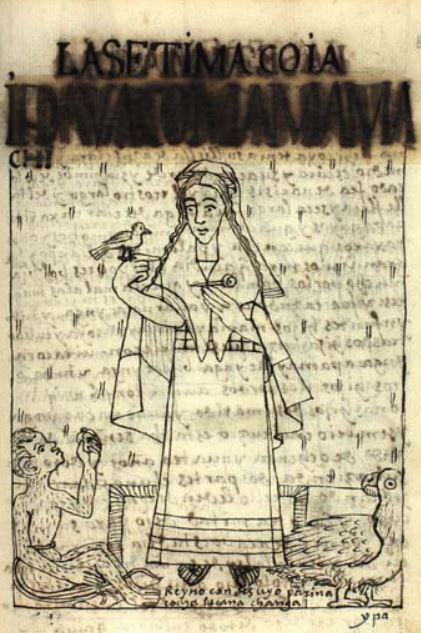
This illustration depicts Ipa Huaco Mama Machi, the seventh Coya [Queen] to the Inca kings. She was married to Yahuar Huacac Inca. She is depicted standing in the centre of the image holding a small bird on her right hand. There is a larger bird at the bottom right hand corner of the image. The author explains that this queen raised birds such as macaws and parrots, which is why there are birds in this image. There is also a small child in the bottom left hand corner of the image, which is one of her many children. The words Reyno conde suyo parinacocha lucana changa which translates to He reigned to Condesuyos, Parinacochas, Lacuna, Changa. This is referring to her and her husband who ruled these regions.
El Cid is standing in front of the count Lozano both have tension in their eyes. El Cid is wearing pants with a belt. On his belt is a sheath. Below his tunic he is wearing chainmail. He has short hair. He is positioned as if he is going to unsheathe his sword. The count is wearing much more clothing than El Cid, they are more lavish ones as well. He has his hand on his sword, which is still in his sheath attached to his belt. He is wearing a long tunic with designs at the end of it. He is also wearing a headdress. In the background there are buildings with windows.
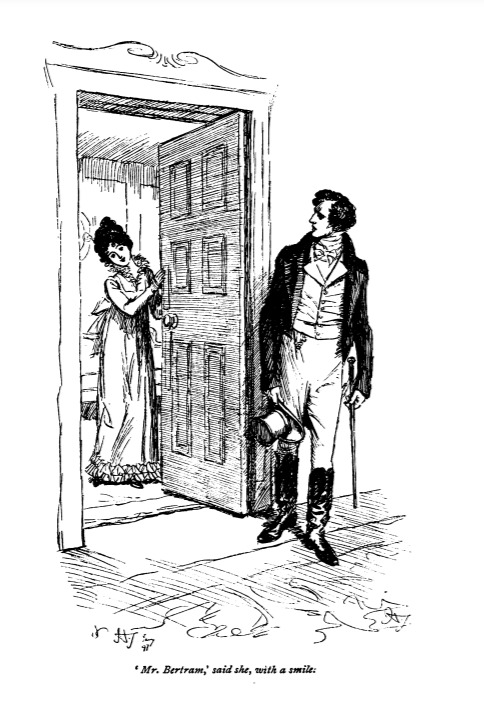
In this image Miss Crawford looks out the door at Edmund after he visited her in London. He went to visit her after hearing about the scandal between Mr. Crawford and Mary. Miss Crawford only seemed to show regret that the two had been caught, rather than renounce their behaviour. She also said that the scandal was Fanny’s fault because she refused to marry Mr. Crawford and so he felt the need to be satisfied elsewhere and turned to Maria with whom he had been flirting while at Mansfield. This upset Edmund, believing it to show her true colours. As he left, she stopped him, calling his name, smiling at him, trying to subdue him in a manner ill suited to the conversation that had passed. This scene occurs in chapter 47. The characters are shown in the traditional regency style. Miss Crawford wears a regency style dress with an empire waistline Edmund wears a waistcoat, and tailcoat, with breeches. In his hand he holds a top hat and a walking cane. The regency period dated to the early nineteenth century (1811-1820) when George, Prince of Wales, later George IV (r. 1820-1830), reigned as regent for his mentally ill father, King George III (r. 1760-1820). The regency period is associated with the rise of neoclassicism in art and fashion.
Pauline, the maid, stands in the kitchen looking at her lover, Regulus Van Cutsum. He is sitting on the table, drinking a flagon of beer, and still dressed in the military uniform from the battle which he was ordered by his colonel to flee, though he tells the tale as though he were the only survivor.
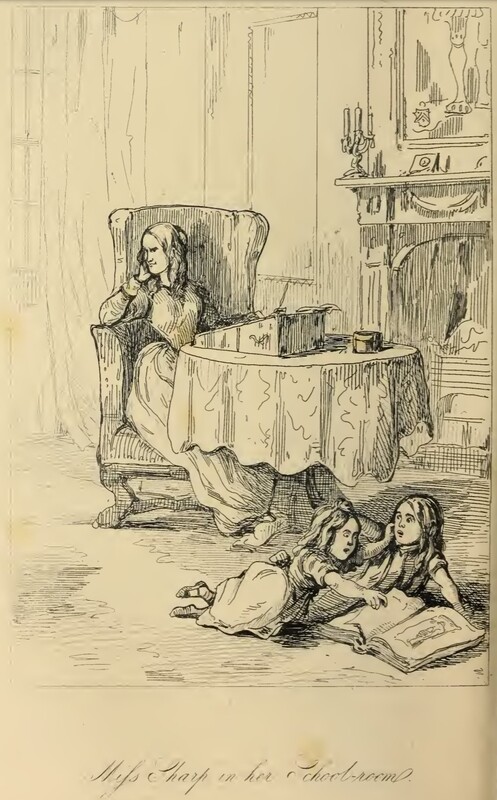
Rebecca Sharp sits in an armchair at a round table with her back to the window, looking irritated. Her table holds a writing desk and round dish. It is next to an ornate fireplace, on the mantle of which are a candelabra and clock, and above which hangs a painting. On the far side of the table Rosalind and Violet Crawley are on the floor, fighting over a very large open book. Violet is pulling on a page from the book and pushing her sister away, while Rose has grabbed her sister by the hair and looks somewhat shocked. Below the illustration is printed in cursive its title, Miss Sharp in her School-room.
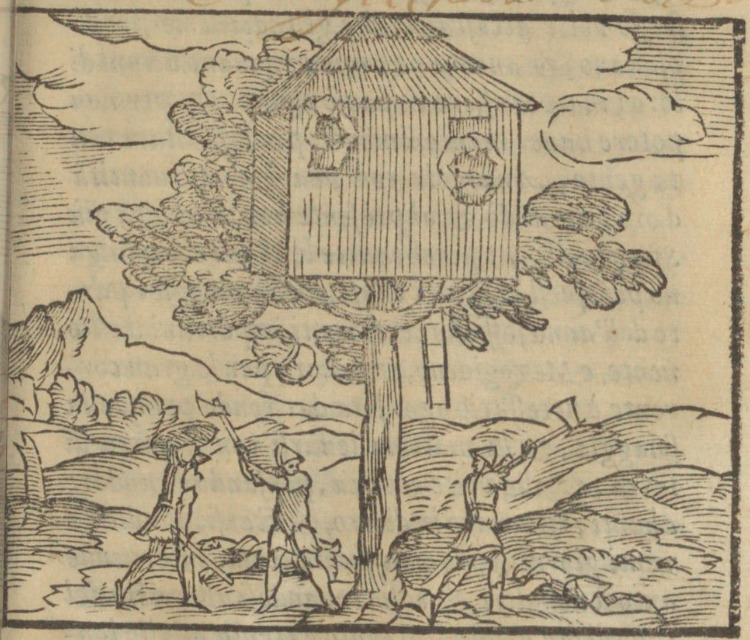
A wooden treehouse with a thatched roof built by Indigenous people sits high in a tree. Two Spanish colonists use axes to chop down the tree while another watches from the side with a shield held over his head. In the treehouse, two Indigenous inhabitants drop rocks and pots of boiling water onto the Spaniards and at least one has found their mark - a Spanish man lays immobile on the ground to the right. This image is identical to one found on page 160 of Venice, 1565.
Elicia (presumably the leftmost figure, seeing as veils indicate mourning dress) walks to Areusa’s house to tell her about the deaths of Celestina, Sempronio, and Pármeno. As she approaches, Elicia hears Areusa (central figure) wailing within and infers that she must have already heard the bad news. She then hears another voice and realizes that Areusa is arguing with someone (Centurio, rightmost figure). In a fit of rage, Areusa forces Centurio out of her house. Once he leaves, Elicia enters and informs Areusa of the tragedy. They blame the deaths on Calisto’s love for Melibea and set their sights on revenge. They resolve to seek the aid of Centurio in murdering Calisto.
In this image we see Gulliver’s telescope and glasses lying on a tablet. All of which are lying on a sheet. The image comes at the end of the second chapter. The same image appears in the 1843 Krabbe edition.
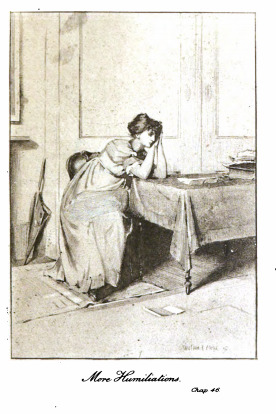
Here we see Georgiana Darcy, Mr. Darcy’s sister, sitting at a table in their home, Pemberley. Georgiana looks embarrassed, as she was reminded of when she was going to marry Mr. Wickham. She believed she loved Wickham, but he only wanted to marry her to get to Mr. Darcy’s wealth. Wickham felt he was entitled to Darcy’s wealth, because he was godson to Mr. Darcy’s father, and was left some money in his will. After using all of his inheritance, he wanted to gain more of the family wealth. Caroline Bingley brought up Mr. Wickham to try and embarrass Elizabeth, but it backfired, embarrassing Georgiana instead. Caroline wanted to embarrass Elizabeth because she wanted to marry Mr. Darcy herself. This scene occurred in chapter 45, noted beneath the title of the image. The characters are shown in the traditional regency style, with Georgiana wearing the regency style dress with an empire waist. Her hair is worn tied up, as was tradition for women after their coming out before the queen, signaling her entrance into society. The regency period dated to the early nineteenth century (1811-1820) when George, Prince of Wales, later George IV (r. 1820-1830), reigned as regent for his mentally ill father, King George III (r. 1760-1820). The regency period is associated with the rise of neoclassicism in art and fashion. The same image appears as an insert between pages 88 and 89 for the Dent 1893, 1894, 1895, 1896, and 1897 editions of Pride and Prejudice.
Here we see Gulliver throwing empty wine barrels. Gulliver throws the barrels away and the Lilliputians run in fear. The Lilliputian named Hekinah Degul told Gulliver to throw the barrels. These Lilliputians can be seen at Gulliver’s feet. All around Gulliver we see various ladders and a ramp which the Lilliputians used to climb on Gulliver. Gulliver is still tied up on the shore, with a cityscape in the background. The same image appears in both the 1839 and 1843 Krabbe editions.
In this image Jimena has her arms around El Cid’s neck in embrace. She is wearing a dress, her long dark hair is divided into two braids. El Cid is wearing armour and a helmet. At his waist there is a dagger sheathed. Behind the two there are soldiers on horses with spears and shields in hand and they are all wearing armour.
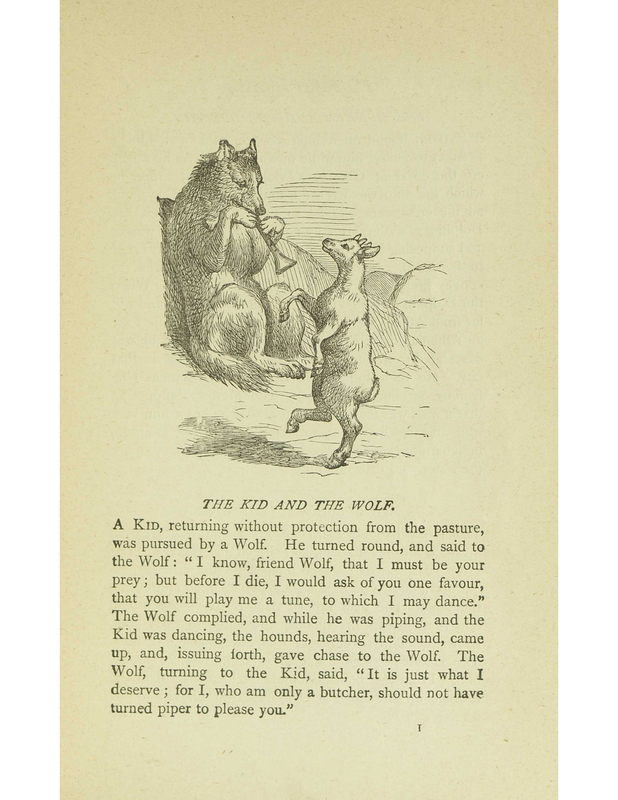
On the left side of the image, a wolf is sitting on its hind legs. It is resting its back against a large rock and is holding a small trumpet with its front paws to his snout. In front of the wolf, a kid is dancing around on its hind legs, its head turned in the direction of the wolf. The kid has a smile-like expression on its face as the wolf plays music and looks at the kid dancing.
A bird is flying over a body of water. In his talons is a mouse that is tethered to a frog. The tether goes around the mouse's neck and around the frogs rear left leg.

![[Listening at the Parlour Door]](https://collections.cemvc.ca/files/large/4ca78c920f1a04f30c7e47d93f91ccd154d1fe6f.jpg)
![[profile of Charles V]](https://collections.cemvc.ca/files/large/2b375066795a1d69209ad9ffddedfb3813797cbd.jpg)
![[Tupinambá people in canoes approach a European ship]](https://collections.cemvc.ca/files/large/c1754442f9e61313fe334f1dfa646baa387b330e.jpg)
![[Gulliver drinks from a trough following games at the general council]](https://collections.cemvc.ca/files/large/195f6fd8838e04a5af625153a068d25c70d82b62.jpg)
![[The Cid fighting the count Lozano]](https://collections.cemvc.ca/files/large/147ad00c0ca246de825d810ab75ef2111dea0788.jpg)

![[Regulus Tells of the Battle]](https://collections.cemvc.ca/files/large/0dc4b84393f5e4593607b3fb58290e41ffdfa7de.jpg)
![[Act XV – Areusa and Elicia Standing Beside Centurio]](https://collections.cemvc.ca/files/large/463477f9502a1a9930c3a1345c1d462bd76c6c3b.jpg)
![[Gulliver’s telescope and glasses]](https://collections.cemvc.ca/files/large/476de867cc5dc6241f7c75363c2b3f6a86ca6ab3.jpg)
![[Gulliver throws empty barrels]](https://collections.cemvc.ca/files/large/a5ab6d4c162f867518a129214f00b7c030192fde.jpg)

![[Jimena in the arms of El Cid]](https://collections.cemvc.ca/files/large/2a58a740226fb4e913ce4ae94520b6a3141b7c39.jpg)
![[Bird Grasping a Mouse Tethered to a Frog]](https://collections.cemvc.ca/files/large/18ebfbfcdc63fb4f6b32b264b39f9df4160c5dad.jpg)