A group of Indigenous Brazilians engage in cannibalism. A man on the right uses a hatchet to dismember a human body. Several limbs and torsos lie scattered on the ground around the group. A wooden frame has been erected over a fire, and an arm sits on the frame to roast over the fire. There is a structure on the right, and a dismembered head mounted on a long pole sticks out the window. This image is identical to one found in Frankfurt, 1557.
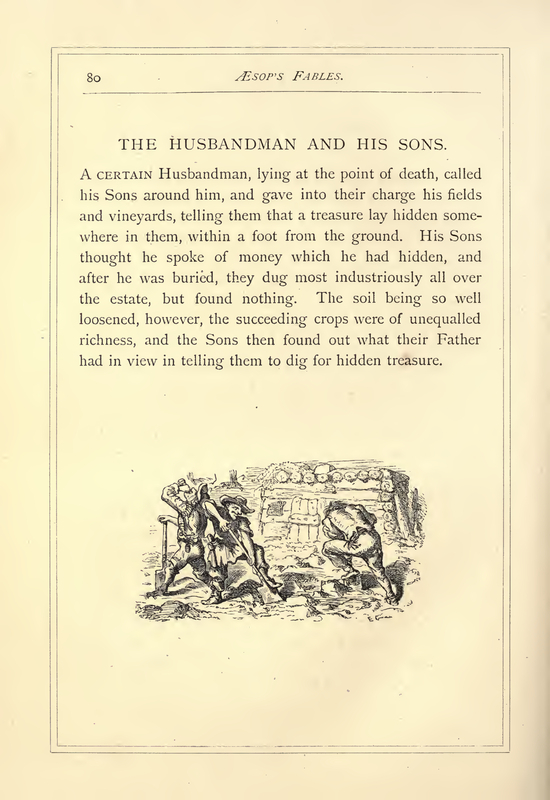
Three men are working in a field. The one on the far left is resting his foot on his shovel that is deep in the ground and is drinking from a small bottle. The man in the middle is digging into the dirt, its left foot on the shovel as he holds the shovel with both hands. The man to the right is facing with his back to the reader, pressing down on his shovel with his left foot and putting all his upper body weight onto it. In the background, a round-wood cabin lined with logs of wood is there.
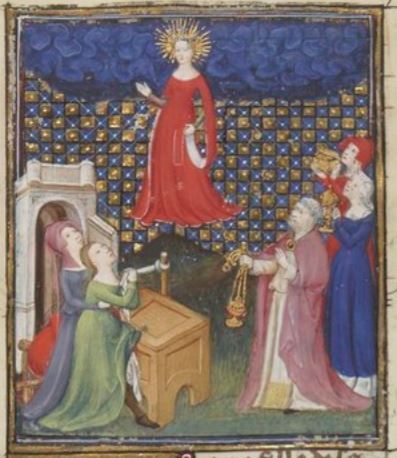
This illuminated image depicts a statue of the goddess Juno being worshipped by the citizens of Samos. She is illustrated wearing a red dress and a large crown as she is elevated in the sky. The people on the ground are depicted looking up to her. Boccaccio explains that Juno was sent to live in Samos during her early childhood years until she entered puberty and married her brother Jupiter. The people of Samos erected the statues of Juno to honour their connection to the goddess.
This image is illustrated in a chapter that discusses the descendants of the Inca and Andean nobles under Spanish colonial rule in Peru and their importance to a revived Andean society. This image depicts a cicaque [native lord] standing on the left side of the image taking his hat off to greet the Spanish corregidor [magistrate] on the right side of the image. There is a native commoner kneeling on the ground while looking up at the corregidor as he holds out his tribute (which appears to be a bad of money or food). There is dialogue written on the page which reads, cayllata senor corregidor ricuchicomuyqui chasquipullauay [Lord magistrate, I’ve come to give you these things, please receive it]. The corregidor replies, por que no trays buenas gallinas y capones y carneros a buestro corregidor, bos me lo pagarés por éstas [Why don’t you instead bring me good chickens, capons, and llamas?].
Here we see a lamp with a tall base. In the background we see a neoclassical building with a large dome. This image appears at the beginning of the eleventh chapter, in which Gulliver returns home to England. This architectural style was popular in England in the eighteenth century, thus reminiscent of Gulliver’s return home. The lamp represents Japan, where Gulliver traveled from Luggnag, and was able to return home. The same image appears in the 1843 Krabbe edition.
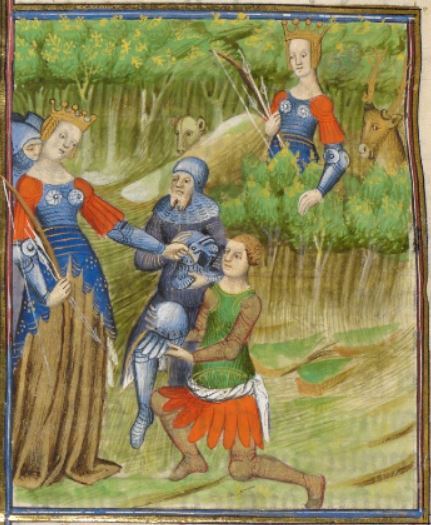
This image depicts Zenobia, queen of the Palmyrians, walking through the forest as she hunts with her bow and arrow. She is depicted in the foreground wearing armour and reaching out towards a servant who is carrying her helmet. She is also wearing a crown to demonstrate her royal status. Zenobia was known to have abandoned womanly duties and activities to pursue hunting and more physical activities. Boccaccio explains that she was known to hunt and capture ferocious animals such as bears, leopards, and lions. Zenobia is depicted walking through the trees in the background of the engraving with a bear to the left of her and another animal (what appears to be a horse) to the right.
In this image we are shown the scale of all the animals on Lilliput next to Gulliver’s ruler which measures twelve inches. The average Lilliputian man measures six inches tall. The scale includes a human, cow, horse, goat, ram, sheep, dog, monkey, cat, fox, rabbit, mouse, rooster, owl, parrot, parakeet, dove, swan, duck, toucan, turtle, lizard, frog, snake, fish, butterfly, moth, and several other types of insects. The purpose of the image is to demonstrate that the animals on Lilliput are roughly the same scale to the human as is true in the real world. Due to this scale we are also led to believe that the same animals exist on Lilliput as do in reality, simply on a smaller scale, and thus they likely have the same roles and utilities. This contrasts to some animals in the other lands visited by Gulliver later in the story where the animals are more highly fictionalized. The same image appears in the 1839 Krabbe edition.
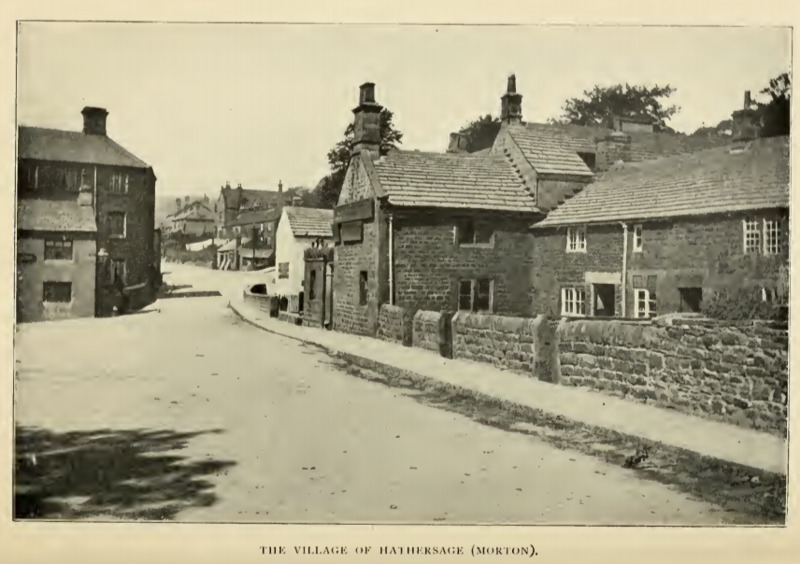
Here we see an image of a street in Hathersage, a village in Derbyshire. After running away from Thornfield after ending her engagement to Mr. Rochester she ended up in Morton, which was based on the real village of Hathersage. The same image appears in the 1899 Bigelow, Brown, and Co edition of Jane Eyre.
In Luggnagg there is a small population of immortal people. These people are born with a red spot on their forehead, and this spot changes colour over time. This spot is represented by the peacock because of its colours. There is a L on the peacock’s chest because this image appears at the beginning of chapter ten and the L is the first letter of the chapter. The same image appears in the 1839 Krabbe edition.
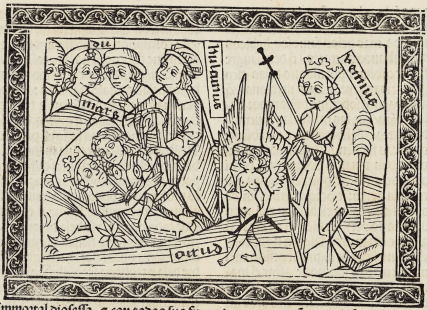
The goddess Venus is depicted on the right-hand side of the engraving wearing a crown and holding a long staff in her left hand. We can identify this figure as Venus as her name is engraved directly beside her. Her son, Cupid, is depicted walking alongside her with his bow and arrows in hand and his wings erected in the air. His name is engraved by his feet. The left-hand side of the engraving also depicts Venus as she commits adultery with her half-brother, Mars. Mars’ name is engraved just above Venus’ head. Boccaccio explains that Venus’ husband, Vulcan, had walked in on the adulterous crime, which is what the engraving is illustrating. Vulcan’s name is engraved behind him as Vulcanus. There are unidentified figures in the background of the engraving in the top left-hand corner. Boccaccio explains that Venus was highly adored in Cyprus as well as Rome, and he chose to write on her for her beauty. He criticizes her highly due to her invention of brothels.
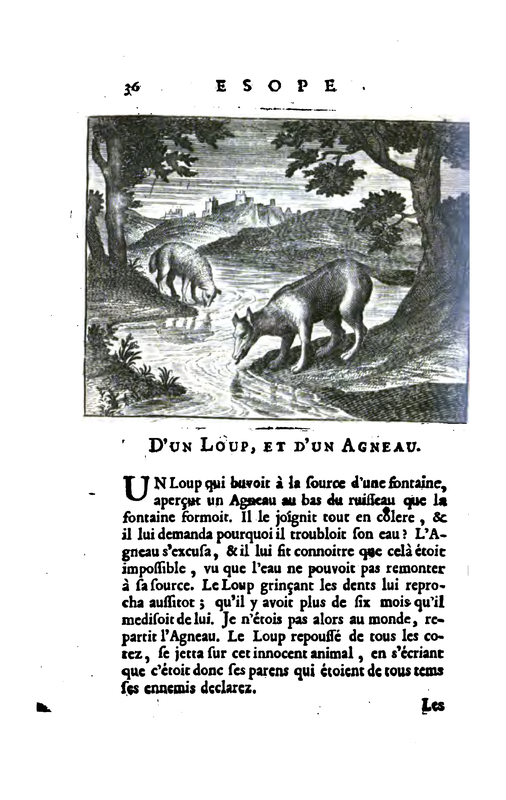
There is a wolf drinking water from a river flowing through the village. A few steps behind the wolf there is a lamb drinking water from the same river. In the vast distance there is a castle on a mountain. There are trees on both sides of the river. The origin and the end of the river is unknown in this image.
Lady Rose Crawley, who looks worn down, enters the dining room on the arm of her stepson, Mr. Pitt Crawley. To the right of the picture, Sir Pitt Crawley stands behind the door, holding a jug in one hand. To the left side, through the open door, Rebecca Sharp can be seen talking to one of the Crawley daughters.
Here we see a human grooming a horse in a stable. The Houyhnhnms asks about the horses in Europe and how they live. Gulliver explains that humans or yahoos govern the country and care for the horses or Houyhnhnms, including brushing the horse. The same image appears in the 1839 Krabbe edition.
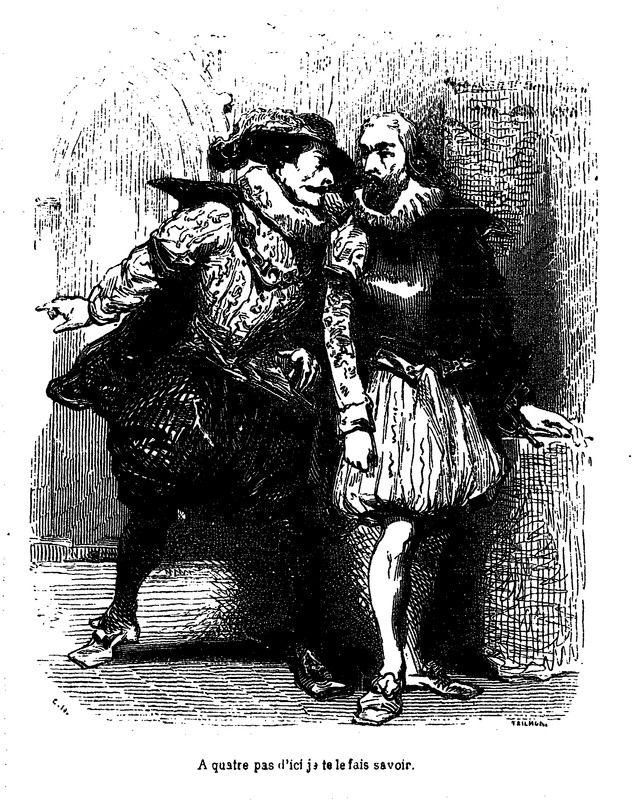
Rodrigue confronts the Count over the grievance the Count has done to Rodrigue’s father. He challenges him to a duel, which we later learn he wins. Rodrigue is seen on the left, pointing, while the Count stands on the right.
A small Tupinambá Indigenous village is shown. There is a fence around the village, and four long structures. At the center of the village a man stands, his legs are tied together. Facing him is an Indigenous man wearing a feathered headdress and a large feathered garment on his backside. The Indigenous man is pointing at the captive man. Several other Indigenous people in the village gaze towards the captive man. Beside a gap in the fence in the lower left of the fence there are three long poles with skulls mounted on top of them.
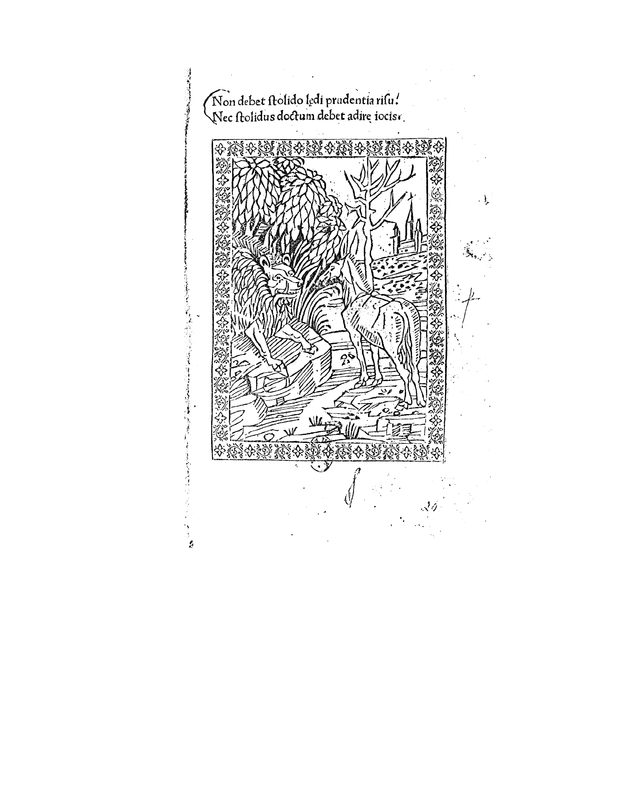
On the right side of the image there is an ass standing looking at a seemingly agitated boar who is on the left side of the image elevated on a rocky platform.
This illumination depicts a portrait of Sophonisba, the queen of Numidia. She is illustrated wearing a crown and holding a scepter in her left hand to signify her royal status. Sophonisba is famous for her death, as she willingly drank a poison given to her by her husband to avoid dying at the hands of her enemies, the Romans.
A pig and a fox are in a field. The pig lies down on the ground to the left of the image, and the fox stands to the right of the image. The fox is sniffing the pig’s back. Two tree’s stand tall in the background.
A fox is standing on a pile of bricks peering at a goat below in a water well. The goat is staring back. There is a house in the distance. A huge tree sits behind the fox. There are some plants growing out of the bricks at the bottom edge.
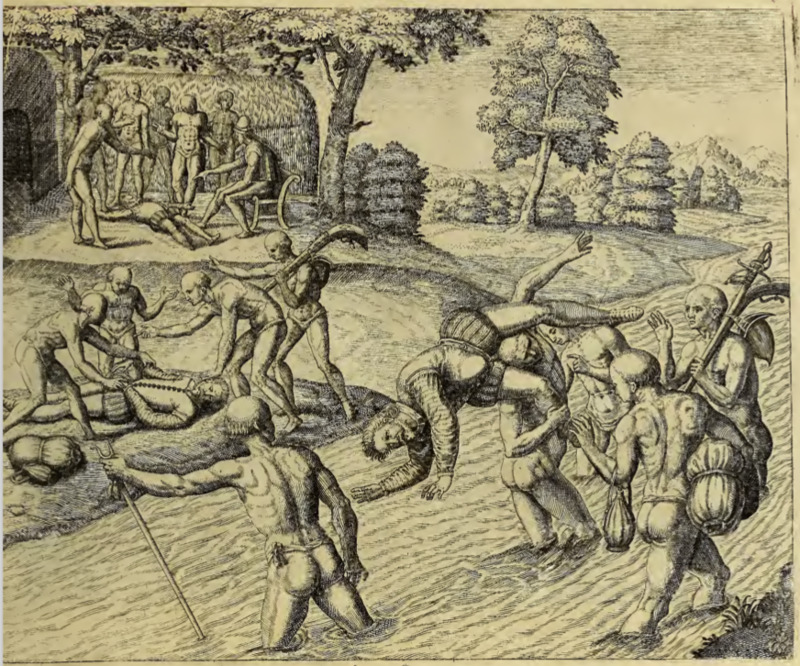
A group of Indigenous men stand knee-deep in a river. One of the men carries a Spanish man over his shoulders and throws him into the water. Another of the men holds the musket and helmet of the Spaniard. On the far bank, four Indigenous men are now gathered around the Spanish man who lies on the ground, deceased. In the background there are two structures. The group of Indigenous men stands in front of them, gesturing at the deceased Spanish man who lies on the ground at their feet.
In this image, the central figures are four Lilliputian Cavaliers who are practicing underneath an archway attached to the royal palace. The cavaliers are skirmishing, with some of the horses rearing. The riders are wearing plumed hats. We see Gulliver’s legs in the background. We see another Lilliputian watching from a window in the background. The same image appears in the 1843 Krabbe edition.
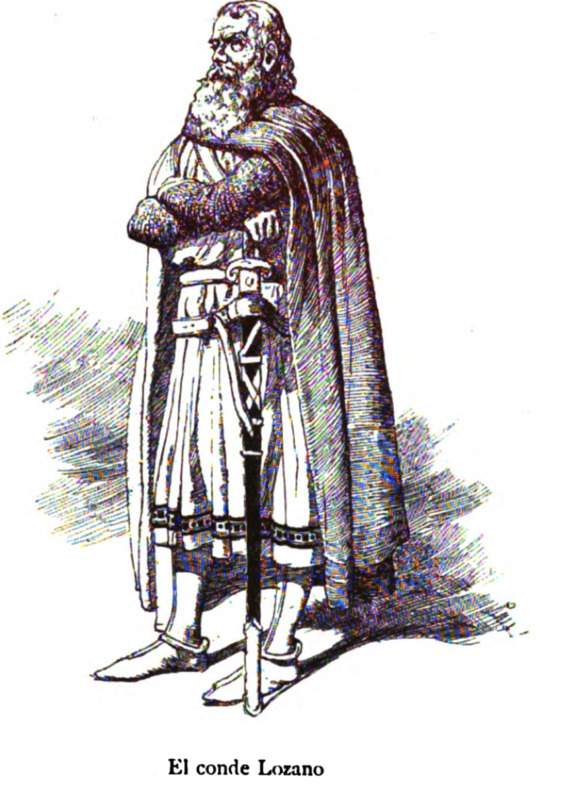
The image is of the count Lozano. He is standing with his arms crossed against his chest; he has a long beard and hair. He is wearing robes with a cape and a belt at his waist. On his belt is a sheath where the tip of the sword is visible. He is also wearing pointed shoes.

![[Vanity Fair Vol. II Chapter XXXVII Inhabited Initial]](https://collections.cemvc.ca/files/large/af01aed88e9c3087986ba1f4eaa406117dad83f0.jpg)
![[Cannibalism amongst Indigenous Brazilians]](https://collections.cemvc.ca/files/large/c131ef36a9870afe40e490fddac0da267ac5f9aa.jpg)
![Q[ve] Lleva de Presentes el Cacique Principal al Dicho Corregidor y no le Agradese en Este Rreyno](https://collections.cemvc.ca/files/large/89bc178ced2a130410cd1a9a2cbb8ce103878dd6.jpg)
![[a lamp in front of a neoclassical building]](https://collections.cemvc.ca/files/large/deb4aeacfcc93b69d2159d1d3b51d1317b47b3da.jpg)
![[The scale of humans and animals on Lilliput]](https://collections.cemvc.ca/files/large/f77902b9d99947434b3cfcbcb6e398ec53536328.jpg)
![[A peacock representing the immortals of Luggnagg]](https://collections.cemvc.ca/files/large/9bbe28d3d5c4425aee61b544f1d39ab78e725124.jpg)
![[Lady Rose Crawley and Mr. Pitt Crawley]](https://collections.cemvc.ca/files/large/1feeb9c9b41a2e8a41a4e186694376fe33a33864.jpg)
![[a human grooms a horse]](https://collections.cemvc.ca/files/large/2f77fcfa800390d94faff25d87cfe542670e260a.jpg)
![[A European man is held hostage in a Tupinambá village]](https://collections.cemvc.ca/files/large/579aec000008e6602f568dc6098206085eff4108.jpg)

![[The Pig and the Fox]](https://collections.cemvc.ca/files/large/33fbf836b689baa41cbf48bf12280238b0c2c12a.jpg)
![[The Fox and the Goat]](https://collections.cemvc.ca/files/large/94eb90c0c5e47fcb80a654607d691a60931dc277.jpg)
![[Lilliputian cavaliers practice while Gulliver watches]](https://collections.cemvc.ca/files/large/58ca2bf6114dc5bcaf780fda873977e2d2d14b45.jpg)