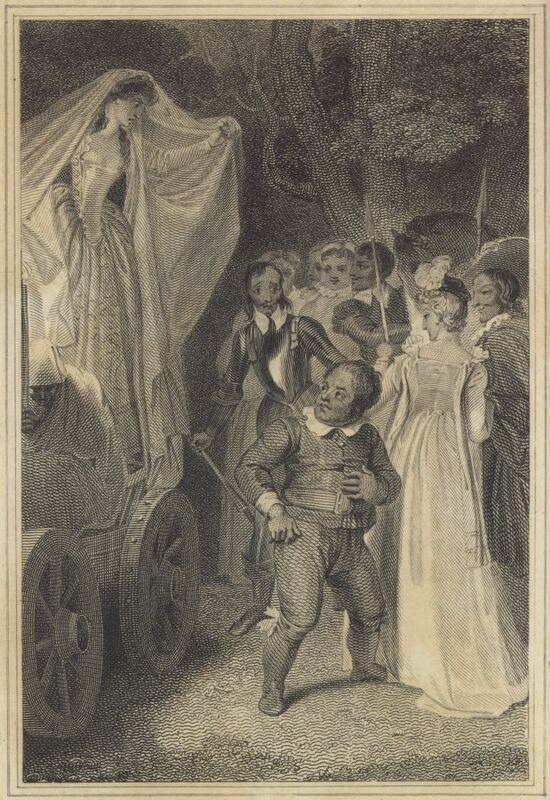
The enchanted Dulcinea (a page disguised) removes her veil and reproaches Sancho Panza for not wanting to whip himself to disenchant her. In the background, Don Quixote, the duke, and the duchess are pictured. Signed by T. Stothard (illustrator) and C. Armstrong (engraver). Part 2, ch. 35.
Sancho Panza (left) falls to his knees to beg a little milk of some shepherds who were milking their ewe, a wooden bowl in his hand to keep the milk. In the middle, behind the ewe, a shepherd holds a wooden bowl in either hand to hold milk in, meanwhile, on the right a hatless shepherd grabs the ewe's hind leg and milks the creature, filling his wooden bowl with the lactose.
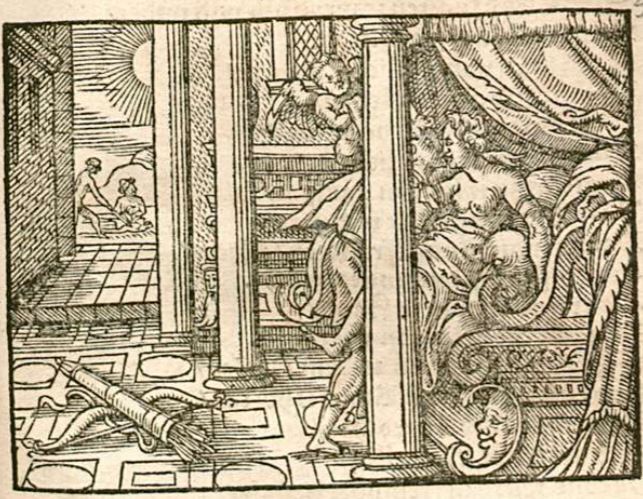
This engraving illustrates the sun god, Phoebus, having sexual intercourse with Leucothoë, the daughter of Orchamus, king of Assyria. The goddess Venus had cursed Phoebus to fall madly in love with Leucothoë as a punishment for humiliating her. Phoebus had disguised himself as Leucothoë’s mother and commanded the slaves to leave the room. The slaves are illustrated in the background of the engraving through a doorway. Once the god was alone with Leucothoë, he showed her his true godly form and proceeded to have sex with her. Phoebus’ is the also the god of archery and his bow and arrows are depicted lying on the ground on the left side of the engraving. Leucothoë is depicted lying on her bed topless with Phoebus kissing her. The god is difficult to see in the image as he is directly behind a column. Leucothoë’s father had her buried alive after her encounter with Phoebus. She subsequently transformed into an incense plant while underground.
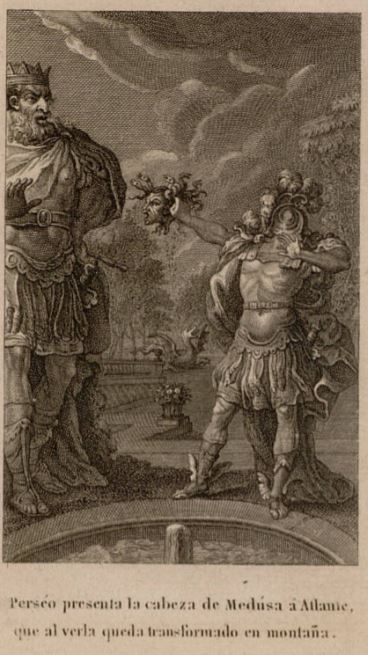
This image depicts the demi-god Perseus on the right side of the image presenting the head of Medusa to Atlas, who is standing on the left side of the image. Perseus is holding out Medusa’s head with his right arm and he uses his left arm to shield his own face away to avoid looking into Medusa’s eyes. Atlas is depicted holding out his hands and has a shocked expression on his face. When people look into Medusa’s eyes they turn to stone, however, Atlas is so large and strong that when he looks at Medusa’s head he turns into a mountain. Years ago, Atlas was given a prophecy that predicted a man born of Zeus would steal the apples off his trees, so in order to protect them from Perseus, he erected a high wall made of stone and forced a serpent to guard the entrance to the orchard. The serpent is illustrated in the background of the image.
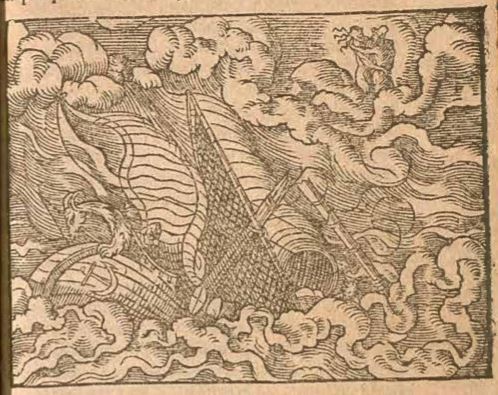
This engraving illustrates a horrible storm that engulfed the ship of Ceyx and his crewmembers. Ceyx, the king of Thessaly, left his native land to seek out the Oracle at Claros. His wife, Alcyone, had begged him not to travel by sea as she knew there were dangers associated with naval travel. He went, despite her warnings, and found himself amidst a terrible storm. King Ceyx can be vaguely seen behind the figurehead at the bow of the ship. King Ceyx continued to call out the name of his wife as the ship was being destroyed. King Ceyx and Alcyone are illustrated at the top-right hand corner of the engraving in clouds in an embrace. Ceyx dies in this shipwreck.
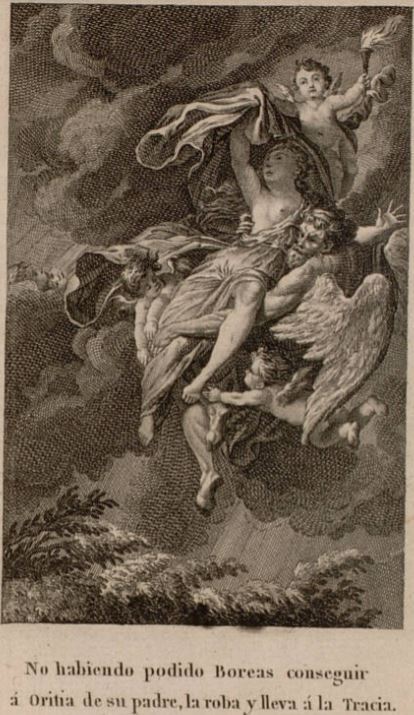
Boreas, the personification of the North wind, had fallen madly in love with Orithyia, a princess of Athens. He had attempted to impress her, but she showed no interest in him. Violence and force felt more natural to Boreas, so he abducted her and took her to Thrace. Boreas is depicted with large wings, and he is surrounded by small, winged cherubs. Orithyia is depicted with her hands in the air as she tries to escape Boreas’ clutch. He flies away with her and they end up having four children together.
Don Quixote (left in the background), clad in armor with a lance and shield by his side, mounted upon Rocinante, chases after the cart of players that have wronged him and his squire, yelling out at them for their treachery. Hearing these cries, the players jump out of their cart, every one from the angel to he who was dressed as death, and cupid, and the devil, all of them taking up stones and preparing themselves for battle, waiting to receive Don Quixote.
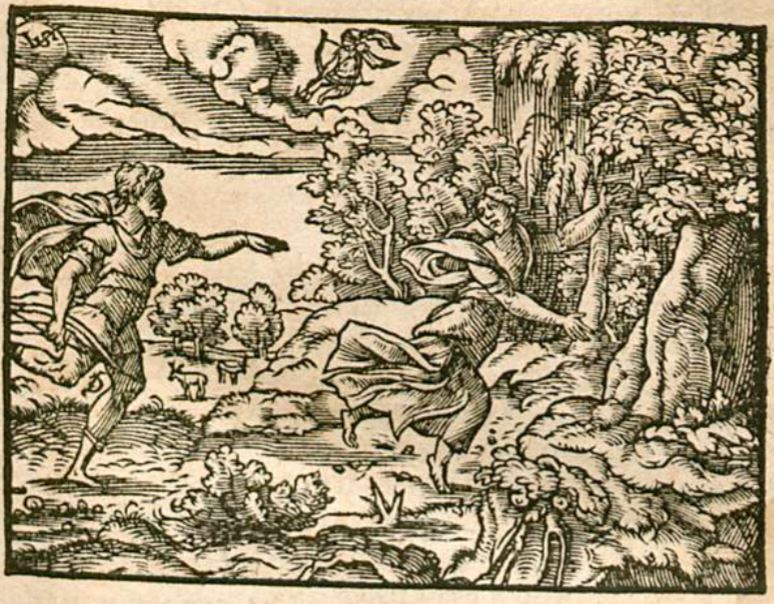
This engraving illustrates Phoebus, the archer god, on the left side of the image with his bow in his right hand. Daphne, the daughter of Peneus, is depicted running away from Phoebus. Cupid is depicted in the sky with his bow and arrow in hand, flying above Phoebus and Daphne. Phoebus had just offended Cupid by saying that he himself is the only one who should be using a bow and arrow as he had just slain a fearsome serpent. Cupid, angered by this insult, had shot Phoebus with an arrow infused with love and obsession for Daphne. Daphne, however, was shot with an arrow that dispels any type of love for Phoebus. This image illustrated the unrequited love that Phoebus has for Daphne.
Don Quixote (right), removes a page from a pocketbook and reads it while mounted atop Rocinante who is grazing on a nearby bush. To read the paper, Quixote couches his lance against his shoulder and slings his shield over his back. Beneath Quixote, Sancho Panza empties a portmanteau of its linen. To the left of Sancho stands Dapple, his donkey. In the goreground on the right rests a saddle.
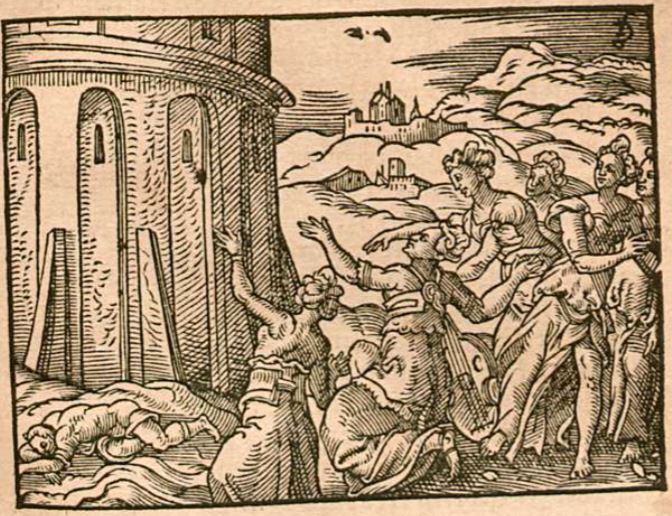
This engraving illustrates the Muses who have just witnessed the death of King Pyreneus of Thrace, who is depicted on the ground on the left side of the image. King Pyreneus had invited the Muses inside his palace during a rainstorm, but once the rain had subsided, the king would not allow the Muses to leave. The Muses took to their wings and flew out of the palace in order to escape. Pyreneus fell to his death as he threw himself off the highest summit to fly after the Muses. There is a group of people standing at the base of the tower that King Pyreneus had just fallen from. They appear to be upset as they hold their arms up in mourning.
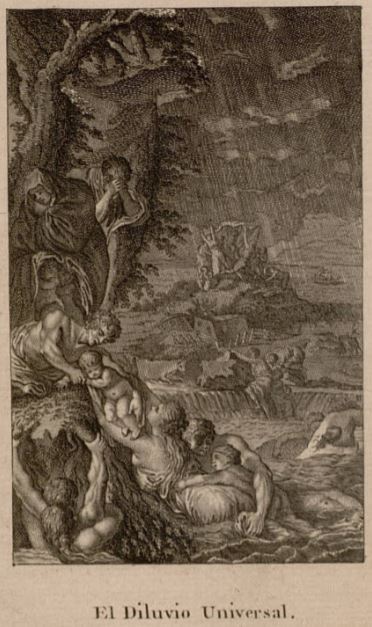
The god Jupiter had become angry with the humans on earth as they had become violent and destructive, so he decided to destroy them. He did not want to use his thunder bolts as he did not want to risk burning the heavens. Jupiter decides instead to send a flood to rid the world of humankind. This image depicts the flood sent by Jupiter. There are people on the left side of the image trying to climb trees to avoid the rising water and to and rescue their children. There are also people illustrated in the background trying to get out of the water.
In the city of Seville, a man with a hollow cane, pointed at one end, let's go of a dog, having applied the pointed end of the cane to the dog's posteriors, tried to blow it up as round as a ball. Having slapped the inflated body of the dog, he let him go, saying to the numerous surprised bystanders: “ Well, gentlemen, I suppose you thinkit an easy matter to blow up a dog?” Two children on the right follow the bloated dog, one boy with his hands in the air, and a young girl reaching towards the dog. Meanwhile, the onlookers on the left consist of a bearded man with a feathered cap, a woman asking the man with the hollow cane why he would commit such an act, and a child by her side.
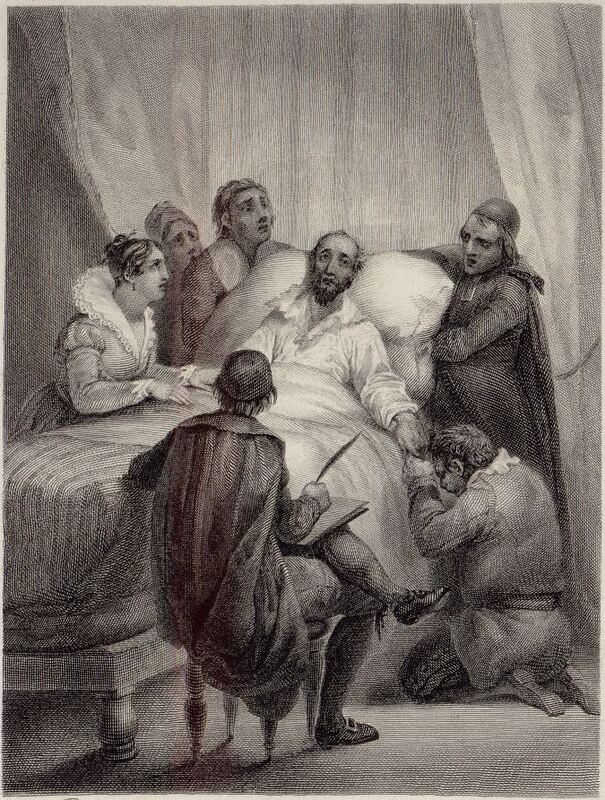
On his deathbed, Don Quixote becomes Alonso Quijana again. He is surrounded by Sancho Panza, Sansón Carrasco, the housekeeper, the priest, the niece, the barber, and the notary (sitting, with his back to the viewer). Sancho is pictured kneeling and holding Don Quixote’s hand. Signed by E. Vernet (illustrator) and A. Burdet (engraver). Part 2, ch. 74.
Don Quixote (left) clad in full armor, rides atop Rocinante (his sickly horse) with the reigns and a lance couched in his right hand, a sword is sheathed on his left hip, he turns his body to his left to listen to his Squire. Sancho Panza rides just behind his master on Dapple (his donkey), gesticulating with his right hand and holding both the reigns for his donkey and a sharp stick in his left hand, he appears to be discussing some topic with Quixote. In the background on the left two windmills can be seen in the distance.
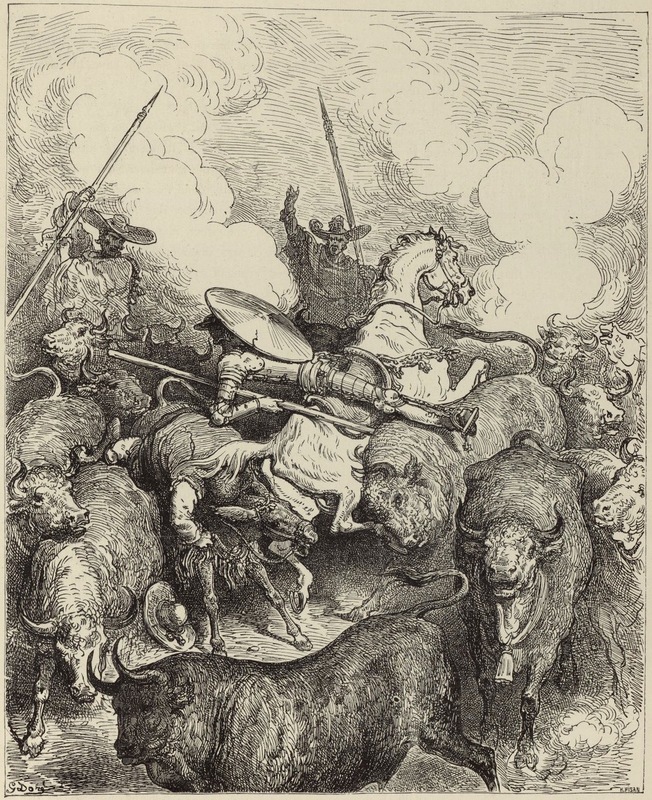
Don Quixote, Sancho Panza, and Rocinante are trampled by a herd of bulls. In the background, the herders are pictured. Signed by G. Doré (illustrator) and H.-J. Pisan (engraver). Part 2, ch. 58.
Sancho moves around the room with stealthy steps, allowing only the balls of his feet to touch the ground. His body is bent, and his finger on his lips. The image is occasioned by the duchess asking Sancho to speak freely, and the squire, not wanting to be overheard by his master, looks for any signs of any who would overhear him and bring him trouble.
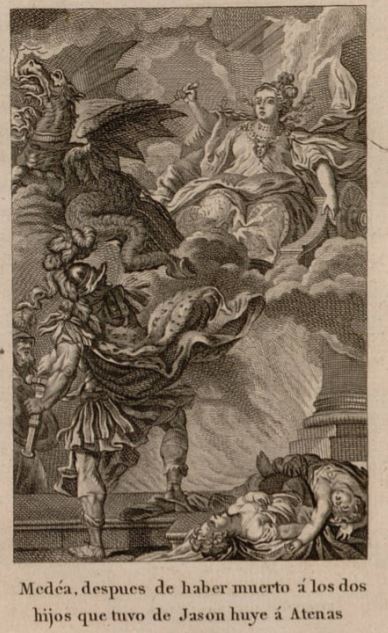
This image depicts Medea fleeing after having killed her children. Medea had learned that her husband Jason had fallen in love with another woman and married her. Angered by this betrayal, Medea murdered her and Jason’s two children, who are depicted at the bottom right corner of the image. She also set fire to Corinth to kill Jason’s new wife. There are flames and smoke in the image to depict the fire she had started. Jason, angered by Medea’s actions, is illustrated on the ground drawing his sword out to kill Medea. Medea, however, flees to Athens on a golden chariot led by dragons.
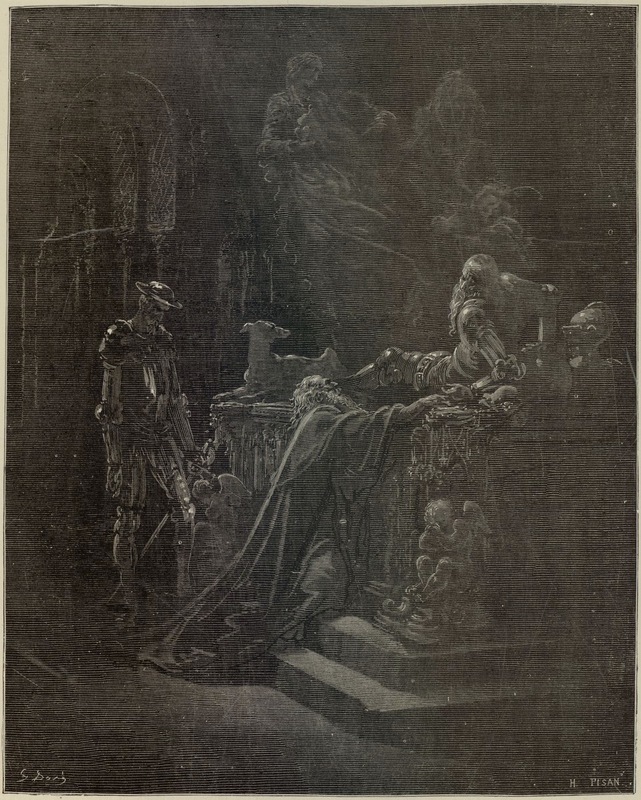
The illustration depicts one of Don Quixote’s visions in Montesinos’ cave: Don Quixote watches Montesinos talking to Durandarte, who lies on his tomb. Montesinos confirms to Durandarte that, according to his will, he has taken his heart to Belerma (represented as a flying ghost holding Durandarte’s heart). Signed by G. Doré (illustrator) and H.-J. Pisan (engraver). Part 2, ch. 23.
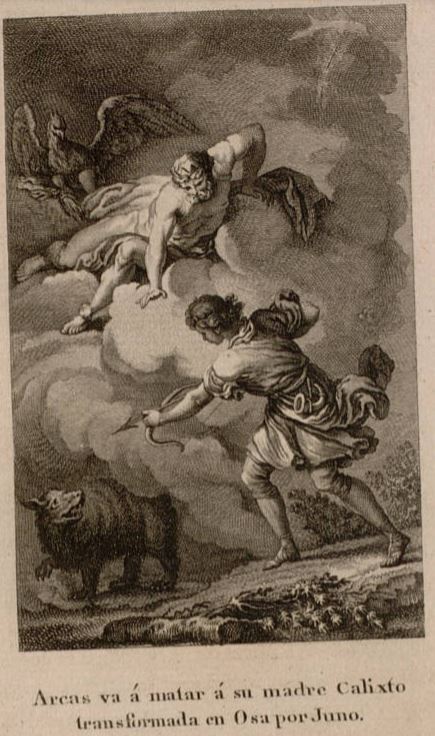
A nymph named Callisto had been raped by Jupiter and became pregnant and had a son named Arcas as a result. Jealous that her husband had gotten a woman pregnant, Juno exacted her revenge on Callisto by transforming her into a bear. Callisto’s son, Arcas, was hunting one day and came across his mother (unbeknownst to him) in the form of the bear. Arcas is illustrated pointing his bow and arrow at his mother who has a terrified expression on her face. Jupiter steps in to save Callisto by also transforming Arcas into a bear. Jupiter is pictured above Arcas and his mother hovering on a bed of clouds with his hand reached outwards to stop Arcas. There is an eagle depicted behind Jupiter as he is known for transforming himself into eagles.
This engraving illustrates the gods Apollo and Neptune in human form on the left-hand side of the engraving with tools in their hands. There are big stones at their feet as they help build the walls of the soon-to-be city, Troy. The trident of Neptune and the lyre of Apollo sit on the stones to indicate that they are in fact gods. There is a man illustrated on the right-hand corner facing the two gods. This is King Laomedon, who had promised Apollo and Neptune a sum of gold in return for their help to build the walls of Troy. King Laomedon, however, does not keep his word and fails to provide the gods with their payment. Upset by this, Neptune causes a great flood which destroys the country’s crops. To further the punishment, Neptune orders that King Laomedon’s daughter, Hesione, will be tied to a rock and fed to a sea-monster. Hesione is illustrated in the background of the engraving, tied to the rock whilst being rescued by Hercules.
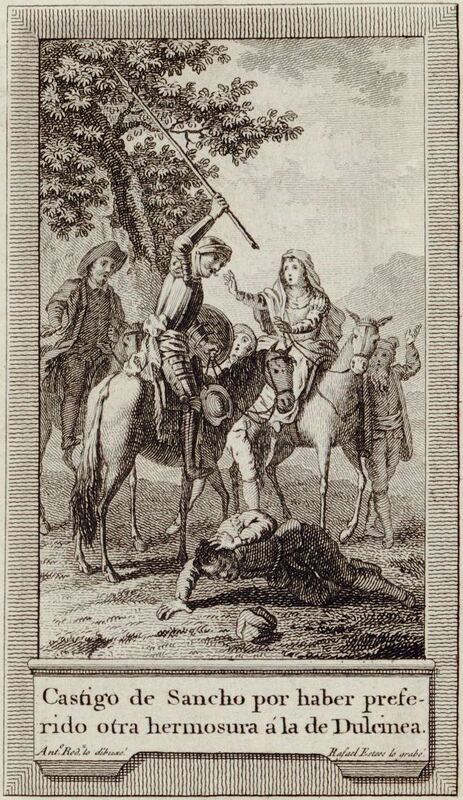
Sancho Panza suggests that Mimicona (Dorotea) is not a genuine princess, provoking Don Quixote. The knight is infuriated and hits him with his lance. Dorotea, who understands Don Quixote’s madness, tries to pacify him by claiming that Sancho Panza saw illusions that offended her good name. Also pictured are the barber (disguised as Dorotea’s page with a fake beard), the priest (on horseback), and Cardenio. Signed by A. Rodríguez (illustrator) and R. Vilella (engraver). Part 1, ch. 30.
Having ridden on Clavileno, Don Quixote (right), clad in armor, and Sancho Panza (left) stand in the garden of the duchess, surrounded by four folks stretched upon the foreground. Visibly in a state of surprise, Quixote and Sancho perceive a great lance sticking in the earth, and a smooth piece of white parchment hanging to it by two green silken strings, which bears an inscription.
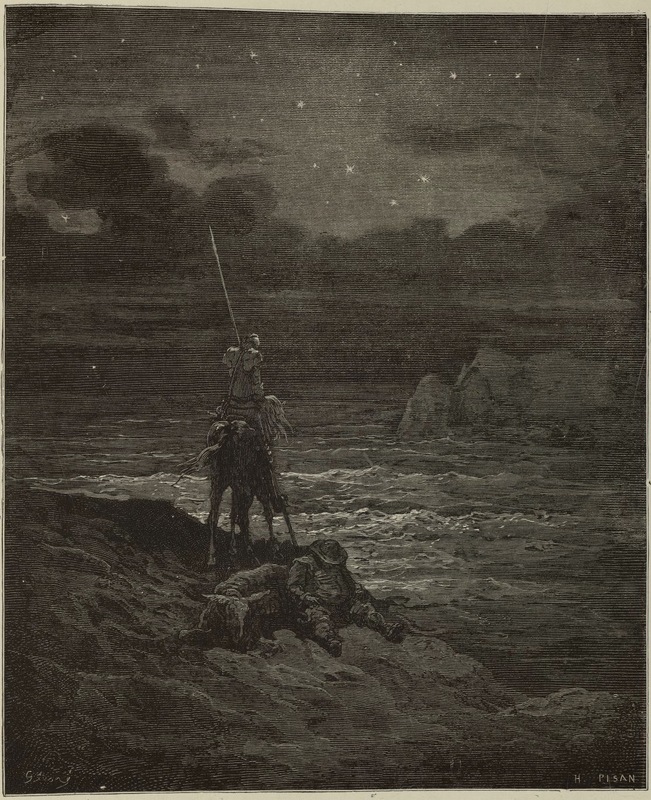
Using abandoned roads, shortcuts, and hidden paths, Don Quixote and Sancho Panza reach the shores of Barcelona on the night of St John’s Eve. They spend the night there, waiting for daybreak. Signed by G. Doré (illustrator) and H.-J. Pisan (engraver). Part 2, ch. 61.
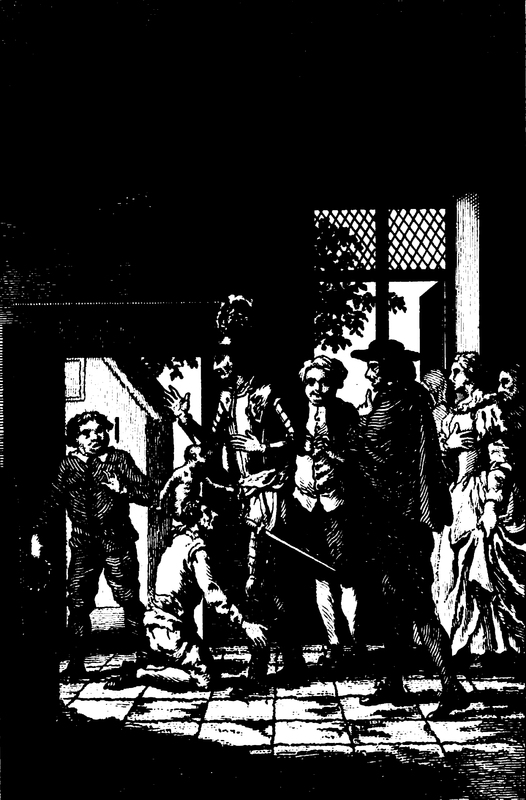
While Don Quixote and Sancho Panza have dinner in an inn, a man, clothed in a doublet, breeches, and shamoy hose comes through the door. The Landlord recognizes the man as master Peter. This master Peter has his left eye and half of his cheek covered by a green patch to hide the fact that he is also the veritable thief Gines De Pasamonte who has interacted with Sancho and Quixote in the past. Master Peter, seeking to keep his identity a secret, is living as a master puppeteer with a fortunetelling ape. He leaves the inn to fetch his puppets and his ape which are being held on a cart. Sancho Panza (pictured on the left surprised by Master Peter's behaviour towards his master) went to ask the monkey about his wife, but the monkey recognized Don Quixote swiftly, returning to its masters shoulder, and Master peter fell to his knees and hugged Quixote's leg, praising Quixote for his chivalrous deeds. Beneath the image is the inscription "Peter declares his ape can all things tell; that are at present, or that have befell; but challenging the knight reveals no more than what unknown to them, he knew before".
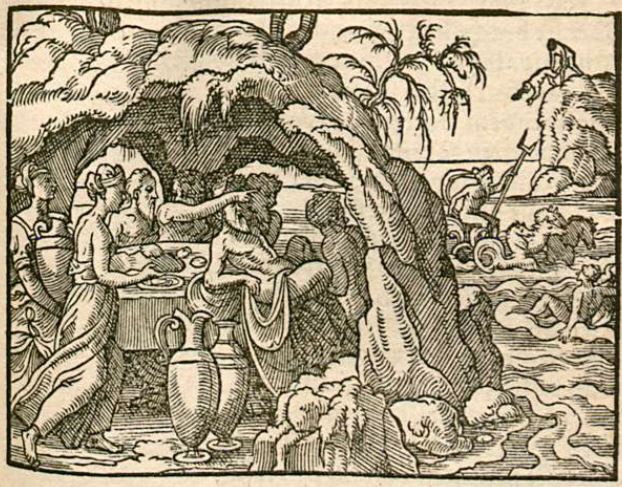
After taking part in the boar hunt in Caledonia, Theseus is being held up at the river Achelous due to its raging currents. The river god, Achelous, urges Theseus to stay with him in the meantime. Achelous is depicted leaning backwards onto a table in the engraving, and Theseus is illustrated with his arm outstretched, pointing to an island in the far distance. Theseus asks about the island and what its story is. Achelous goes on to explain that the island was once a princess named Perimele, and that he had stolen her virginity. When her father found out, he felt dishonored and pushed her off a cliff. This scene is depicted in the background of the engraving. Achelous prayed to Neptune to save her, so he quickly transformed her into the island. Neptune is illustrated emerging from the ocean to signify that he rescues her.

![[Of How Sancho Begged for Some Milk of Some Shepherds]](https://collections.cemvc.ca/files/large/3781d34e9ce892bd6bb1eef6dcc70943f4f92535.jpg)
![[Of How Don Quixote Chased After the Cart of Players]](https://collections.cemvc.ca/files/large/f3dbb8db799bf3c330b3146f1b416b83a10b9a68.jpg)
![[Don Quixote Reads from a Pocketbook Found on the Side of the Road]](https://collections.cemvc.ca/files/large/6169885979e8fede85dbe59dea8cb42622fa7ffa.jpg)
![[A Man Speaks to Onlookers having Flung Around a Dog]](https://collections.cemvc.ca/files/large/c0eafe81d220d5d18596cd8cf3e9cec009f5aeee.jpg)
![[Of How Don Quixote and Sancho Panza Travelled and Discussed Amongst one Another]](https://collections.cemvc.ca/files/large/aa71a8f7bcd655e5c70f240a231cd9aff5a043b5.jpg)
![[Sancho Scopes the Room for Eavesdroppers]](https://collections.cemvc.ca/files/large/29b5c1a3305f50417e8ef5c6466520b26464b285.jpg)
![[Apollo and Neptune Help Build the Walls of Troy]](https://collections.cemvc.ca/files/large/5fc6cfae7241e95b0bcdc2e80ac4106b3b4edafe.jpg)
![[Don Quixote and Sancho Panza Arrive in the Land of the Giant Malambruno]](https://collections.cemvc.ca/files/large/1521da57070b4d4ab8e025d2fc9b7aebe72f3749.jpg)