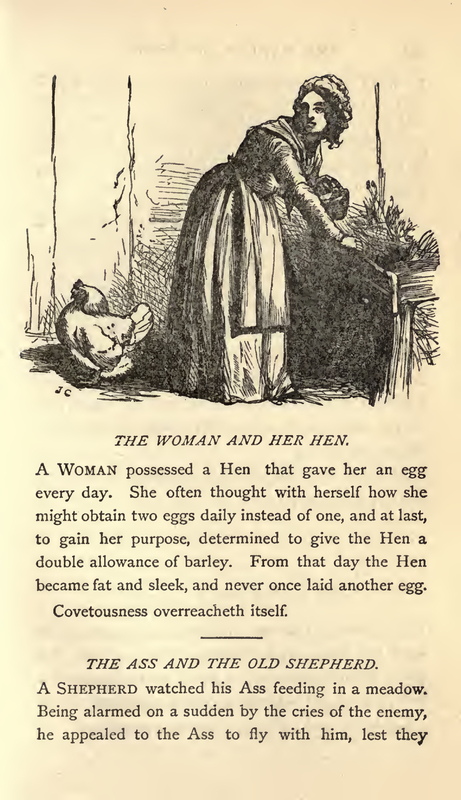
A woman is standing on the right side of the image and a hen on the left. The hen has its back to the woman. The woman has a basket in her left hand and is reaching down with her right hand to what seems to be a drawer. She is looking back at the hen.
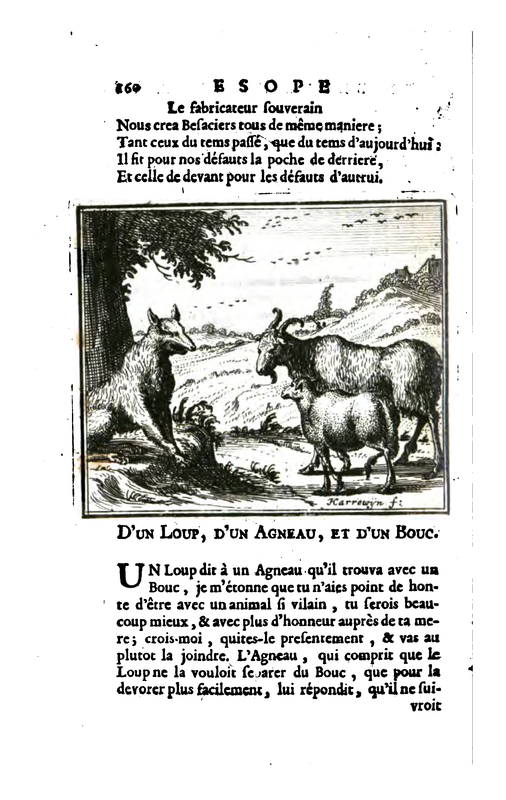
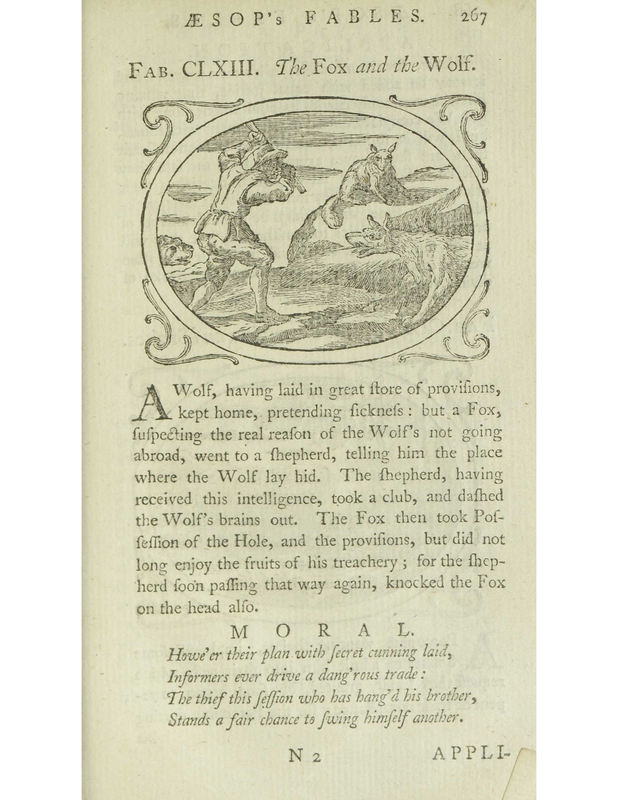
In the foreground to the right there is a man. To the left there is a snarling wolf. The man has a stick above his head, ready to strike the wolf. Behind the man there is the head of an unknown animal. In the background, a fox sits on the rock, observing the situation.
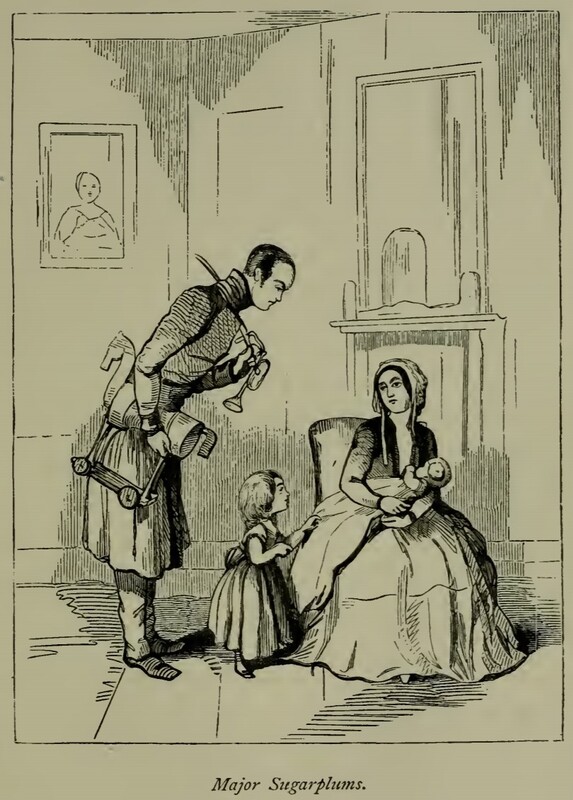
William Dobbin, carrying a toy sword, trumpet, and wooden horse on wheels, bows to Amelia Osborne. She is seated on a chair, holding her son Georgy, who is asleep. At her side is Mary Clapp, the landlord’s daughter, acting as the mistress of ceremonies to announce Dobbin. Below the illustration is printed in cursive its title, Major Sugarplums.
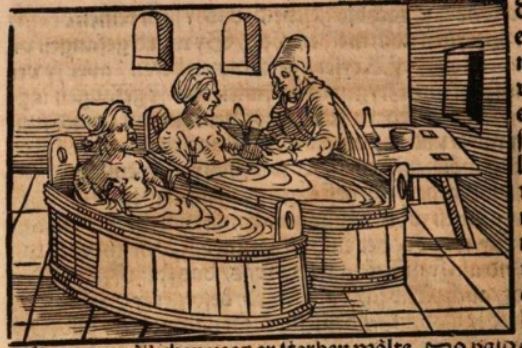
This engraving depicts Seneca and his wife Pompeia Paulina committing suicide in bathtubs. Seneca is depicted on the left side of the image with Pompeia Paulina in the tub beside him. After Emperor Nero found out that his tutor, Seneca, was involved in the conspiracy to assassinate him, he ordered a centurion to command Seneca to commit suicide. Not wanting to live without her husband, Pompeia Paulina got into the tub next to Seneca and slit her arm to die with him. Seneca is depicted dead in the engraving; however, a servant is illustrated saving Paulina by tying a rope around her arm to stop the flow of the blood. Emperor Nero did not want Pompeia Paulina to die as he had nothing against her, which is why the servant came to save her life.
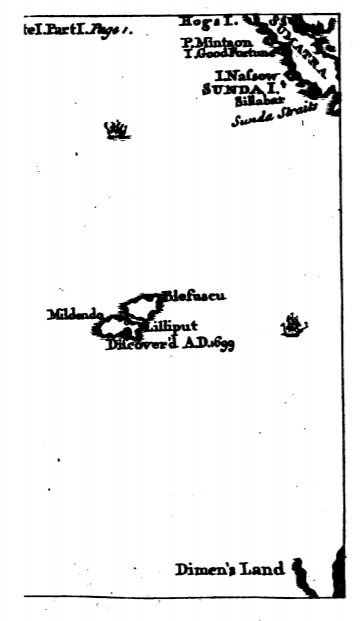
A map depicting the fictional lands of Lilliput and Blefuscu that Gulliver visited in the first part of the story. Under the fictional lands is written Discovered, AD 1699. The map also depicts the lands of Sumatra and Diemen’s Land. Two ships – likely the man-of-war type ships which were popular in the eighteenth century and are mentioned in the text – are shown. The same map is featured in several other editions of the text, including those in other languages.
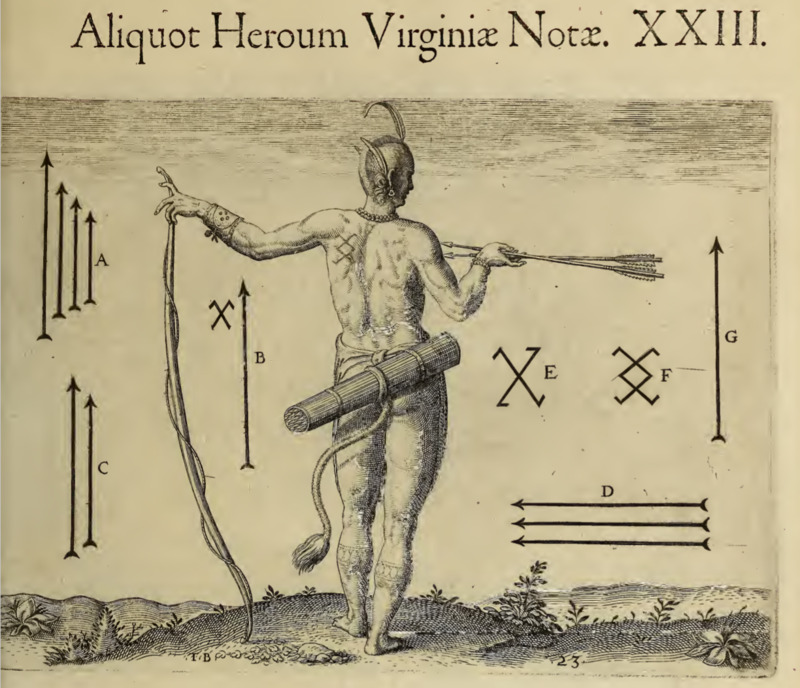
An Indigenous man is shown from behind. He holds a longbow in his right hand and two arrows in his left, and a quiver of arrows is tied around his waist. Drawn around him are seven designs that are labelled with the letters A to G. Design A is comprised of four arrows side by side pointing upwards, with the sizes decreasing from right to left. Design B has an arrow pointing upwards with a stylized ‘X’ to the left of the arrowhead. Design C has two arrows side by side pointing upwards in decreasing size from right to left. Design D has three arrows of the same size side by side pointing to the left. Design E is a stylized ‘X’. Design F is a crosshatch pattern. Design G is a singe arrow pointing upwards. The man has design F on the back of his left shoulder, suggesting that the designs are common tattoo/scarification art.
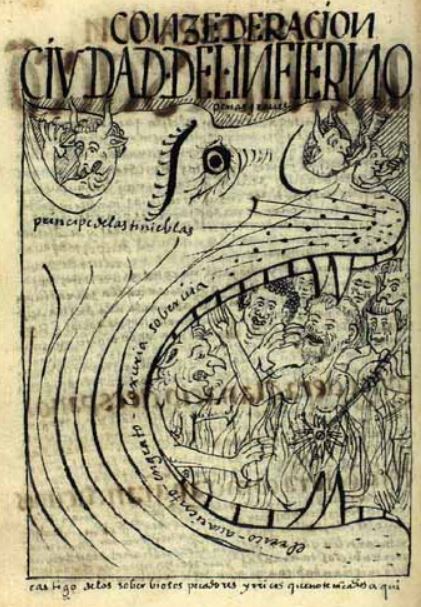
This image depicts sinners in the inferno of Hell. The author urges his readers to be good Christians so that they do not end up here. The image is a large jaguar head with sinners inside of its open mouth. There is a devil inside the mouth of the jaguar torturing the sinners, and there are also devils coming out of the ears and nostrils of the jaguar. There is a man inside the mouth who has a spear impaling his chest as torture. The rest of the people all have terrified expressions with tears running down their face. The caption written on the jaguar reads, príncipe de las tinieblas, el rrico auariento, engrato, luxuria, soberuia [The prince of darkness, the avaricious man, the ungrateful, lust, pride]. The caption at the bottom of the image reads, Castigo de los soberbiosos pecadores y rricos que no temen a Dios [Punishment of the proud sinners and rich men who do not fear God].
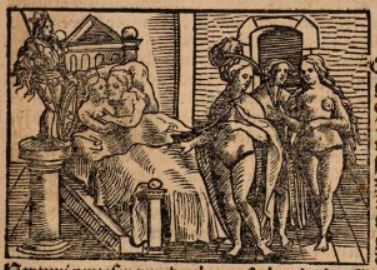
This engraving illustrates Queen Semiramis of the Assyrians lying in bed while having sexual relations with her son, Ninyas. There is a statue sitting on a platform to the left of the bed which appears to be a king. The statue is in fact Semiramis, who had a substantial military career and took part in many battles. The three women on the right side of the image represent the women who Semiramis feared. She was afraid that they would desire her son and take her away from him. Semiramis is said to have invented the chastity belt to avoid anyone having sexual relations with her son.
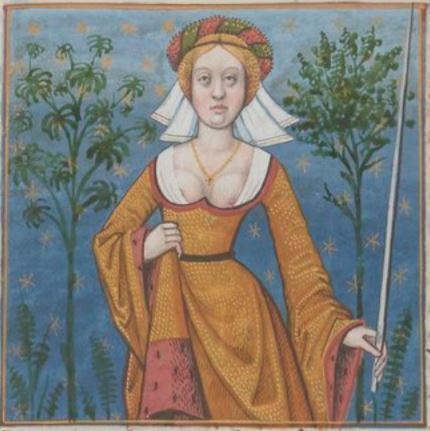
This illumination depicts a portrait of a woman named Flora. Flora was a famous prostitute in Rome who was incredibly wealthy. She is illustrated in this image with her breasts exposed to signify her status as a prostitute. Boccaccio explains that Flora used her wealth to have annual games held in her honour. He also explains that the Roman senate did not want a prostitute being honoured, so they fabricated a story which describes Flora being married to the wind, Zephyrus, who made her a goddess of flowers and trees. There are trees illustrated in the background of the illumination to signify her connection to this story.
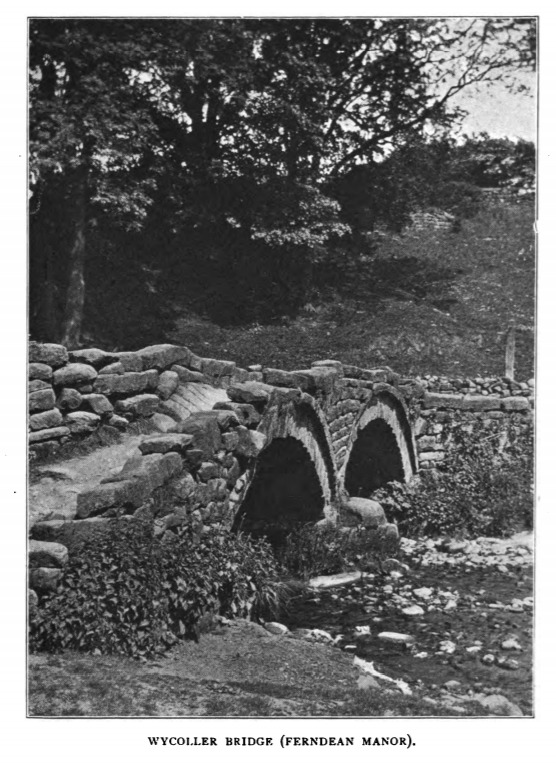
Here we see the Wycoller bridge, near the manor house called Wycoller Hall in the village of Wycoller in Lancashire. After hearing Mr. Rochester’s voice calling to her while at Moor House, Jane decided she had to return to Thornfield to see him. When she arrived, she found that Thornfield had been burnt down, and Mr. Rochester had moved to Ferndean Manor. Jane then married Mr. Rochester and moved into Ferndean Manor. The same image appears in the 1899 Harper edition of Jane Eyre.
This image is illustrated in a chapter that discusses the Christian priests in the colonial government in Peru. There is an indigenous noble on the right side of the image named Don Juan Pilcone. There is another unnamed indigenous man standing behind him. They are both holding their fingers up as they speak with the parish priest sitting in front of them. The priest is dressed in clerical adornments. They are speaking with the priest to issue a complaint against a magistrate. The priest is illustrated writing the complaint down with a quill. The priest’s letter says, don juan pilcone de apcara curaca camachicoc: digo que el corregidor me pide yndio para traxenaedor [Don Juan Pilcone de Apcara, chief of the Camachicoc: I say that the magistrate asks me for an Indian to betray].
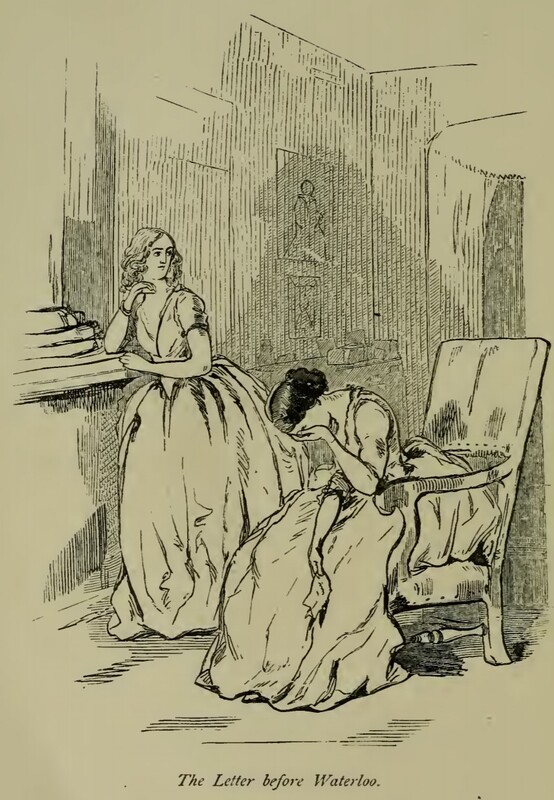
A scene from a chapter not in the volume. It depicts Amelia Sedley after she is given the letter her husband gave to Rebecca Sharp in Chapter XXIX asking her to run away with him. On the left, Rebecca is standing against a column and looking to the right towards Amelia, who sits crying in a chair with one hand over her face. In her other hand she holds the letter. In the background can be seen two pictures on the wall, a dresser with various objects placed upon it, and part of the canopy of a bed. Below the illustration is printed its title, The Letter before Waterloo.
After seeing the slaughter of the Cimbrian men, the Cimbrian women would not allow themselves or their children to be caught or killed by the Romans. They first killed their children, and then used the ropes and reins of horses found in the shelter they had built to hang themselves. In the image, the dead children are seen lying on the ground, with their mothers hanged in the trees above them.
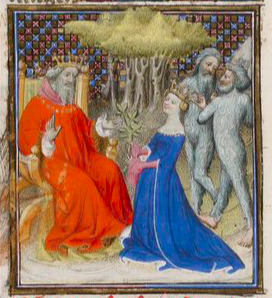
Nicaula, also referred to as Saba, wears a blue gown and holds out a branch of balsam. It is an offering to King Solomon as she stops to see him on her travels. King Solomon is seated in a throne, very impressed with Nicaula. The men standing behind Nicaula are considered savages as they are from Ethiopia – the land that she rules.
In this image Mr. Darcy visits Elizabeth at Hunsford. Mr. Darcy calls unexpectedly on Elizabeth at the Hunsford Parsonage. The conversation was awkward, and they struggled to find things to talk about. In their conversation Mr. Darcy implied that Mr. Bingley was unlikely to return to Netherfield from London. Elizabeth thought this call was odd, and Charlotte suggested that he only called because he was in love with her. This scene occurs in chapter 32. The characters are shown in the traditional regency style. Elizabeth wears the regency style dress with an empire waistline. Mr. Darcy wears a waistcoat and tailcoat with breeches and holds his top hat. The regency period dated to the early nineteenth century (1811-1820) when George, Prince of Wales, later George IV (r. 1820-1830), reigned as regent for his mentally ill father, King George III (r. 1760-1820). The regency period is associated with the rise of neoclassicism in art and fashion.
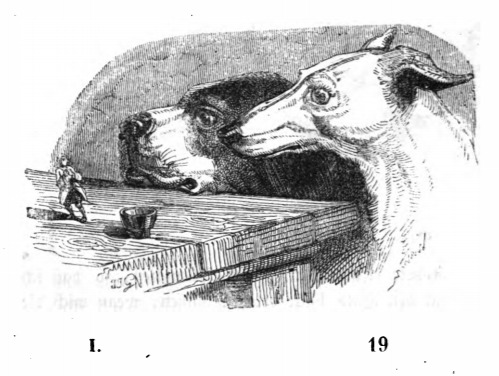
Here we see Gulliver encountering the farmer giant’s dogs. Two dogs stand at the edge of the table looking at Gulliver. The two dogs resemble a St. Bernard and a greyhound. The St. Bernard’s head is resting on the table. Gulliver stands on the table with his small bowl of food next to him. He leans back away from the dogs. This image highlights the difference in scale between the giant’s world and reality. The same image appears in the 1839 Krabbe edition.
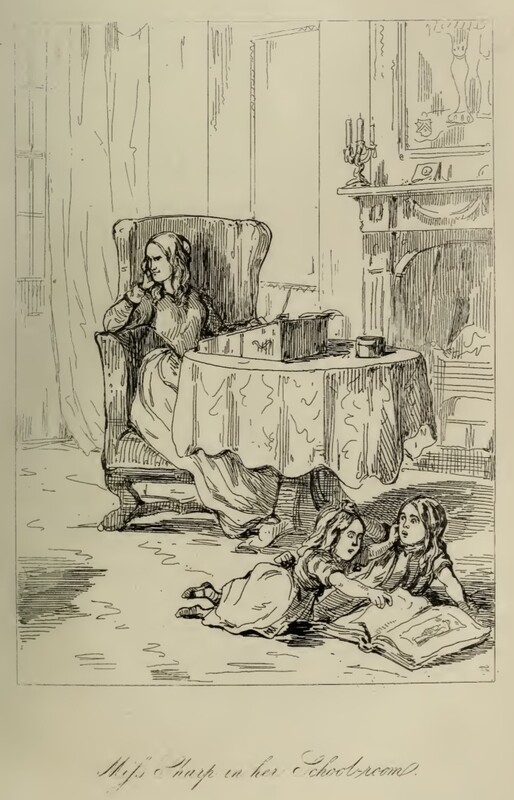
Rebecca Sharp sits in an armchair at a round table with her back to the window, looking irritated. Her table holds a writing desk and round dish. It is next to an ornate fireplace, on the mantle of which are a candelabra and clock, and above which hangs a painting. On the far side of the table Rosalind and Violet Crawley are on the floor, fighting over a very large open book. Violet is pulling on a page from the book and pushing her sister away, while Rose has grabbed her sister by the hair and looks somewhat shocked. Below the illustration is printed in cursive its title, Miss Sharp in her School-room.
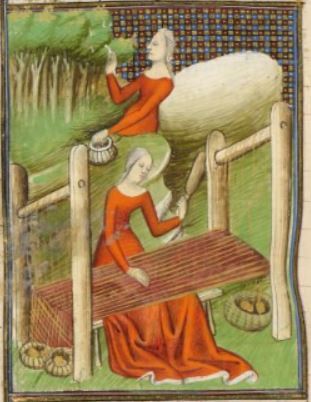
This illumination depicts a Greek woman named Pamphile in both the background and the foreground of the image. She is said to have been the first person to pick cotton from plants, which is why she is illustrated picking cotton in the background of the image. The foreground of the image depicts Pamphile sitting in front of a spindle and distaff as she is also renowned for having combed and spun the cotton into thread and weaved it.


![Haze Peticion I Nota el Padre y Enciste al Cacique Contra el Corregidor o Contra el Mismo Cacique Prencipal Para Rrebolbello Entre Ellos. Despues al Cabo s[e] Uenga del Cacique y Pide Cohechos a los Yndios](https://collections.cemvc.ca/files/large/c75504119fb43f7b531a584239b109255bae5c28.jpg)

![[Mr. Darcy visits Elizabeth]](https://collections.cemvc.ca/files/large/686883bffd6fa2ec4f245d624477e218630d0954.jpg)