Here we see the Houyhnhnms watching as Gulliver sails away. The council of the Houyhnhnms decided that Gulliver could not live with the Houyhnhnms any longer and he had to leave. Gulliver built a boat and sailed away. The image appears at the beginning of chapter ten, and the letter I is in the top right corner of the image, as it is the first word of the chapter.
In this image we see a depiction of the Emperor of Lilliput in front of a window looking out on the city. He holds a sceptre and wears a cape. In the background we see his sedan chair and a curtain blocking out part of the cityscape from view. In front of the Emperor is a crest with a lion and unicorn. This image comes when Gulliver is describing the practices and traditions of the Lilliputians. The same image appears in the 1839 Krabbe edition.
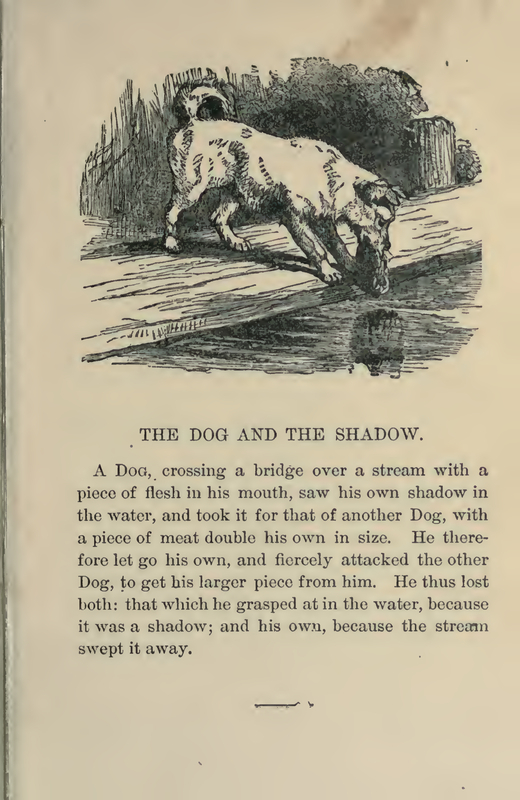
A dog is standing on a bridge, looking down at the water at its reflection. The dog holds a large piece of meat in its mouth as it bends its head to look closer to the water.
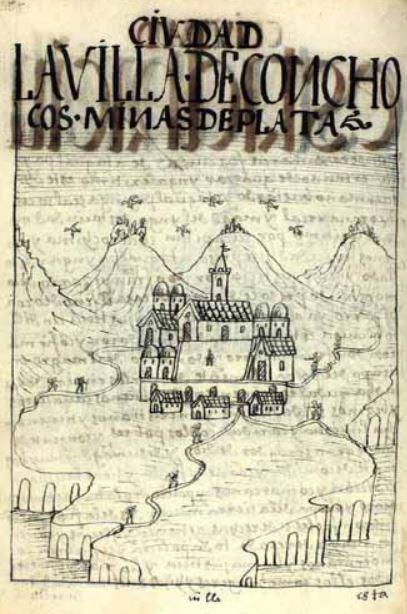
This image is depicted in the author’s chapter where he discusses cities, towns, villages, and provinces in colonial South America. This image depicts the city of Conchucos in Peru. It is illustrated as a cluster of buildings that forms a square in the centre. There is a person illustrated standing in the square. It is located amongst the mountainous Andean landscape. There are four pathways illustrated leading into the city from different directions with people walking along them. The author explains that the city was located near many silver mines. The caption at the bottom of the image reads uilla [town].
A coach drawn by two horses, driven by a coachman in a three-cornered hat. Beside him sits Sambo, the footman. On the right side of the image is the gate to Miss Pinkerton’s academy for young ladies, at which the coach has just arrived. In the background there are two trees and a building. In the top right of the image is the letter W, from While.
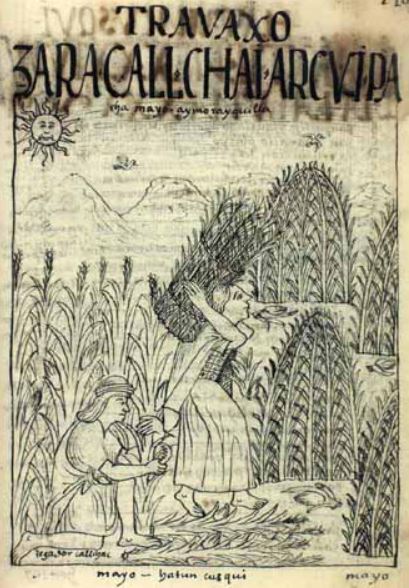
This image is reflected in the final chapter of Ayala’s chronicle where he provides a description of labours and festivals that occur in the rural areas of the Spanish colonial Andes during each month of the Inca calendar year. This image depicts the month of May, which was spent harvesting corn from the corn fields. The sun is shining in the top left corner of the image as a barefooted indigenous man and woman are illustrated gathering the corn. The woman has gathered enough corn to pile it in a bundle and is carrying on her back. The man is illustrated kneeling as he uses a tool to cut the corn from the stalk. There are piles of harvested corn on the right side of the image. The mountainous Andean landscape is depicted in the background with birds flying over top. The caption written below the left leg of the indigenous man reads zegador callchac [corn harvester]. The caption below the image reads mayo, hatun qusqui [May, the great pursuit].
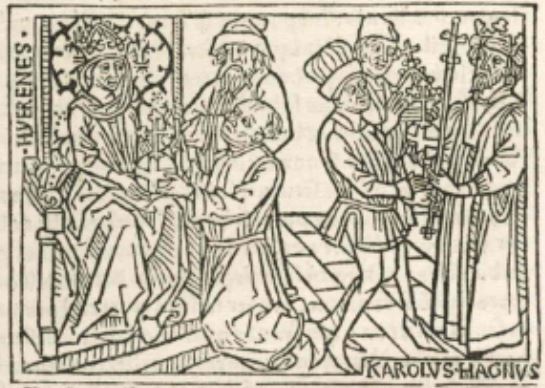
There are two women by the name of Irene that Boccaccio describes in his book. One was a empress of the Eastern Roman Empire. This engraving depicts Empress Irene as she is handed the globus cruciger. This engraving, however, is wrongly placed in the book as this engraving is meant to depict the other Irene that is discussed in the book. Irene was a Greek woman and a renowned, skillful painter during her time which Boccaccio believed to deserve praise as the arts were not a common practice of women. Boccaccio explains that Irene was the daughter of a man named Cratinus, who was also a painter (although much less renown).
Inside a structure, a group of Indigenous people tend to a sick man. The man stands in the middle of the group with his arms outstretched to either side. Two people each hold one of the sick man’s arms, with the person on the right touching his lips to the man’s arm. Another man stands behind the afflicted man and holds him by the shoulders. To the right, a man wearing a feathered headdress holds a rattle or other ornament over the group. There is a hammock slung between two beams of the structure behind the group, above them a monkey and a bird sit on another beam and a bow and bundles of arrows lie on the ground. This image is identical to one found in Frankfurt, 1557.
Here we see Gulliver participating in a military procession to boost military morale in preparation for battle with the neighbouring land of Blefuscu. The Emperor asked Gulliver to stand with his legs apart so that the army could walk underneath him, as though he were a triumphal arch, and Gulliver obliged. In the front, we see the military band, complete with drums and horns. Near Gulliver’s right foot, we see three men on horseback. The army is about to pass under Gulliver’s legs, with many men carrying either swords, spears, or bows and arrows. The procession can be seen well into the distance. The royal box with the Emperor and Empress and their page is near Gulliver’s right foot and is decorated with feathers on top of the box. Other spectators watching from stands near Gulliver’s left foot. The image comes at the point when the Lilliputians prepare for war, and Gulliver is asked to join the war effort, which he does, helping the Lilliputians to win the war. The same image appears in both the 1839 and 1843 Krabbe editions.
In this image we see Mrs. Elton inviting herself to Donwell Abbey, Mr. Knightley’s home. Mrs. Elton was eager to see into the finest houses around her, and as such invited herself and her party to go and see Donwell Abbey. Mr. Knightley agreed to show the house but would not let Mrs. Elton form the party. He said that she may invite her husband, but the rest of the invitations were to be his to extend. This scene occurs in chapter 42. The characters are shown in the traditional regency style. Mrs. Elton wears the regency style dress with an empire waist and a bonnet. Mr. Knightley wears a waistcoat and tailcoat. The regency period dated to the early nineteenth century (1811-1820) when George, Prince of Wales, later George IV (r. 1820-1830), reigned as regent for his mentally ill father, King George III (r. 1760-1820). The regency period is associated with the rise of neoclassicism in art and fashion.
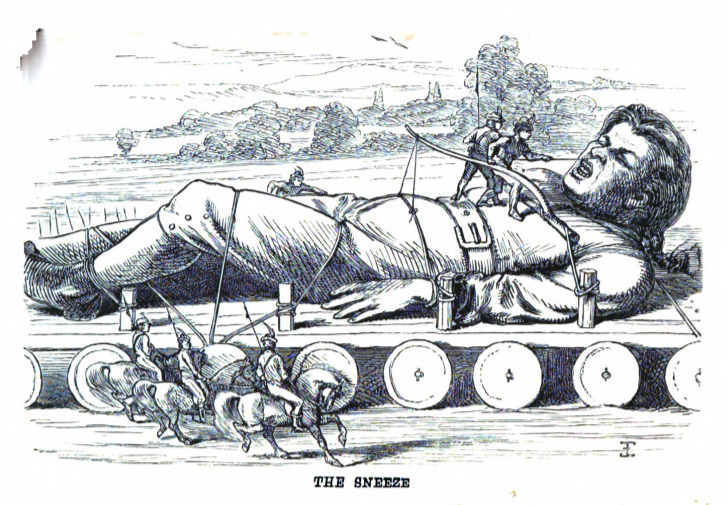
This image shows the scene in Lilliput where Gulliver is transported into the city from the shore on a large gurney. A Lilliputian guard stuck his sword into Gulliver’s nose, tickling Gulliver causing him to sneeze, which in turn threw the guard off of Gulliver’s chest. Gulliver is shown tied onto the gurney, with two guards on Gulliver’s chest and three on horseback next to the gurney.
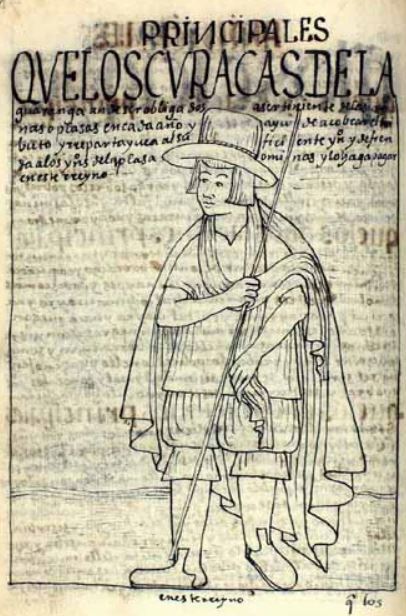
This image is illustrated in a chapter that discusses the descendants of the Inca and Andean nobles under Spanish colonial rule in Peru and their importance to a revived Andean society. This image depicts a waranka kuraka [an administrator who oversees 1,000 tributary natives in his town]. He is illustrated standing while wearing short trousers, a tunic, and a cloak that is draped over his shoulders. He is holding a long staff in his right hand. The waranqa kuraka was responsible for ensuring there was enough native workforce in the mines and collecting their tribute. The caption at the bottom of the image reads, en este rreyno [in this kingdom].
Miss Rhoda Swartz, seated on the stool in front of the piano in the Osborne drawing-room, is turned towards the reader with an expression of joy on her face. She has just seen Amelia Sedley’s name on the sheet music she was using and is hoping for news of her friend.
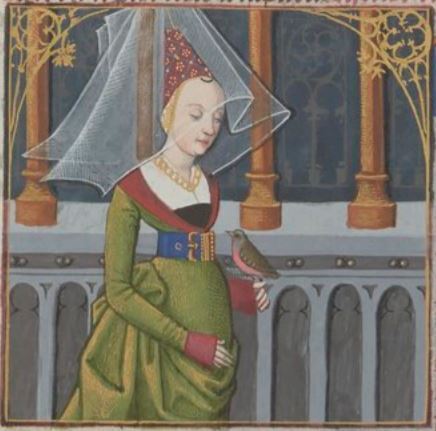
This illumination depicts a portrait of a noble Roman woman named Verginia. Verginia was born into a noble family, and married a former consul named Lucius Volupinus. Because her husband became a member of the plebeian class when he was no longer a consul, Verginia was cast out of a temple consecrated to Patricia Pudicitia by noble women. Verginia is famous for having created her own temple for the plebeian women called the Plebeia Pudicitia.
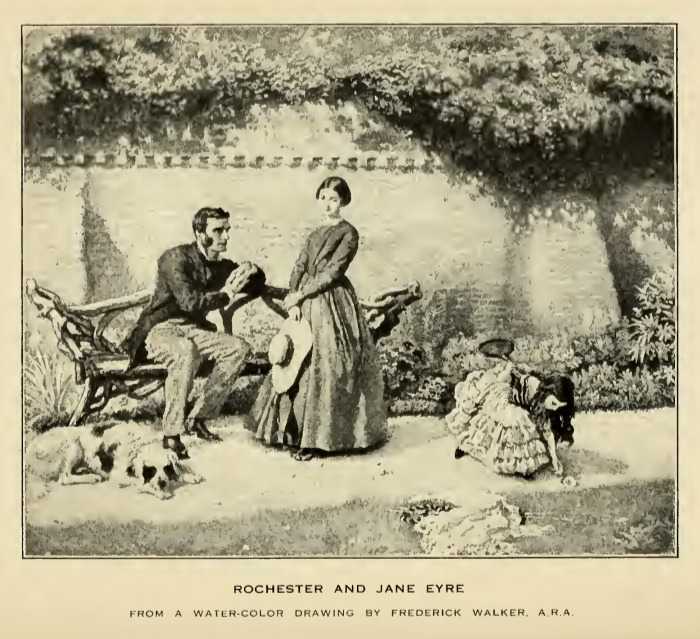
Here we see a photograph of a watercolour painting of Mr. Rochester and Jane Eyre. The two stand outside in the courtyard at Thornfield. Adele – Mr. Rochester’s charge – bends over nearby picking flowers. The image does not represent a scene from the book, but rather it shows the main characters.
In this image we see how the Lilliputians bury their dead. The deceased is buried head down because they believe that the world will eventually turn upside down and the dead will be resurrected, thus when this happens, they will be right side up. The burial is attended by a crowd of mourners. This image appears when Gulliver discusses the various traditions and practices of the Lilliputians. The same image appears in the 1839 Krabbe edition.
As Celestina informs Calisto of her meeting with Melibea, he cannot contain his emotions (they are seen talking to the right of the image). Pármeno repeatedly makes snide remarks under his breath, insulting both Celestina and Calisto. Sempronio overhears these remarks and grows angry with Pármeno (they can be seen to the left of the image), pointing out that his words are damaging to both Celestina and to Sempronio himself. To the right of the illustration, we can see Celestina wearing a robe and a veil. Calisto stands beside her, wearing a coat and a hat, with a sword mounted on his belt (it can be seen protruding from behind his coat in the bottom right corner). His hung head and facial expression convey and air of sadness. To the left, we see Pármeno and Sempronio, who are both wearing hats. We also see a sword protruding from behind Pármeno. Pármeno is pointing at Sempronio as he glances toward Celestina and Calisto, perhaps warning him of Celestina’s treacherous and deceitful ways.The entire image is identical to those found on pages 47 and 171 of the text.
A large group of Indigenous Brazilian people take part in a long procession, possibly preceding or following a burial as part of a mourning practice. They first stop at a vat on the ground where they take a bowlful of the beverage inside. The group then proceeds towards their village and through several of the structures. Many members of the group wear feathered headdress, ornaments around their neck or waists, necklaces, and/or feathered capes. Many also carry bows, clubs, rattles, conch shells or other wind instruments, or pipes. This image is identical to one found in Frankfurt, 1557.
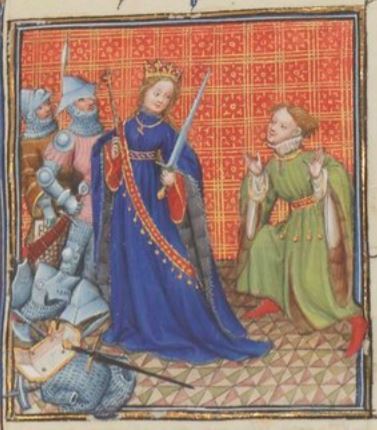
This illuminated image depicts Semiramis, an ancient queen of the Assyrians. She is depicted wearing clothing specific to the time of the creation of the image. She is depicted wearing a crown to signify her status as queen. After her husband (King Ninus) died, she decided to disguise herself as their son so that she could obtain power of the kingdom. She led her kingdom fearlessly and achieved great military success, which is why she is depicted holding a sword in the image. The boy on the right of the image is assumed to be her son, as they look alike in the face and hair colour.
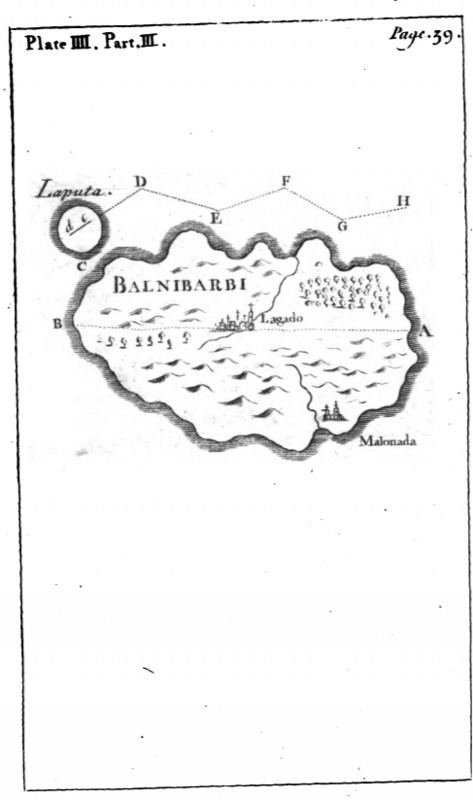
This image depicts the fictional floating island of Balnibarbi. There are regions of hills in the Southern, and North-West areas of the island. Forests are also shown in the North-East and Central regions. The city of Lagado is in the centre of the island. The town of Maldonada is in the South-East of the island. Above the island are letters, which depict the different ways in which the island moves, hovering over Laputa through magnetic opposition on an adamantine base. The same map appears in other editions of Gulliver’s Travels, including those in other languages.

![[The Houyhnhnms watch as Gulliver sails away]](https://collections.cemvc.ca/files/large/4bb21abeab864a2ff0a7cf6a7eb1767117582ff7.jpg)
![[Depiction of the Lilliputian Emperor]](https://collections.cemvc.ca/files/large/3f829526f59351b17b2869752cb83c17d9786d6d.jpg)

![[Vanity Fair Vol. I. Chapter I Historiated Initial, W]](https://collections.cemvc.ca/files/large/8505600415747d96eb6683fdbdb7a1ab513b2ad3.jpg)
![[Practice of caring for the sick in an Indigenous Brazilian community]](https://collections.cemvc.ca/files/large/d7d8074d86ae657795da4f9755fd624324d57db9.jpg)
![[Gulliver stands as a triumphal arch for Lilliputians]](https://collections.cemvc.ca/files/large/2c2ac4ef60fa87f3fc587bac1cb28b23abf0959a.jpg)



![[Rhoda Swartz]](https://collections.cemvc.ca/files/large/b5c6a6c84e6b87859cf9cd3c3b324bdf60011025.jpg)
![[Depiction of Lilliputian burial rites]](https://collections.cemvc.ca/files/large/2507a3d4ae7e5f7eb37c8ea39333a69f35911c3d.jpg)
![[Act VI – Sempronio Chastises Pármeno for His Snide Remarks While Celestina Talks with Calisto]](https://collections.cemvc.ca/files/large/6d3c231668891d09534ae5af30c1afd7a849df96.jpg)
![[An Indigenous Brazilian group participates in a ceremonial procession]](https://collections.cemvc.ca/files/large/87e54ab5b32fb96be7aa5c7e749e63b904c7dedf.jpg)