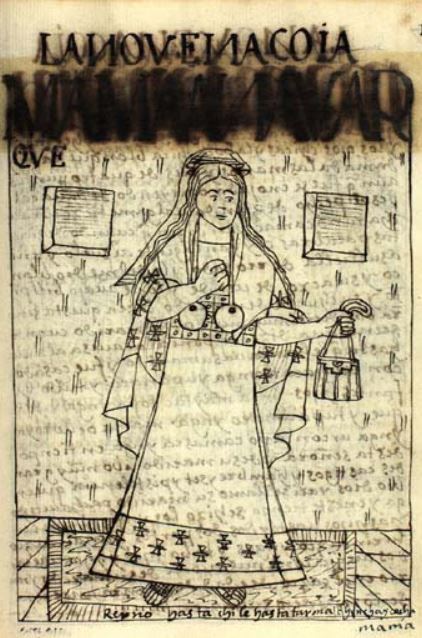
This illustration depicts Mama Anawarkhi, the ninth Coya [Queen] of the Inca Empire. She was married to Pachacuti Inca, the ninth king of the Inca Empire. She is depicted standing in the centre of the image wearing traditional garb with an embroidered belt and embroidery at the bottom of her skirt. The author explains that she was an obedient wife to her husband and died at the age of 80. The words Reynó hasta Chile, hasta Tarma, Chinchay Cocha are written at the bottom of the image which translates to He reigned to Chile, Tarma, Chinchayqucha. These are the regions that her and her husband reigned over.
A man is facedown with his feet in the air. There is a man behind him, motioning either a pushing gesture as if he has just pushed him down, or a gesture towards trying to grab and help the man. On the right side of the image there are three individuals, two of which are wearing robes, while the third body is out of site. The two who are dressed in robes are also wearing a hat. None of the the individuals are looking at the fallen man.
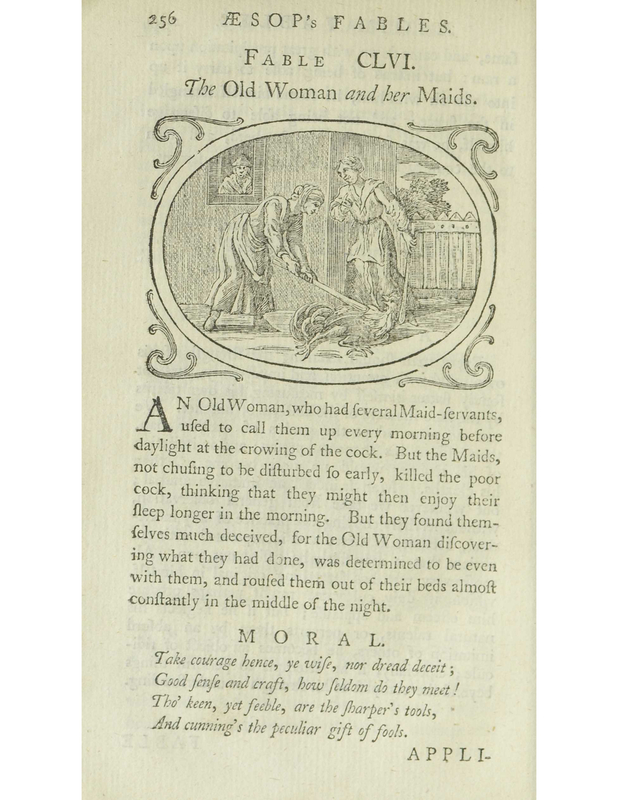
Two younger women stand outside the house with bats. They are using bats to beat a Cock that is laying on the ground. In the background, from a window in a house, an older women watches on with concern.
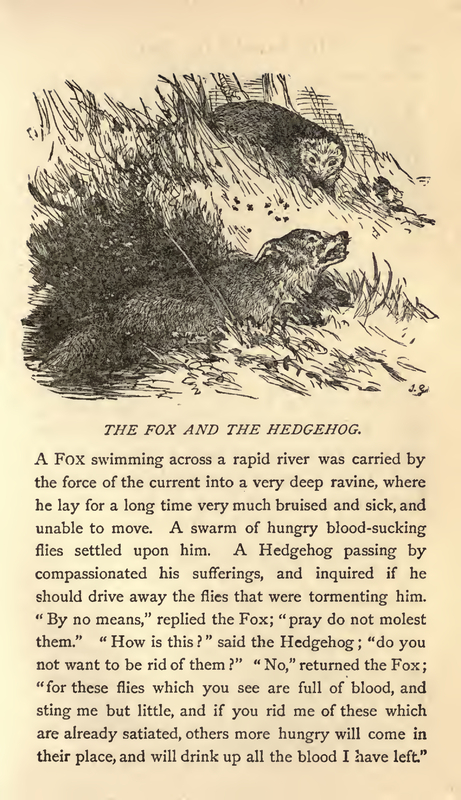
A fox seems to be stuck in a river bank. There are flies hovering over its head and it is growling. In the far right side of the image, a hedgehog is peeking out from the bushes, looking at the fox.
In this image Gulliver demonstrates his pistol to the Lilliputians. Gulliver’s right arm is visible, holding his pistol. A cloud of smoke emerges from the pistol. A crowd of Lilliputians cower on the ground, scared by the bang of the gunpowder. Two horses rear also scared by the noise. This image comes at the point in the story where Gulliver demonstrates his weapons to the people of Lilliput, including his rapier and his pistol, which he loaded with gunpowder to demonstrate its use. The town is visible in the background. The same image appears in the 1843 Krabbe edition.
This illumination depicts Hypsicratea, the wife of King Mithridates VI of Pontus, riding horseback and wearing armour on the right side of the image. She is illustrated looking at the soldier on the left side of the image, which is presumably her husband. Boccaccio explains that Hypsicratea is praiseworthy as she bravely risked her life as she followed her husband on his military expeditions.
Two figures are climbing over a wall using a ladder placed next to a tree. The man, representing Captain Rawdon Crawley, is at the bottom of the ladder, holding the hand of the woman. She is Rebecca Sharp, who is looking backwards as she climbs over the wall and onto the ladder. The ladder forms the letter H from How.
Two animals are in the field, a donkey and pig. The pig is lying on the ground on the left-hand side of the image, while the donkey is in the back standing with its head inclined towards the pig. Plants and trees are behind both animals.
A group of Indigenous Tupinambá people sit on the ground in a circle inside their village and smoke pipes. A bearded man stands in the center of the circle. The village is surrounded by a circular fence and is comprised of four long structures. In the bottom left corner there is a gap in the fence and two long poles with skulls mounted on top of them. There are stars in the sky, and a moon with a face that gazes down at the group.
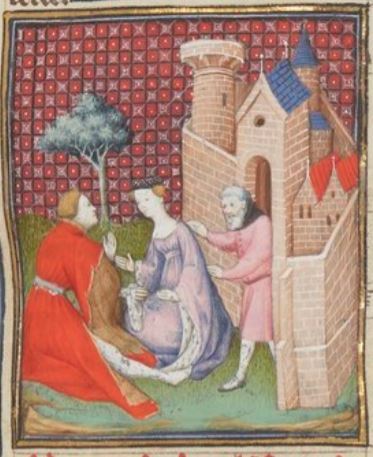
This illumination depicts Hypermnestra, daughter of King Danaus of The Argives, helping her lover escape from her father’s wrath. Boccaccio explains that King Danaus wanted to secure his throne by eliminating any possible heirs. He married each of his daughters off to his many nephews and instructed them to kill their grooms after the wedding. All but Hypermnestra followed through on these orders, as she fell in love with her new groom and cousin. She helped him escape, as illustrated in the image. Her husband, Lynceus (also known as Linus), is depicted in a red outfit looking at his wife after being led out of the castle to escape. Hypermnestra’s father is illustrated coming out of the castle door about to grab onto his daughter. She was put into prison by her father for disobeying him, however, Lynceus eventually defeats his father-in-law and releases his wife from prison.
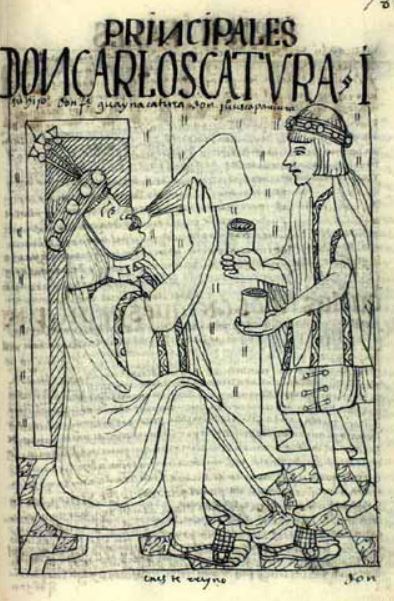
This image is illustrated in a chapter that discusses the descendants of the Inca and Andean nobles under Spanish colonial rule in Peru and their importance to a revived Andean society. This image, however, depicts a native lord who the author criticizes for being a drunkard. He criticizes him for spending all his tribute money on wine and gambling. His name is Don Carlos Catura, and he is depicted wearing traditional clothing and sitting down while drinking alchohol. He is being served by his son, Don Felipe Guayna Catura, who is illustrated holding cups in both of his hands as he watches his father drink. The caption at the bottom of the image reads, en este rreyno [in this kingdom].
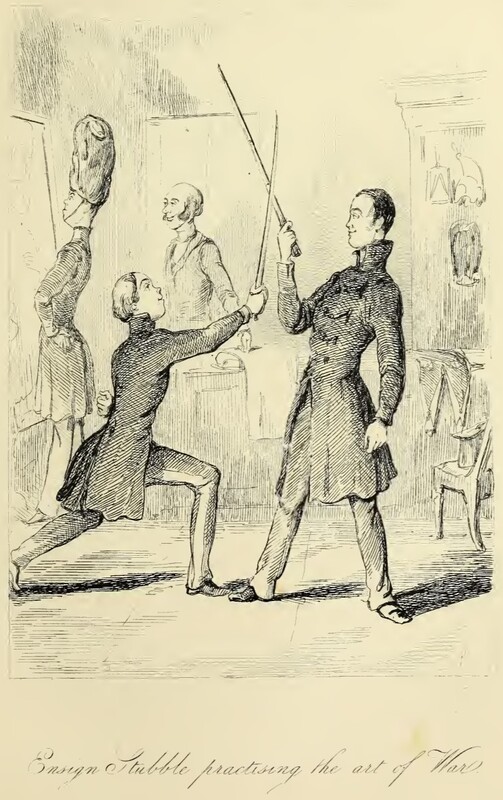
Tom Stubble holds up a new sword at the accoutrement-maker’s, lunging at the much taller William Dobbin, who parries with his bamboo walking-stick. Both men are smiling. In the background a store employee can be seen, along with a man trying on a tall guard’s hat. Below the illustration is printed in cursive its title, Ensign Stubble practising the art of War.
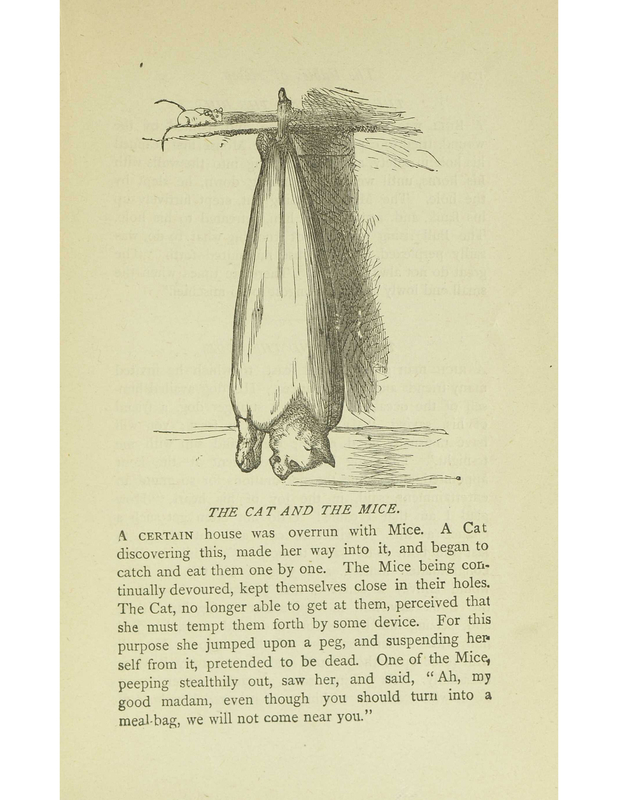
A cat is stuck inside a a cloth hanging upside down. Only its head and its two front paws are sticking out of the cloth. On the peg where the cloth hangs, two small mice are looking down at the cat.
Two English ships are pictured sailing near the coast of Virginia (what is known today as the Outer Banks of North Carolina). One smaller ship is pictured within the outer islands, closer to the coast. Several Indigenous towns are labelled.
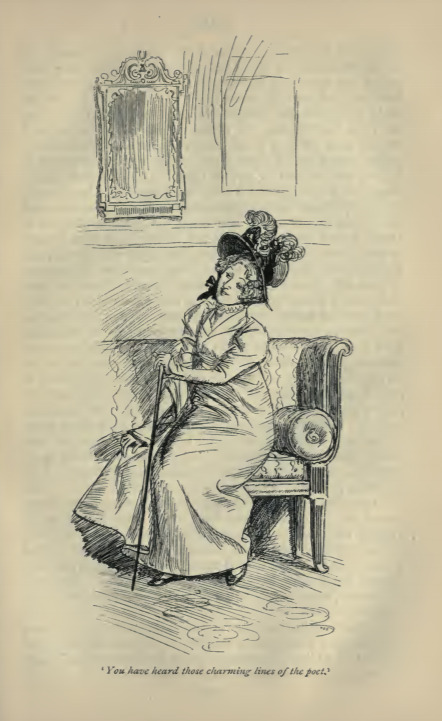
In this image we see Mrs. Elton speaking to Emma about Jane Fairfax. Mrs. Elton took a liking to Jane Fairfax and saw herself as Jane’s protector. In describing Jane to Emma, she quoted poetry to describe Jane’s loveliness. This scene occurs in chapter 32. The characters are shown in the traditional regency style. Mrs. Elton wears the regency style dress with an empire waist. She has a bonnet and holds a walking stick. The regency period dated to the early nineteenth century (1811-1820) when George, Prince of Wales, later George IV (r. 1820-1830), reigned as regent for his mentally ill father, King George III (r. 1760-1820). The regency period is associated with the rise of neoclassicism in art and fashion.
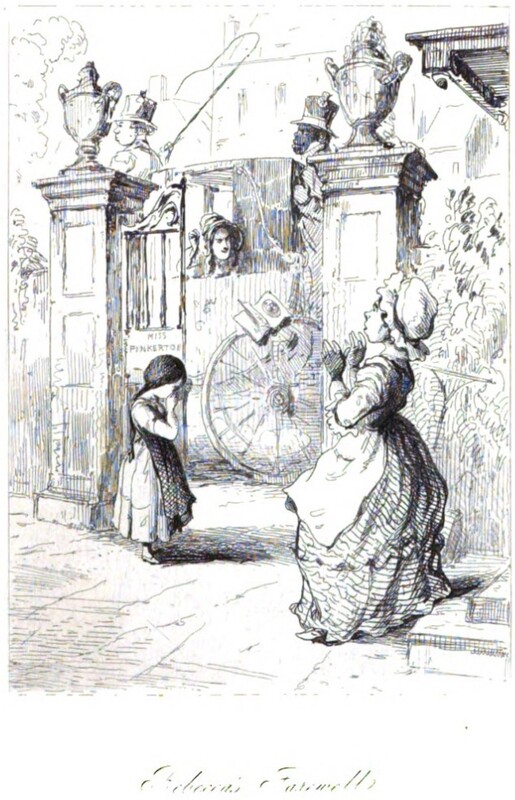
The image depicts two pillars topped with cups, between which is an open gate with a plate reading Miss Pinkerton. The pillars frame a carriage with very large wheels, at the front of which sits the coachman, holding his whip, and at the back of which stands Sambo. Rebecca Sharp’s face can be seen from the window of the carriage as she flings a book at the surprised Miss Jemima, who stands on the right side of the image at the bottom of the stairs and had just given the book to her. Next to the left pillar is a young girl with long braids, likely Laura Martin, crying and covering her face with her hands. Below the illustration is printed in cursive its title, Rebecca’s Farewell.c
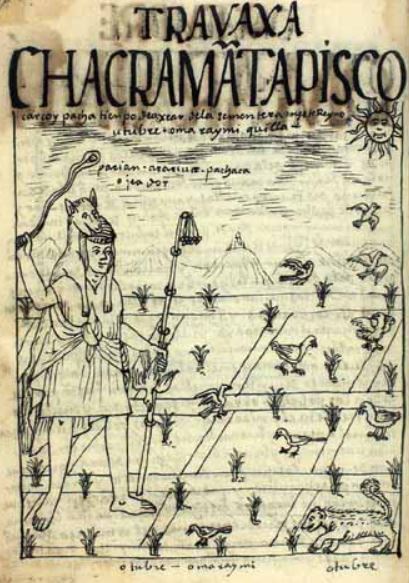
This image is reflected in the final chapter of Ayala’s chronicle where he provides a description of labours and festivals that occur in the rural areas of the Spanish colonial Andes during each month of the Inca calendar year. This image depicts the month of October which was an important month for ensuring the safety of the newly sown corn, potato, and wheat crops. There is an indigenous man illustrated on the left side of the image standing in a field that is organized in a grid pattern. There are small crops beginning to grow in the field. There are birds walking on the fields and flying above as they try to eat the crops. An animal which appears to be a skunk is also depicted eating the crops. The native man is illustrated scaring the animals away from the crops by swinging a sling in his right hand and holding a long staff in his left. He also has a dog skin over his shoulders. The caption written above his head reads parian arariua pachaca [scares the sparrows]. The mountainous Andean landscape is visible in the background of the image with a shining sun in the top right corner. The caption at the bottom of the image reads otubre, oma raymi [october, eleventh month].
Here we see two Lilliputian tailors taking Gulliver’s measurements for new clothes. Gulliver is kneeling on the ground. One tailor stands on Gulliver’s shoulder and drops the weighted measuring tape down to the ground. A second tailor stands on the ground and records Gulliver’s measurements in a notepad. A tall ladder is leaning against Gulliver’s back. The same image appears in the 1839 Krabbe edition.
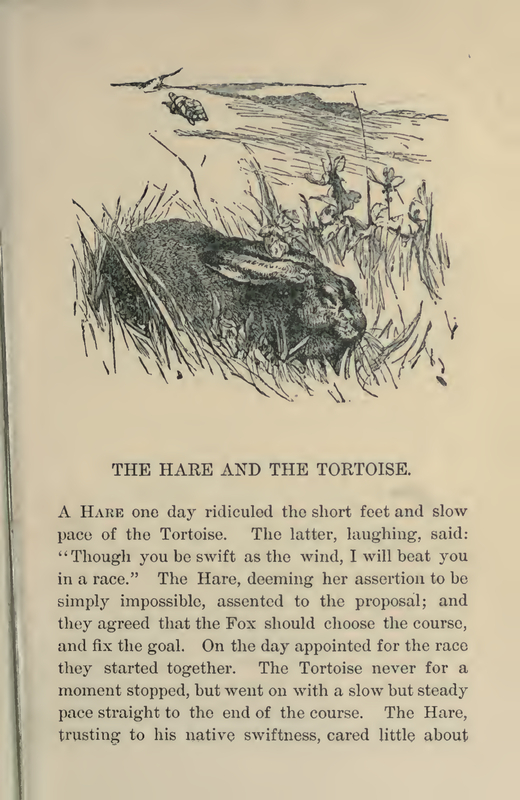
A large hare is lying in the grass in the fore ground. Its long ears are bent backwards, and its eyes are slightly closed, it looks as though the hare is sleeping. In the background, a tortoise is lounging on the sand near the shore, its little head looking in the direction of the sleeping hare.
![[A Man Facedown with Spectators]](https://collections.cemvc.ca/files/large/4eb701fda0609368e5bd0071b92325bc0b58aeca.jpg)
![[Gulliver demonstrates his pistol to the Lilliputians]](https://collections.cemvc.ca/files/large/e627d9e3116fee040b31f030bd1e8c61cbdecf9c.jpg)

![[Vanity Fair Chapter XVI Historiated Initial]](https://collections.cemvc.ca/files/large/1d22aab1e1ca356a022e01f03c01721fe32e83ad.jpg)
![[The Donkey and the Pig]](https://collections.cemvc.ca/files/large/9c8e64f8883ba83d3332137c4bc36770f525be2b.jpg)
![[Tupinambá people smoke pipes in a village]](https://collections.cemvc.ca/files/large/770dd3cd5619783abc4448d90184ad92b9f90684.jpg)

![[Tailors on Lilliput measure Gulliver for new clothes]](https://collections.cemvc.ca/files/large/2c4681813fd2069228b727605cd9fa93d35a1a53.jpg)