A man and a woman are sitting in a kitchen. There is a child embracing the woman. The man and women are both pointing at the child. The man has a sword by his side.
A small Tupinambá Indigenous village is shown. There is a fence around the perimeter, with four long structures inside. In the lower right corner, there are three long poles with skulls mounted on top of them. In the center of the village there is a group of Indigenous men, women and children. A bearded man sits on the ground on the right and is tended to by one of the Indigenous women.
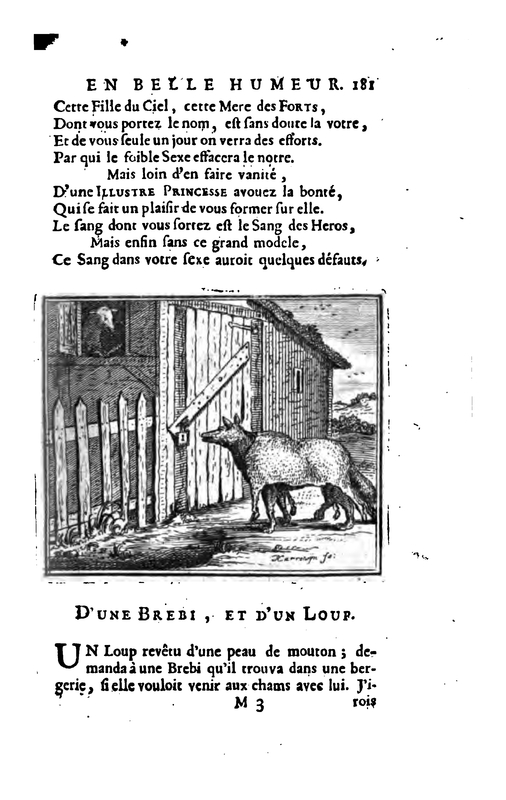
A sheep is standing up off the ground in the window of a building looking down on a wolf that appears to be wearing a piece of fabric on its back to look like a sheep.
Here we see Gulliver surrounded by giant books. These books were the stories Gulliver had written about his travels to the various places in the world.
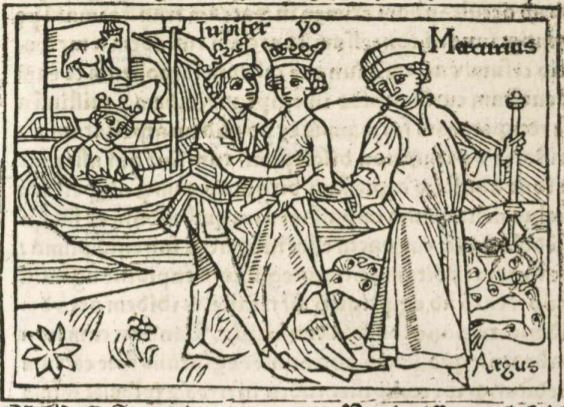
This engraving illustrates the story of Isis and Jupiter. Jupiter is depicted in the center of the engraving with his arms wrapped around Isis as he shows his affection for her. We know that these figures are Jupiter and Isis as the creator engraved their names directly above their head. Isis’ name reads Yo, as she is also known by this title. Boccaccio explains that Jupiter had transformed her into a cow and gave her as a gift to Juno in order to hide his crime of raping her. Mercury had saved Isis as he killed Argus, Isis’ 100 eyed guardian. Mercury is on the right-hand side of the engraving holding a staff in his left hand, standing above the body of Argus. Mercury’s name is engraved beside his head, and Argus’ name is engraved just below his own arm. Isis is visible in the background of the engraving sitting on a ship, as she had sailed to Egypt after being transformed back into her human form. The sail on the ship has a heifer emblem to signify her transformation into a cow.
Here we see the farmer giant who discovered Gulliver presenting him to his wife. The farmer holds Gulliver on a cloth. Gulliver kneels on the cloth in front of the woman with his arms out towards her. The woman wears a dress with a pocket hanging in front of her. Her hair is covered with a cap. She looks surprised by Gulliver and holds her left arm close to her as though she is alarmed or put off by Gulliver. The same image appears in the 1839 Krabbe edition.
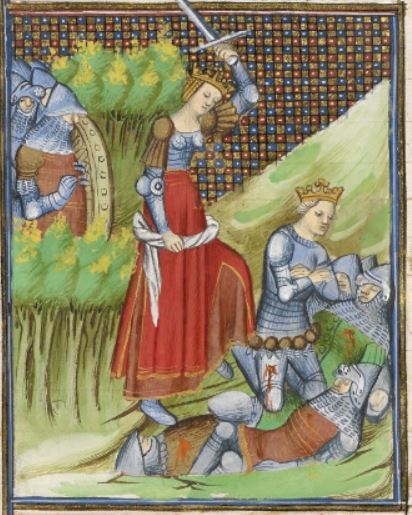
This illumination depicts Queen Thamyris in the centre of the image wearing a crown and armor as she swings a sword above her head. She was renowned for her nobility and capabilities of ruling a nomadic tribe. Boccaccio explains that King Cyrus of Asia Minor had invaded Scythia looking for glory, and when he had killed Thamyris’ son, she exacted her revenge by killing his entire army. When Thamyris found Cyrus’ dead body, she took his head for revenge. She is illustrated swinging her sword, about to cut off the head of King Cyrus. King Cyrus is depicted wearing a crown in order to identify him and his royal status.
George Osborne is leaning against a table with one hand at his waist and the other at his chin. He is looking at himself in a large standing mirror, and both he and his reflection have a slight smile. In the top right of the image, overlapping the mirror, is the letter I.
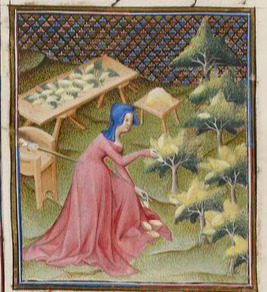
Pamphile was the first person thought to have worked with cotton. This included picking it, cleaning it, and weaving it for use. The image represents all three of these steps – Pamphile is seen picking the cotton, behind her the cotton is on a table and stool in the process of being cleaned, and to the far left the cotton is being weaved.
In this image we see Gulliver standing next to the Lilliputian Castle, surrounded by Lilliputians. Here we see the real height difference between Gulliver and the Lilliputians. Several Lilliputians hold swords, while others hold the ladders, they used to climb Gulliver while he was lying on the shore. Two dogs are in the foreground next to the fence. Others stand on the roof of the turret on the right side of the image. Gulliver looks down to the Lilliputians in conversation. The same image appears in the 1843 Krabbe edition.
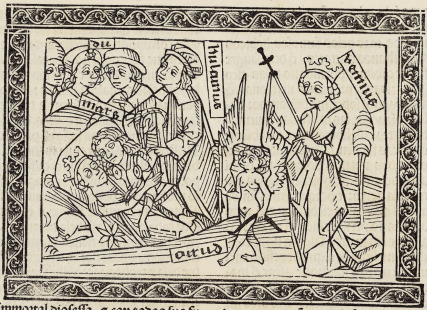
Ops, wife of the god Saturn, is depicted laying in a bed after just having given birth to her children: Jupiter, Neptune and Pluto. We know the woman lying in the bed is Ops as her name is engraved directly beside the curtains of the bed. Baby Jupiter is illustrated being carried away by a servant with his name engraved just beside the person carrying him. Boccaccio’s story explains that Saturn and Ops’ brother, Titan, planned to kill the children to avoid them growing up and defeating them. Saturn is illustrated with his hands outstretched towards baby Jupiter. Titan is on the opposite side of Ops’ bed with a sword in his hand. His name is written as Titanus beside his head.
Two small children peer into the holes cut in a cabinet. Behind the cabinet stands a man in a long jacket and tall hat. Behind his head, the letter W from Without is formed by four sticks.
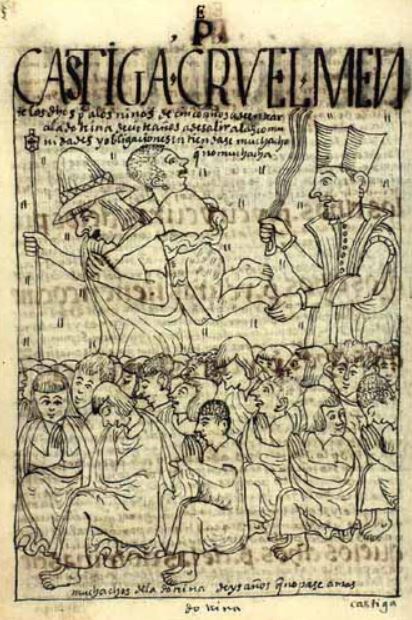
This image is illustrated in a chapter that discusses the Christian priests in the colonial government in Peru. The top of the image depicts Spanish parish priests collecting a child and taking them away from their native community to go and live in a parish where they receive religious instruction and suffer punishments. The author explains that children were taken from their homes around the age of five and leave at seven. One man is depicted carrying the child on his back while the priest on the right is holding a whip. The bottom of the image depicts the indigenous children living in the parish and wearing long cloaks as they sit and pray. The caption at the bottom of the image reads, muchachos de la doctrina de seis anos que no pase a mas [boys of the doctrine at six years old].
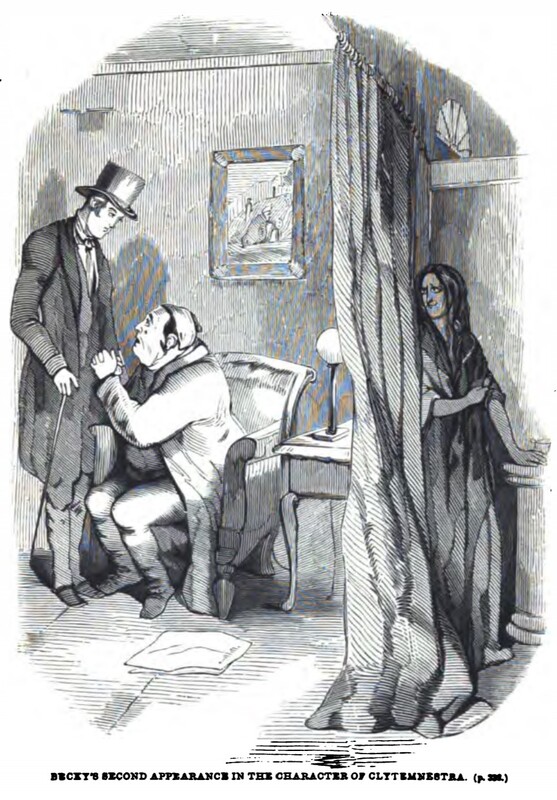
Joseph Sedley sits in a chair, begging William Dobbin, now his brother-in-law, to come and live near him, or else help him escape to India without Becky finding out. Behind a curtain on the far side of the room is Rebecca Crawley, listening in and holding a dagger in one hand. Below the illustration is printed its title and location in the story, BECKY’S SECOND APPEARANCE IN THE CHARACTER OF CLYTEMNESTRA. (p. 332.).
Sulpicia’s husband was exiled, and she was ordered not to follow him. She escaped her mother’s watch by wearing slave's clothing and following after him. It was discovered that she had done this when they found the slave’s clothing on the ground. The image depicts many women discovering the slave’s clothing that lie on the ground in front of them.
This image depicts the famous poetess, Cornificia, sitting at a desk as she writes her poetry. She is said to have written many Heliconian verses which were highly esteemed. Boccaccio explains that she is worthy of praise as poetry and writing was not something women excelled in or pursued during Cornificia’s time. There are two figures on the right side of the illumination who are watching Cornificia write.
In this image we see Gulliver walking sideways between buildings in the Lilliputian city of Mildendo. The street where Gulliver is walking is likely a residential street, since it is considerably narrower than the main street seen on page 55, meaning Gulliver must walk sideways to fit down the street. Lilliputian residents are leaning out their windows, standing on their balconies, and on the roofs to get a look at Gulliver, who is a giant to them. Some Lilliputians children are still on the street and their mother rushes them inside to get out of Gulliver’s way. The same image appears in the 1839 Krabbe edition.
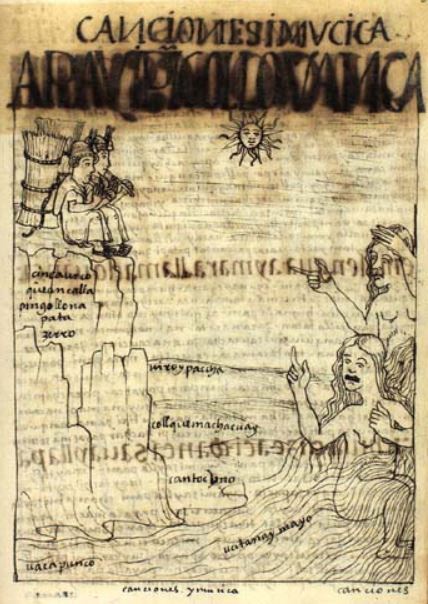
This chapter is dedicated to discussing the various celebrations and festivals that would be held in the Inca Empire. This image reflects the importance of music and songs. There are two boys illustrated on the left side of the image sitting on a hill with straw or wheat bales strapped to their backs. They are depicted playing flutes. The author explains that boy’s flute songs were called pincollona. The girls on the right side of the image are depicted nude in a river as they look and point at the boys playing their flutes. The author explains that girl’s songs are called uanca.
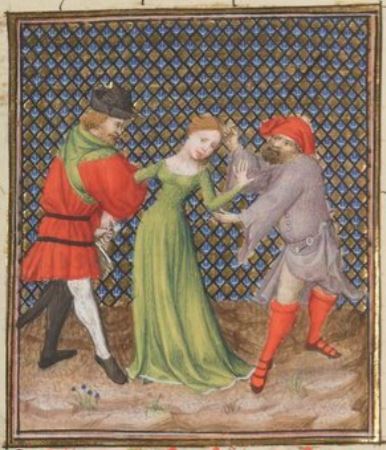
This illumination depicts the prostitute Leaena being violently tortured for information regarding a conspiracy. There is a man on the right side of the image pulling on Leaena’s hair, and a man on the left side pulling on her arm. Boccaccio explains that she is being tortured for being involved in a conspiracy to overthrow a tyrant.
Rebecca Sharp, wearing a bonnet, holds onto the arm of Joseph Sedley, who is wearing a top hat and carrying a cane. The two figures are standing beneath a crescent moon. In the background is another couple, possibly George Osborne and Amelia Sedley, possibly a pair of strangers.
The custom of stepping on a crucifix was common in Japan in the early modern period. Christianity was outlawed in Japan, and anyone who was suspected of Christianity was required to step on a crucifix to demonstrate that they were not Christians. In major trading cities the Dutch, who were the only Europeans to trade with Japan, were often required to perform this custom. Gulliver requested to that he be allowed to bypass this custom, which made some Japanese question if he were really Dutch (he pretended to be Dutch as they were the only Europeans permitted in Japan), as most Dutchmen, according to Swift – who had a negative view of the Dutch – would perform this ritual regularly and without opposition. Gulliver asked the King of Luggnagg to request Gulliver’s exemption from this custom in his letter. Gulliver was in Nagasaki, a Dutch colony in Japan at this point in the story. The same image appears in the 1839 Krabbe edition.

![[Couple and child in kitchen]](https://collections.cemvc.ca/files/large/15c5719ea6d5daec28958233b919de62a7f5e6a3.jpg)
![[A Tupinambá community]](https://collections.cemvc.ca/files/large/2a8d745600a54e0fa3be8c4b6bd588517504ffaa.jpg)

![[Gulliver with his books]](https://collections.cemvc.ca/files/large/ab6a6464915f974fd5fba61791bba6ca471ec645.jpg)
![[The giant farmer shows Gulliver to his wife]](https://collections.cemvc.ca/files/large/8a7125b0fc935a1fa4a137fcf38a46a6c882006d.jpg)
![[Vanity Fair Chapter XIII Historiated Initial]](https://collections.cemvc.ca/files/large/283c43a6cc3299e09b7204c77702b820dcfab32a.jpg)

![[Gulliver stands examining the Lilliputians]](https://collections.cemvc.ca/files/large/0eefc87c347ee51cb6d3b50f2f5dbde3dc4b0622.jpg)
![[Vanity Fair Vol. I Chapter XX Inhabited Initial]](https://collections.cemvc.ca/files/large/c1447b4df7d818461eed84e2d34e3aa31e724955.jpg)

![[Cornificia Sitting at a Desk Writing Poetry]](https://collections.cemvc.ca/files/large/c5012c7d9a6881ca700d9e0dd6a12735731eb8bb.jpg)
![[Gulliver walks through the streets of Mildendo]](https://collections.cemvc.ca/files/large/8699b40201d7fbfe43b257703c62aa1b07e51352.jpg)
![[Rebecca and Joseph at Vauxhall]](https://collections.cemvc.ca/files/large/4869f78ecf1652f22b99fbdb672486e1379ea1a6.jpg)
![[depiction of the custom of stepping on a crucifix]](https://collections.cemvc.ca/files/large/52a0afa323948f8c84b6a905885ee7c515d1eed0.jpg)