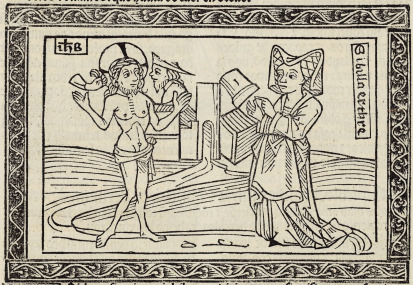
This engraving depicts the sibyl named Erythraea on the right side of the engraving with her fingers pointing to the man on the left side of the engraving. We know that this is the sibyl Erythraea as her name is engraved directly beside her body. The man she is pointing to is the son of God, Jesus. His name is engraved beside his head. Boccaccio explains that Erythraea was so intelligent that her prophecies were taken as Gospel rather than fortune-telling. She even foretold the entire events from the life and death of Jesus, which is why he is depicted in this engraving. Boccaccio explains that Erythraea had also foretold the fall of Troy, which is assumed to be the city in the background of the engraving. There is an unidentified man’s head engraved beside Jesus.
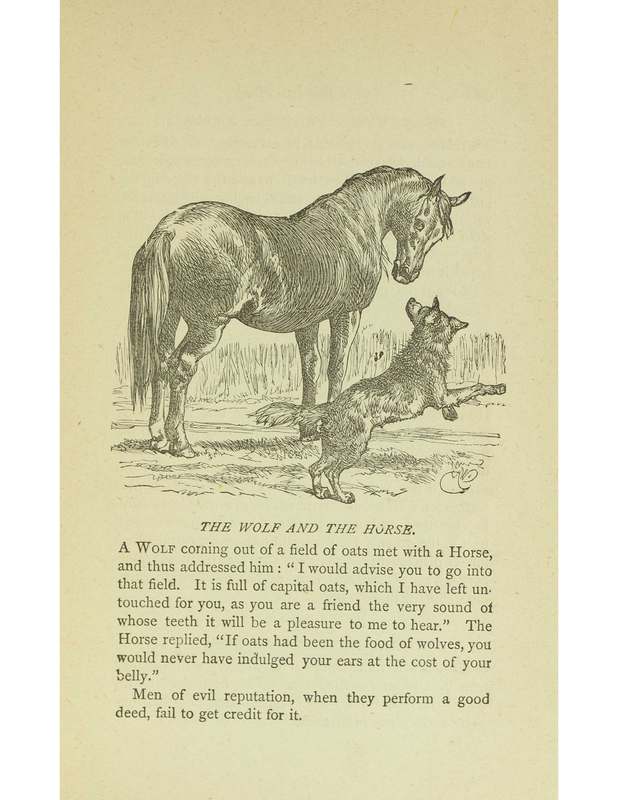
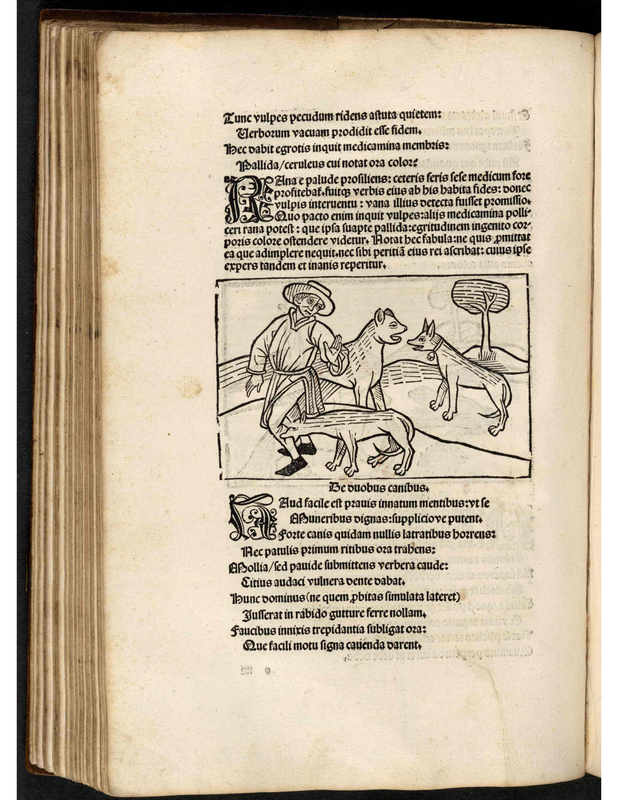
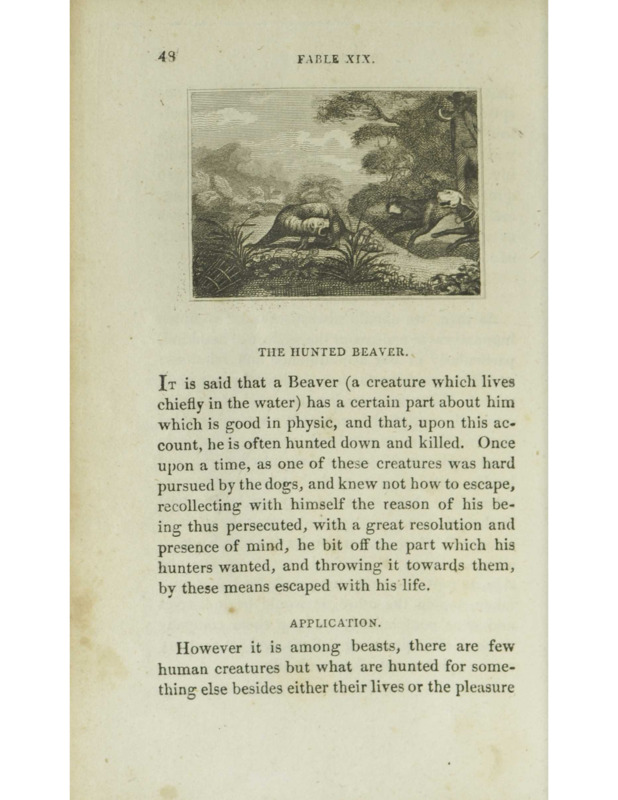
A horse stands tall, its head slightly bent to the right looking at the ground. Next to the horse, a wolf is jumping off its hind legs, looking up at the horse. The wolf is gesturing to the field in front of them with its right paw in the air.
Two groups of Indigenous Brazilians engage in armed conflict. Members of both groups wield bows and arrows and clubs, and some bite members of the opposing group. Most of the men in both groups wear feathered headdresses and adornments around their waists, and some wear necklaces. Several men have fallen to the ground. This image is identical to one found in Paris, 1557.
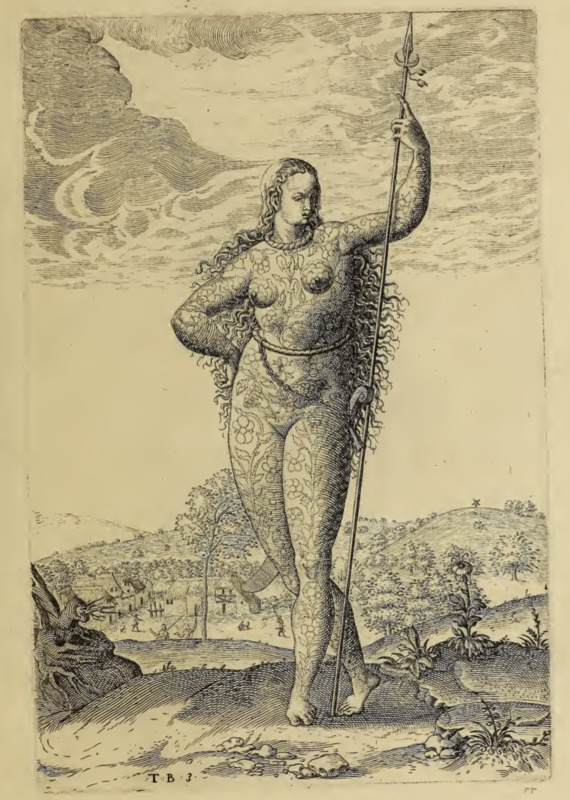
A young Indigenous woman is shown from the front. She carries a spear in her left hand. Her hair is long, she wears a twisted cord around her neck, and a sword with a curved blade hangs another cord around her waist. She is nude, and her body is covered in painted designs. The Picts were an Indigenous group who lived in Britain long before the author’s time. Images of Picts were included in this book so that readers could compare their customs to those of the Indigenous people living in Virginia.
In this image there are four people. The two in the middle are Jimena and El Cid. Jimena is wearing a dress with her long dark hair falling from her head. She is looking at her husband, El Cid. He is holding her hand and looking at her, he is wearing a tunic with different designs on it, he is also wearing a cloak and a hat. He has medium length hair and a beard. The boy behind Jimena is wearing a little cloak under his tunic. In the background there seems to be a priest wearing his habit. Behind the priest there is a statue of a person holding a vase. They are coming out of San Isidro, a church.
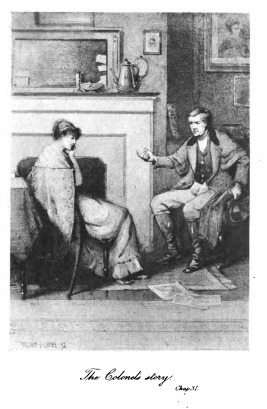
Here we see Colonel Brandon telling Elinor about his own experience with Mr. Willoughby. After Willoughby denying he ever loved Marianne, she was crushed, and all their mutual friends renounced his actions. The Colonel, who also admired Marianne, came to speak with Elinor and tell her about his private interactions with Willoughby. The Colonel tells her that as a young man he was in love with a young woman who was married to his older brother. She then divorced the Colonel’s older brother while the Colonel was in East India with his regiment. When he returned, he found her dying in a debtor's prison, with a young daughter. The Colonel then took charge of the daughter, named Eliza. He paid for her schooling. He permitted Eliza to go to Bath with her friend who was accompanying her ill father. The father was largely confined to the house, and the girls went out unchaperoned. Eliza met and fell in love with Willoughby, and she had a child by him. Willoughby then abandoned her. The Colonel told Elinor this in the hopes that it would help Marianne to get over him. In this image the two are sitting in front of a fireplace. This scene occurs in chapter 31 as noted underneath the title of this image. The characters are shown in the traditional regency style, with Colonel Brandon wearing waistcoat, tailcoat, and overcoat. Elinor wears the regency style dress with an empire waist. Her hair is worn tied up, as was tradition for women after their coming out before the queen, signaling her entrance into society. The regency period dated to the early nineteenth century (1811-1820) when George, Prince of Wales, later George IV (r. 1820-1830), reigned as regent for his mentally ill father, King George III (r. 1760-1820). The regency period is associated with the rise of neoclassicism in art and fashion. The same image appears as the frontispiece for the Dent 1893, 1894, 1895, 1896, and 1897 editions of Sense and Sensibility.
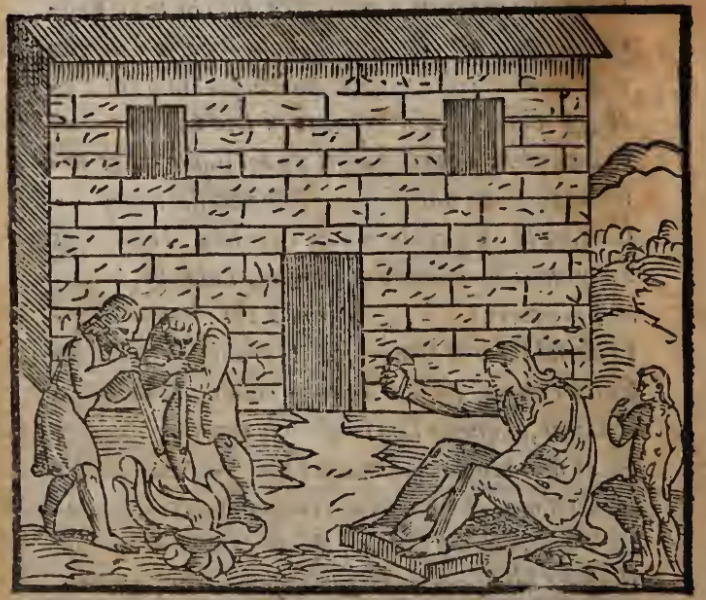
Three Indigenous people in Peru engage in metalworking with gold and silver. Two people use long tubes or hollow reeds to blow air onto a fire to melt the metal. Another person to the right sits on the ground and pounds the heated metal with a rock to shape it. A child stands nearby. In the background is a large stone structure.
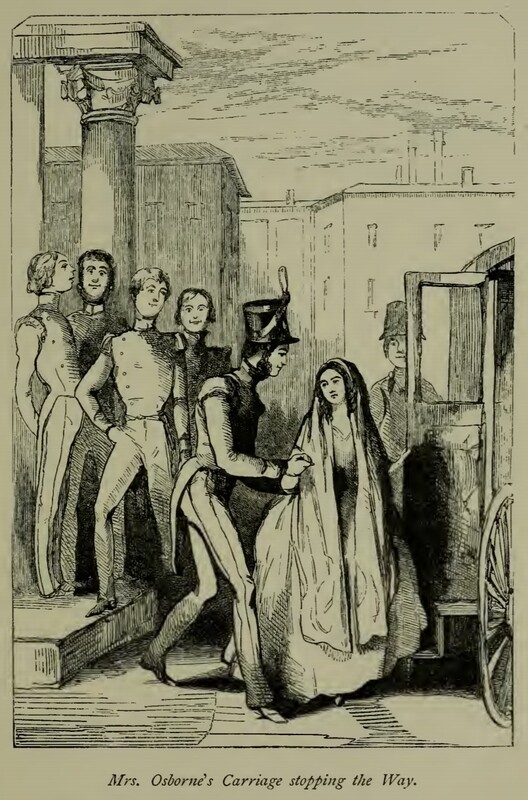
William Dobbin hands Amelia Osborne into her carriage as she leaves the ball. Behind the carriage door, the footman can be seen, and to the left of Dobbin, on the stair four young men are talking and smiling. In contrast to the others in the image, Amelia looks quite tired and sad. Below the illustration is printed its title, Mrs. Osborne’s Carriage stopping the Way.
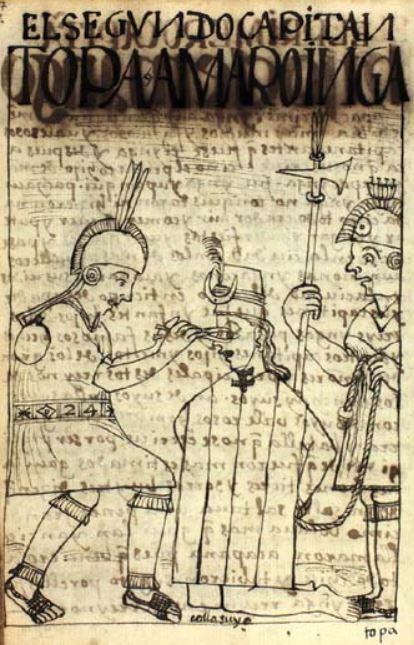
This illustration depicts the second Captain, Topa Amaro. These captains were a level of Inca authority who helped lead the conquest of the Andes. The author explains this captain was the son of Sinchi Roca, the second Inca king in the kingdom of Cusco. The author explains that this captain was violent and would torture and kill his enemies, which is why he is depicted gouging the eyes out of an enemy in this image. His enemy is depicted kneeling as he is being tortured by Topa Amaro. There is another Inca on the right side of the image holding the rope that the enemy is tied to. The word collasuyo is written at the bottom of the image, which was a southern region in the Inca Empire.
The two men in this image are El Cid stabbing the count Lozano and the count himself. El Cid is wearing a tunic and the way he is positioned, his face is not visible. The arm he is using to kill his combatant is hiding his face. In that hand he is wielding a sword. Only the hilt and a little bit of the sword is visible because the rest is buried in the count’s body. The fabrics from his sleeves are in the air due to his quick action. The count is lying on the floor with his sword still in his hand. He appears to be larger than El Cid wearing more lavish clothes than his killer. His head is tilted towards the back hiding his face as well.
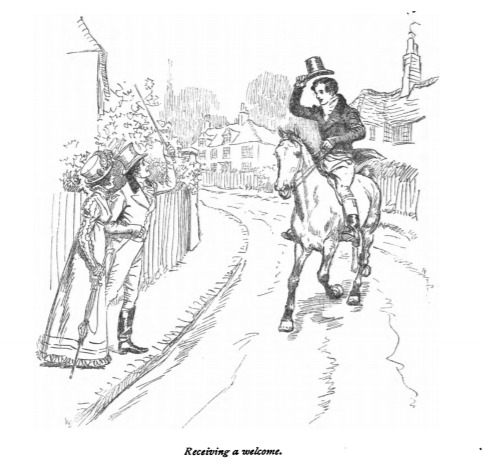
Here we see Edmund riding into Mansfield after being absent in Thornton Lacey raising his top hat to Mr. And Miss Crawford. Edmund was surprised to see them, as he thought that they would have left to go to London before he returned. This scene occurs in chapter 34. The characters are shown in the traditional regency style. Miss Crawford wears a regency style dress with an empire waist. Mr. Crawford and Edmund wear waistcoats and tailcoats with breeches and top hats. Mr. Crawford holds up his walking stick in greeting Edmund. The regency period dated to the early nineteenth century (1811-1820) when George, Prince of Wales, later George IV (r. 1820-1830), reigned as regent for his mentally ill father, King George III (r. 1760-1820). The regency period is associated with the rise of neoclassicism in art and fashion.
After spending the night with Areusa, Pármeno (rightmost figure) wakes to find that it is already noon. Areusa asks him to stay and talk, but he explains that his master Calisto will already be upset with his lateness. He proposes that they have dinner with Celestina, Elicia, and Sempronio that night, and she happily agrees. When he returns to Calisto’s house, he is met by Sempronio (leftmost figure), who chides him for his lateness. Pármeno explains his new love for Areusa, and Sempronio immediately infers that Pármeno is now working to scam Calisto with him and Celestina. They decide to check on Calisto (central figure) in his bedroom, and they find him in a state of despondency, talking to himself in verse. When he regains a semblance of sanity, he tells them that he is going to Saint Mary Magdalene’s Church to pray for a remedy to his situation.
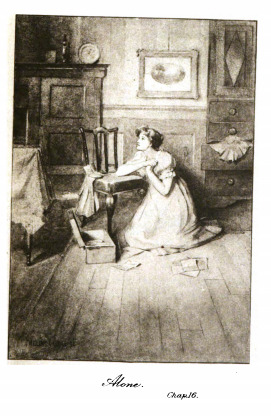
Here we see Marianne kneeling on the floor, leaning on a chair. She is surrounded by Willoughby’s letters after he left. Willoughby left very suddenly, coming to the Dashwood’s cottage while Marianne was home alone. She was in love with him and was distraught to hear of his departing so suddenly. Her box with his letters is open, and some are strewn on the floor. This scene occurs in chapter 16 as noted underneath the title of this image. The characters are shown in the traditional regency style, with Marianne wearing the regency style dress with an empire waist. Her hair is worn tied up, as was tradition for women after their coming out before the queen, signaling her entrance into society. The regency period dated to the early nineteenth century (1811-1820) when George, Prince of Wales, later George IV (r. 1820-1830), reigned as regent for his mentally ill father, King George III (r. 1760-1820). The regency period is associated with the rise of neoclassicism in art and fashion. The same image appears as an insert between pages 82 and 83 for the Dent 1893, 1894, 1895, 1896, and 1897 editions of Sense and Sensibility.
Jane and Maria Osborne and their governess, all with displeased expressions on their faces. One sister is standing with her chin on one hand. She and the governess, Miss Wirt, are looking towards the right of the picture, staring in the direction in which Amelia Sedley just left. The other sister is seated on a cushioned chair, holding a piece of cloth or paper and looking back at the others. On the floor by her side there is a small dog.
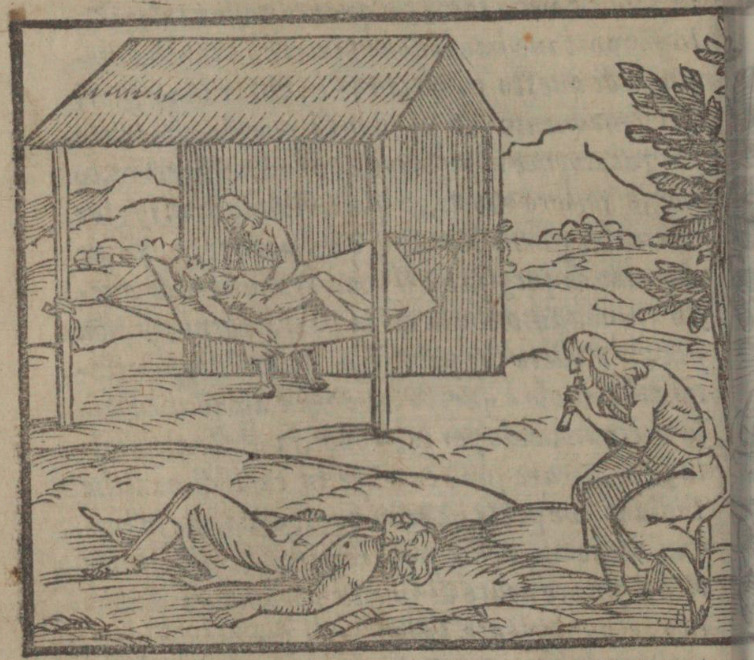
An Indigenous man seated on a three-legged stool smokes a pipe, while a second man lays on his back on the ground nearby with a pipe on the ground near his arm. In the background, a man tends to another person lying on a hammock under a shelter with a roof and one wall. This image is identical to one found on page 55 (unnumbered) of Venice, 1565.
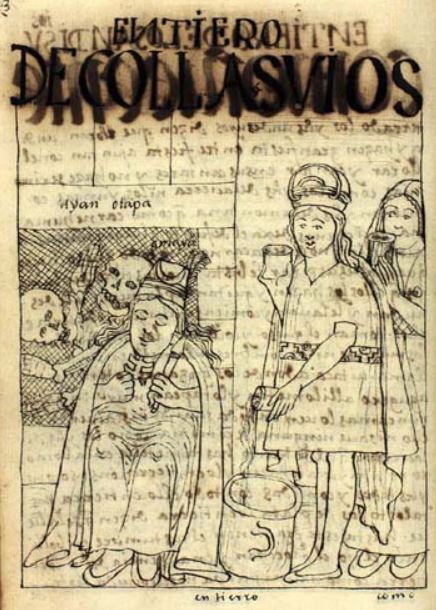
This image depicts the burial traditions of the people in the Collasuyo region of the Inca Empire. The author explains that the deceased would be buried in fully clothed in an upright-seated position five days after their death. They would be given food and dinner ware for their burial. The deceased in this image is illustrated adorned in garments as they sit in an upright position in front of the ayan otapa [house of the dead]. The figures on the right side of the image are depicted drinking and making liquid offerings to the dead. The caption at the bottom of the image reads enterrio [burial].

![[Vanity Fair Vol. II Chapter XLII Inhabited Initial]](https://collections.cemvc.ca/files/large/5eaed40998e995ad0045e45ff26ecf6b343a5381.jpg)
![[Two Indigenous Brazilian groups in conflict with each other]](https://collections.cemvc.ca/files/large/4059d6090f9c655d23a105358e76f5ac078dce0b.jpg)

![[Wedding of Jimena and El Cid]](https://collections.cemvc.ca/files/large/6d7aef5b7e08becd2f8acd7fd2073b351a472276.jpg)



![[The Cid stabbing the count Lozano]](https://collections.cemvc.ca/files/large/5e69b7f19b683dae235b1166a828a2c45ae3ff00.jpg)
![[Act VIII – Sempronio, Calisto, and Pármeno Talking]](https://collections.cemvc.ca/files/large/3b7cfbf7dc3589389cefde0222e9920393c6df6b.jpg)
![[The Osborne Sisters and their Governess]](https://collections.cemvc.ca/files/large/41b1bd2cba0a9990fb51a1136e595732f8cfaa4d.jpg)