Here we see the Houyhnhnm’s house. Gulliver describes it as a long building made of timber with a low, straw roof. The house has a smooth clay floor and a rack and manger that extends the entire length of the house. The letter A is on the house because this image appears at the beginning of chapter two, and A is the first letter of the chapter. The same image appears in the 1839 Krabbe edition.
Sempronio (rightmost figure) arrives at the house of Celestina (central figure) and angrily chastises her for the slackness with which she is fulfilling Calisto’s request. She explains that she will be able to extract more compensation from Calisto if she takes her time. She asks him to join her in scamming Calisto, offering him an equal share of the profits and her prostitute Elicia (top-left corner, looking out from the window) in exchange for his loyalty. Sempronio readily agrees, and when Celestina departs for Melibea’s house, he stays behind to spend time with Elicia.
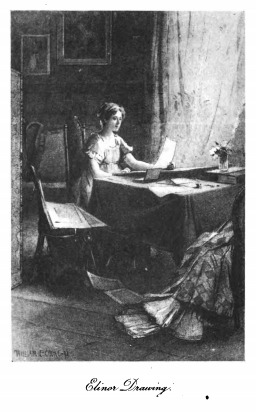
Here we see Elinor sitting at a desk drawing. She was an accomplished artist, with some of her drawings displayed on the wall behind her. Young upper-class women in this period were expected to be accomplished in at least one form of artistic endeavor. Elinor chose drawing as her primary pastime. Her sister, Marianne, on the other hand was a good pianist. Women would practice these skills during the day. Practicing these skills was a means of dividing the upper-classes from the lower-classes, as it stood as a symbol of these upper-class women’s free time, because they did not have to do any labour or provide for their families, as did lower class women. In this image, Elinor sits at a desk with an easel sitting on top to elevate slightly the drawing on which she worked. The characters are shown in the traditional regency style, as Elinor wears the regency style dress with an empire waist. Her hair is worn tied up, as was tradition for women after their coming out before the queen, signaling her entrance into society. The regency period dated to the early nineteenth century (1811-1820) when George, Prince of Wales, later George IV (r. 1820-1830), reigned as regent for his mentally ill father, King George III (r. 1760-1820). The regency period is associated with the rise of neoclassicism in art and fashion. The same image appears as an insert between pages 16 and 17 for the Dent 1893, 1894, 1895, 1896, and 1897 editions of Sense and Sensibility.
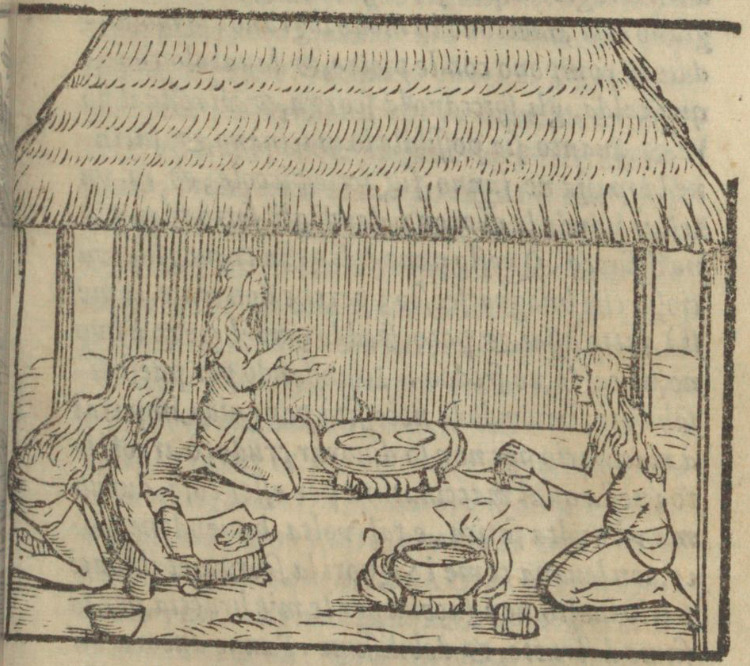
Here Indigenous women make bread inside a shelter comprised of a thatched roof and one wall. The woman on the right grinds corn and cooks it over a fire, the woman on the left rolls dough, and the woman in the middle grills the bread on a flat surface over a fire. This image is identical to one found on page 56 verso of Venice, 1565.
A thin man walks along a raised path. He has his cane and free hand out in front of him, and behind him is a small town in the distance. In the top right of the image is the letter W from We.
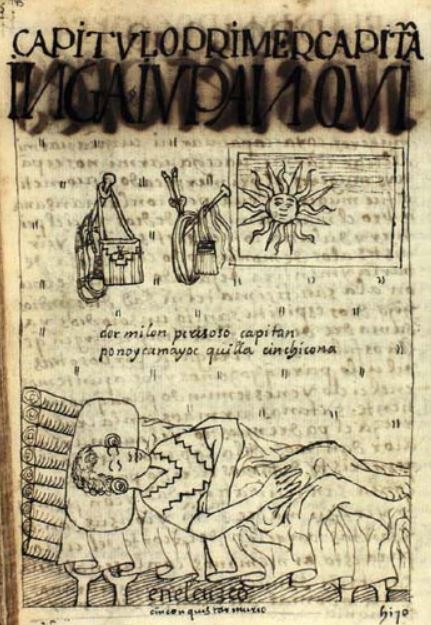
This illustration depicts the first Captain, Yupanqui. These captains were a level of Inca authority who helped lead the conquest of the Andes. The author explains that this captain was lazy, slept all the time, had parties, and was not focused on his duty. This is why he is depicted sleeping in this image with the sun rising through his window. Some of his belongings such as shoes and bag are hanging on the wall above him. The words dormilon, peresoso capitan, ponoy camayoc quilla cinchicona are written in the centre of the image which translates to sleepyhead, lazy captain, he slept all the time. The words en el cuzco are written below the sleeping captain, which means in Cusco, the capital of the Inca empire. The words cin conquistar murio are written at the very bottom of the image which translates to without conquering he died.
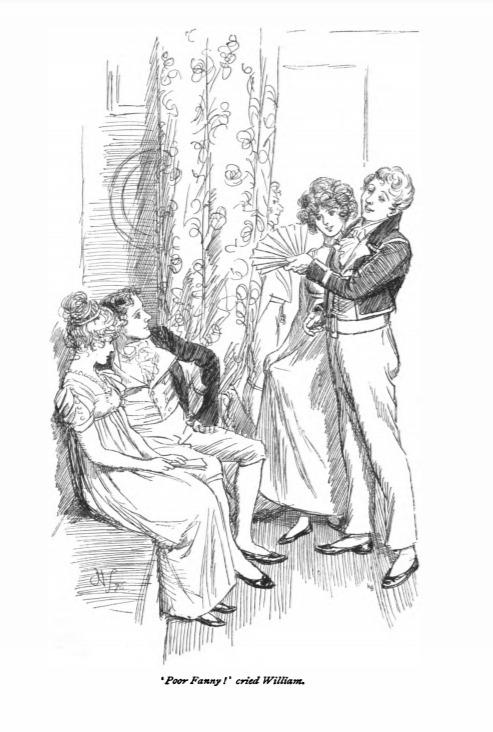
Here we see Fanny and Mr. Crawford sitting down at the ball with Edmund and Miss Crawford standing in front of them. Fanny got tired easily and after the first two dances went to sit down, and Mr. Crawford followed her, still trying to get her to fall in love with him. Edmund, who was dancing with Miss Crawford, came over to speak with them, and Edmund lamented Fanny’s weak constitution. This scene occurs in chapter 28. The characters are shown in the traditional regency style. Fanny and Miss Crawford wear regency style dresses with empire waists. Mr. Crawford and Edmund wear tailcoats, waistcoats, and cravats. The regency period dated to the early nineteenth century (1811-1820) when George, Prince of Wales, later George IV (r. 1820-1830), reigned as regent for his mentally ill father, King George III (r. 1760-1820). The regency period is associated with the rise of neoclassicism in art and fashion.
In this image there is a lot of chaos and a lot of people, the focus of the image is on Jimena in the middle. She is wearing a dark dress; her hair is long and dark as well. She has her hands in the air. She is in the street and there are many people surrounding her, the man in front of her is the king. He is wearing a crown with long robes and a cloak. There is another man beside the king wearing a hat and robes. The building structure behind the king has arches and an entrance in the back. Among the people surrounding Jimena a child and a woman are distinguishable. Also, a man is sitting on his horse with a helmet on. There are also three more horses a part from the one being ridden by the man with the helmet in the background.
An Indigenous person sitting on the ground is in the process of starting a fire by twirling a smaller stick against a log. Nearby there are two trees, the smaller one labelled ‘cacauate’ (a cacao tree) has several large seeds amongst its branches. In the background, a number of the seeds have been picked and laid out to dry on a blanket on the ground.
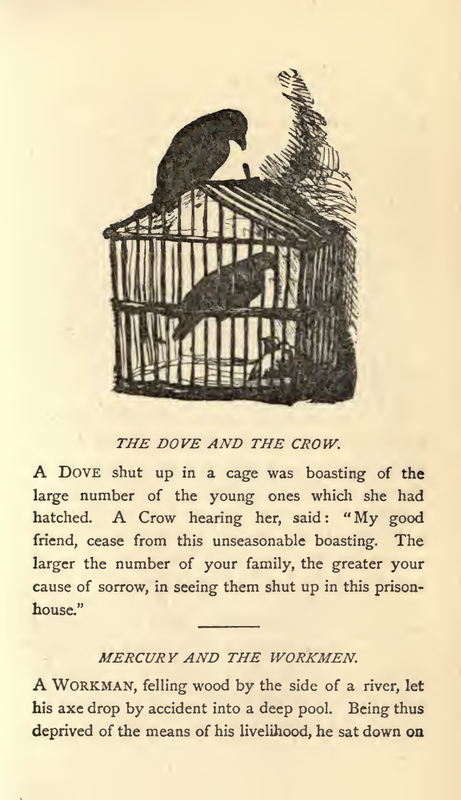
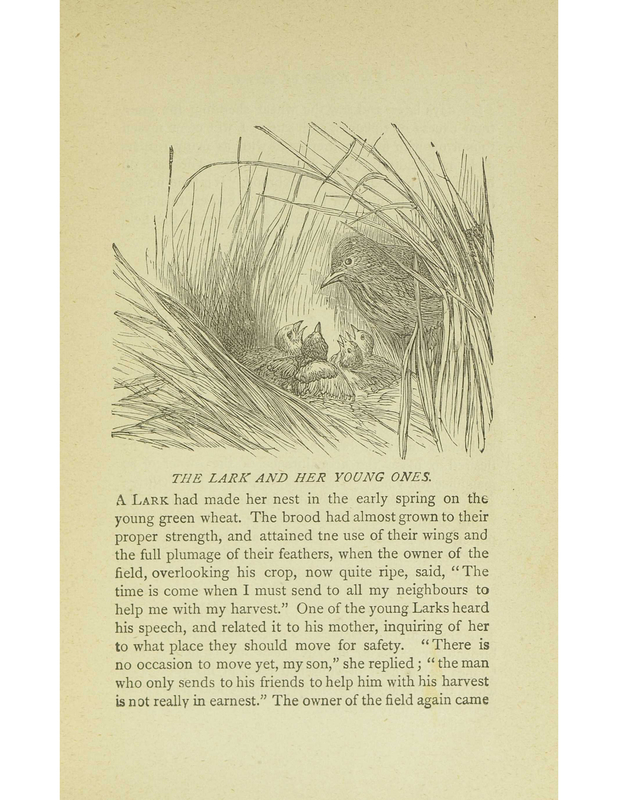
Hidden in the middle of tall grass, a mother lark stands above her four little ones that are resting in their nest. The little ones look up to their mother with their beaks open, awaiting food.
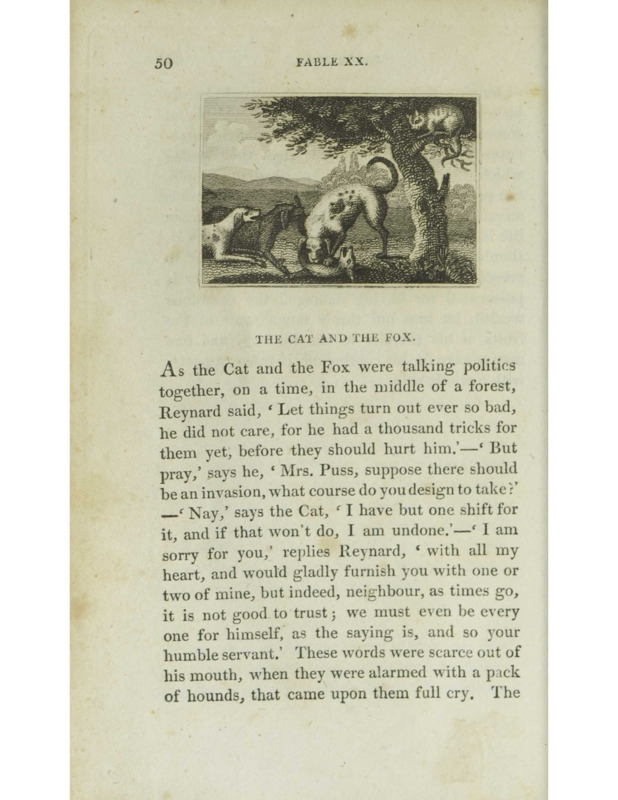
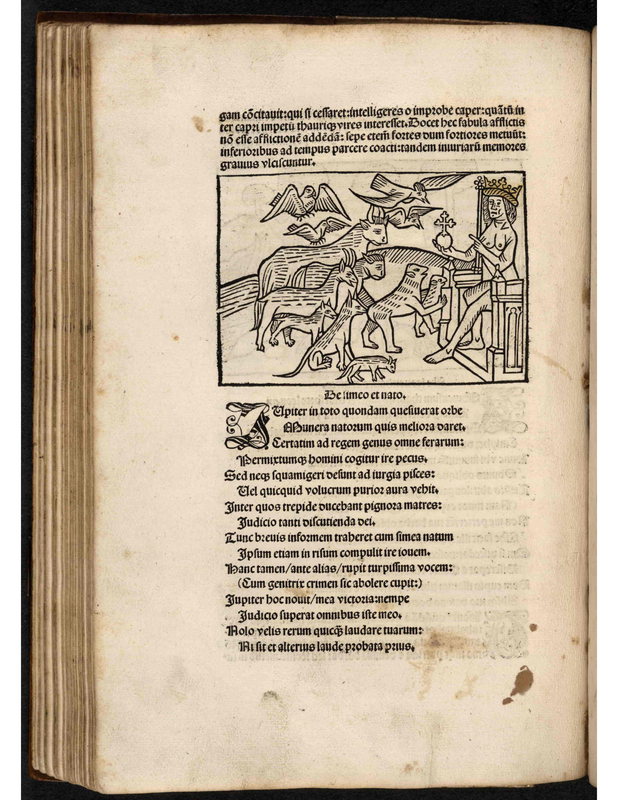
On the left side of the image, there are animals such as birds, cows, dogs, and foxes gathered in front of a naked human sitting on a throne holding a cross. One of the animals is lifting its baby to show to the human.
Miss Betsy Horrocks, the butler’s daughter, with very large ribbons in her hair, sits on a low stool in front of the piano in the Crawley manor’s drawing-room. Beside her stands Miss Hester, the kitchen maid, who is praising her playing.
Three Indigenous people, two men and a woman, pick bananas from a tree and place the fruit in a basket that the woman carries on her back. Two birds swoop down and take fruit from the tree, and a third bird has been shot with an arrow. A bow and arrows rests on the ground behind the man standing on the right and the two men wear feathered headdresses. Bananas were introduced to Brazil by the Portuguese in the early 16th century. This image is identical to one found in Paris, 1557.
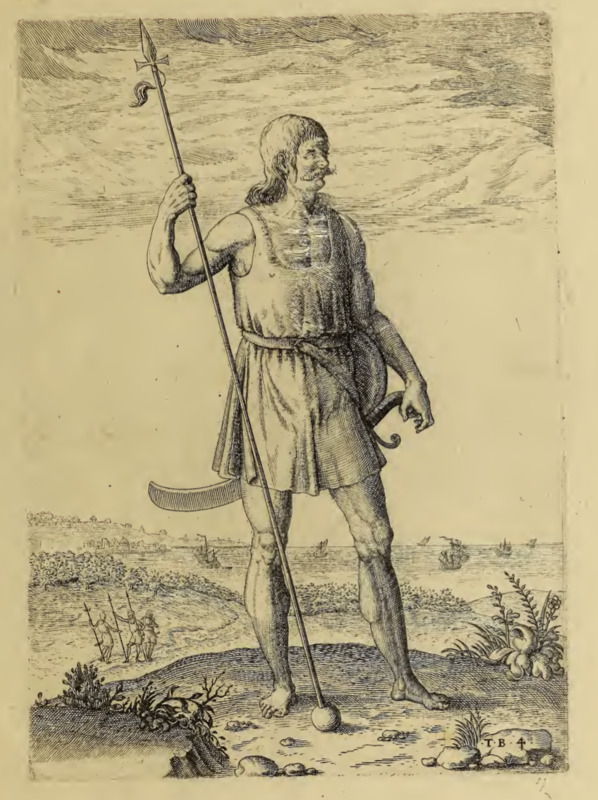
An Indigenous man is shown from the front. He carries a spear with a ball on the end in his right hand. He wears a belted tunic, and both a round shield and a sword with a curved blade hangs from the belt around his waist. This man is described as belonging to an Indigenous group that lived near the Picts. The Picts were an Indigenous group who lived in Britain long before the author’s time. Images of Picts were included in this book so that readers could compare their customs to those of the Indigenous people living in Virginia.
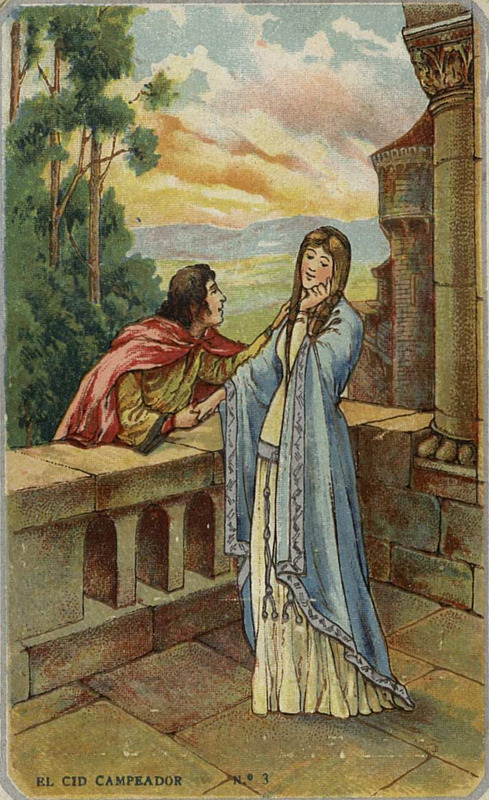
In this image El Cid is courting Jimena. El Cid has brown medium length hair wearing a yellow tunic and a red cloak. Behind El Cid there is a forest and the sky has lines of yellow suggesting sunrise. He is holding Jimena’s hand as her other rests on her cheek. She is wearing a blue and white dress and her blond hair is done up in two braids. She is standing on a balcony of a castle, which is also visible on the right of the image. The castle is made out of stone.
Queen Elizabeth I is depicted standing on a raised dais to the left of the image, drinking from a pitcher of beer she holds in both hands. In front of her is the ancestor of Pitt Crawley, a man with a pointed beard, kneeling and holding the platter from which the beer was taken. A slight figure of a guard can be seen behind the queen, and in the top right of the picture, the letter A from Among is seen through a window.
A diplomat from Luggnag explains the reality of the immortals to Gulliver. He says that they act like mortals until about the age of thirty, and then become very melancholy until about eighty years old. At this time, they recon themselves with the reality of never dying. The diplomat also says that the immortals often become opinionative, peevish, morose, vain, covetous, talkative, and incapable of friendship. Furthermore, they lose all ability for affection, even for their descendants. Their primary characteristics become impotent desires and envy. They cannot experience pleasure, and when they attend a funeral, they find themselves envious of others who could die. Their memories also begin to fade. In this image we see a group of these immortal men looking angry and discontent. They are identified by the large spot on their forehead above their left eyebrow. The same image appears in the 1839 Krabbe edition.

![[the Houyhnhnm’s house]](https://collections.cemvc.ca/files/large/56467b9b843ee50861315f8224ee4b3cf85cb5d3.jpg)
![[Rebecca buys the Portrait]](https://collections.cemvc.ca/files/large/0cda9ec70b2742cf8bc0eacb46daef9edc6ae8cc.jpg)
![[Act III – Elicia Watches as Sempronio and Celestina Arrive]](https://collections.cemvc.ca/files/large/bf11e4bc49387fe4373c65224d6124b7f70a2561.jpg)
![[Vanity Fair Vol. II Chapter XXX Inhabited Initial]](https://collections.cemvc.ca/files/large/d09cab9acd98b2980aa3cd46869e3fb12d44cbeb.jpg)

![[Jimena begging the king to avenge her father]](https://collections.cemvc.ca/files/large/f85c8c1c05714ce70c0df8b1b1b9c3aebab01a48.jpg)



![[Hester and Betsy]](https://collections.cemvc.ca/files/large/4a4e06bc18cdfc2391352ec19710fb2f5d18102b.jpg)
![[Indigenous Brazilians pick bananas from a tree]](https://collections.cemvc.ca/files/large/2cf8c1e6fce31db2f84e47c3049ae1cafa557128.jpg)

![[Vanity Fair Vol. I. Chapter VII Historiated Initial, A]](https://collections.cemvc.ca/files/large/22c07da4889f0f6e0eab8d56e16847dbf6c595d6.jpg)
![[male immortals from Luggnag]](https://collections.cemvc.ca/files/large/20723be51f2c47f3b28502a81c794d1f0aa8452c.jpg)