Two assistants of Mr. Moses, the sheriff’s-officer, watching the Crawley’s residence on Chancery Lane. They are wearing black coats and tall hats, carrying thin sticks, and scowling.
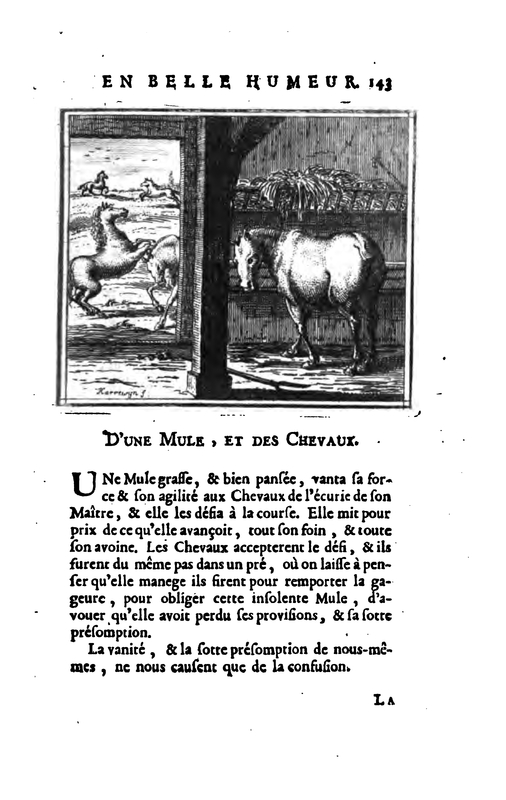
A horse is standing inside a structure while outside the door a horse is up on its two hind legs and other horses can be seen in the distance that appear to be running.
The left panel depicts Melibea’s servant Lucrecia, who is wearing a robe and a veil. To the right we see Celestina, who is also sporting a robe and a veil, holding a flower in her right hand. Both figures are placed outside.The left panel is nearly identical to those found on pages 12, 208 and 271 (where it is labeled ‘Melibea’), pages 173, 287, 306, and 317 (where it is labeled ‘Areusa’), and page 350 (where it is labeled ‘Alisa’). The right panel is nearly identical to those found on pages 235 (where it is labeled ‘Lucrece’), 287 (labeled ‘Elicia’), 299 (labeled ‘Alisa’), and 306 (labeled ‘Elicia’).
A man is standing outdoors. There is a fence surrounding him and two trees. The man is looking at a bird that is on a tree very close to him. The man is holding a stick device.
This image depicts Helen of Troy, previously of Sparta, looking out through a window with Paris of Troy as they watch the ships of the Greeks arrive to their walled city. The soldiers on the ships have their spears drawn as they prepare for what will become the ten year Trojan War. The Trojan War began because Helen, wife of King Menelaus of Lacedaemon (Sparta) went to Troy with Prince Paris, whether she went willingly or unwillingly is still uncertain.
Here we see a pair of hands – likely Gulliver’s - pulling on a glove. The glove has a man embroidered on the cuff. The man has ruffles around his wrists. The image comes at the end of the first part, before Gulliver leave Blefuscu and returns to England. The same image appears in the 1839 Krabbe edition.
Here we see one of the great European kings with their ancestors. Much to Gulliver’s surprise, many kings had ancestors who were not royal. Some families had fiddlers, courtiers, barbers, and prelates as ancestors, rather than a line of royalty. Gulliver amused himself by tracing different features through family lines, both physical attributes and characteristics of one’s personality. The same image appears in the 1839 Krabbe edition.
Two women are talking outside. There is a fence with an arch, and a tree by them. There is a dog by the women patiently waiting for them. The women are wearing long robes.
Here we see the letter Gulliver sent to the secretary of state of Blefuscu informing him that he would be setting out for Blefuscu later that day. Immediately after sending the letter Gulliver left Lilliput without waiting for a response. The same image appears in the 1839 Krabbe edition.
This image is illustrated in a chapter that discusses the descendants of the Inca and Andean nobles under Spanish colonial rule in Peru and their importance to a revived Andean society. This image depicts a native official who was responsible for overseeing five tributary natives in his pueblo of Chipau. He is depicted standing in front of a building while wearing traditional attire with an embroidered tunic and a head piece. He is also illustrated holding a rosary in both hands. The author explains that this official was a mitima [a person who permanently resided outside of the town he administered]. The caption at the bottom of the image reads, tributario y cabildo, no tiene don que no falte cinco yndios tributarios [tributary council, he who lacks five Indians does not have a title].
Joseph Sedley is asleep at the dinner table, leaning back in his chair. On the table in front of him are the remains of dinner, including his plate and cup and a decanter. He is framed in the letter O from On.
Here we see a herd of Lilliputian cattle walking towards the town. The cattle are attended by a Lilliputian man. Gulliver’s head and shoulders are visible over the hill where he watches the cattle. The image comes when the Emperor gives Gulliver his own household and staff, with the cattle making up a part of Gulliver’s household farm. The same image appears in both the 1839 and 1843 Krabbe editions.
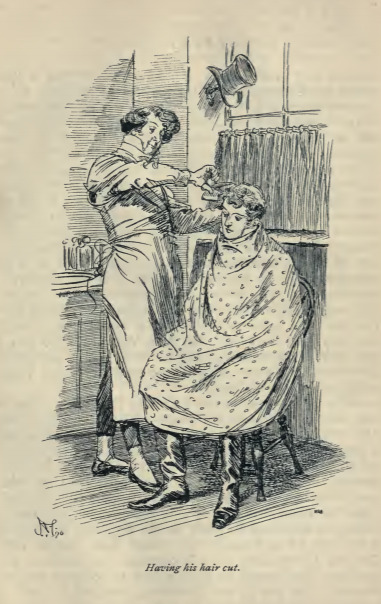
In this image Frank Churchill goes into London to get a haircut. Frank Churchill came to visit Highbury to visit his father, Mr. Weston, for two weeks. One day of his trip he went 16 miles into London to go to a barber to get his hair cut. Emma thought it was quite frivolous, but she was still very fond of him. This scene occurs in chapter 25. The characters are shown in the traditional regency style. The barber wears a waistcoat and tailcoat with a cravat and an apron to protect his clothes. Frank Churchill has a cape wrapped around his neck and his top hat is hung on the wall behind him. He has a top hat and carries a walking stick. The regency period dated to the early nineteenth century (1811-1820) when George, Prince of Wales, later George IV (r. 1820-1830), reigned as regent for his mentally ill father, King George III (r. 1760-1820). The regency period is associated with the rise of neoclassicism in art and fashion.
The left side of this illustration presumably depicts Calisto’s first encounter with Melibea. To the right, we see a group of figures. The leftmost figure in this group represents Celestina, who is wearing a robe and veil. Three of the remaning four figures would represent Calisto, Sempronio, and Pármeno, signalling that this is intended to represent the scene in which Celestina first visits Calisto. However, the presence of a fourth figure does not accord with the number of characters present in this scene.[This illustration is identical to those found in Acts VII (folio 52v), IX (folio 67r), XI (folio 80r), XII (folio 83v), XIV (folio 96v), XVI (folio 106v), and XIX (folio 115v).]
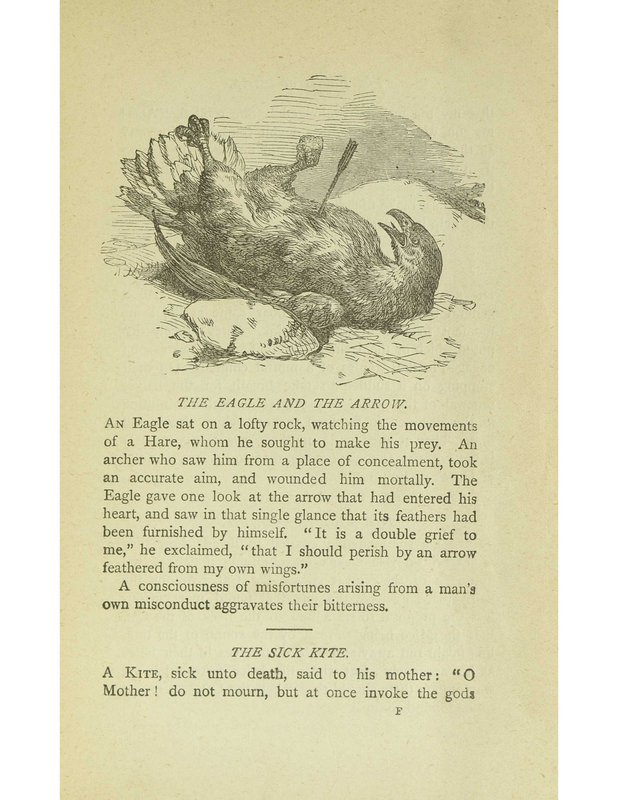
An eagle is lying on the ground on its back. Both is feet are in the air and its claws are curling inwards. The eagle’s beak is wide open, and its eyes look as though it is in pain. An arrow sticks out of the eagle’s chest.
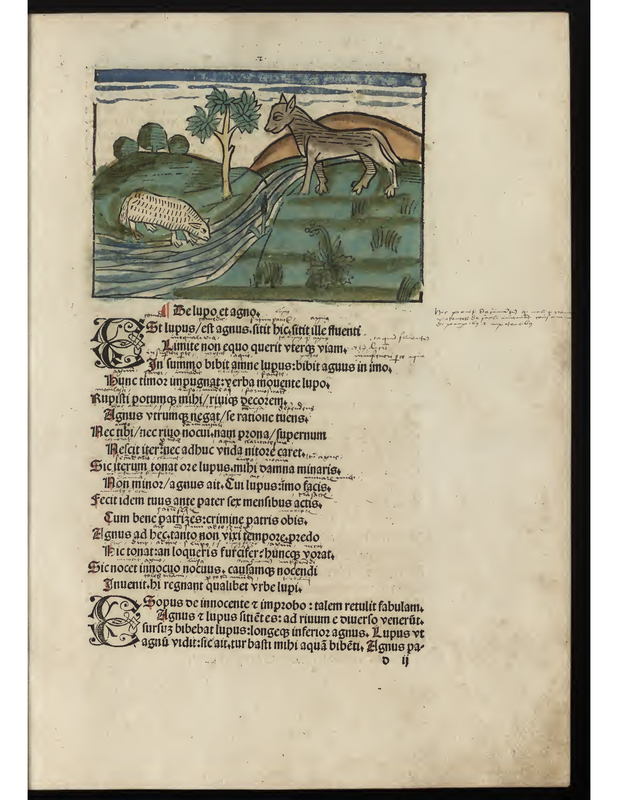
Animals are lounging in a field. There is a bull, a lion, a sheep, and a goat standing. On the ground lies a deer. There are leafy trees in the background, and weeds coming out of the ground where the animals are eating and lounging. Birds are flying in the air further in the back amongst the trees.
This illumination depicts a woman named Cornificia sitting down as she writes on a piece of parchment with a quill. Cornificia is famous for her poetry and writing abilities. She is said to have written many Heliconian verses which were highly esteemed. Boccaccio explains that she is worthy of praise as poetry and writing was not something women excelled in or pursued during Cornificia’s time.
Two groups of Indigenous people approach each other in canoes. Each canoe has one archer in front, and each archer aims their bow at the opposing group. There is a European man in the canoe on the left in the back, aiming a gun. The rest of the Indigenous people in the canoes hold paddles. Two people have fallen into the water between the canoes. Two Indigenous settlements are shown on the shore in the background.
Here we see a satire of lawyers as a spider in a web. The image represents Gulliver’s unflattering views on lawyers as insects. The image represents lawyers wrapping up their clients by confusing them, just as spiders trap their prey in their webs. The image appears at the beginning of chapter six, and the letter M appears in the top corner because my is the first word of the chapter.

![[Mr. Moses’s Men]](https://collections.cemvc.ca/files/large/5641477a381a2eb557bc52ec6413f21ac5c8f6d1.jpg)
![[Act IV – Lucrecia and Celestina]](https://collections.cemvc.ca/files/large/a72c57d427cc6bfd3b877672072b64958edaff31.jpg)
![[Man and bird]](https://collections.cemvc.ca/files/large/02b330878332575e376caaacadf8e37087bf6531.jpg)
![[Helen Watches the Greeks Arrive to Troy]](https://collections.cemvc.ca/files/large/76c8b8e2461078913f17c5d766cd1d002fc8f5dc.jpg)
![[Gulliver puts on gloves]](https://collections.cemvc.ca/files/large/1ce0f36f0bcf36964f696161e30972971c499896.jpg)
![[Gulliver sees great kings of history and their ancestors]](https://collections.cemvc.ca/files/large/d7c61fd9716a3af38d1e12d06ef4a36b8476b8d7.jpg)

![[Rebecca and Amelia on the Stairs]](https://collections.cemvc.ca/files/large/7ae74ed4f1460fa99dad1ddbf83d0476670bb65a.jpg)
![[Women and dog]](https://collections.cemvc.ca/files/large/285460885fca21d1f9ade544174d454fad5d1b00.jpg)
![[Gulliver's letter to the state officials of Blefuscu]](https://collections.cemvc.ca/files/large/99e68615a90307764190a36ce8b72669773657e1.jpg)
![Mandoncillo de Cinco In[di]os, Pichica Camachicoc, Poma, del Ayllu Allauca Guanoco del Pueblo de Chipau, Mitima](https://collections.cemvc.ca/files/large/9a6529f630a8f92a14b7b91ea465214fd20de806.jpg)
![[Vanity Fair Vol. I Chapter XXVI Historiated Initial]](https://collections.cemvc.ca/files/large/01116c374ce2ebcc45fc0ed5ccb5497586540abc.jpg)
![[Gulliver watches a herd of cattle which form part of Gulliver’s household]](https://collections.cemvc.ca/files/large/95e4874e19c3d9a2428fe96d6659fa04bb336875.jpg)

![[Act I – Calisto Encounters Melibea/Celestina Visits Calisto, Sempronio, and Pármeno]](https://collections.cemvc.ca/files/large/92c05aed29020226c9ed2cba4f5a6aa5b82efb4d.jpg)
![[Animals in a Field]](https://collections.cemvc.ca/files/large/7ec4ce07a30b91dc612c26743f7c6ab39750f0ce.jpg)

![[Naval conflict between two Brazilian Indigenous groups]](https://collections.cemvc.ca/files/large/01a8edb9949c96dbc8f0706669dc0289109e4c15.jpg)
![[Lawyers depicted as spiders]](https://collections.cemvc.ca/files/large/ec80dc7f33427f62f66658109583e798114ebcb3.jpg)