Don Quixote (left) clad in armor, lies on the ground next to his crumpled horse Rocinante. Using his right arm to hold himself aloft, the knight-errant feebly raises his shield to protect himself. A man with a cape (left) raises a large wooden stick above his head poised to strike at Quixote. A splintered lance lies in the foreground.
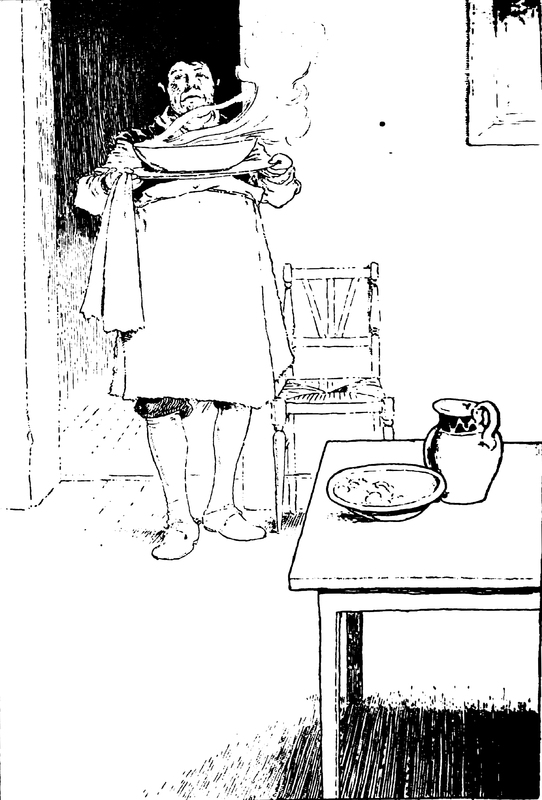
Don Quixote and Sancho Panza stop at an inn, though for the first time Quixote does not mistake the inn for a castle. Sancho Panza asks for many meals from the innkeeper, but the innkeeper responds that he only has a pair of cow-heels that look like calves-feet stewed with peas, onions, and bacon which Panza orders. Supper-time being come, Don Quixote withdrew to his chamber ; the host brought the flesh -pot just as it was, and Sancho Panza sat himself down to supper.
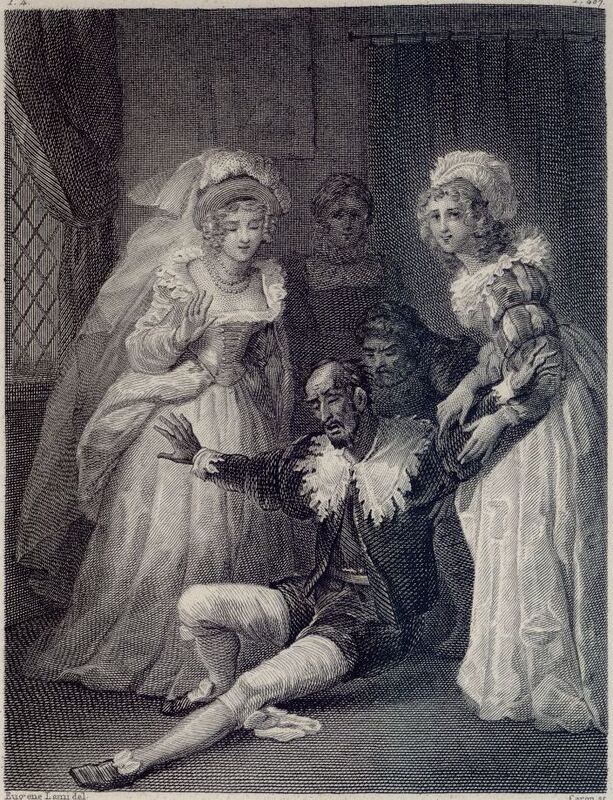
At the soirée, Don Quixote sits on the floor in the middle of the room, exhausted and wearied by so much dancing. Sancho Panza and two ladies try to help him up. Signed by E. Lami (illustrator) and J. Caron (engraver). Part 2, ch. 62.
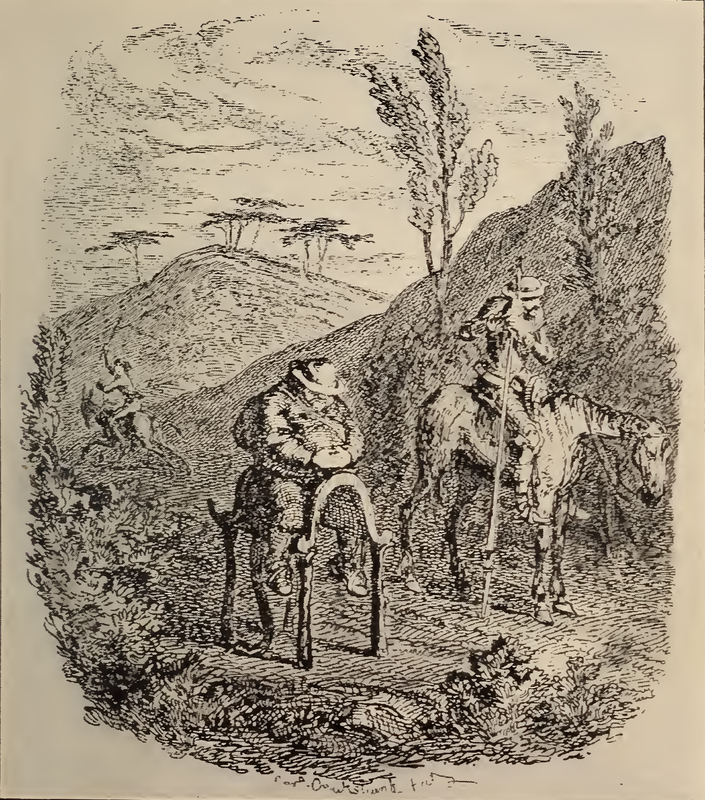
After freeing the galley slaves, Don Quixote and Sancho Panza rest for the night the heart of the Sierra Morena. While they sleep they are visited by Gines Pasamonte, the famous knave and thief who had been freed from slavery by Quixote who subsequently hid in the mountains. Pasamontes is not the grateful type and sets about stealing Sancho's donkey as well as their supplies. Sancho Panza (left) sleeps so soundly that he does not realize when he is lifted from his donkey Dapple and placed onto a saddle held aloft by four stakes. Seeing as Rocinante is such a particularly weak horse, Pasamontes (background) leaves after taking the donkey whilst Quixote (right) and Panza remain asleep
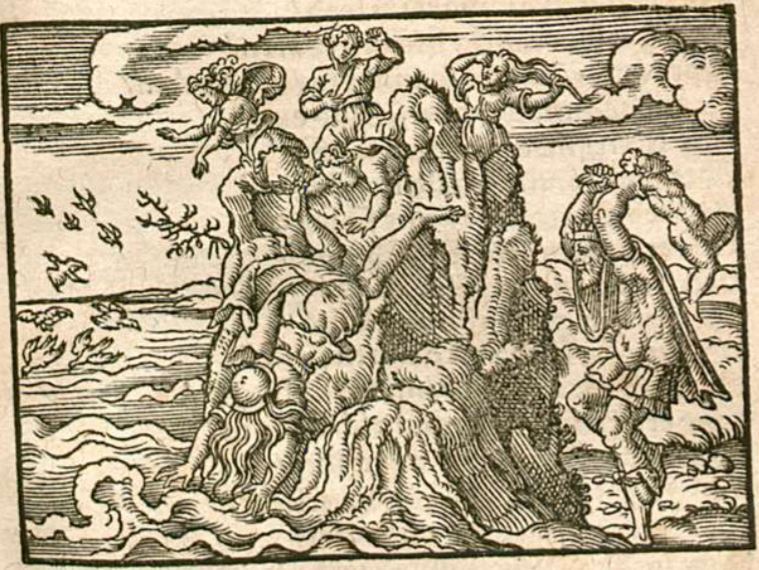
One of the Furies, Tisiphone, had just plagued the minds of Ino and Athamas with utter madness. Athamas hallucinates and believes that his son Learchus is a lion cub. As illustrated on the right side of the engraving, Athamas grabs Learchus and swings him around his head and finally cracks his own son’s head on the rock in front of him, killing him on the spot. Ino’s madness led her to hold her daughter Melicerta in her arms and plunge off the cliff into the water below. Ino’s attendants are depicted on the top of the cliff, grabbing their hair in mourning for their master. The attendants do so without realizing that the goddess Venus had taken pity on Ino and her daughter and got her uncle Neptune to transform them into sea-goddesses before dying.
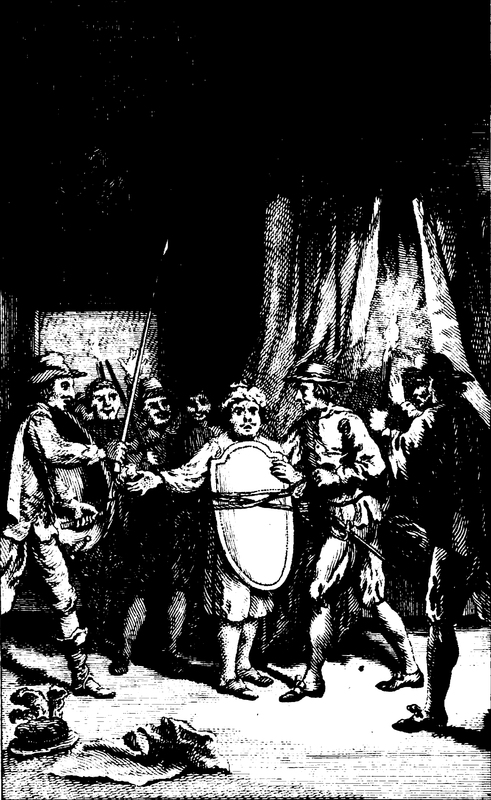
On the seventh night of his governance, Sancho Panza awakes to clamorous noise of bells, trumpets, and drums. Opening his chamber door he found twenty people telling Sancho to bear arms against their enemy for they were being attacked. Although Sancho tried to convince them that he knew nothing about taking up arms they immediately put over his shirt two large shields: one to protect his stomach, and another behind; and then pulling his arms through some holes, they confined him such that he was totally incapable of moving. They then fixed a lance in his hands, and told him to march, as a brave and gallant governor ought to do. Written beneath the image are the lines "fatigued, poor Sancho's senses slumbers charm, but soon he's maked by orders of "arm arm arm". In armour fastened which he cannot use, he fears to fight but does not dare refuse".
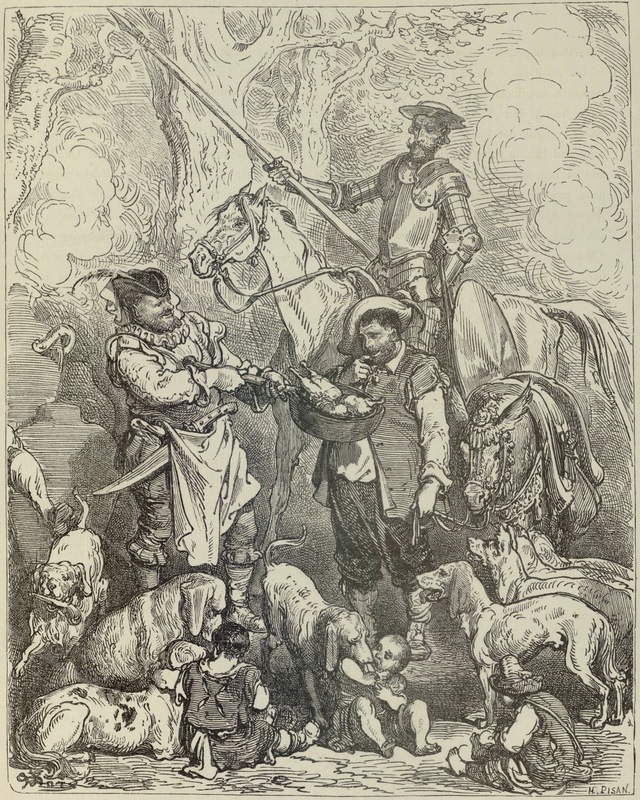
At Camacho’s wedding, Sancho Panza approaches one of the cooks and asks to dip a crust of bread into one of the cauldrons. The cook offers Sancho a pot with three chickens and two geese. Don Quixote, mounted on Rocinante, is depicted in the background. Three children and a half-dozen dogs are pictured in the foreground. Signed by G. Doré (illustrator) and H.-J. Pisan (engraver). Part 2, ch. 20.
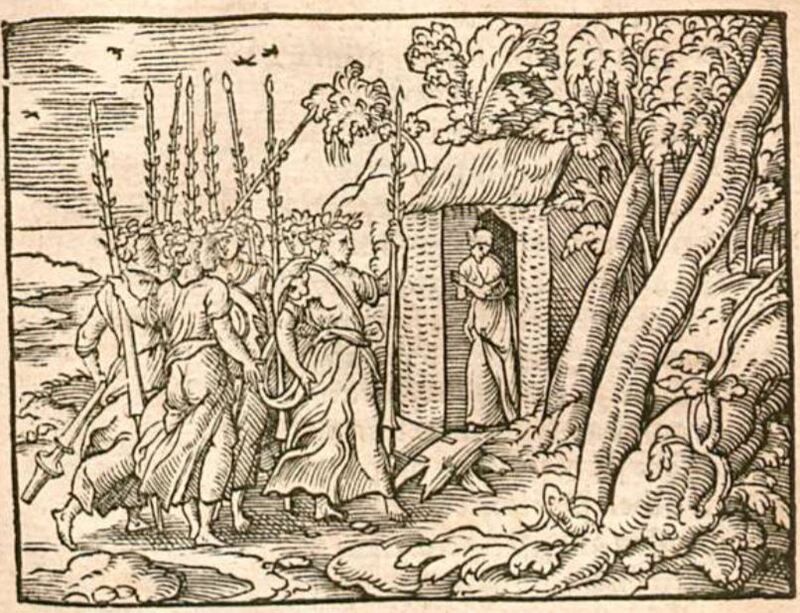
Procne is illustrated with a spear in her hand with a group of companions behind her. They are treading through the woods to rescue Procne’s sister, Philomela, who had been captured by Procne’s husband, Tereus. Tereus had put Philomela in a cabin in the woods and cut off her tongue to prevent anyone from finding her. Philomela, however, weaved a cloth that described the situation and found a messenger to bring it to Procne. Disgusted by her husband’s actions, Procne wasted no time to tread through the woods to find her sister, who is illustrated in the doorway of the cabin.
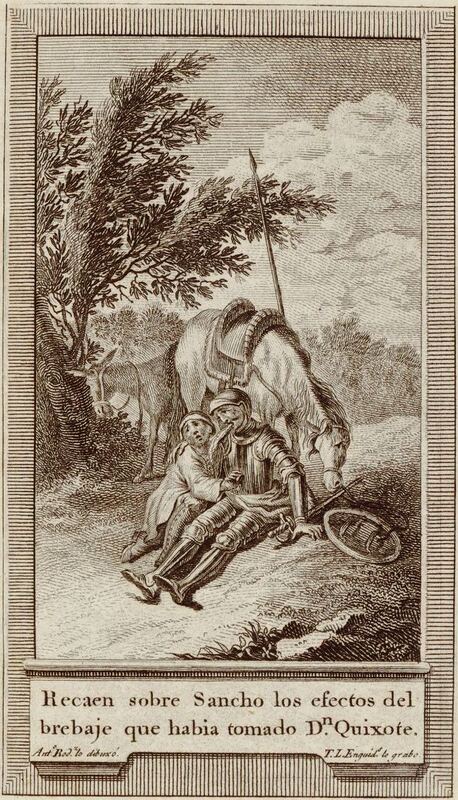
After having attacked a flock of sheep and been stoned by shepherds, Don Quixote asks Sancho Panza to count his remaining teeth. At this time, Fierabrás’ balm takes effect in Don Quixote’s stomach, and just as Sancho looks into his mouth, the errant knight throws up. Signed by A. Rodríguez (illustrator) and T. Enguídados (engraver). Part 1, ch. 18.
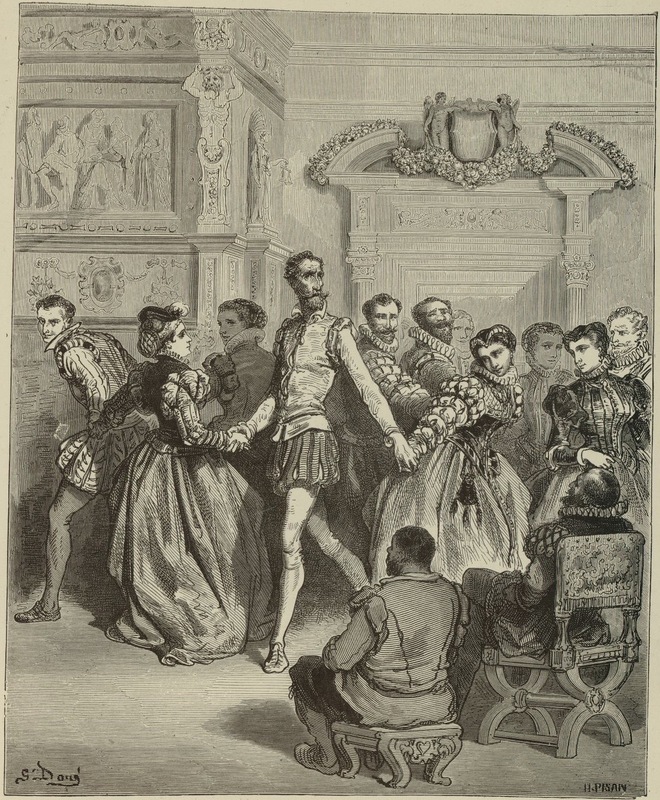
At the soirée, Don Quixote dances with Don Antonio Moreno’s wife and some of her friends. Signed by G. Doré (illustrator) and H.-J. Pisan (engraver). Part 2, ch. 62.
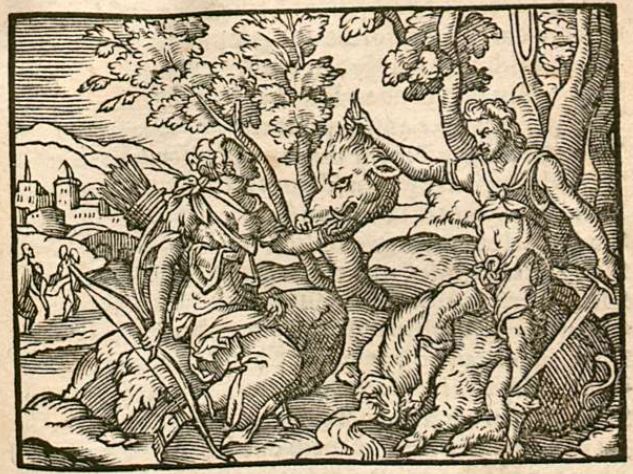
Meleager is depicted holding the severed head of the boar he had just slain, as well as sitting on its dead body. The boar was sent by the goddess Diana to terrorize the city of Sicily as revenge for not being honoured in sacrifice by the citizens. Meleager is a local hero who was tasked, along with other heroes, to slay the boar. Atlanta, a famous huntress was also one of the people tasked with killing the boar, and although she did not kill it, she did hit its ear with an arrow. For her efforts, Meleager decides to share the honour and credit with Atlanta by giving her the severed head of the boar.
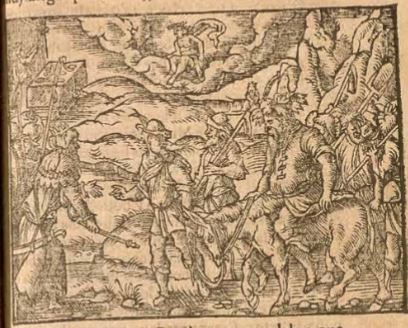
Silenus, one of Bacchus’ companions had one day gone missing. He had found himself captured by Phrygian men while he was stumbling around in a drunken stupor. This engraving illustrates the Phrygian men leading Silenus to King Midas. King Midas is depicted on the left-hand side of the engraving, holding his arms out towards Silenus, as they were once old friends who had learned Bacchic rites together. Bacchus is illustrated at the top of the engraving, sitting on a cloud looking down on the scene as he searches for Silenus.
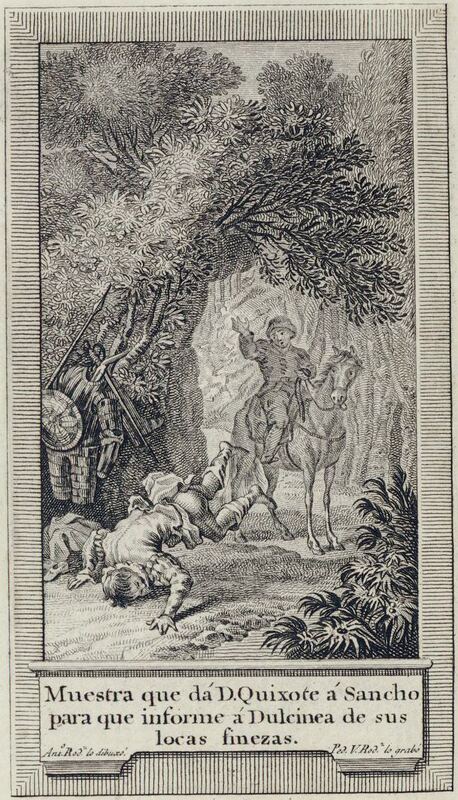
After cutting stalks of broom to serve as markers so he can find his way back, Sancho Panza (background) asks for Don Quixote’s blessing and takes his leave. Mounted on Rocinante, he departs for El Toboso to deliver a letter written by Don Quixote to Dulcinea. Before he leaves, Don Quixote performs cartwheels half-naked as part of his penance. Don Quixote’s armour is pictured hanging from a tree. Signed by A. Rodríguez (illustrator) and P. Rodríguez (engraver). Part 1, ch. 25.
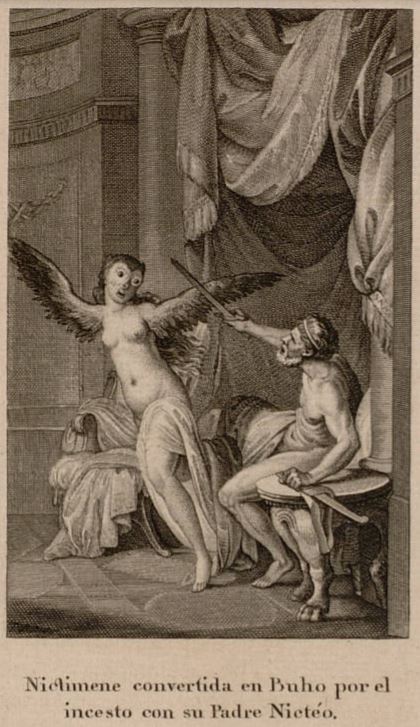
This image depicts Nyctimene being transformed into an owl. She is mid-transformation in this engraving as her body is still human but her arms and face are turning into an owl. She was said to be transformed into an owl by the goddess Minerva as punishment for having an incestuous relationship with her father. Her father is illustrated in this image laying down and holding a sword towards his daughter.
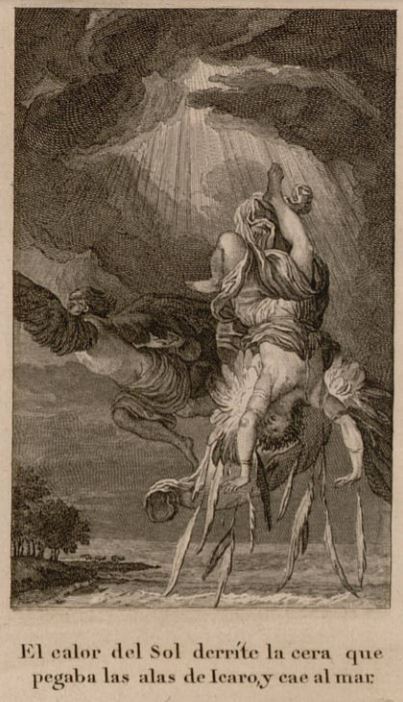
After creating the labyrinth to contain the Minotaur, Daedalus was taken prisoner by King Minos. He came up with a way to escape that did not involve traveling by land or sea to avoid being recaptured. He gathered up feathers and created human sized wings and fastened them together with string and beeswax. He made a pair of wings for himself and a pair for his son, Icarus. Before taking flight, Daedalus instructed his son not to fly too close to the water or the moisture will ruin the wings, and not too close to the sun as the heat would melt the wax. As depicted in the engraving, Icarus did not listen to his father and flew too close to the sun. The wax melted, and Icarus fell into the sea.
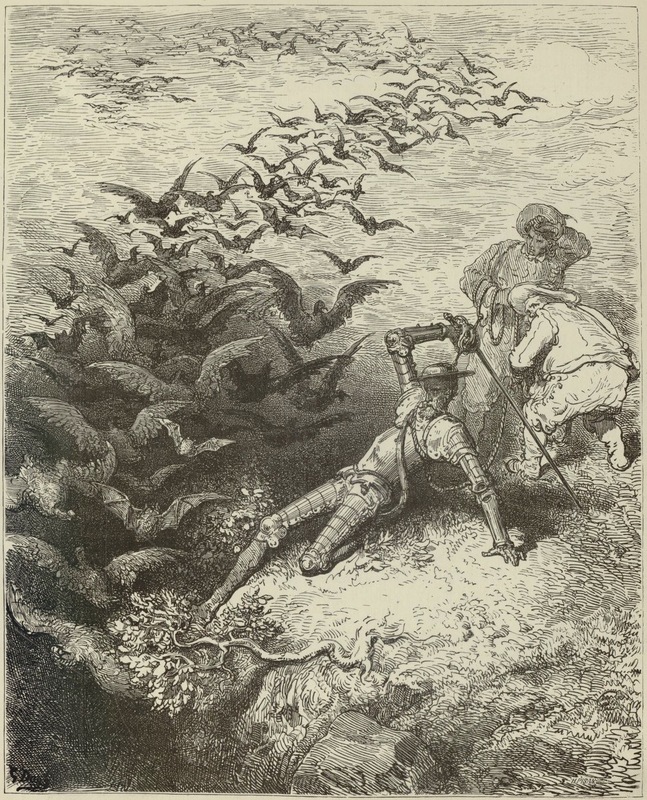
As Don Quixote approaches the chasm of Montesinos’ cave, a flock of crows and rooks surprises him, knocking him to the ground. Sancho Panza and the bachelor’s cousin are pictured to the right, holding a rope that is tied to Don Quixote’s waist. Signed by G. Doré (illustrator) and H.-J. Pisan (engraver). Part 2, ch. 22.
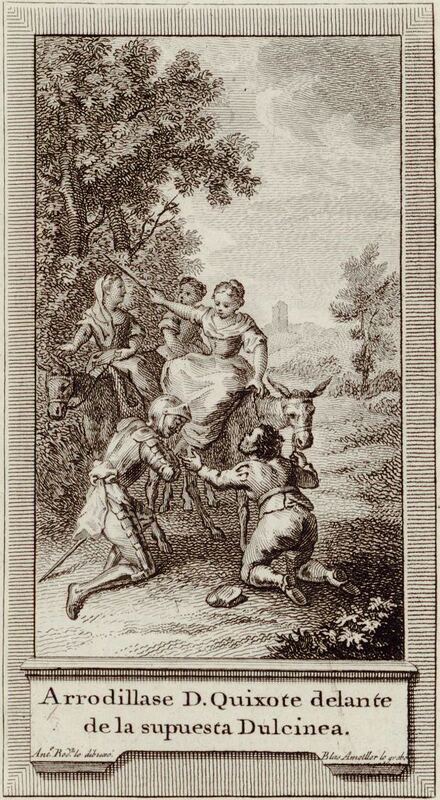
In the foreground, Don Quixote and Sancho Panza kneel before three peasant girls on jennies. Sancho introduces one of them as Dulcinea. Don Quixote, looking at the person Sancho is calling queen and lady and seeing nothing but a peasant girl, is startled and confused. So are the three girls, who ask them to get out of their way and let them pass. Don Quixote reckons that a wicked enchanter must have transformed his lady Dulcinea to deceive him. In the background, the village of El Toboso. Signed by A. Rodríguez (illustrator) and B. Ametller (engraver). Part 2, ch. 10.
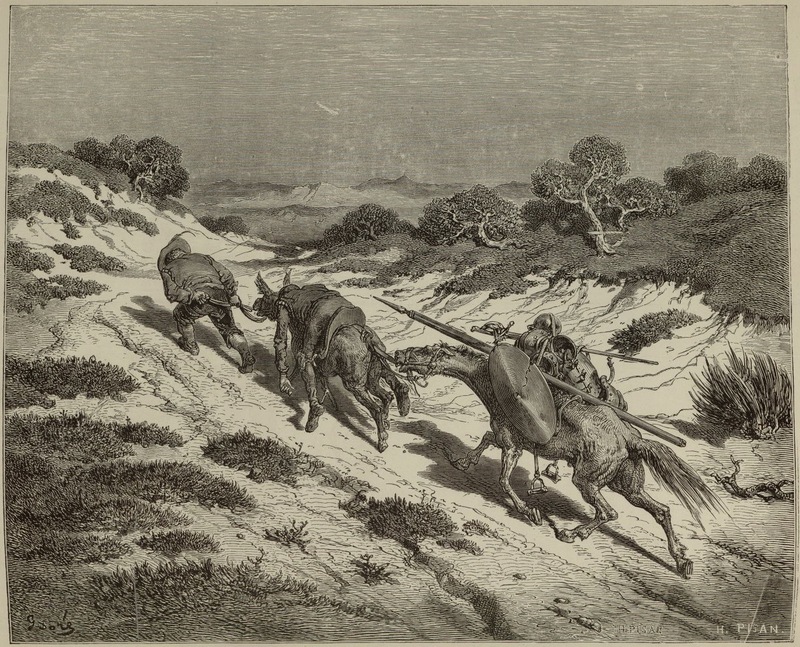
After the fight with the Yanguesans, Sancho Panza struggles to his feet, settles Don Quixote on his donkey’s back, and ties Rocinante behind. Leading his donkey by the halter, he walks in the direction of where he thinks the king’s highway might be. Signed by G. Doré (illustrator) and H.-J. Pisan (engraver). Part 1, ch. 15.
Don Quixote and Sancho Panza kneel before a peasant that Sancho introduces as the enchanted Dulcinea. Two other peasants are pictured. Unsigned. Part 2, ch. 10.
Don Quixote, dressed in cloth, sits forlorn with his lance resting on his shoulder underneath an ash tree next to a rock with "Don Quixote De La Mancha" engraved onto its surface. Quixote has laid his shield, helmet, and boots to his side but has left his leg armor equipped. To the left, a short man (possible Sancho Panza) smiles widely while staring at Don Quixote. In the background a large windmill stands with the face of a giant suspended above its roof.
During master Peter's puppet show three rows of of cavalry set out of a city wall in pursuit of two lovers. The first row of cavalry blow their trumpets adorned with moon flags, these many dulzainas also have kettle-drums attached to their horses. Each member of the cavalry wears white apparel in the Algerian fashion and white turbans, some holding scimitars and others spears. Every figure in the illustration rigid in the joints on account of being made of wood.
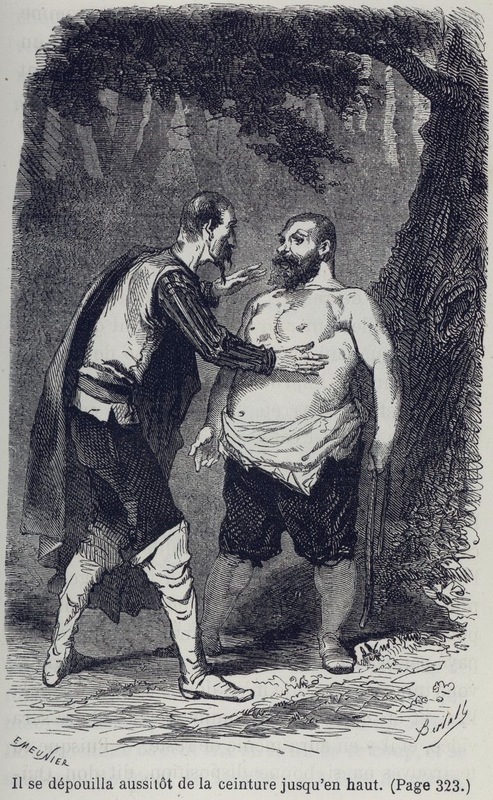
When Sancho Panza accepts to give himself lashes for money, Don Quixote advises him to be careful and pause between lashes. He asks his squire not to hit himself so hard that he loses his life before he reaches the desired number of lashes. Signed by A. ‘Bertall’ d’Arnoux (illustrator) and E. J. C. Meunier (engraver). Part 2, ch. 71.
The goatherd ridicules Don Quixote, starting a fight. The knight seizes a loaf a bread from the table and hits the goatherd in the face. The goatherd tries to choke Don Quixote, while people in the crowd prevent Sancho Panza from helping the knight. The priest and the barber look on. Signed by D.-N. Chodowiecki (illustrator) and D. Berger (engraver), dated 1779. Plate 8. Part 1, ch. 52.
While Don Quixote (not pictured) and the scholar (not pictured) are talking while returning from the cave of Montesinos, they come a across a man with a wide feathered hat who walks on foot, his right hand on the back of his mule which is laden with 6 lances and 3 halberds.
In the foreground, Don Quixote battles the Basque squire while the lady watches the fierce contest from the safety of her carriage (background). The illustration is accurate to Cervantes’ text: the Basque is pictured holding a pillow to defend himself. Signed by J. Rivelles (illustrator) and T. L. Enguídanos (engraver). Part 1, ch. 8.

![[Of How Don Quixote was Beaten with a Stick]](https://collections.cemvc.ca/files/large/fc66dea9b7c350cb16b9ac4edf70b8d9023bf8fd.jpg)
![[Don Quixote and Sancho Panza kneel before the enchanted Dulcinea]](https://collections.cemvc.ca/files/large/a1e4bf13c6f8157ced82220445d0e47e5d6c2a2b.jpg)
![[Don Quixote Sits Forlorn by a Rock]](https://collections.cemvc.ca/files/large/55bb93702ae67ea90dff0a7f1a8b7b7baacc57c7.jpg)
![[The Algerian Puppet Cavalry Rides to Retrieve Melisandra]](https://collections.cemvc.ca/files/large/bd2d2bea7a50f2f964242b5bb09cdbd5ffd1348b.jpg)
![[Don Quixote fights the goatherd]](https://collections.cemvc.ca/files/large/e7488c3b72acd1e1e4578c3c9df9bcdd0430840b.jpg)
![[Of the Mule Laden with Weapons]](https://collections.cemvc.ca/files/large/d2fd09768cbf413a508474b4b2914098f85e1a88.jpg)
![[Don Quixote battles the Basque]](https://collections.cemvc.ca/files/large/66effe363f259680b73e7303ca52f7de4abb4f08.jpg)