In this image we see a group of seven Lilliputian court officials and the Emperor at a table discussing Gulliver’s fate. Some argue that Gulliver should be pardoned or given a less severe charge than treason because of his work in defeating the Blefuscudian fleet during the war between Lilliput and Blefuscu. The Grand Admiral, however, insisted that Gulliver should be put to death because of his actions, specifically urinating on the Imperial Palace. The Grand Admiral is the second figure from the left in this image. He is wearing part of a suit of armour and does not wear a hat. The Emperor sits in the middle of the table, and can be identified by his headpiece with several large feathers coming out of the top. The men are seated in a large hall in the Imperial Palace. The throne can be seen in the distance behind the Emperor as can a row of columns on the right side and a large curtain on the left. The same image appears in the 1839 Krabbe edition.
When Gulliver arrived on Luggnagg he was informed that the ship to Japan would not be ready to depart for another month, and so he should take a trip to the nearby island of Glubbdubdrib, which was the island of sorcerers. Gulliver agreed and was greeted by the Governor of Glubbdubdrib, who was a necromancer. The Governor could resurrect anyone he wanted for twenty-four hours and have them in his service. In this image we see Gulliver’s arrival at the palace, which was surrounded by guards whom Gulliver describes as strange or grotesque. Gulliver is seen here on the left, walking between rows of guards all of whom were much taller than he was, and wearing several types of uniform. One reason for these variations in uniform might be that the guards were people from different eras or locations who were resurrected by the Governor and were therefore wearing the uniform that suited the era in which they lived. The same image appears in the 1839 Krabbe edition.
Two figures are depicted on a backdrop of the letter C from Cuff. The figure on the left is a boy with a toy sword and tall newspaper hat, riding a rocking horse, representing Cuff. This figure is bearing down on the other, representing William Dobbin, who has a triangular newspaper hat with a plume and a wooden sword raised to block his opponent.
A small girl, probably either Rosalind or Violet Crawley, is seated on the floor. In front of her on a stool is a small card tower, three high, towards which she is reaching.
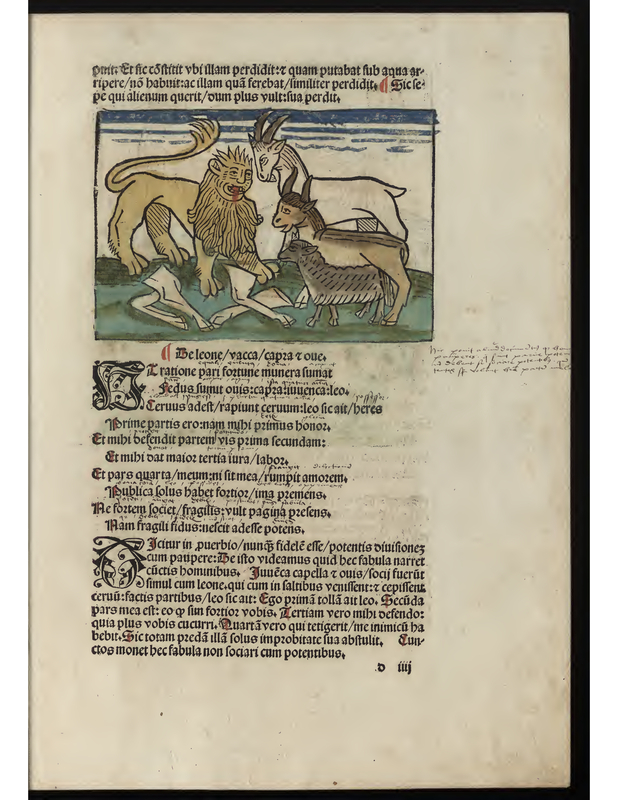
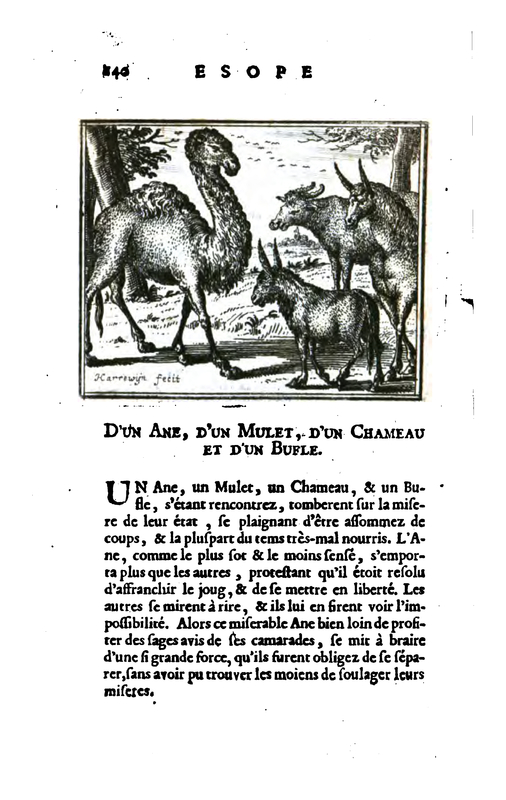
On the left-hand-side of the image, a lion stands in front of four animal legs with blood dripping from it’s mouth. Beside the lion, on the right-hand-side of the image a goat scowls towards the lion. Also on the right-hand-side stands a smaller goat as well as a sheep.
In this image we see Gulliver’s ship sailing into Brobdingnag. The ship appears quite small compared to the landscape of Brobdingnag. Large cliffs and hills surround the bay into which the ship sails. The same image appears in the 1839 Krabbe edition.
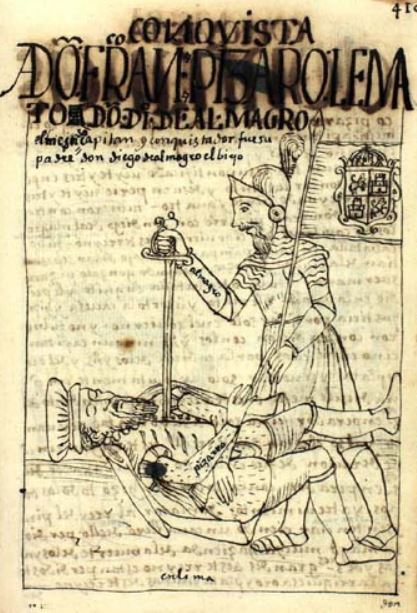
This chapter focuses on discussing the arrival of Spaniards and the Spanish conquest of Peru. This image depicts the murder of Don Francisco Pizarro, a leading conquistador in the conquest of Peru and the Inca Empire. He is being stabbed in the chest by another leading conquistador, Don Diego de Almagro. Almagro is depicted wearing a suit of armour and holding the flag of Castile as he stabs Pizarro for contradicting him. The caption at the bottom of the image reads, en Lima [In Lima].
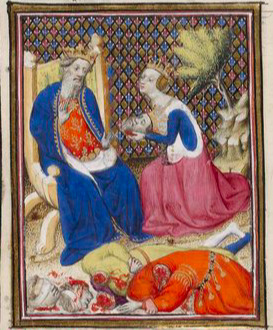
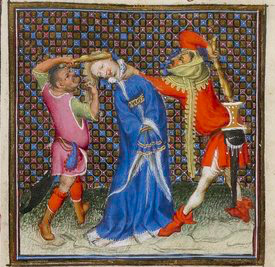
While being held captive, the centurion guarding Drigiagon’s wife desired her. She hated him so much that once her ransom was paid and she was freed, she ordered to have his head cut off. Once she had the head, she returned to her husband, and dropped the head before his feet. The head was a symbol of her shame from the acts of the centurion. The image represents Drigiagon in his throne while his wife holds the head of the centurion out to him. In front of them lie the bodies of two other beheaded men.
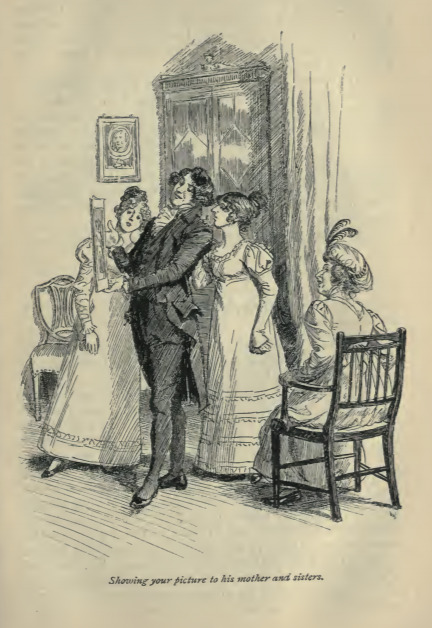
Here we see Mr. Elton showing Harriet’s portrait to his mother and sisters. After Emma completed the portrait Mr. Elton took it to London to get it framed. Mr. Elton flattered highly the portrait Emma drew, and Emma took this as a sign that Mr. Elton was in love with Harriet. She was mistaken, however, because Mr. Elton was flattering the portrait because of Emma’s skill in producing it, as he was in love with her. This scene occurs in chapter 7. The characters are shown in the traditional regency style, with Mr. Elton’s sisters and mother wearing the regency style dress with an empire waist. Their hair is worn tied up, as was tradition for women after their coming out before the queen, signaling her entrance into society. Mr. Elton wears a waistcoat and tailcoat, with a cravat. The regency period dated to the early nineteenth century (1811-1820) when George, Prince of Wales, later George IV (r. 1820-1830), reigned as regent for his mentally ill father, King George III (r. 1760-1820). The regency period is associated with the rise of neoclassicism in art and fashion.
Amelia Osborne sits in the chair in her bedroom from before she was married, looking melancholy. Behind her, the maid is leaning over the chair with one hand on her hip. On a smaller, wooden chair and the floor in front of Amelia there are scattered papers.
A framed portrait of Joseph Sedley holding a gun while riding on the back of an elephant, with a native driver sitting behind its head. In the top right of the painting is the letter I, from If. The picture is tagged in the top left corner with a paper labelled LOT369.
When Leaena was taken hostage by Hyspar, she was tortured for a long time in an effort to find out her identity. As the torture went on and she grew weak and fearful that giving this information would hurt other people, she decided to bite down onto her tongue, cutting it off so that she couldn’t speak, even if she wanted to. She is seen in the image between two men that are torturing her, but her mouth remains shut. Because she gave herself to prostitution earlier in her life, her identity, family and country remain unknown, although it is thought that she may be Greek.
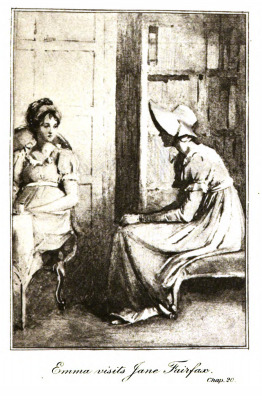
Here we see Emma visiting with Jane Fairfax. Jane Fairfax is the granddaughter of the elderly Mrs. Bates. She came to Highbury to visit her grandmother and her aunt Miss. Bates. She was orphaned young and was taken in by a friend of her father, Colonel Campbell. Miss Fairfax was a very accomplished pianist, and quite popular with the residents of Highbury. Emma, however, did not like Miss Fairfax. It comes out that Miss Fairfax was engaged to Mr. Frank Churchill, the son of Mr. Weston, a close friend of the Woodhouse family. Frank Churchill lived with his aunt and uncle following the death of his mother in the north of England. He came to visit his father and his second wife, Emma’s governess in February. During this visit Frank Churchill flirted with Emma. In July, Emma found out that Frank Churchill had become engaged to Miss Fairfax the previous October, before either Frank Churchill or Jane Fairfax arrived in Highbury, but both kept their engagement a secret. In this image, Emma pays a visit to Jane shortly after her arrival in Highbury. This scene occurs in chapter 20 as noted underneath the title of this image. The characters are shown in the traditional regency style, with Emma and Harriet wear the regency style dress with an empire waist. Their hair is worn tied up, as was tradition for women after their coming out before the queen, signaling her entrance into society. Emma wears a bonnet to protect her face from the sun. Bonnets were a popular fashion in this period because a common pastime was going out for walks. The regency period dated to the early nineteenth century (1811-1820) when George, Prince of Wales, later George IV (r. 1820-1830), reigned as regent for his mentally ill father, King George III (r. 1760-1820). The Prince of Wales was a fan of Austen’s work, and she dedicates the novel to him. The regency period is associated with the rise of neoclassicism in art and fashion. The same image appears as an insert between pages 164 and 165 for the Dent 1893, 1894, 1895, 1896, and 1897 editions of Emma.
The Peruvian city of Cuzco, the capital of the Inca Empire, is shown from above. The city is laid out in an orderly fashion, with wide streets running in straight lines dividing city blocks. The city is surrounded on three sides by a square stone wall with towers built at each corner and in the middle of each wall. On the west side of the city there is a palace built atop several pyramidal layers and nestled into the hillside. There are guards armed with spears standing on each layer of ground leading up to the palace. A group of Inca people form a procession heading towards the palace. Four people carry a litter on their shoulders, upon which the Incan king Atahualpa sits. Atahualpa was the last Inca Emperor (or Sapa Inca) to officially rule before the Spanish conquistadors established their control. Along the bottom of the image, a group of Inca people on the left engage in acrobatic activities and a group on the right hold finely crafted statuettes, probably of gold.
Mrs. Tinker, Sir Pitt Crawley, and Rebecca Sharp stand around a small round table in front of the fireplace in the dining room. Mrs. Tinker has just brought Sir Pitt’s pipe, which she holds, and a paper of tobacco, which is on the table. Sir Pitt has grabbed hold of Miss Sharp’s hand and is leering at her, while she is turned mostly away from the other two and glaring back in their direction.
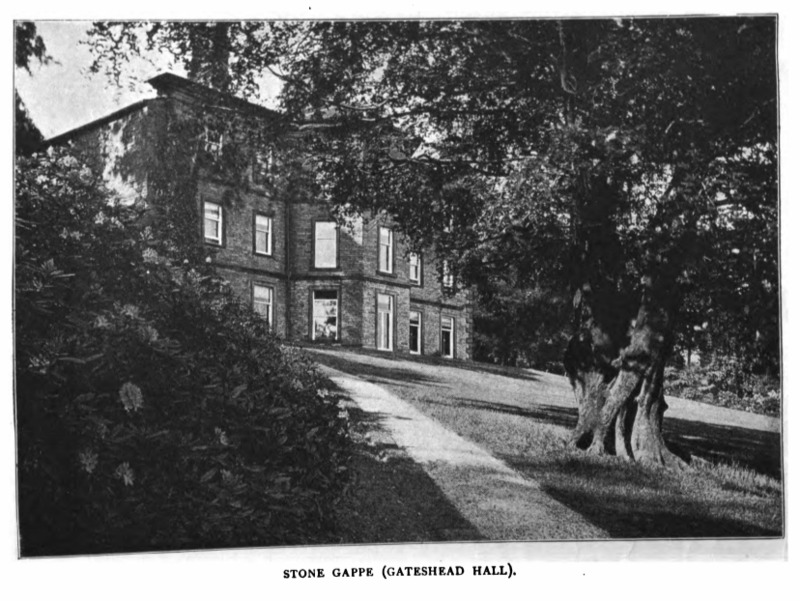
Here we see an image of Stone Gappe, a house in Lothersdale, a town in North Yorkshire. This house is supposedly that on which Gateshead Hall – the house where Jane lived with her Aunt Reed – was based. The same image appears in the 1899 Harper edition of Jane Eyre.
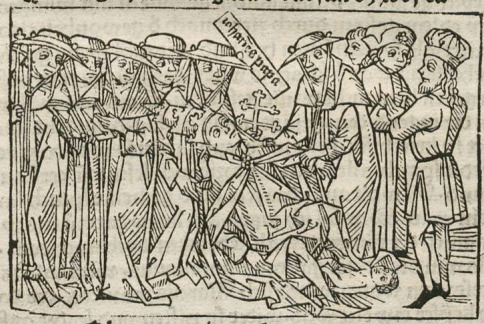
In order to follow her lover to England as he attended school, a maiden named Joan disguised herself as a man and went to school with her lover. Joan had excelled in academics and became incredibly knowledgeable. Continuing to dress as a man, Joan went to Rome and was elected to succeed as Pope, known as Pope John. No one had known she was a woman, however, she ended up having a love affair which resulted in pregnancy. This engraving depicts Joan, dressed as Pope John laying on the ground with her legs open as she gives birth to a child. There are other ecclesiastics surrounding her as they look disgusted that she is giving birth as a Pope. Pope John (Joan), was thrown into a dungeon where she would die.
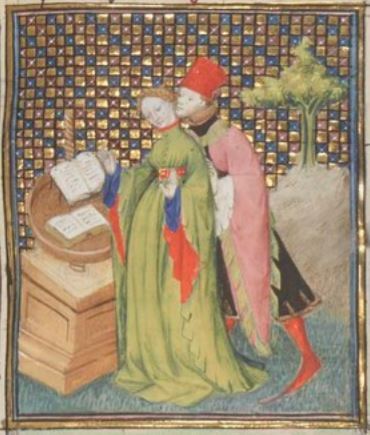
This illumination depicts a Greek woman named Leontium. Boccaccio explains that Leontium was an intellectual scholar and philosopher and became renowned for criticizing and speaking against certain philosophers of her time. Leontium is depicted standing in the centre of the image with books sitting on a podium beside her. These books are reflective of her intellectual life. There is also a man holding Leontium as he stands behind her. This is depicted due to her becoming a prostitute later in her life. Boccaccio believes her fame was hindered by becoming a prostitute.
After Gulliver spoke about the wonders of immortality, a diplomat from Luggnag corrected him. The diplomat explained that while elsewhere in the world most people did not want to die, saying that even with one foot in the grave they would try and hang onto life. This is the image shown here. A skeleton, representing death, tries to pull a man into his grave, while the man pulls away, holding onto the cliff, representing life. The diplomat from Luggnagg explained that on the island, most people did not have this same resistance to death because they could see people who were immortal. These immortals would not die, but would continue to age, thus their quality of life would continue to deteriorate forever. The same image appears in the 1843 Krabbe edition.

![[Lilliputian officials discussing Gulliver’s fate on Lilliput]](https://collections.cemvc.ca/files/large/02fb0dca24b9538ff25eabe7114e2c6408838808.jpg)
![[Gulliver arrives at the Palace at Glubbdubdrib]](https://collections.cemvc.ca/files/large/c9b58747e1bf047f892513b854ec937cef7f8367.jpg)

![[Vanity Fair Vol. I. Chapter V Historiated Initial, C]](https://collections.cemvc.ca/files/large/a16b88330c4f418deeb2805e37b80deca875b218.jpg)
![[House of Cards]](https://collections.cemvc.ca/files/large/a0dc9da33bf475066dff8aa26187114fe7a4594b.jpg)
![[Gulliver sails into the harbour of Brobdingnag]](https://collections.cemvc.ca/files/large/ecfe37ef705815eb036a0095858e201d65e2ceec.jpg)
![[Amelia and the Maid]](https://collections.cemvc.ca/files/large/3fe59f108cb59c9e20d7ebb340e57c21550b9a3c.jpg)
![[Vanity Fair Vol. I Chapter XVII Historiated Initial]](https://collections.cemvc.ca/files/large/d530a1aedaa1493ddd0f97ac037d714f4cbf7eb7.jpg)
![Cvsco urbs nobilissima & opule[n]tissima Peruani regni in occide[n]tali parte sita, in qua habitabat magnus ille Rex Atabaliba quo tempore Hispani regnum illud armis sibi vindicarun](https://collections.cemvc.ca/files/large/01aee4414b8808831ca3146e26ed9844592221a4.jpg)
![[Mrs. Tinker, Sir Pitt Crawley, and Rebecca Sharp]](https://collections.cemvc.ca/files/large/b87b7b0d969030eccec7af457ce5a7db26b08f3d.jpg)
![[Depiction of a human resisting death]](https://collections.cemvc.ca/files/large/deb2b4421ab819c408c12137c65e3176bd390c2e.jpg)