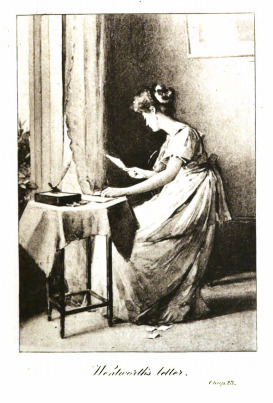
Here we see Anne sitting at a table next to the window reading a letter from Captain Wentworth. On this table is a small writing desk with a quill and inkwell. In this letter, Captain Wentworth declares his constant and undying love for her. He writes that although he flirted with Louisa, his love for Anne never faltered. Anne met with Wentworth later that day, and he proposed to her, and she happily accepted, wishing only that they had married six years earlier, sooner to their original engagement. This scene occurs in chapter 23 as noted underneath the title of this image. The characters are shown in the traditional regency style, with Anne wearing the regency style dress with an empire waist. Her hair is worn tied up, as was tradition for women after their coming out before the queen, signaling her entrance into society. The regency period dated to the early nineteenth century (1811-1820) when George, Prince of Wales, later George IV (r. 1820-1830), reigned as regent for his mentally ill father, King George III (r. 1760-1820). The regency period is associated with the rise of neoclassicism in art and fashion. The same image appears as an insert between pages 236 and 237 for the Dent 1893, 1894, 1895, 1896, and 1897 editions of Persuasion.
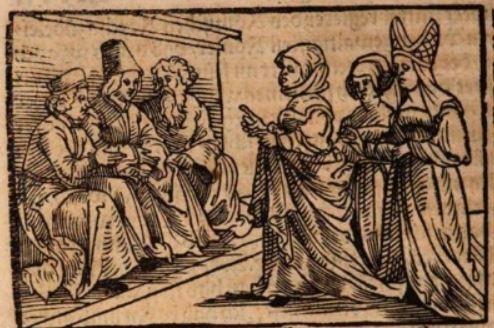
This engraving depicts Hortensia, the daughter of famous orator Quintus Hortensius, speaking in front of the triumvirs. Hortensia inherited the gift of oration from her father, and when the triumvirs raised taxes unbearably high, she spoke so eloquently to them that they revoked the taxes. The triumvirs have pleasantly surprised looks on their faces as they are impressed with Hortensia’s abilities. Hortensia appears to look confident as she speaks to them. There are other women standing behind her in support of her approaching the triumvirs.
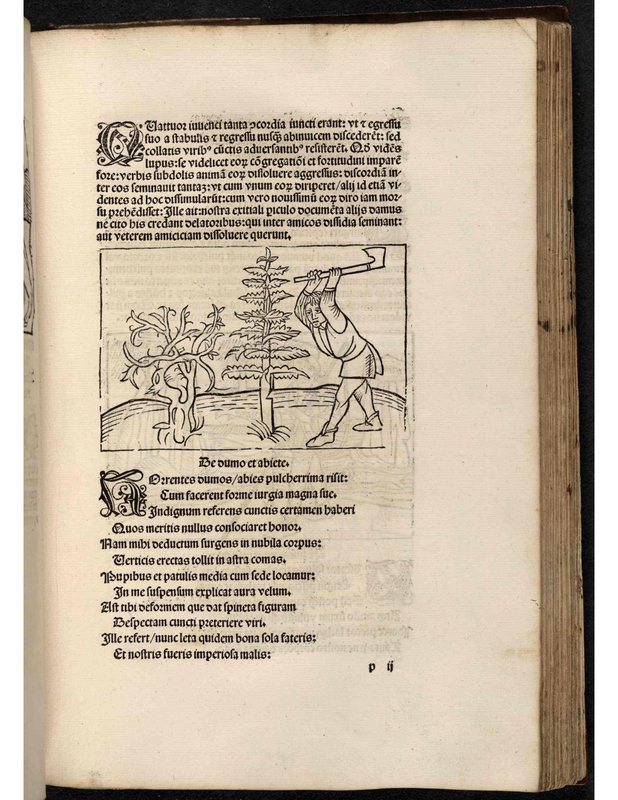
An man is trying to chop down a tree with an axe. On the left side of the image, there is a vine-like tree without many leaves, and in the center of the image, there is a tall tree with many leaves
In this image we see Gulliver kneeling and saluting the Lilliputian Emperor. Gulliver was recruited to fight in the war between Lilliput and Blefuscu. In this image, the Emperor reads Gulliver’s duties to him, while pages attend the Emperor. Gulliver salutes the Emperor, signaling his acceptance of his duties. The same image appears in the 1843 Krabbe edition.
A small boy in a uniform and triangular hat with a pair of tiny angel wings holds a packet of sealed correspondence out to a doorway. He has a bag in his other hand and more letters tucked under his arm.
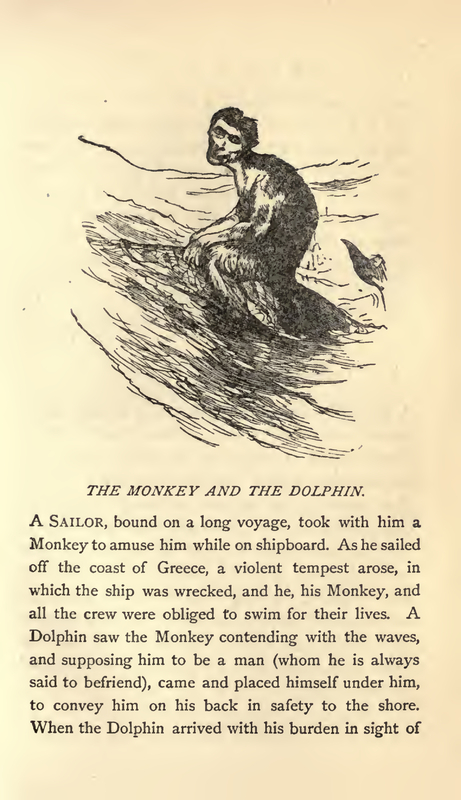
A monkey is sitting on the back of a dolphin. There are strong currents and large waves typical of a storm. The monkey is sitting calmly, slouching, and looking over to its left side in our direction.
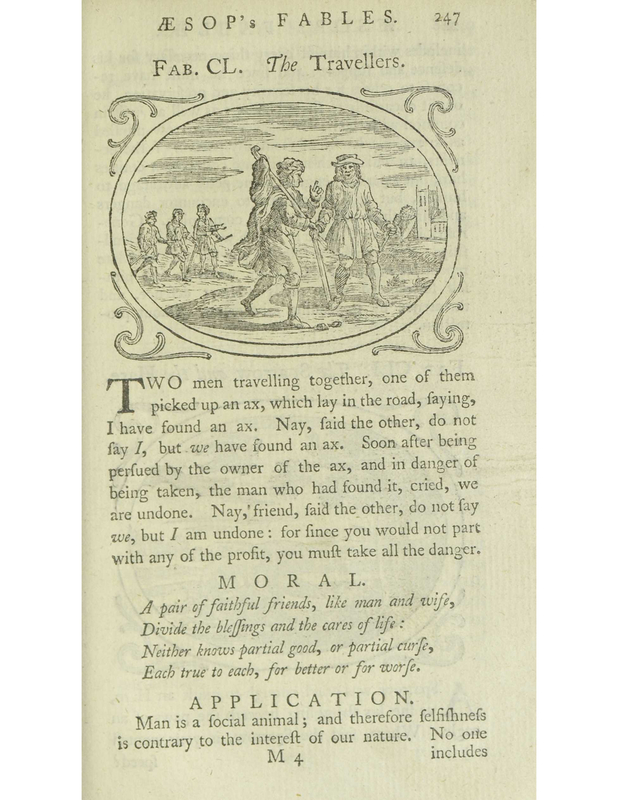
Two men in foreground in deep discussion. The one of the left holding an axe and the one to the left holding a large stick with animal skins attached. In the background to the right if the men there is a small church. In the background to the right of the men there is another group of three men, who also appear to be in deep discussion.
A group of Indigenous Tupinambá people are shown dismembering bodies and roasting body parts over several fires. There are three wooden frames set over three fires where human limbs are roasting. One Indigenous person sits in a hammock while others stand around them. In the center of the image a man is kneeling, with an Indigenous person on either side of him holding his arms. Another Indigenous person stands over the kneeling man holding a club-like weapon raised over his head. Below this group another Indigenous man holds a headless torso. A bearded man (likely representing Staden) gestures broadly in the lower middle part of the image.
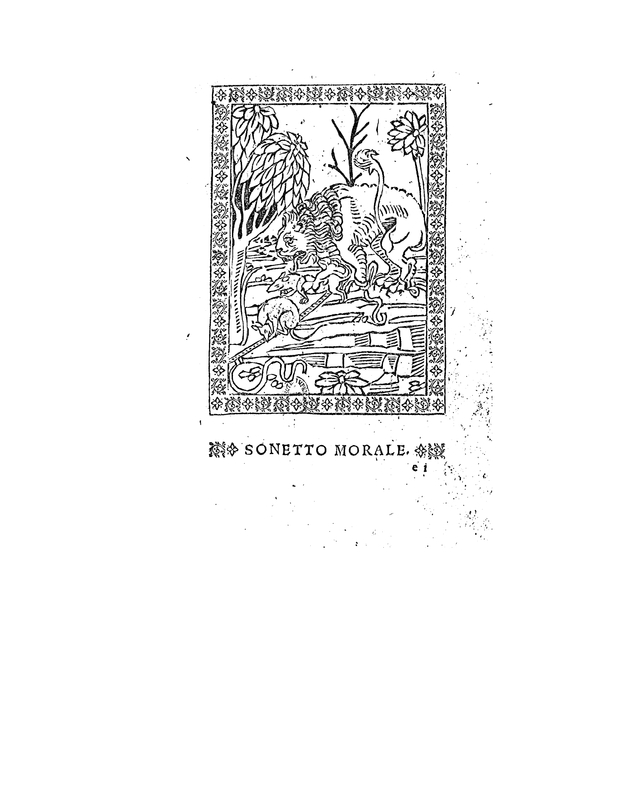
There is a lion with its tail between its legs and seems to have a rope tied to it. The left front paw of the lion is pinning down a mouse. In the forefront of the image there is mouse chewing on the rope that is trapping the lion.
The right-half of the image is a man on one side of a door. The man wears a hat, possibly a chef’s hat, and holds a set of keys. On the left-half of the image is a storage room with wine barrels, and a table with a plate sitting atop it. On the ground are two large rodents. Three wall shelves are holding vases and other instruments.
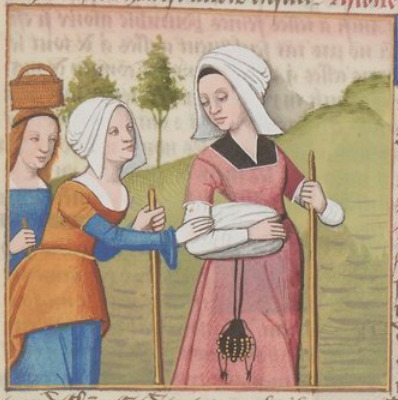
This illumination depicts a woman named Sulpicia leaving her home to find her exiled husband. Her husband, Lentulus Cruscellio, had evaded proscription and fled to Sicily to live in exile. Sulpicia was incredibly devoted to her husband and left the comfort of home to follow him into exile. There are two other women in the image, one of them being Sulpicia’s mother, Julia. Julia is illustrated grabbing her daughter’s arm to stop her from leaving. Sulpicia is depicted with a walking stick as she carries her belongings in her right arm.
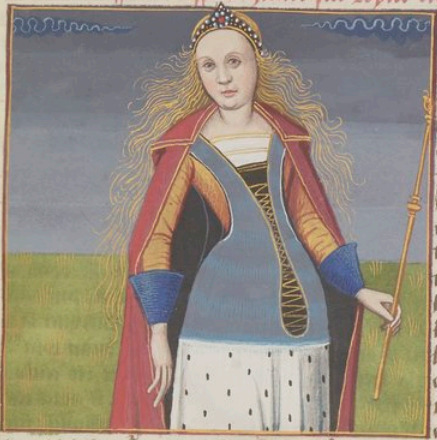
This illumination depicts a portrait of a woman named Dido (also known as Elissa), who was the founder and queen of Carthage. Boccaccio explains that Dido had stolen her brother’s treasure in retaliation for him murdering her husband. After fleeing with her brother’s treasure, she made her way to Africa where she established and became queen of the city of Carthage.
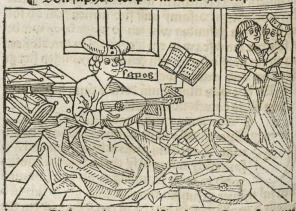
This engraving depicts Sappho, the famous poetess from Lesbos, sitting in the foreground while playing the lyre. We know that this is Sappho as her name is engraved beside her head. There are other stringed instruments and sheet music surrounding her. Sappho was in love with a man (depicted on the right-hand side of the engraving) who did not share the mutual feelings. Boccaccio explains that this is the reason as to why her poems and music verses were so somber.
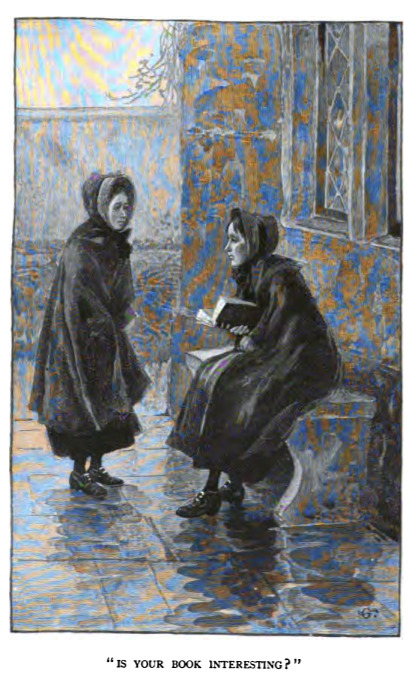
Here Jane meets Helen Burns. Jane was spending her allotted hour outside where she encountered Helen reading. Jane asked about her book, striking up a conversation with Helen. This was when Jane and Helen first became friends.
Here we see Gulliver’s first encounter with the Lilliputians. We see the surprise on Gulliver’s face when he wakes up to the Lilliputians – who are one-twelfth his size – walking over him. Gulliver appears to be tied up by his hair. Several of the Lilliputians are armed, either with spears or bows and arrows. The same image appears in the 1839 Krabbe edition.
Isis, the queen of Egypt, is depicted on the left side of the illustration wearing a crown and holding a book in her right hand. She is presenting the book to a group of four citizens who are kneeling in front of her. Boccaccio explains that when Isis became queen of Egypt, she wanted to use her intellect to provide the people with a letter system to go along with their native language. This illustration depicts Isis teaching this letter system to her citizens.
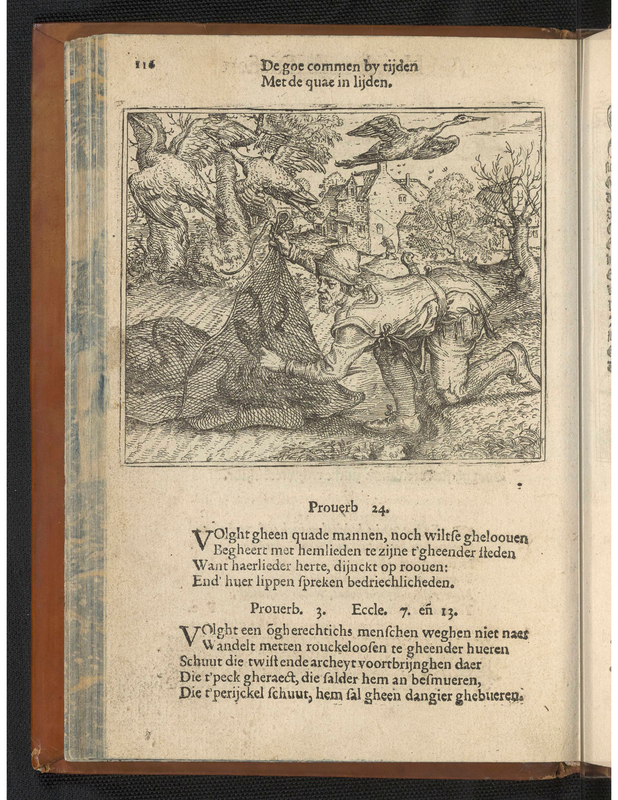
A man at right, catching a deer in a net at left; birds are flying away in different directions; Dutch letterpress on verso; illustration to Eduwaert de Dene's edition of Aesop's Fables, De Warachtighe Fabulen der Dieren (Pieter de Clerck, Bruges: 1567). c.1567Etching
Melibea overhears her parents Pleberio and Alisa discussing her purity, how they should start trying to find a husband for her, and their belief that she has probably never considered having a male companion. Melibea starts to grow frustrated with their assumption that she is ignorant, and she tells Lucrecia to enter the room and interrupt the conversation. This illustration likely represents the scene in which Lucrecia interrupts Pleberio and Alisa. The left side of the image depicts Melibea and Lucrecia. Melibea is likely the figure seated on the ornate and draped bed, while Lucrecia is approaching the door with her finger pointed toward Pleberio (which is somewhat odd, since it implies a confrontation or argument). Each of the them is wearing a robe and a veil. The right side of the image depicts Pleberio, who is wearing a hat and a cloak of sorts, as he opens the door for Lucrecia. Meanwhile, Alisa sits on another ornate and draped bed while displaying an air of sadness, likely at the thought of finding someone for Melibea to marry.The entire image is identical to the one found on page 264 of the text.
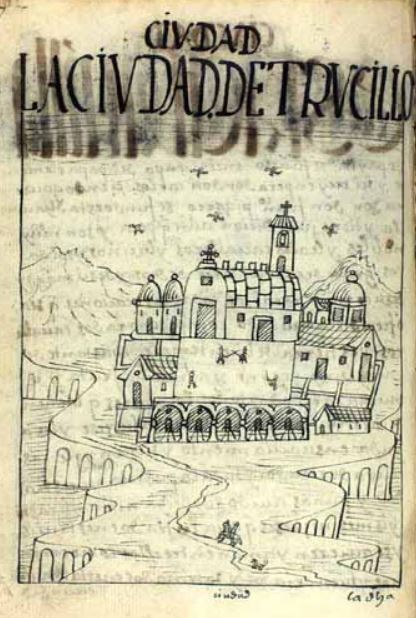
This image is depicted in the author’s chapter where he discusses cities, towns, villages, and provinces in colonial South America. This image depicts the city of Trujillo in Peru. The city is arranged in a cluster of buildings which forms a square in the centre. There appear to be two soldiers who are sword-fighting in the square and two other people walking. There is a person riding a horse along a path approaching the city walls with what appears to be a dog following them. The caption at the bottom of the image reads ciudad [city].
Several Indigenous Brazilian men and women, as well as a small child, weep together with their hands over their faces inside a dwelling. One individual sits in a hammock that has been strung between two beams of the structure with the others surrounding the hammock. A bow and bundle of arrows lie on the ground beside the hammock, and a bird sits on a beam above looking down on it. This illustration is a simplified and mirrored version of the one found on page 85 verso of Paris, 1557.



![[Gulliver kneeling and saluting the Lilliputian Emperor]](https://collections.cemvc.ca/files/large/c70ea822df46bdd076b0d989d2222483c47b5b44.jpg)
![[Letter Carrier]](https://collections.cemvc.ca/files/large/d6b6f825f65c73dc4c54bf9b7d331fcf0d89d301.jpg)

![[Tupinambá people roast limbs over fires]](https://collections.cemvc.ca/files/large/b344afdda501f93ba74c0cf830728aab437bf4aa.jpg)
![[The Chef, the Wine, and the Rodents]](https://collections.cemvc.ca/files/large/c49d37ac6c7f5c0b2fcb5a713eef6c20e59e5263.jpg)
![[Gulliver first meets the Lilliputians]](https://collections.cemvc.ca/files/large/dcac199eb0b381d2bfb69361eb7ee882af7f987c.jpg)

![[Isis Teaching a New Letter System to Citizens of Egypt]](https://collections.cemvc.ca/files/large/fb5a012a97d1558481bb572a122586d5527c270b.jpg)
![[Act XVI] Pleberio spreect tot Alisa syn huysurouwe.](https://collections.cemvc.ca/files/large/8c9b0c36fdcfd1984e9d961b85844f1ac9d45c10.jpg)
![[Emotional solidarity in an Indigenous Brazilian community]](https://collections.cemvc.ca/files/large/45fcc5ff42b021010996c62104bff62bbd722232.jpg)