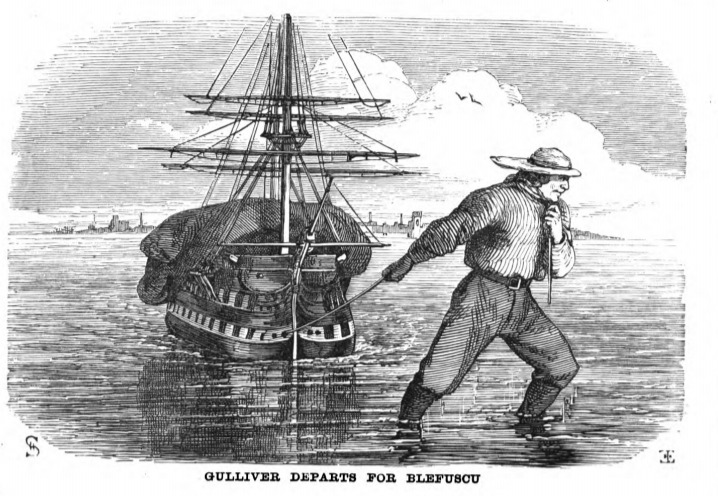
Here we see Gulliver leaving Lilliput after being charged with treason to go to Blefuscu. Gulliver waded across the water dividing between the two countries, pulling a man-of-war ship that he took from the Lilliputian fleet behind him. Gulliver used the ship to carry his belongings to Blefuscu.
In this image we see Gulliver in the foreground running away from two giants on Brobdingnag. Gulliver ducks and runs through wheat stalks fleeing the giants. The central figure is the giant famer who eventually takes Gulliver in. He holds a large scythe and wears loose short pants and a shirt sewn together using various pieces of fabric. A second giant is visible in the distance. Only the head and shoulders of the second giant is visible. The second giant wears a large brimmed hat, while the Farmer is bareheaded. The same image appears in the 1843 Krabbe edition.
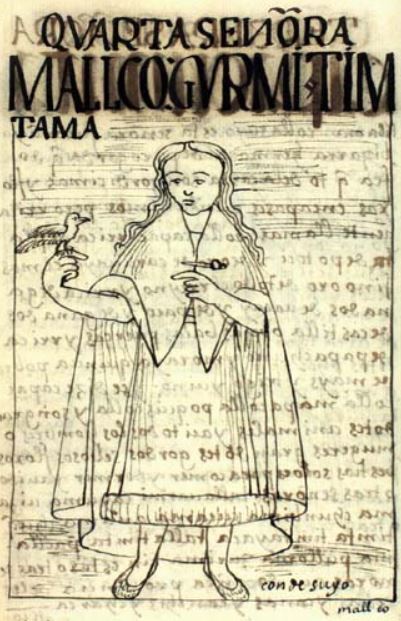
This illustration depicts the fourth lady of the region Condesuyu in the Inca Empire. Her name was Mallco Huarmi Timtama. The words conde suyo are written at the bottom of the image to identify Condesuyu as the region this image takes place in. The author explains that she came from a poor background but was still a good person. She is depicted standing in the centre of the image wearing a large cloak and holding a small bird in her right hand.
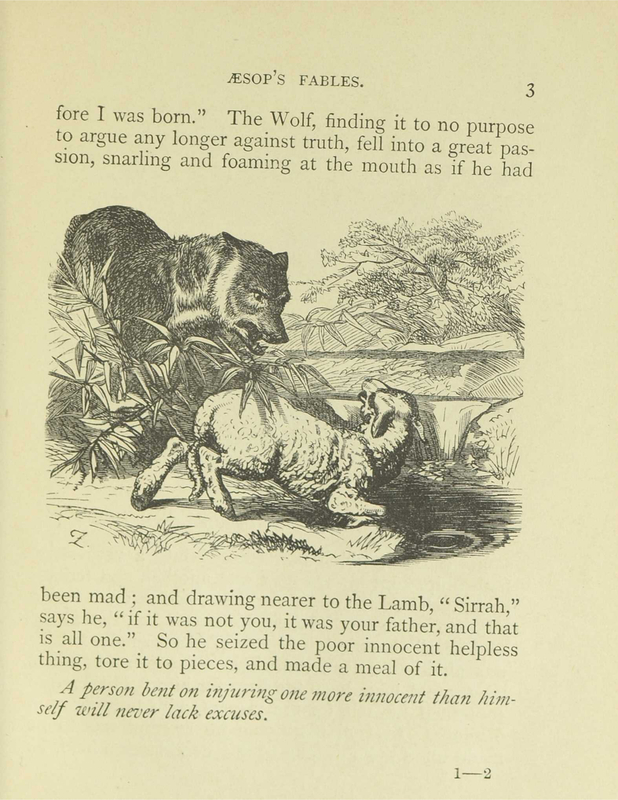
One hot, sultry day, a Wolf and a Lamb happened to come, just at the same time, to quench their thirst in the stream of a clear silver brook that ran tumbling down the side of a rocky mountain. The wolf stood upon the higher ground, and the Lamb at some distance from him down the current.
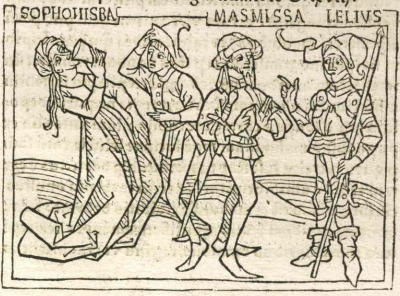
Masinissa, the King of Numidia is depicted on the right side of the engraving speaking with a man named Laelius. Laelius is depicted pointing at Masinissa as he reproaches him for marrying a captive of the Romans. We know that these figures are Masinissa and Laelius as the creator engraved their names written as Masmissa and Lelius above their heads. Not able to disobey Laelius, Masinissa ordered a servant to give Sophonisba, his wife, a cup of diluted poison. Sophonisba is depicted on the left side of the engraving willingly drinking the poison. The servant in front of Sophonisba looks astonished at how willfully she drank the poison. We know that the woman depicted in the engraving is Sophonisba as her name is engraved above her head.
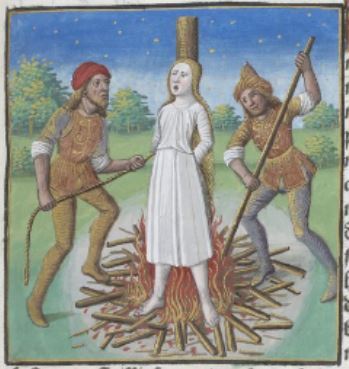
This image depicts Poppaea Sabina, the wife of Emperor Nero being burned alive. There is a man on the left side of the image tying her up while the man on the right pokes at the fire. This image is not reflective of the genuine story of Poppaea Sabina in the way that Boccaccio describes it. Boccaccio describes that Poppaea died by getting kicked in the abdomen while pregnant by Emperor Nero in a fit of rage.
Here we see the letter Gulliver sent to the secretary of state of Blefuscu informing him that he would be setting out for Blefuscu later that day. Immediately after sending the letter Gulliver left Lilliput without waiting for a response. The same image appears in the 1843 Krabbe edition.
Here we see two dead horses lying on a beach. The Houyhnhnms asks about the horses in Europe and how they live. Gulliver explains that humans or yahoos govern the country and care for the horses or Houyhnhnms. Gulliver tells his master that horses were beloved by humans until they became sick of injured and could no longer work. Then, they would be sold to do menial work until they died, at which point their skins were stripped and sold. One of the horses is only a skeleton, implying his skin was sold. The same image appears in the 1843 Krabbe edition.
A woman in a long gown with wild loose hair flies through the sky, looking back with a fearful expression. She is holding out in front of her two swords or long daggers. Behind her, the sky is dark and filled with clouds, and at the bottom right of the image is the letter W from We, with bright rays coming out from it as if it were the sun.
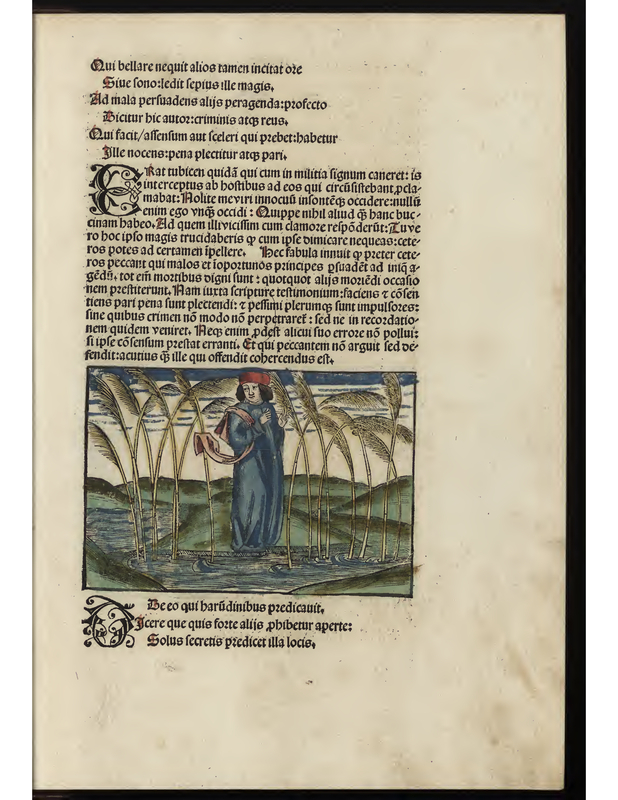
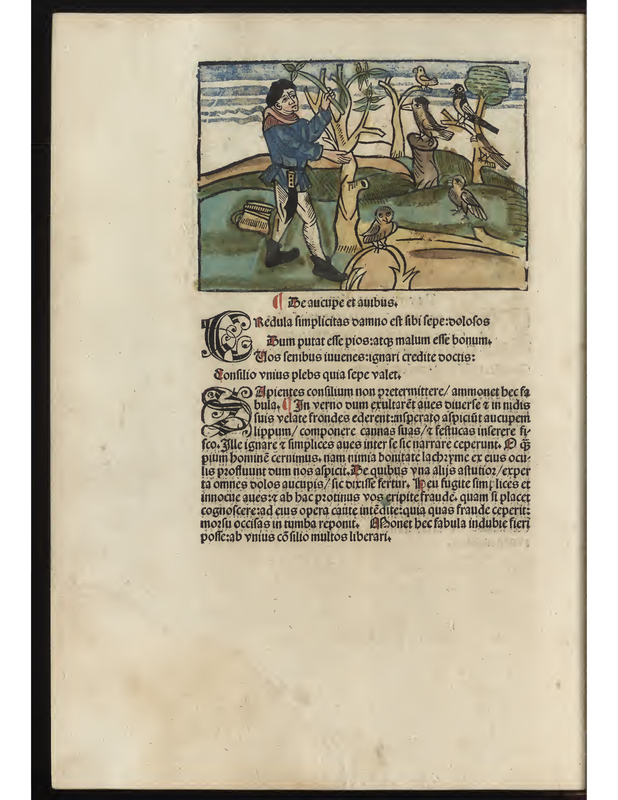
To the right of the image stands a bird catcher holding onto branches of a tree. He has a knife on his side. There are many birds and trees around the bird catcher.
William Dobbin hands Amelia Osborne into her carriage as she leaves the ball. Behind the carriage door, the footman can be seen, and to the left of Dobbin, four young men are talking and smiling on the stair. In contrast to the others in the image, Amelia looks quite tired and sad. Below the illustration is printed in cursive its title, Mrs. Osborne’s carriage stopping the way.
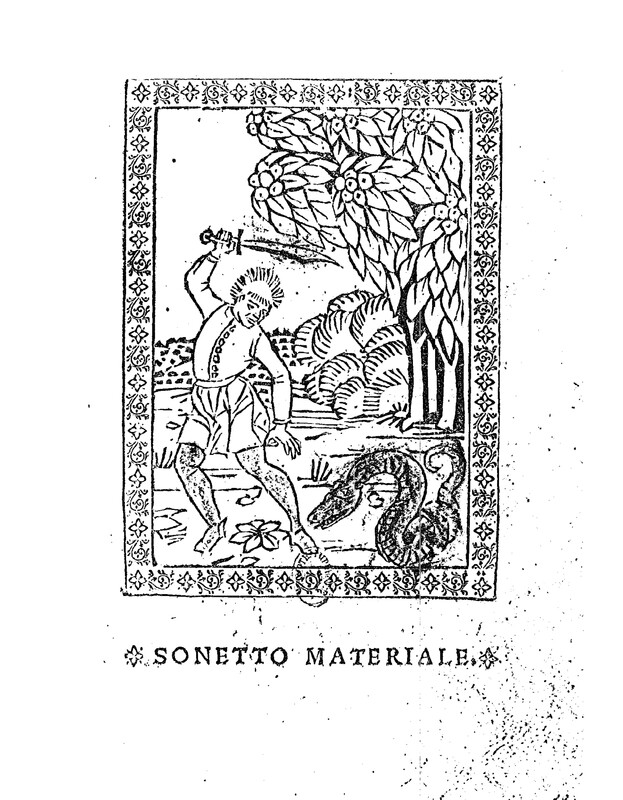
A man is in battle stance weilding a sword above his head looking down at a large serpent which looks like it is about to strike. They are underneath a Tree and many bushes in the backround. The image is bordered by a vine design and the signature of Liberale de Verona is stamped on the bottom
A group of Indigenous people attacks a fenced European settlement near the coast. In the center of the image, several Indigenous people fire arrows towards a fenced European fort, while four cannons fire at the Indigenous people from within the fence. There are several structures within the fence in addition to the four cannons, with two more fenced areas to the left and right. A line of Indigenous people holding spears cross a river towards the fort by walking over two logs laid across the river. There is a large settlement closer to the coast on the left with a large ship in the water nearby, and another smaller settlement on a small island at the mouth of the river. The three settlements are labelled Garast, Tamerea and Mamn (clockwise from center bottom).
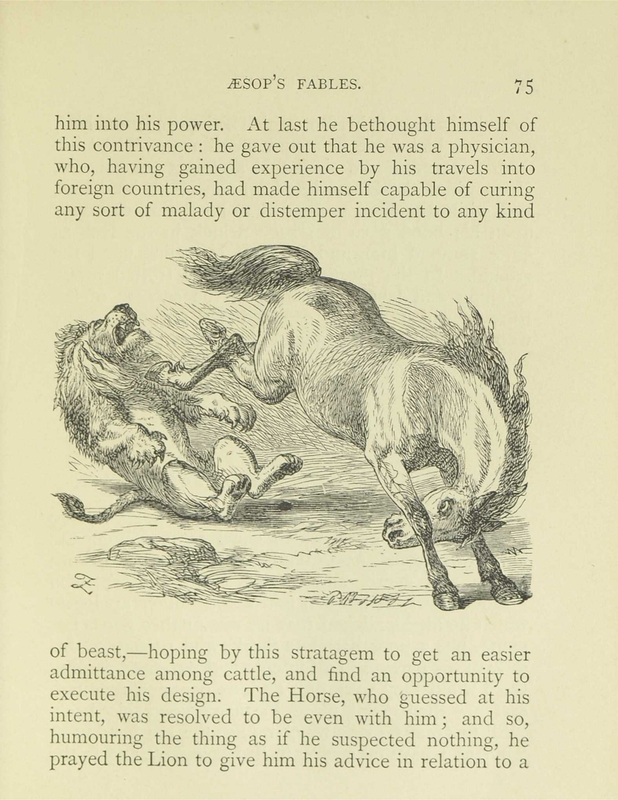
On the left side of the image a lion is falling backwards on its back into the ground with a painful expression on its face. On the right a horse is reared up with both back hooves in the air presumably from just kicking the lion of the right, it dips its head towards the ground in force showing the strength behind the kick.
The yahoos are a form of human who live in the Country of the Houyhnhnms. Gulliver looks down on the yahoos, thinking of them as a form of inferior human, which is reflected in this image. In this image we see Gulliver in the background, with a group of yahoos in the front. A female yahoo nurses her child, while another climbs a tree. The same image appears in the 1843 Krabbe edition.
This image depicts an indigenous sacristan pulling on ropes to ring the bells of a small church. There is a larger bell and a smaller bell in the bell tower. The author explains that the sacristan will ring the large bell to call parishioners to church for Holidays such as Easter, Vespers, and on Sundays. He rings the bell ten times, and when the people enter the church, the sacristan rings the bell an additional ten times on the smaller bell. The author explains that before they made an indigenous sacristan rings the bells to call people to mass, officials would go through pueblos themselves and call people to mass, which he believed to be an excuse to rob people’s homes. The author also explains that when people were called to church with the bells, officials would use this as an excuse to go through the pueblos and punish those who did not respond to the bell tolls. He believed that the bell tolls reformed the Inca people into continuing to believe that they are Christians.
A group of Indigenous Canadians (identified as such by the author) attacks the village of another group. The attackers arrive by canoe, bearing spears, bows and arrows, and torches. Some of them set fires along the shore and in the village. A few individuals on the left flee the fire by running and crawling away in an attempt to avoid the smoke. This illustration is a simplified and mirrored version of the one found on page 156 of Paris, 1557.
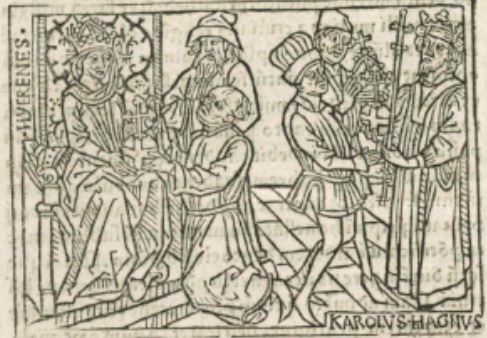
The left side of the engraving depicts Empress Irene of the Eastern Roman Empire sitting on her throne. There is a man kneeling in front of her presenting her with the globus cruciger to demonstrate her authority. The right side of the image depicts the pope crowning Charlemagne as emperor. The pope did not recognize Irene’s rule as she was a woman, which led him to coronate Charlemagne as emperor.
In the centre of the illustration, we see a female figure wearing a robe and a veil. There are two male figures to the left and one to the right. Because there are no female characters in Act XIII, we can say that this illustration does not relate to the events contained within the act.[This illustration is identical to those found in Acts IV (folio 32r), V (folio 42r), VI (folio 45r), VIII (folio 62r), X (folio 74r), XV (folio 102r), and XVII (folio 109r).]

![[Gulliver runs from two Giants on Brobdingnag]](https://collections.cemvc.ca/files/large/3b25f0b14df2e3726073feccf3caba14bbeafa6e.jpg)
![[Gulliver’s letter to the secretary of Blefuscu]](https://collections.cemvc.ca/files/large/972093c540c6c7b2cfcc08f3618ac9d68241868f.jpg)
![[deceased horses on a beach]](https://collections.cemvc.ca/files/large/4afa3ac8045569e639b1db221f78c697c59aa070.jpg)
![[Vanity Fair Chapter XXXII Inhabited Initial]](https://collections.cemvc.ca/files/large/0748dbf2fb62ae85d1f75b1c4e0b1f2784933f59.jpg)

![[Indigenous group attacks a European settlement]](https://collections.cemvc.ca/files/large/dce19de2c77285a86f6d5530c47042f96c987c78.jpg)

![[Gulliver first encounters the yahoos for the first time]](https://collections.cemvc.ca/files/large/b19c17b5332137debd98d440c8bf451c22ea79c8.jpg)
![Q[ve] Los P[adres] an de Mandar a los Sacristanes que Llame a Misa, Fiestas y Dominigos Dies Canpanadas y Con la Chica, Otros Dies a Misa en Este Rreyno](https://collections.cemvc.ca/files/large/0061065b9c3d824ea0ac1b3a0a5804b380ceeaba.jpg)

![[Conflict between Indigenous Canadian groups]](https://collections.cemvc.ca/files/large/7240ad50d11582b7bdad4f4ecc2cfd0a9062ce23.jpg)
![[Act XIII]](https://collections.cemvc.ca/files/large/e13739833501bae39fb6ef6c93959193040684ed.jpg)