George Osborne is leaning against a table with one hand at his waist and the other at his chin. He is looking at himself in a large standing mirror, and both he and his reflection have a slight smile. In the top right of the image, overlapping the mirror, is the letter I.
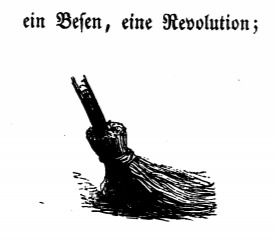
This image shows a broom, which is the code word for a revolution. This image comes in a description of a conspiracy found by a professor from the Grand Academy on Balnibarbi. This idea is representing code word for terms in the conspiracy that Swift is satirizing. The professor advises that those named in the conspiracy papers be closely monitored at all times, naming specifically while they were using the bathroom, as this is when men were most thoughtful. This conspiracy is thought to be an allusion to the trial of Francis Atterbury, the bishop of Rochester for allegedly plotting with the Jacobites. Atterbury was charged with treason in 1722 and was exiled to France. The same image appears in the 1839 Krabbe edition.
Here Mr. Rochester sits in a straight back chair with her back to the viewer. Mr. Rochester requested Jane spent several evenings with him in the library. She obliged and Mr. Rochester is seated with his head in his hand speaking with her. There is a similar image of Jane Eyre on the opposite page, to appear to the reader as though the two characters are having a conversation across the page.
In this image we see Gulliver standing next to the Lilliputian Castle, surrounded by Lilliputians. Here we see the real height difference between Gulliver and the Lilliputians. Several Lilliputians hold swords, while others hold the ladders they used to climb Gulliver while he was lying on the shore. Gulliver looks down to the Lilliputians in conversation. The same image appears in the 1839 Krabbe edition.
After the execution of a captive, the Tupinambá prepare to dismember the body. On the left a man lays on the ground with a woman, who appears distressed, supporting his head. A man stands beside them holding the ceremonial club used in the execution of the man. To the right the body has been laid out on face down and a group of women clusters around to begin the dismemberment. A pot has been set on a fire near the women. A bearded European man stands in the center watching the group.
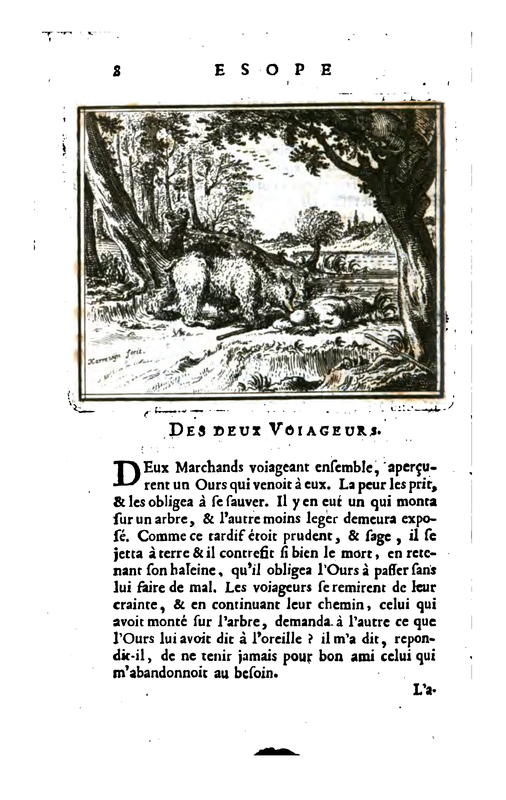
There is a tree with a man in it in the right of the illustration. In the middle, a bear sticks its face into the face of a man lying on the ground. There are trees and grass in the background, with birds in the sky. The illustration has the signature of Harrewijn in the bottom right corner.
A group of Tupinambá people are shown engaging in cannibalism. In the foreground a man holds a dismembered torso over a fire – a small hatchet is on the ground beside the man. To the right of the fire a woman holds a dismembered leg in the air and to the left another woman holds an arm. A group of Indigenous men and women observes the torso being held over the fire. A woman in this group holds a dismembered leg in the air, and another person holds an arm.
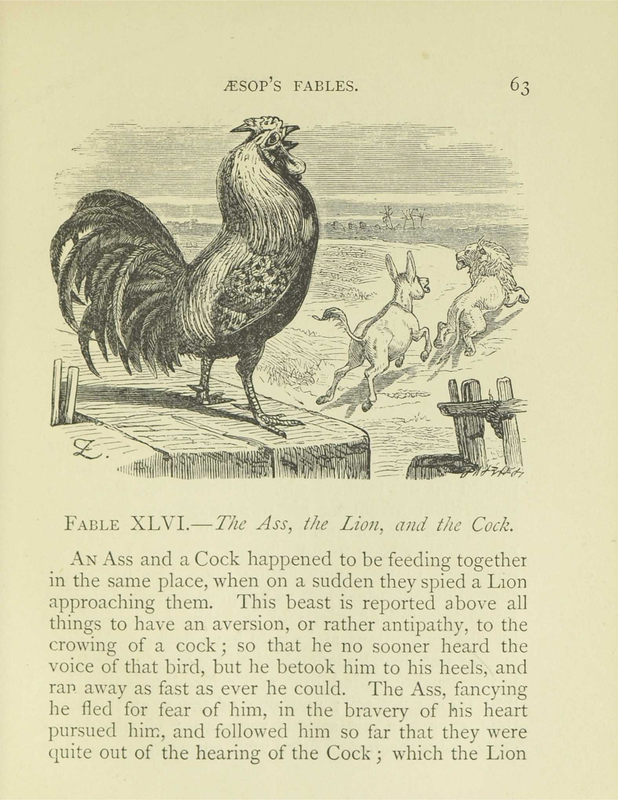
A rooster stands proudly crowing on the left foreground of the image atop a platform. Below on the right side there is a small portion of a wooden fence sticking out. In the background of the image on the right there is a donkey actively chasing a lion over a hill into the distance. In the distance there is a faint outline of foliage and trees.
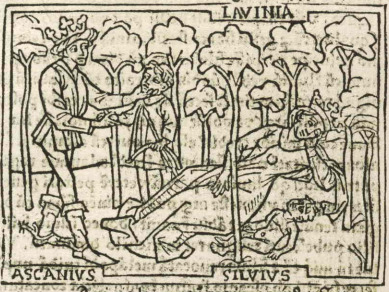
This engraving depicts Lavinia, wife of Aeneas and queen of Laurentum, hiding in the forest in fear of her step-son, Ascanius. Lavinia had given birth to a son who she named Silvius. Boccaccio explains that after Aeneas died, Lavinia fled to the forest as she was afraid that her step-son, Ascanius, would kill her. Lavinia was wrong, and Ascanius voluntarily gave the kingdom of Laurentum back to her and helped raise Silvius. Lavinia’s name is engraved at the top of the illustration, and Silvius’ name is engraved below his body at the bottom of the engraving. Ascanius is pictured on the left-hand side of the engraving with his hand touching a young Silvius’ face with brotherly affection.
A soldier with a thick moustache stands with one foot out and his sword pointed to the ground. Another soldier is next to him, facing away. In the background, a row of guards can be seen. In the top right corner of the image is the letter T, from The.
A European man is held captive inside a Tupinambá village, which is comprised of five long structures arranged in a pentagon and surrounded by a fence. The village is labelled ‘Uwattibi’. The man is shown having his hair cut by a Tupinambá woman in the left, and then on the right he is shown standing in a group of women with a rope tied around his neck. Several Tupinambá women hold both ends of the rope and dance around the man. There are two children present as well, and a monkey and parrot sit on top of one of the buildings on the left.
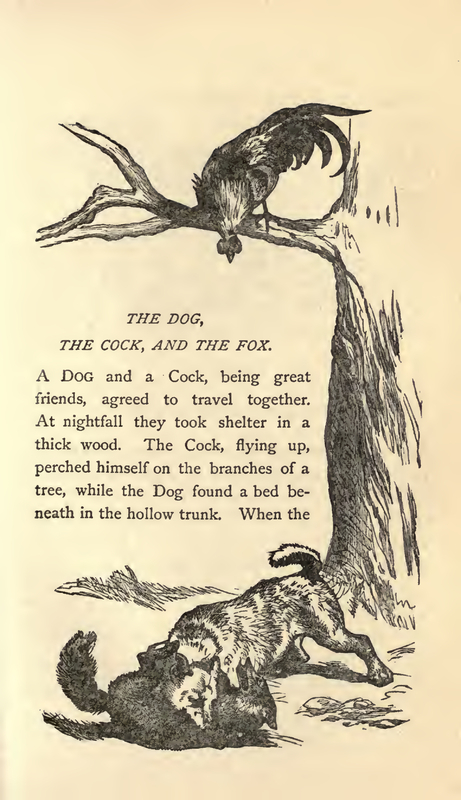
In this picture, the fox and the dog were the tree while the cock was on the tree and looked down to see them. The dog attacked the fox and the fox can’t do anything instead of lying down and suffered the attack from the dog
This image depicts a woman named Sulpicia walking on the left side of the image while a male servant and a maid follow behind her. Sulpicia’s husband, Lentulus Cruscellio, had been proscribed by the triumvirs, and to avoid being proscribed he fled to Sicily to live in exile. Sulpicia left her life behind in the middle of the night with two maids and two male servants to meet her husband in exile. Boccaccio writes on Sulpicia to praise her bravery of leaving her comfortable life to be with her husband.
Here we see two Lilliputian tailors taking Gulliver’s measurements for new clothes. Gulliver is kneeling on the ground. One tailor stands on Gulliver’s shoulder and drops the weighted measuring tape down to the ground. A second tailor stands on the ground and records Gulliver’s measurements in a notepad. A tall ladder is leaning against Gulliver’s back. The same image appears in the 1843 Krabbe edition.
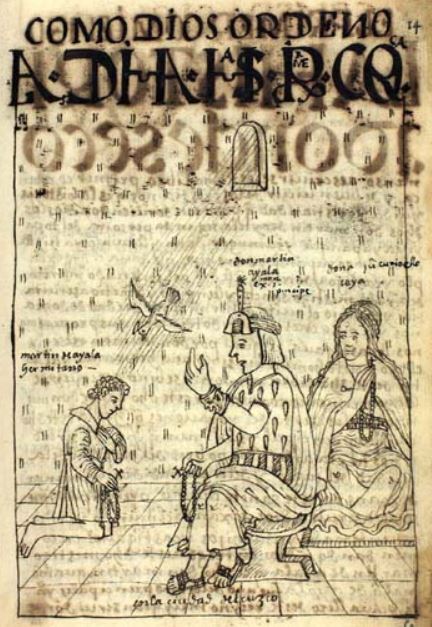
This illustration depicts Don Martín de Ayala, the father of author Felipe Guaman Poma de Ayala sitting on a small throne in the centre of the image. He is illustrated holding a rosary in his right hand and gesturing to his stepson with his left. His stepson, Martín de Ayala, is illustrated kneeling before his step-father who is teaching him about his doctrine and God. Don Martín de Ayala’s wife, Doña Juana Curi Oclla Coya, is pictured beside him on the right of the image sitting cross-legged. Their names are written above their heads to identify them. The script written at the feet of Don Martín reads en la ciudad del Cuzco which translates to In the city of Cusco. There is a dove flying above Martín de Ayala’s head which symbolizes the Holy Spirit.
A long-haired worker seated on a rock inspects the paw of a lion just on the outside of the woods. On the ridge overhead, goats or deer observe attentively.
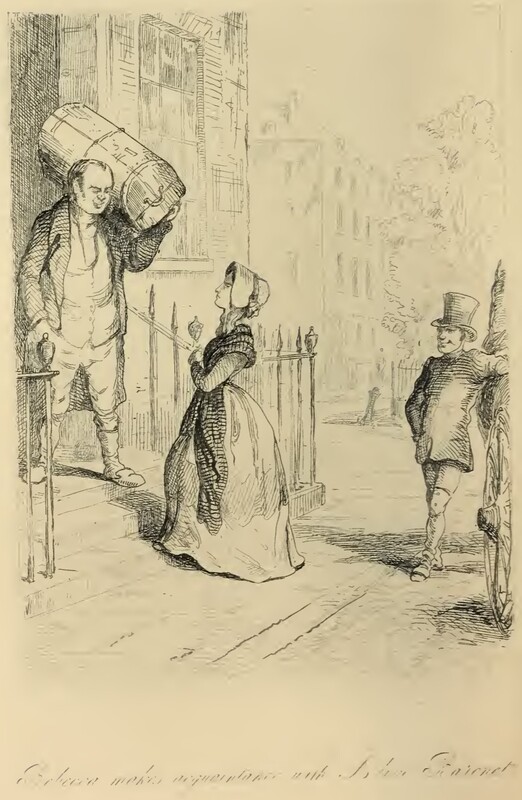
Rebecca Sharp stands in the center of the picture at the base of the staircase to Crawley mansion, scowling up at the man on the stairs. He is holding her trunk on her shoulder with his other hand in his pocket, and, though assumed by the others to be a porter, is Sir Pitt Crawley. To the right of the image, John, the Sedley’s groom, is leaning against his carriage with a smirk on his face. In the background the corner of the Crawley mansion and a neighboring house are lightly sketched. Below the illustration is printed in cursive its title, Rebecca makes acquaintance with A live Baronet.
A leopard and a fox stare at one another as they cross paths. The leopard's tail is sticking up in the air. There is another leopard barely visible on the left side of the illustration, with its eyes opened wide. There are trees and mountains in the background.
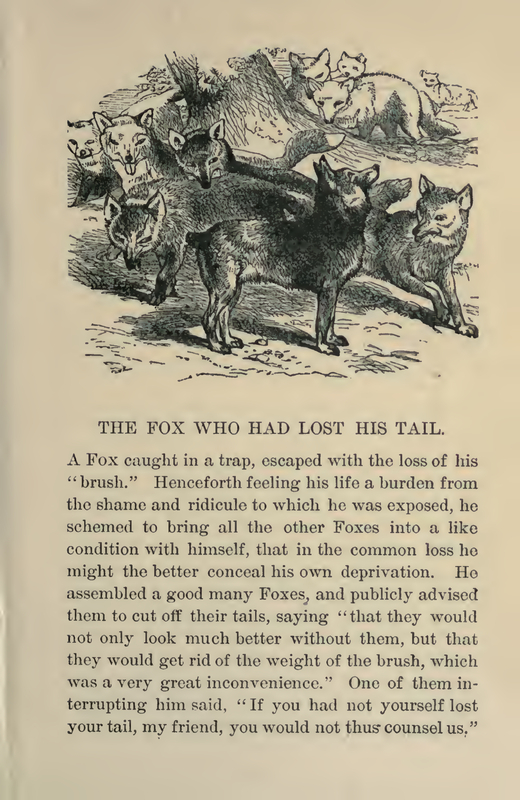
A group of foxes are gathered together around a tree. In the foreground, one fox stands in a proud stance amongst the other foxes. That proud fox is missing a tail. The other foxes look at the fox lacking a tail in a wary way, as though they have to be careful of him because he lacks a tail.
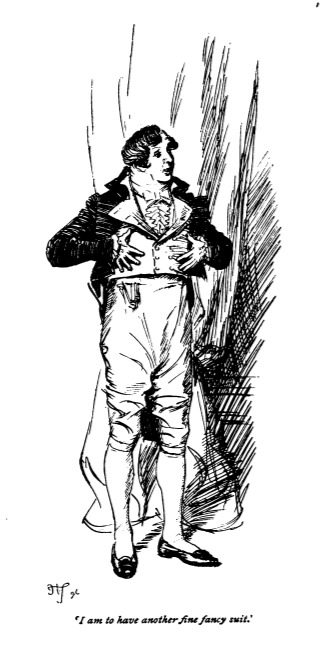
Here we see Mr. Rushworth showing off his costume for the play Lover’s Vows. In this scene, Edmund arrives home and Mr. Yates, Mr. Rushworth, and Tom Bertram are all discussing the play they have chosen. Mr. Rushworth stepped forward to tell Edmund about the play, and happily saying that he would need to get a new suit as his costume. This scene occurs in chapter 15. The characters are shown in the traditional regency style. Mr. Rushworth is wearing a waistcoat and tailcoat, with breeches and a cravat. The regency period dated to the early nineteenth century (1811-1820) when George, Prince of Wales, later George IV (r. 1820-1830), reigned as regent for his mentally ill father, King George III (r. 1760-1820). The regency period is associated with the rise of neoclassicism in art and fashion.
Here we see Gulliver showing Captain John Biddel who rescued Gulliver and brought him aboard his English Merchant Ship one of the cows he brought from Blefuscu. Captain Biddel allowed Gulliver to board his ship and return to England. As thanks Gulliver offers one of the miniature cows to Biddel. In the image we see the two men in a room on the ship with a table separating the two. Gulliver holds the cow in his hands while Biddel looks in astonishment at it. Biddel is on the right and is wearing a wig as was the fashion of the eighteenth century. The same image appears in both the 1839 and 1843 Krabbe editions.
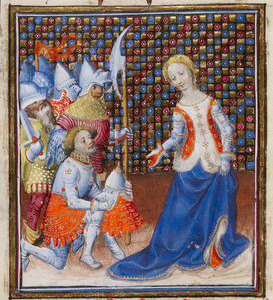
Zenobia, Queen of Palmyra, gestures to her soldiers. She is depicted with very light skin, despite being known for having darker skin as many people in her region did. She was known for her extraordinary beauty, generosity, intelligence, skill, and virtuosity, among other traits. She supposedly never spoke to her army without wearing a helmet, though in this image she wears no armor. She is depicted with blonde hair and fair skin, wearing an elaborate gown. She addresses her army who are all wearing armor, and one man kneels before her as a sign of respect. She was equally respected and feared for her skill at military affairs.

![[Vanity Fair Volume I. Chapter XIII Historiated Initial, I]](https://collections.cemvc.ca/files/large/80447f9226272a1ef716f02615346ea03cc9fe17.jpg)
![[Mr. Rochester sits in a chair looking at Jane Eyre]](https://collections.cemvc.ca/files/large/a0c4916a5fd9d7e1c0297d3bf51823551bf646ce.jpg)
![[Gulliver standing outside a castle on Lilliput]](https://collections.cemvc.ca/files/large/a086e6d687c55ee6447a4de5f8c150bc91afbb8b.jpg)
![[The Tupinambá prepare to dismember an executed man]](https://collections.cemvc.ca/files/large/62bb4134fd028a8d5c5b1af24cb6361594c67a68.jpg)

![[A Tupinambá group practices cannibalism]](https://collections.cemvc.ca/files/large/f674c69468674a8d1accb0f15fba5a5f7cea52d6.jpg)
![[Vanity Fair Chapter XXVIII Inhabited Initial]](https://collections.cemvc.ca/files/large/9ce61c47e563fb386567a6e55960a8366d124ef1.jpg)
![[Inside a Tupinambá village a European man are held captive]](https://collections.cemvc.ca/files/large/9220b618ac6d603ab196b03b8cce91c8ba7643f9.jpg)
![[Sulpicia Following Her Husband into Exile]](https://collections.cemvc.ca/files/large/009012757bbc28cf0b03b88f3782a2be6f64b77c.jpg)
![[Lilliputian tailors take measurements for Gulliver’s clothes]](https://collections.cemvc.ca/files/large/f9333650e1910e45d8e464f8ff45f1977b5808ad.jpg)
![[The Leopard and the Fox]](https://collections.cemvc.ca/files/large/762f1fa64afc787a91f2f2b5c1219b9dc5f8297d.jpg)
![[Gulliver shows Captain Biddel a cow from Blefuscu]](https://collections.cemvc.ca/files/large/478a2580f109220b05238b2db1221353d03f3ef2.jpg)